Showing posts with label radioactive. Show all posts

Saturday, June 8, 2013

Using my Leica M3 DS at a Bluegrass Festival

I recently added an M3 to my Leica collection. Part of my motivation was pure curiosity. I have understood that the M3 was a milestone development for Leica, being the first M body produced, way back in 1955. Otherwise, it wasn't obvious to me why so many people were in love with their M3s, seemingly more so than other M models. One thing I really didn't get was that the M3 has limited framelines in the viewfinder, meaning that the widest lens you can use without a "goggles" attachment is 50mm. More on this later.
 
I decided that I wanted to get an early unit, which meant that it is a double stroke (DS) - this simply means that you have to wind the lever twice to fully advance the film. I looked at a few different cameras, but didn't find exactly the one I wanted until I contacted Youxin Ye, Leica repair master. Youxin has serviced several cameras for me in the past. He happened to have a very early M3 ready for refurbishment.
 
(Click Here) to go to Youxin's page. Youxin provides quick, reliable service. He has my full endorsement.
 
In any case, the other "features" of the early M3, besides DS, are the lack of a frameline lever for manually changing the framelines in the viewfinder, and a glass film plane plate, for maximum film flatness. Glass was replaced with metal later in the M3 production cycle.
 
Needless to say, Youxin provided me with an absolutely gorgeous M3 DS at a reasonable price. I fell in love as I opened the box. Looking through the viewfinder sealed the deal. You see, since the finder is not as wide angle as other Ms, when you do use the 50mm lens, you get this beautiful, bright image in the viewfinder. Making it wide enough for say a 35mm lens on other M models makes the 50mm framelines cover less of the total finder image. Since I am a 50mm guy, I'm quite happy with the M3s finder being optimized for that focal length.
 
Enough about the camera. I popped my vintage 1955 Summicron 50mm f2 collapsible lens (which was my Whole Lotta Leica selection for April) on and went to shoot a daytime bluegrass festival near my home in Loudoun County, Virginia.
 
(Click Here) to read about this special lens.
 
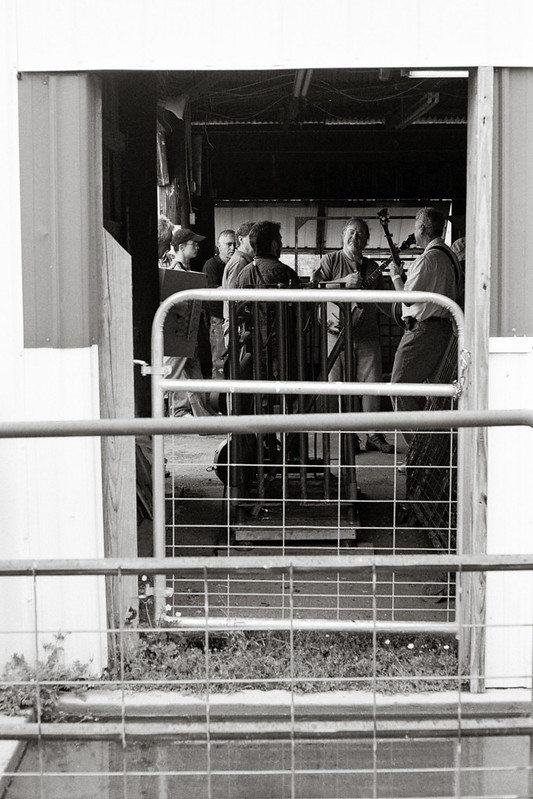
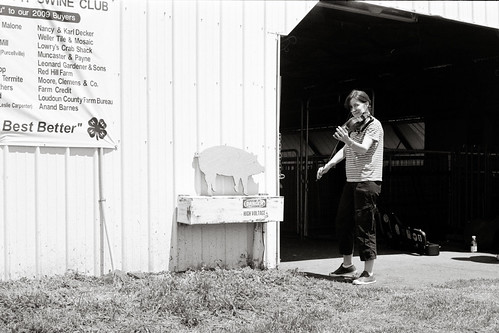
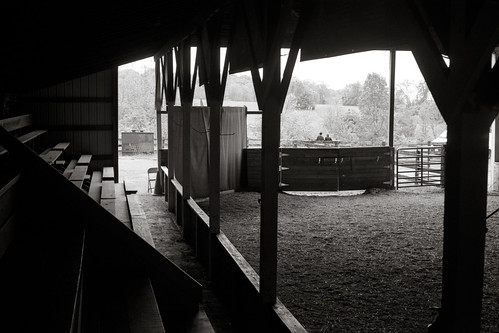
Here are some results:



All Images by Reed A. George
Leica M3 DS, Summicron 50mm f2 Collapsible
Kodak TMax 400 film
 
As usual, The Darkroom processed my film with excellent results.
 
(Click Here) to visit The Darkroom and use their awesome mail-in processing services!
 
DMC-365.blogspot.com


Saturday, April 6, 2013

April's Whole Lotta Leica Lens - the Summicron 5cm f2 Collapsible LTM "Radioactive" Lens

 
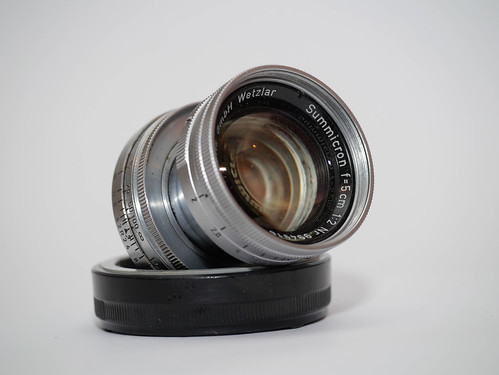
Leica Summicron 5cm f2 Collapsible Lens
 
This month, I am choosing the Summicron 5cm f2 collapsible lens as my Whole Lotta Leica selection. I will pair it up with my Leica M9 for the month and share the results with you here.
 
The Summicron 50mm has been a benchmark lens for Leica (and for comparisons from other manufacturers) since it was first introduced around 1955. The first version (shown here) was a collapsible lens. Originally made in Leica Thread Mount (LTM), the collapsible was also made in Leica M mount. Mine is an LTM lens.
 
The collapsible Summicron was an evolutionary step up from the previous Summitar 5cm f2 collapsible, which remains a favorite of vintage Leica shooters.
 
Mine happens to be an early unit (serial no. 994,XXX), which is classifed as having radioactive glass. There is some disagreement about the meaning of this, but here's a quote from Brian Sweeney, a lens expert with a lot of credibilty:
 
 
"Brian Sweeney
04-27-2010, 03:48
The original Summicrons use Thorium Glass and they are radioactive. I own two of them. Summicrons with SN after 105xxxx do not use radioactive glass.
 
The original prototype Summicrons were marked as Summitars, and had the asterisk (or star) next to the name. I have only seen photographs.
 
http://www.imx.nl/photo/leica/lenses/lenses/page92.html
 
The Summar is a double-gauss, 6 elements in four groups, 1-2-2-1 configuration. The Summitar and earlier Summicrons are evolutions of it, 7 elements in 5 groups. The type 2 Rigid Summicron (black, the 70s version) was 6 elements in 5 groups. The modern Summicron went back to the 1-2-2-1 configuration."
 
 
If you're interested, you can (click here) to read more about thorium glass, contaminated lanthanum glass, and whether or not the radioactive glass will fog film (it won't at normal distances).
 
The glass in these lenses is normally yellowed. Some people think it makes these lenses better for black and white shooting. I know it's common to use a yellow filter to increase contrast in blue skies. Or maybe the yellow is worse for color photography?
 
In any case, mine is in gorgeous condition. It is rare to find one without cleaning marks. I got lucky.
 
(Click Here) to read a nice summary of the different versions of the Leica Summicron 50mm lenses on antiquecameras.net
 
The International Leica Society (aka LHSA) is having their Spring Shoot in Ft. Lauderdale, Florida on April 17-20. I'll be taking the Summicron collapsible along for the trip.
 
By the way, if you aren't a member of LHSA, I highly recommend it. It's a great group. Even though it formerly had "historical" in its name, the LHSA comprises a wide variety of members with experience ranging from the earliest vintage models through the latest digital Leicas. This is not a group stuck in time. In fact, at my first LHSA event, I took a great workshop on high dynamic range (HDR) imaging. That's not an old technology.
 
In addition to their Spring Shoot and annual meeting, the LHSA holds an annual raffle where they give away extremely expensive and wonderful cameras, and they publish a great journal, known as the Viewfinder. They also offer an electronic membership, where the Viewfinder is delivered as a pdf. Wonderful. No clogging up the mailbox with a paper magazine.
 
So, check out the LHSA:
 
(Click Here) and join!
 
DMC-365.blogspot.com