Showing posts with label insect. Show all posts

Monday, September 7, 2015

A Glass Menagerie - Panasonic Lumix DMC-TS5

I carry a camera with me every day. Today, it happened to be my little waterproof Lumix TS5, which I was bringing in to work to loan to a friend. The camera has accompanied her to Central America, and is now on its way to Tibet.
 
Anyway, the building where I work represents one of the world's largest installations of structural glass. Walking to my office, I noticed these apparently random tracks on the condensed water droplets on the outside surface. Obviously not guided by gravity, these tracks twist and turn, intersecting themselves and wandering both up and down. After looking at a few of them closely, I determined the source.
 
Slug, by Reed A. George
Panasonic Lumix DMC-TS5
 
At about 1 1/2" in length, these guys cover some territory.
 
Further down the hall, I found this predator:
 
Praying Mantis, by Reed A. George
Panasonic Lumix DMC-TS5
 
I'm not sure if a mantis will eat slugs, but I have a suspicion they will. Quite an interesting little world in operation just on the other side of the glass...
 
The TS5's macro capability came in handy here. The wifi did as well, allowing me to quickly transfer the images to my iPad so I could include them in this morning's post.
 
Then, I look up from the table where I'm writing and see this:
 
 
I grabbed this shot with the iPad's onboard camera. Okay, digital imaging can be pretty cool.
 
DMC-365.blogspot.com


Monday, July 14, 2014

Bug Closeups with the Micro 4/3 Panasonic-Leica 45mm f2.8 Macro Elmarit

I have had the Pana-Leica 45mm f2.8 Macro Elmarit lens for quite some time. When I purchased it, the Macro-Elmarit was the only medium telephoto available for the Micro 4/3 mount. Had the Olympus 45mm f1.8 been out at the time, I probably would have bought that instead.
The extra >1 f-stop of the Olympus would be nice. That said, the macro ability of the Pana-Leica is great. I like to be able to take closeups of details when I travel.
I have not really explored the capabilities of this lens in more classical macro applications. Yesterday, I had the time and opportunity to go bug hunting while my wife practiced free swimming in a local quarry. I decided to see what the Macro-Elmarit could do. So, I mounted it on my Panasonic Lumix DMC-GX7, set up the touch screen to focus and trigger exposure (I rarely use the touch screen features of the GX7), and connected my Nissin flash with a remote cord. Having mounted the camera on a sturdy tripod, I was ready to go.
Well, it was hot, and the bug hunting was a little tough. After waiting an eternity (okay, about 30 minutes) for a gorgeous dragonfly to return to a particular perch to no avail, I started stalking. By the way, dragonflies usually will come back to exactly the same spot over and over. I think maybe I was just too close for comfort. This is where a longer macro focal length would come in handy, giving me more working distance.
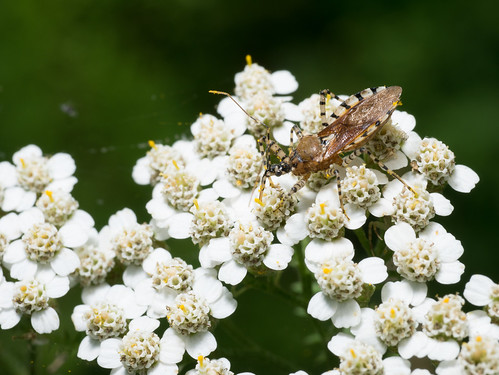
My stalking actually resulted in finding a stationary dragonfly, but my best subject of the day was this bug you see below. I'm not sure of his exact species, but guess that he's part of the hemiptera family of true bugs.
Bug, by Reed A. George
Panasonic Lumix DMC-GX7, Pana-Leica 45mm f2.8 Macro Elmarit, Remote Flash
iso 200, f11 1/100 sec.
 
I used a mini softbox mounted on the flash head, and handheld the flash. Even with the camera on a tripod, I had too many things to hold, and the flash-to-subject distance wasn't well controlled with my hand holding method. I should work on mounting the flash to a bracket if I continue this line of imaging. I did use the touch screen to identify where to focus and trigger the exposure. I must admit it's a pretty cool tool, as long as the camera is held stationary. It was a little difficult to get the focus point just right, on the bug's head, at this magnification. But, I did get it a few times.
 
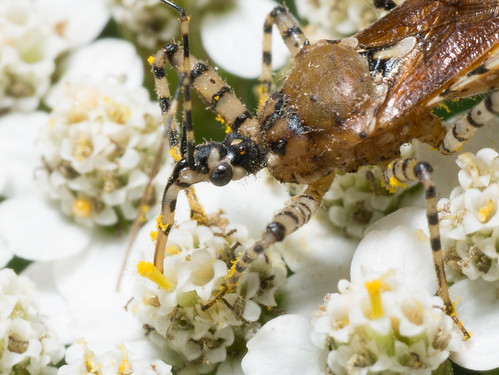
I was not at the closest focus distance of the lens, but was at about the shortest useful working distance for this subject. Here's a 100% enlargement of the same image (a little clarity and sharpness applied in Lightroom):
 
100% Crop of Image Above
 
So, I'd say this lens is pretty capable in the true macro realm. I don't shoot a lot of nature macro images like this, and would normally tend toward the large sensor of my Nikon D700, and either my true macro 60mm Micro-Nikkor f2.8, or a longer lens (say 105mm f2.5) with extension tubes. The longer lens would make the working distance more reasonable. Now I know that the Micro 4/3 sensor in my GX7 and Macro-Elmarit are quite capable in this realm.
 
On top of that, the Macro-Elmarit is a reasonably good portrait lens (limited in its shallow depth of field potential by the relatively small maximum aperture of f2.8), and an excellent lens for capturing closeup details when on travel.
 
DMC-365.blogspot.com

Saturday, July 5, 2014

Panasonic Lumix DMC-TS5, Macro, and Damselflies


P1010917.jpg
 
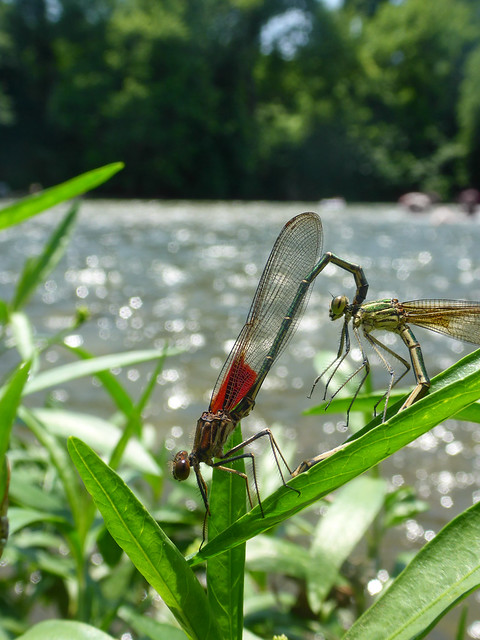
Damselflies - American Rubyspot (Hetaerina americana)
by Reed A. George
Panasonic Lumix DMC-TS5
 
Last weekend, I took a little float trip down the Shenandoah River. Part of the River and Roots music festival, held at Watermelon Park in Berryville, Virginia, this educational event was led by musician and teacher Josh Bearman of The Hot Seats.
 
Anyway, back to the subject at hand - damselflies. This potential couple of American Rubyspots was perched very near the water surface. I say potential couple, because at this stage, the female (to the right) is being held by the male, and allowed to evaluate him for suitability. If she approves, her abdomen and terminal genitalia will connect to his body, forming a sort of circular orientation between their bodies.
 
These guys spend 1-3 years as aquatic larvae, with only a couple of weeks as adults, during which they mate and then die.
 
The tiny sensor on the Panasonic Lumix DMC-TS5 has all of the drawbacks of a small sensor, of course, which includes digital noise at high ISO settings. However, a big advantage of the small sensor is the closeup capability, as demonstrated here. This would have been exceedingly difficult to capture with a DSLR, even forgetting about the risk of getting it wet. In this case, I simply left the camera in iAuto mode, and slid it down into the grass next to the damselflies. I shot several images in a few seconds, but found this one to be the best.
 
DMC-365.blogspot.com

Monday, June 10, 2013

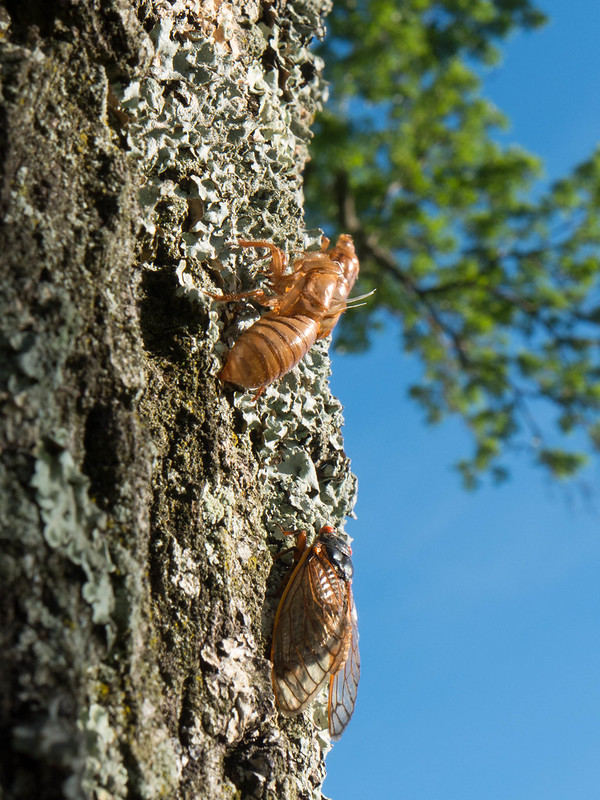
Panasonic Lumix DMC-LX7 Shoots Cicadas Close Up! The Cicada Class of 2013 is a Big One.

 
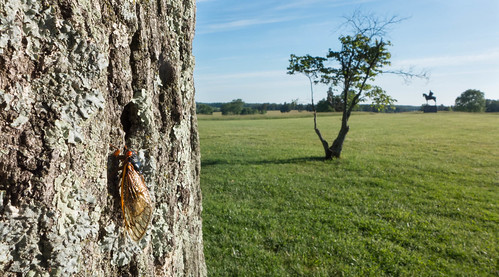
History Bug, by Reed A. George
Panasonic Lumix DMC-LX7
iso 100, f7.1, 1/250 sec
 
On Memorial Day weekend, I went to the Manassas National Battlefield a few times for some shooting. In the image above, you can see Thomas "Stonewall" Jackson's statue to the far right on the horizon. Up close, you see a 17 year cicada, freshly molted from the nymph stage into the adult.
 
(Click Here) to read about the cicadas of 2013.
 
Cicadas live between 13-17 years underground, and emerged in synchronized fashion with their siblings. Scientists don't know for sure why they do this - some believe it's to avoid predation, both by being unpredictable because of the long time scale and by safety in numbers making it more likely that some of them will get through. Others believe it's due to climate changes, whereby colder weather severely slowed down their previously faster development.
 
You Can Never Go Home, by Reed A. George
Panasonic Lumix DMC-LX7
iso 100, f8, 1/250 sec
 
In the picture above, you see the adult (lower center) next to the molted skin of a nymph. Quite a change in body plan, huh?
 
Big Year for the Cicadas, by Reed A. George
Panasonic Lumix DMC-LX7
iso 100, f3.5, 1/250 sec
 
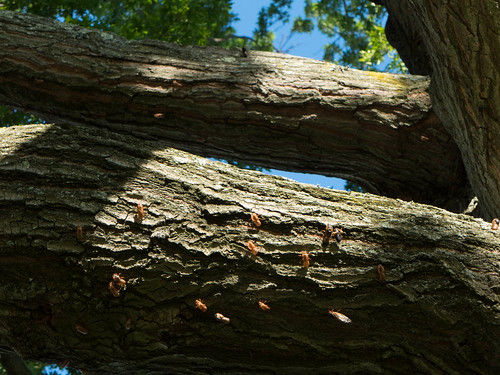
As you can see in the picture above, there are a lot of cicadas in this year's brood. Those are the abandoned nymph skins left behind after moulting.
 
This subject reminded me again of the flexibility of the little Lumix DMC-LX7. I was also carrying my Leica M9 with Summaron 3.5cm f3.5 LTM lens and my Minolta Autocord TLR. Neither of them could have made these images. Even with the Rolleinar close up lens on the the Autocord, I couldn't have come close to this focusing distance. The LX7 sure does a lot of things right.
 
DMC-365.blogspot.com


Thursday, August 9, 2012

Damsels - Not in Distress - Pentax M42 Macro on Lumix DMC-GH2

 
Damselflies, by GShooter on mu-43.com
Image Source: http://www.mu-43.com/f40/asahi-pentax-100mm-macro-lens-gh2-29746/
 
Poster GShooter on mu-43.com posted two awesome images of damselfiles, made with a Pentax screwmount 100mm macro lens. This is right up my alley. The subject, the equipment, the execution are all great!
 
(Click Here) to see the original post and comments. GShooter followed up with links to high resolution images.
 
I bet no one at Asahi Optical ever dreamed how that sweet little macro lens would end up being used...
 
DMC-365.blogspot.com