Showing posts with label distortion. Show all posts

Wednesday, July 6, 2016

Getting Out and About With the 4x5 Speed Graphic

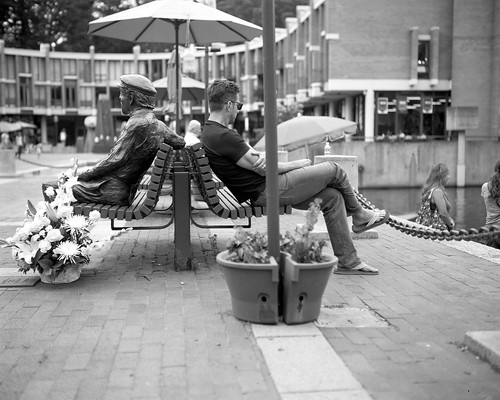
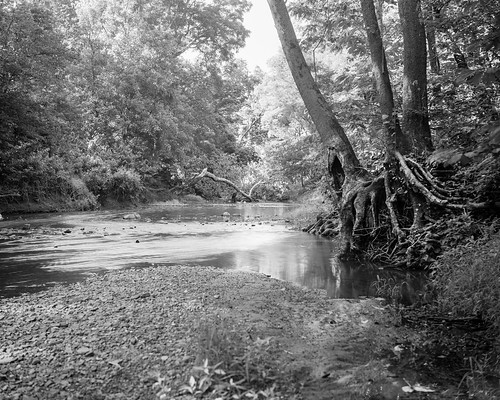
I have a beautiful early Graflex Speed Graphic 4x5 camera. Because it's not so convenient to use, I haven't spent much time with it. I decided to change that over the three day 4th of July weekend. I made a total of ten exposures (on Arista EDU film), and found that five of them are worth sharing. That's a pretty good hit rate compared to smaller formats, where I shoot a lot more images per scene.
 
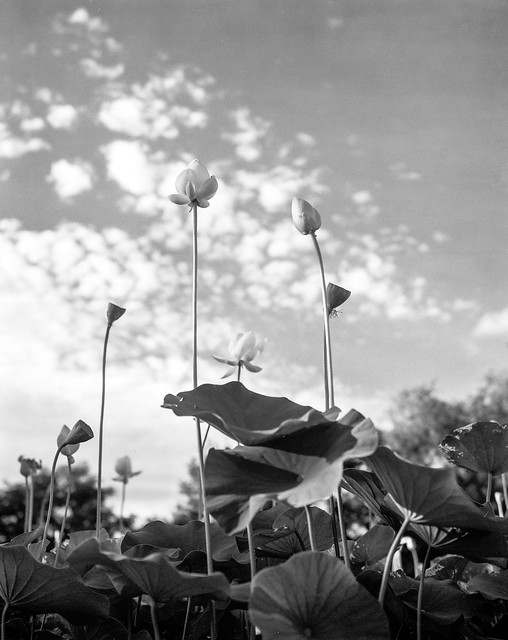
Here are my five favorites from the weekend:
 
 
I usually set the camera on a tripod, using the ground glass back to frame and focus. I did that for the last three images above. For the first two, I used the rangefinder and shot handheld. Getting the focus right is a challenge, and I missed on some other shots. But, when you get it right, it's pretty nice.
 
In the picture of the house (Thornton House at Manassas National Battlefield), I used the front rise movement of the camera to allow me to keep the camera level to avoid distortion, yet still capture the roof and chimney. Pretty cool.
 
In the shot of the lotus flowers, I threw all concern for distortion to the wind, shooting with the camera nearly on the ground, pointing up at a steep angle.
 
I'm very happy that the Speed Graphic is not my only camera, or even my main one. But, it's instructive and fun to use.
 
DMC-365.blogspot.com

Tuesday, June 19, 2012

I Think I Got My Fisheye Fix - On The Cheap!

Fisheye!  by Reed A. George
Distorted Metal and Structural Glass, by Reed A. George
Lomography Fisheye, iso200, f8, 1/100 sec.
 
Well, if you've followed my blog, you will know that I've toyed with fisheye, even ordering and then subsequently cancelling a fisheye attachment for my Panasonic Lumix DMC-G3. I knew that I wanted to play with the effect, but that it would not be a mainstay of my photography. At $200 for an attachment (the DMC-GF1) that only goes to 120 degrees field of view, to three times that much for a dedicated Panasonic fisheye lens (the Lumix H-F008, 8mm f3.5), I just couldn't justify it, even to myself.
 
So, when I saw the Lomography fisheye camera come up, I had to have it. Now, be warned, this is no high quality equipment. It is a 35mm film camera with 170 degree field of view. The body is very cheaply-built - think disposable camera. There are no adjustments - it is fixed focus (everything is in focus anyway), fixed shutter speed (1/100 sec.), and fixed aperture (f8). The only thing you can control is the iso of the film you use. I learned from my first two rolls that I should be shooting iso 400, as many of my iso 200 shots were underexposed. All those qualifications notwithstanding, this is a FUN little camera!
 
There is a newer version, the aptly named "Fisheye 2," which includes an improved viewfinder, 180 degree field of view, the ability to do timed and multiple exposures, and some additional flash capabilities. It costs about $60. Anyway, I went with the cheaper first version.
 
You will likely see some more images from my Lomo Fisheye. In fact, I have one or two from a music festival this weekend that I plan to share.
 
So, I didn't go Lumix for my fisheye solution. However, I'm thinking - since it's got such wide depth of field and is focus-free - I wonder if there's a way to remove the lens from the plastic camera body and attach it to an adapter for use on my Micro 4/3 bodies? It would crop the view quite a bit, but the distortion would still be there. Hmm... Maybe a future project.
 
DMC-365.blogspot.com