Showing posts with label lotus. Show all posts

Wednesday, July 6, 2016

Getting Out and About With the 4x5 Speed Graphic

I have a beautiful early Graflex Speed Graphic 4x5 camera. Because it's not so convenient to use, I haven't spent much time with it. I decided to change that over the three day 4th of July weekend. I made a total of ten exposures (on Arista EDU film), and found that five of them are worth sharing. That's a pretty good hit rate compared to smaller formats, where I shoot a lot more images per scene.
 
Here are my five favorites from the weekend:
 
 
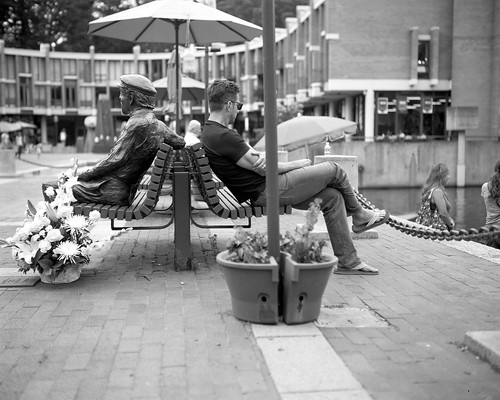
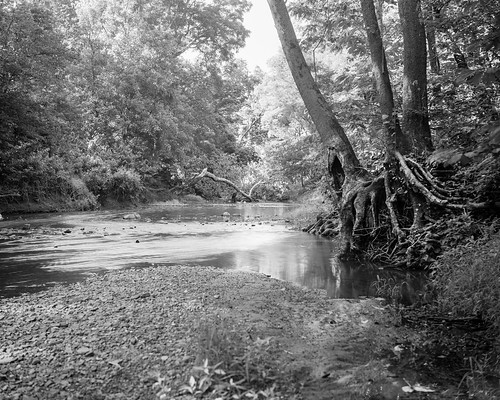
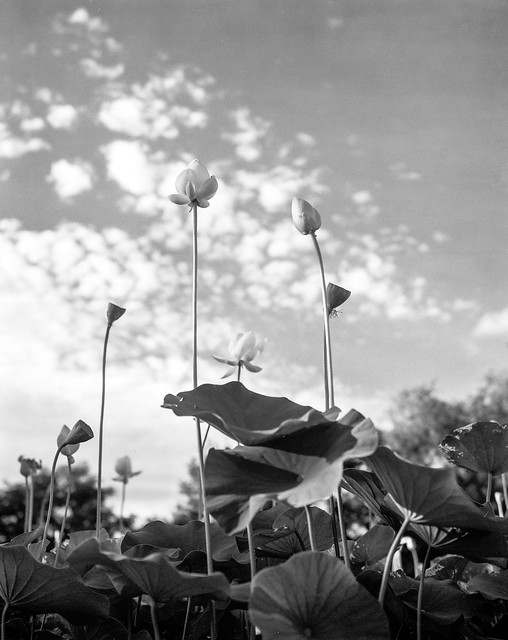
I usually set the camera on a tripod, using the ground glass back to frame and focus. I did that for the last three images above. For the first two, I used the rangefinder and shot handheld. Getting the focus right is a challenge, and I missed on some other shots. But, when you get it right, it's pretty nice.
 
In the picture of the house (Thornton House at Manassas National Battlefield), I used the front rise movement of the camera to allow me to keep the camera level to avoid distortion, yet still capture the roof and chimney. Pretty cool.
 
In the shot of the lotus flowers, I threw all concern for distortion to the wind, shooting with the camera nearly on the ground, pointing up at a steep angle.
 
I'm very happy that the Speed Graphic is not my only camera, or even my main one. But, it's instructive and fun to use.
 
DMC-365.blogspot.com

Tuesday, March 26, 2013

When the Inner and Outer Worlds Converge


I read a thoughtful post, about the simultaneous exploration of the outer world and the inner world of the photographer himself (or herself) in the making of photographs, on Otto Von Munchow's blog.
 
(Click Here) to read the entire post on munchow.wordpress.com, including some thoughts from Henri Cartier-Bresson, a master of sharing the inner and outer worlds and where they converge.
 
One of the concepts that Munchow brings up is "tunnel vision," the exclusive focus that one gets when fully absorbed in photography. He mentions that when he achieves this state, he can be sure that there will be some good images in whatever he's taken. But, he cannot usually say which ones, until he reviews them.
 
I am very different in that way. I certainly experience this focus on the subject, process, and myself - "tunnel vision." However, I usually know which images are going to be the best from the set, even when I'm shooting film and cannot review them on the spot. Of course, there are sometimes surprises, both positive and negative. Those "missed the focus by that much" to use Maxwell Smart's expression (sorry, it's an old TV show, called "Get Smart"), and those rare images that didn't make an impression while shooting but just jump out at you when you see them developed. However, I can usually pinpoint the three or four best shots before seeing them.
 
Below is a case in point. I was initially attracted to the water droplets on this lotus leaf. As I was working on different angles and approaches, the shadows and textures became much more apparent. In fact, the line of the shadow taking on approximately the shape of a yin-yang symbol finally popped into my head, and I captured it. To me, this embodies how I felt about this place, this moment, and myself, photographing lotuses on the grounds of a Buddhist temple. I knew I liked this one before reviewing it.
Lotus Leaf and Water, by Reed A. George
Nikon D700, 24-85mm f2.8-4 Lens
iso 100, f16, High Dynamic Range (HDR) composite of three exposures
 
DMC-365.blogspot.com


Friday, August 31, 2012

Perfection Lost

 
Near Perfection, by Reed A. George
Leica M9, 135mm Hektor f4.5
iso 200, f8, 1/125 sec
 
I've written before, recently, about the challenges of photographing often-photographed subjects. Yesterday, I decided to re-familiarize myself with an old lens, now that I have a Leica M9 that accepts older lenses without demanding a lens code and UV/IR filter, or cropping the image by a factor of 1.33x, as the M8 did.
 
All images in this post were made with the Leica Hektor 135mm f4.5 (ca. 1955). I think it's front-focusing by a small amount, but by f8 it looks pretty good. It certainly has character.
 
I went to my local Buddhist temple, which has a gorgeous set of small ponds with lotus flowers. The image above is the one that I think anyone would take. The amazing shape of the blossoms, along with the incredible colors and the repetition of the shape three times make for a nice, standard composition.
 
I wanted something more, something that may not appeal to everyone, but required a different perspective from me as an artist. The following images are what emerged - I call them "Perfection Lost."
 
Perfection Lost Number One, by Reed A. George
Leica M9, 135mm Hektor f4.5
iso 200, f8, 1/250 sec
 
You see, as Buddhism would teach us, all things are temporary. The blossoms achieve perfection only to be destroyed, to "go to seed," as some would say. They maintain beauty, just not perfection. And going to seed just starts the cycle over again.
 
Perfection Lost Number Two, by Reed A. George
Leica M9, 135mm Hektor f4.5
iso 200, f9.5, 1/90 sec
 
 
Perfection Lost Number Three, by Reed A. George
Leica M9, 135mm Hektor f4.5
iso 200, f8, 1/125 sec


Perfection Lost Number Four, by Reed A. George
Leica M9, 135mm Hektor f4.5
iso 200, f6.7, 1/180 sec
 
You see, life is not linear, going from start to finish. It is circular. It goes in cycles. That's comforting to a person a little past mid-life.
 
DMC-365.blogspot.com