Showing posts with label people. Show all posts

Wednesday, July 6, 2016

Getting Out and About With the 4x5 Speed Graphic

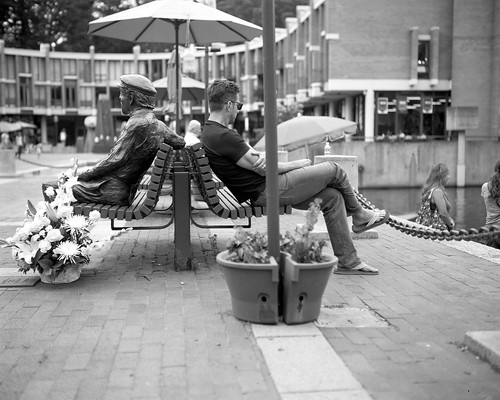
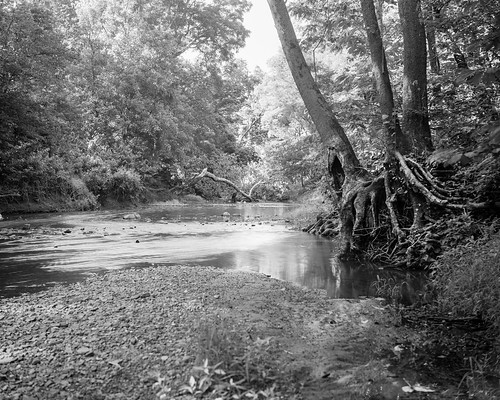
I have a beautiful early Graflex Speed Graphic 4x5 camera. Because it's not so convenient to use, I haven't spent much time with it. I decided to change that over the three day 4th of July weekend. I made a total of ten exposures (on Arista EDU film), and found that five of them are worth sharing. That's a pretty good hit rate compared to smaller formats, where I shoot a lot more images per scene.
 
Here are my five favorites from the weekend:
 
 
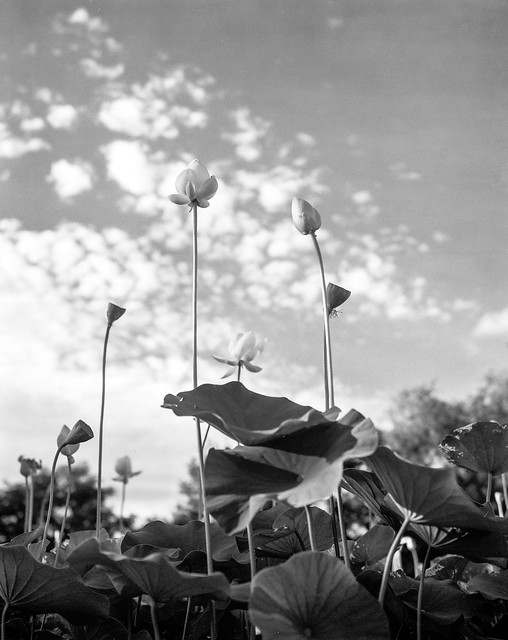
I usually set the camera on a tripod, using the ground glass back to frame and focus. I did that for the last three images above. For the first two, I used the rangefinder and shot handheld. Getting the focus right is a challenge, and I missed on some other shots. But, when you get it right, it's pretty nice.
 
In the picture of the house (Thornton House at Manassas National Battlefield), I used the front rise movement of the camera to allow me to keep the camera level to avoid distortion, yet still capture the roof and chimney. Pretty cool.
 
In the shot of the lotus flowers, I threw all concern for distortion to the wind, shooting with the camera nearly on the ground, pointing up at a steep angle.
 
I'm very happy that the Speed Graphic is not my only camera, or even my main one. But, it's instructive and fun to use.
 
DMC-365.blogspot.com

Thursday, June 16, 2016

Eyes

 
DMC-365.blogspot.com


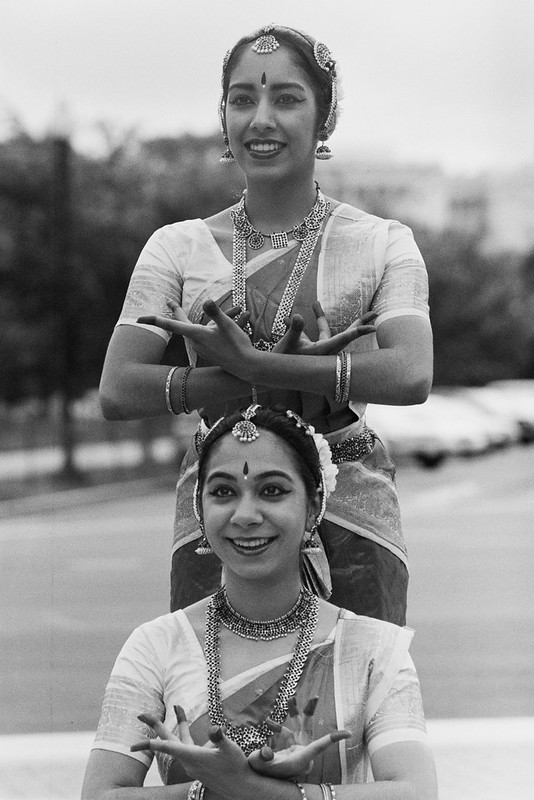
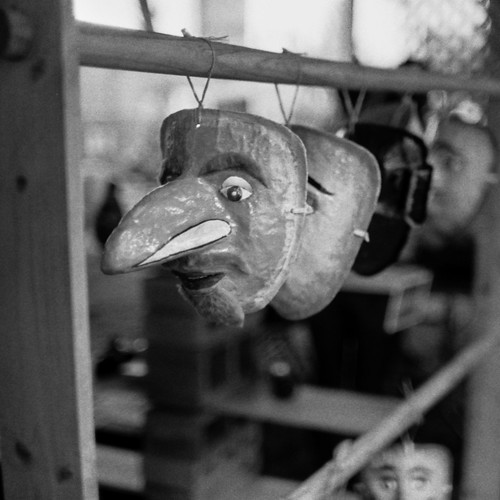
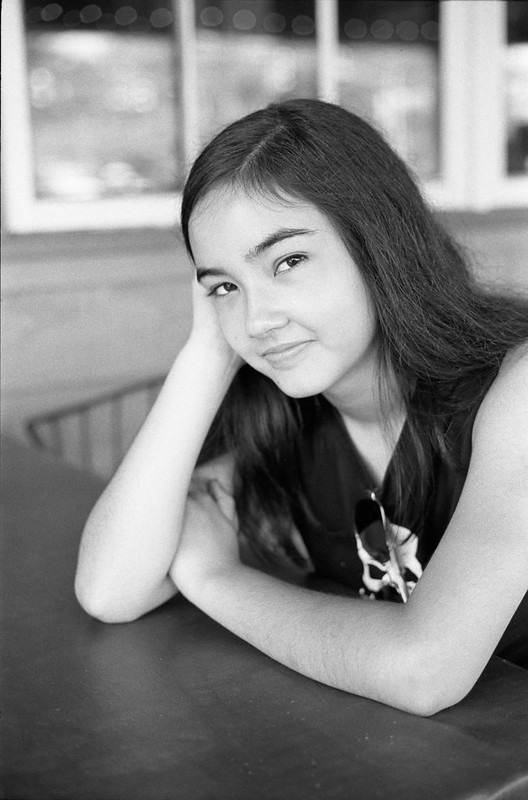
Asia Festival, DC - Rolleiflex SL2000F

Here are a couple of images I made at a festival over the memorial day weekend. I was shooting my Rolleiflex SL2000F, with the wonderful Sonnar 135mm f2.8 lens. I think it's the best lens I have for this outfit.
 
 
Don't know what a Rolleiflex SL2000F is? (Click Here).
 
DMC-365.blogspot.com
 

Monday, May 30, 2016

Triptych - Youth and Humor

Youth and Humor
Nikon Df, Nikkor 85mm f1.8 AF-S Lens
 
 
I accompanied my friend, Charles Arnhold, to one of his regular haunts this weekend. Charlie is doing a project on the place, Cafe Amouri, in Vienna, Virginia. (Click Here) to check out the cafe's website. Great coffee.
 
These are Charlie's friends, Anna and Jayna, having a little fun on the sidelines.
 
DMC-365.blogspot.com

Friday, September 4, 2015

Annoying Some Kids With My Rolleiflex

Get it Over With, Mister. By Reed A. George
Rolleiflex 2.8F Planar, Kodak TMax 400 Film
 
Every single time I use it, I am reminded why the Rolleiflex is such an important piece of photographic history, and my photographic present. I just love the expression on this little girl's face, as well as her posture. I also like that her shirt says "SMILE" on it...
 
DMC-365.blogspot.com

Thursday, July 23, 2015

Pinhole Portraits by Stefan Killen

 
I love shooting pinhole images. I've shot a lot of scenery images, and even some people pictures with my pinhole cameras. But, I've never really tried any portraits.
 
(Click Here) to check out Stefan Killen's pinhole portraits. Inspiring.
 
DMC-365.blogspot.com
 

Monday, July 6, 2015

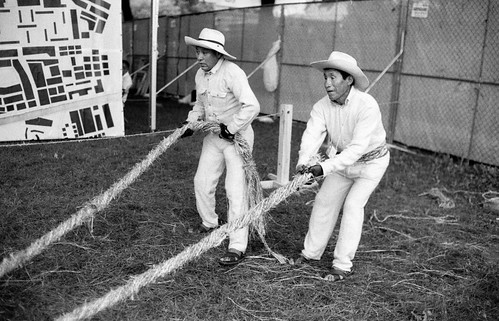
Smithsonian Folklife Festival - Featuring Peru - Shot with Nikon FM2 and Nikkor 35mm f1.4 AIS Lens

I just replaced the seals on my Nikon FM2. My latest roll of film showed evidence of a minor light leak. That's all fixed up now. It took about an hour to get all the old seal residue off and install the new ones, but it was well worth the effort.
 
To test it, I mounted my new Nikkor 35mm f1.4 AIS lens, loaded a roll of Agfa APX400 film (thanks again, Dennis!), met my friend Charlie, and headed into DC. We attended the Smithsonian Folklife Festival, which featured Peru this year. Here are a few of the first pics I've scanned.
 
 
I just got the lens from another friend, Alain, a short time back. I haven't used it a lot. I think I like it.
 
I will be posting more from this event as I get them scanned.
 
DMC-365.blogspot.com

Friday, July 3, 2015

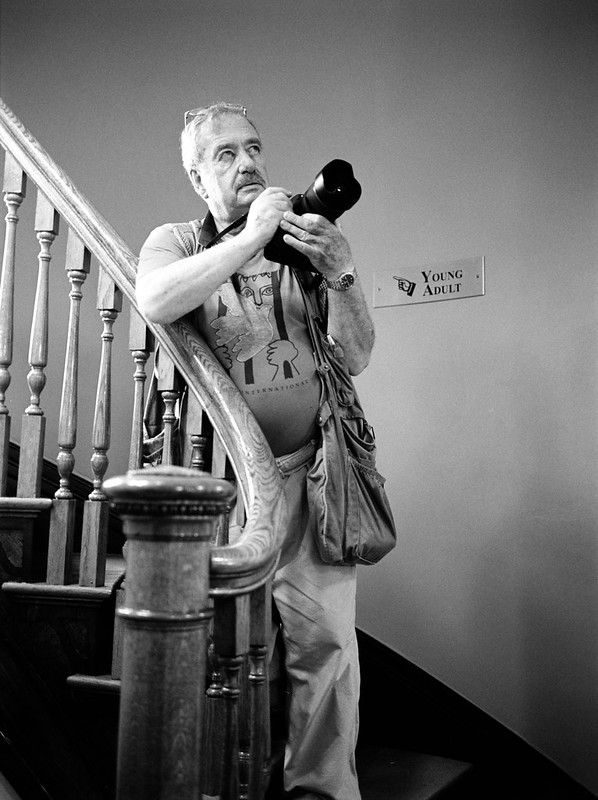
And Another From the Handley Library - Fujifilm GS645S

 
Young Adult, by Reed A. George
Fuji GS645S, Kodak TMax 400 Film
 
I absolutely love how this image turned out. The "Young Adult" sign on the back wall was a bonus; I didn't even notice it when I was shooting the image! Too funny.
 
DMC-36.blogspot.com
 

Saturday, June 27, 2015

Posing - Not So Easy for Me

I've been reading and working on posing techniques recently. It's not easy for me, but I do believe I'm learning some important tools.
Christine, by Reed A. George
Leica M3, Summicron 50mm f2 v.2 Lens
 
Out of all of the things I've learned so far, getting the arms to be part of the composition, and not just in the way, is one of the most important.
 
I'm definitely continuing to learn, and with each image I make, I can find weaknesses, problems with the pose. In this one, I should have moved a little to the left, to make it where her eyes and face were as close to the camera as her shoulder. As it is, her shoulder draws too much attention.
 
By the way, if you're looking for a good book on the subject, check out Roberto Valenzuela's Picture Perfect Posing. I've included a link to it on Amazon below.
 
DMC-365.blogspot.com


Tuesday, March 31, 2015

Trip to the Hirshhorn Museum in Washington, DC

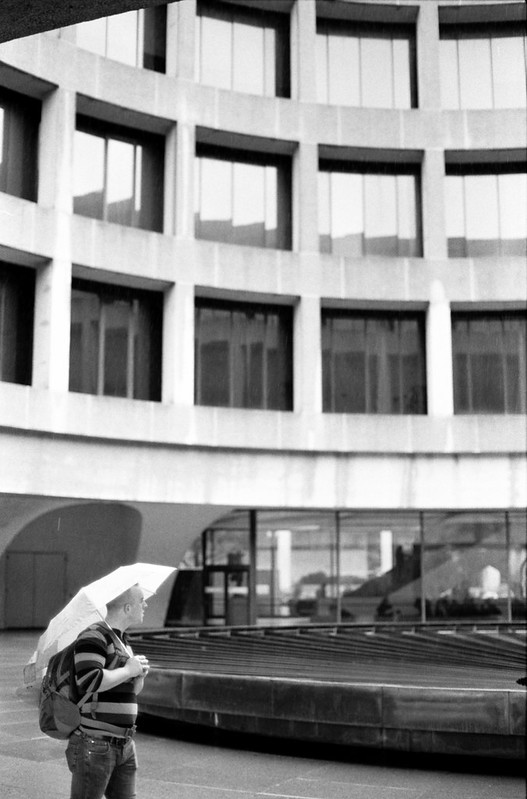
I took my Nikon F2SB with me to the Hirshhorn Museum of Art in Washington, DC.
 
It was a cold, rainy afternoon.
 
Museums are Good for Rainy Days, by Reed A. George
Nikon F2SB, 50mm f1.4 AI Lens
Ilford HP5 Film
 
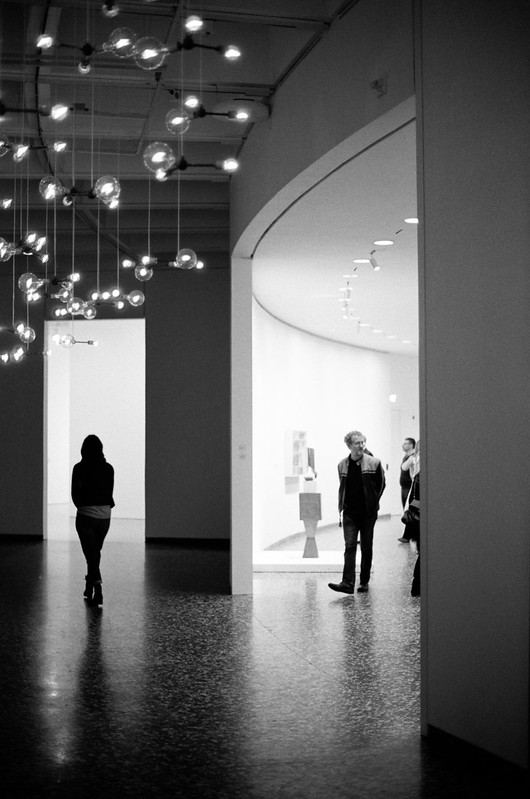
While photographing the displays or pieces of art in a museum is tantamount to stealing someone else's creativity, I always enjoy photographing people in the interesting environment created by a museum.
 
Separate Worlds, by Reed A. George
Nikon F2SB, 50mm f1.4 AI Lens
Ilford HP5 Film
 
I like how the left and right of the frame above could have come from completely different photographs.
 
The more I use the F2SB (which is a normal Nikon F2 SLR with the photomic finder that uses a very sensitive silicon sensor for light metering), the more I like it. Mine's in very nice user condition - not so nice that I'm afraid to take it out, but certainly well-preserved for its age. I enjoy shooting film with older manual Nikkor lenses, as well.
 
DMC-365.blogspot.com
 

Friday, October 24, 2014

Some Tips for Taking Great Images in the Studio

Danny Knicely, by Reed A. George
 
I've been doing some promo images for my musician friends lately. I'm thoroughly enjoying the process, and always looking for new tips. I thought that the studio lighting setup would be one of the challenges, and therefore looked up some common configurations before starting. After a couple of these sessions, I now feel pretty comfortable with the lights. Really, I think it's more important to get them set, stop fiddling with them, and develop trust and interaction with the person being photographed.
 
I recently read a post by Sarah Hipwell on the Digital Photography School website. It has several good tips for getting things to flow:
 
  • Music can help to calm down a tense atmosphere. I use this one every time when I'm shooting musicians. I have not tried bringing recorded music to the session, though. Since my subjects are musicians, and typically want to be photographed with their instruments anyway, I always ask them to play. I get a private concert, and they get to do what they love. Another added benefit is that it brings out the performer in the person; they're not used to being in a photo studio, but they are used to playing in front of people, and even in front of cameras.
  • A tip that Sarah shares is asking the subject to blink ten times. I like this idea very much, as it will give a better catchlight in the eyes if they're wet, and I bet it reduces blinking during exposures.
  • Ask them to wear neutral clothing. The pictures are about them, not their clothes.
  • Sarah mentions that most great images come at the end of a session. I've definitely found this to be true. I think it's when the pressure is off, and everyone is pretty sure you've got some good images, that both the photographer and subject relax. This relaxation shows in the pictures.
  • Get feedback during the session. This is a mixed bag, in my opinion. First, showing them tiny images on the camera LCD generally won't work. Connecting to a larger display requires some technical ability; if you have it, great. If not, don't fiddle with wires, cards, and gear while the studio clock is ticking.
  • Get them to talk. Yes! Except, as mentioned above, I generally get them to sing. This is easy with most musicians.
  • Work fast. Agreed. While I try to work fast, sometimes I rush myself too much, and don't go deep enough with the subject. In other cases, what should be a one hour session easily goes into the second hour, probably too long from the point of view of the person being photographed. So, for me, the challenge is to balance between rushing too much and taking too long.
  • Another practical tip - have them point their legs toward the main light source, and twist their upper body to face the camera.
(Click Here) to read Sarah's full piece on the Digital Photography School site.
 
 
It's harder than it looks, folks. In my opinion, getting the technical stuff out of the way so that you can focus on the person and interaction with them is key.
 
DMC-365.blogspot.com
 

Wednesday, September 24, 2014

Impromptu Portrait Session - an Add-On to my Magnum Workshop Experience

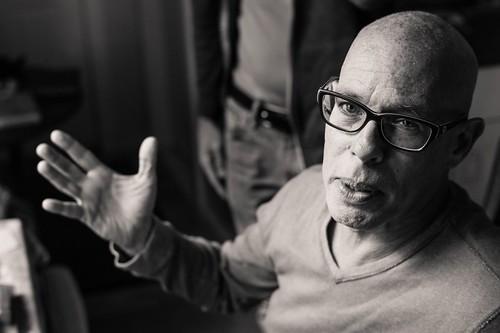
I had the good (great) fortune of meeting this gentleman at the very end of my Magnum workshop in Provincetown, Massachussetts. I met him by being open to opportunities, and by approaching him with an honest request to make a few images.
 
David is a figure of some prominence around here, and was planning to have a photographer visit him next week to shoot portraits for a magazine article. However, he gave me the opportunity to come into his writing studio and shoot a few of my own. Here are the best four shots I got from my ten minutes or so with him.
 
All of these were shot on my Leica M9 with 50mm f1.4 Summilux. I would have liked to use my 35mm lens, as the writing studio was quite cozy and I was challenged to get far enough away to make the picture I wanted. But, I only had the 50mm lens with me, and made the best of it.
 
One of the things I learned (re-learned?) in this workshop is the importance of being out there, being ready for opportunities to make images, and even creating opportunities when necessary. I worked for five days on a project, having a very difficult time getting to even the rather meager number of 5-8 images needed for our presentation to the workshop and to the public at the Fine Arts Work Center here in Provincetown. The experience of meeting David was exactly what I was looking for all week.
 
I ended up using only a single image of David in my presentation (not one of the images shown here), but feel that the experience of meeting him significantly added to my workshop experience.
 
DMC-365.blogspot.com
 

Monday, August 18, 2014

Belizean Kids Selling Mango

We met these two kids on the beach at San Pedro, Belize. They were selling fresh mango slices (which the boy's carrying in the tub on his head). They were quite good at their jobs.
 
Fresh Mango on the Beach, by Reed A. George
Panasonic Lumix DMC-LX7
iso 200, f5.6, 1/320 sec.
 
I loved how the people in Belize were generally quite happy to have their photograph taken. This image will remind me of their welcoming attitude for a very long time.
 
DMC-365.blogspot.com


Sunday, July 27, 2014

Korean War Memorial Reflecting Pool - Leica M9, 90mm Elmarit f2.8

 
Korean War Memorial Reflecting Pool, by Reed A. George
Leica M9, Leica Elmarit 90mm f2.8 v.1 Lens
iso 160, f4.8, 1/500 sec.
 
 
I went into DC with my friends Alain and Charlie today, to do a little shooting at the National Mall. It was a gorgeous day. While I find the national monuments a bit challenging to shoot, mainly because they've all been done so much, I do like this image. I think the combination of the curved lines, reflections, and people interacting with the environment are just enough to make it a decent composition.
 
DMC-365.blogspot.com
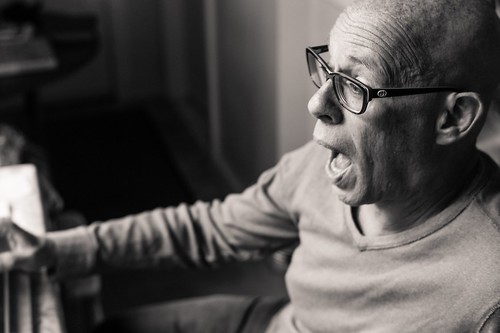
 

Wednesday, June 25, 2014

A New Orleans Character

As you may know if you follow my blog, I love to meet and photograph interesting people when I travel. While returning from Audubon Park to the French Quarter on the streetcar in New Orleans, I met Tony:
 
Tony from New Orleans, by Reed A. George
Leica M9, 50mm Summilux f1.4 Lens
iso 200, f3.4, 1/750 sec.
 
Tony was dressed especially nicely, and his black hat and white bowtie really stood out. But, what started our conversation was the stack of (very) old books he was carrying. I asked about them, and Tony proceeded to tell me that he is currently writing a play about New Orleans and the Civil War. The books are family heirlooms, and he is using them to guide his research. On this day, he was on his way to see some remaining slave quarters somewhere near the Quarter.
 
Tony is a very nice guy, and the conversation really added to my travel experience. I only had one opportunity to shoot a couple of pictures of him, but feel that this one came out pretty good. The light was challenging, but I got it right for his skin tone, at the risk of blowing out the background. As it turns out, it's not too badly overexposed, and the streetcar pulling away in the background is perfect for my memory of the experience.
 
DMC-365.blogspot.com
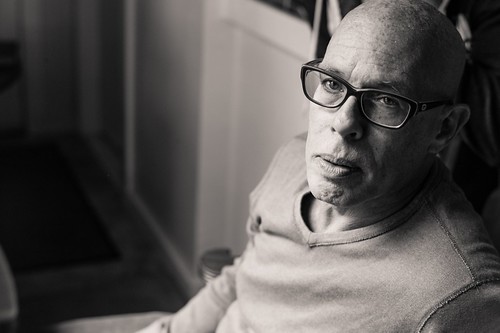


Tuesday, April 8, 2014

I Love Meeting Interesting People When I Travel

This is Doc. I met him on my recent trip to New Mexico.
 
Doc, by Reed A. George
Panasonic Lumix DMC-GX7, Lumix 14-42mm f3.5-5.6 Series II Lens at 33mm
iso 200, f5.4, 1/200 sec.
 
Doc had just gotten out of the hospital and ventured into town looking for work. He loves living in New Mexico, and it shows.
 
Doc's Hands, by Reed A. George
Panasonic Lumix DMC-GX7, Lumix 14-42mm f3.5-5.6 Series II Lens at 29mm
iso 200, f5.4, 1/320 sec.
 
As you can see, I was using my Lumix DMC-GX7 on this trip. With the Series II kit zoom mounted, I think of it as a reasonable stand-in for the Leica X-Vario. I find the lens specifications to be extremely similar. While the GX7 has the disadvantage of a smaller sensor, it has the major advantage of interchangeable lenses, making it a much more flexible system camera. I'm quite impressed with the performance of the Series II kit lens.
 
One of my goals on this trip was to bond with the GX7, which I've had for a while now, and used very little. Did I meet that goal? Well, to some extent, yes. I now better respect the imaging capability of the GX7, which is really quite tremendous. I also reminded myself just how compact and light the Micro 4/3 kits can be. I carried two bodies (GX7, GX1), several lenses: a Bower fisheye 7.5mm f3.5, Lumix 20mm f1.7, Lumix 14mm f2.5, Olympus 75mm f1.8, 14-42mm Series II kit lens, a Pentax 55mm f1.8 lens and adapter (just for fun), and a small flash, all in a single messenger bag. It was light and easy to carry.
 
That said, the form factor of the GX7 is just not ideal for me. Can I live with it? Yes, but I do inadvertently hit buttons sometimes. I find the GX1 fits my hand better. Maybe one of the SLR-shaped Lumix cameras, perhaps the DMC-G6, would suit me better. But, the performance in such a small package in the GX series cameras is truly impressive to me.
 
More results to come from the GX7 and GX1 on this trip.
 
DMC-365.blogspot.com
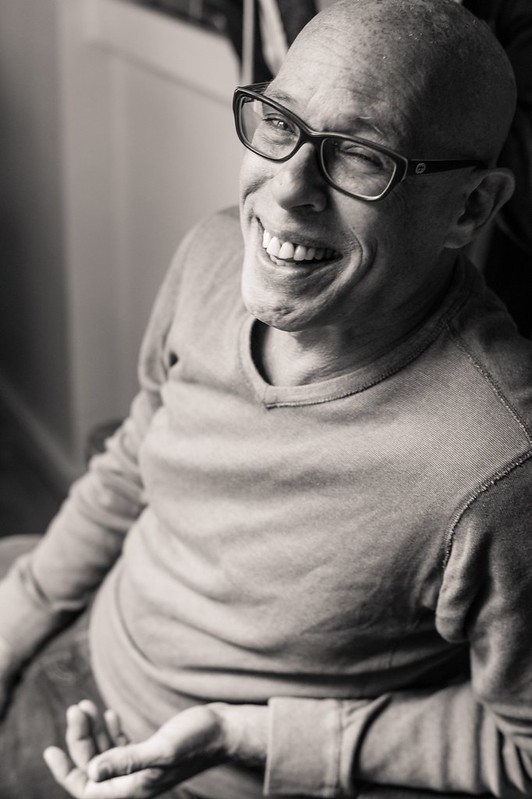
 

Thursday, January 9, 2014

Three Approaches to Using a Barnack (Leica Screwmount) Camera - Tips by Khoa Tran on Steve Huff's Site

Yes, It Works as a People Camera!, by Reed A. George
Leica IIIC, 5cm Summitar f2 Lens
 
Well, for those of you following, I may be on a path to recovering most of my files lost in the Lightroom transfer. Until I'm done with that, I'm writing without access to most of my files. The one above is in my flickr account, so I could grab it for the purposes of this post. Fingers crossed, I hope to be back on my main image collection soon.
 
I recently bought a second wartime IIIC, which is currently on its way to see Mr. Youxin Ye, Leica service wizard, in Massachussetts. If you ever need your Barnack camera or lens serviced fast, well, and inexpensively, you should give Youxin a try. You can reach Youxin by email at: wye7@yahoo.com
 
I was reading posts about the IIIC and other Barnack cameras, when I came across a guest post on Steve Huff's site, by Khoa Tran.
 
(Click Here) to read the full post on Steve Huff's site.
 
In it, Khoa suggests three approaches to using a Barnack camera:
 
  1. As a point and shoot camera
  2. As a tool to develop your photographic skills
  3. As a portrait/people camera
By "point and shoot," I think he means to use a small aperture, hyperfocal or zone focusing, and preset exposure. When you do this, you can basically have in your mind as you walk down the street:
 
"Anything X ft or further away is in focus"
I do this all the time. All you have to do at this point is look for the right moment or composition, lift the camera to your eye, frame, and shoot. I totally agree with this being a great way to use one of these cameras.
 
As far as a tool to develop your skills, I think he's talking about the fact that these cameras have no meters. So, you can teach yourself to guesstimate exposure for different lighting situations. Again, I agree. Especially if you stick to a particular film speed (400 is my standard), you'll see that you can guess exposure settings much faster than you may have thought.
 
Finally, yes, the Leicas are great people cameras. I love to shoot photos of people, those I know (as above) and those I don't. The little Barnack Leica screwmount cameras are anything but threatening to people. Great for candid people photography.
 
DMC-365.blogspot.com



Sunday, December 22, 2013

Following Up On Tips for Shooting Strangers - Wait For It!

Yesterday, I wrote about a post on Digital Photography School's site which gave 8 tips for photographing strangers.
 
One of the hardest practices for me to learn was to take my time and get the right shot, once I'd gotten over the barrier of talking to someone and getting permission to take their portrait. As I mentioned yesterday, many times I used to walk away thinking "If only I'd move a little to the right (or left)." or "I should've bracketed the exposure."
 
Well, I am learning to take my time and wait for the image I want. Here's a recent example. I was in San Francisco, walking around Chinatown with my Leica M6 and Summicron 50mm f2, when I saw this little girl and the woman I guessed to be her grandmother. I rather bravely walked up to them, and asked the older lady if I could take their picture. She smiled, which I took as a yes. As I put the camera to my eye, the little girl figured out what was happening and did this:
 
Oh, No! Not What I Wanted!, by Reed A. George
Leica M6, Summicron 50mm f2 (v.3) Lens, Kodak iso 400 Color Print Film
 
I felt it right on the spot - what a horrible shot I've just made. This is cheesing for the camera of the very worst type. The forced smile turned this sweet little girl's face into an image of stress and tension for me. But, I WAITED. As soon as she heard the shutter click, the little girl relaxed and gave me this:
 
Here's What I Saw in the First Place, by Reed A. George
Leica M6, Summicron 50mm f2 (v.3) Lens, Kodak iso 400 Color Print Film
 
This is what I saw in the little girl's face that drew me to photograph them in the first place.
 
One more note - on asking versus just shooting. Another thing that really drew me to this pair was how the older lady was looking into the face of the little girl (like in the top shot). I really wanted to catch that interaction between them, but while they were looking natural and not posing for the camera. I think you can probably see that in both pictures, on the right side, there are men watching me, rather protective of what I'm photographing. This prevented me from taking the candid that I hoped to get. So, asking directly at least got me the shot. If the situation didn't have this tension, I would have shot a candid first, and maybe then asked permission for a follow-up shot like I got.
 
DMC-365.blogspot.com


Saturday, December 21, 2013

How to Shoot a Stranger's Photograph - 8 Easy Steps by Valerie Jardin on Digital Photography School

I love to photograph people on the street, people I don't know. Weird? Okay, I can accept that.
 
Sometimes, I really want to photograph people going about their business, hopefully oblivious to me and my camera. This is where a small, discreet camera comes in. Other times, I feel a little more outgoing, and enjoy meeting and talking with the people I come across. That's a very different type of photography, and it's not for everyone.
 
Matching Glasses, by Reed A. George
Panasonic Lumix DMC-G3, Lumix 14mm f2.5 Lens
iso 160, f8, 1/160 sec.
 
Digital Photography School has posted a piece by Valerie Jardin, outlining 8 "easy" steps to taking portraits of strangers.
 
(Click Here) to read the post on Digital Photography School.
 
Here are the steps, and my thoughts on each:
 
  1. Practice without a camera. This may not work well for me. In fact, many times, the camera gives me a reason to talk with someone. I'm sure that I would not have spoken to the young ladies in the photo above if I didn't have a camera and a picture in mind. But maybe that's just me.
  2. Photograph street performers. This is great advice. If you want to interact with your subject, this is a very good way to go. Performers are doing just that - performing. They generally love to have their pictures taken, and it shows.
  3. Take a friend along when you go to shoot. This one really doesn't work for me. I do so much better interacting with strangers when I'm alone. For one thing, they're not outnumbered. I think that can be threatening (it would be to me).
  4. Don't hide behind a long lens. Great advice, again. If you use a spy lens, you get a spy image. Sometimes that can be okay. Usually not. It's tough to interact with your subject from across the street.
  5. Be confident. Great advice, if you can pull it off. If it's not natural to you, this advice is like telling a tall person "be short." Some days it comes natural to me; other days, I don't want to talk to anyone.
  6. Take your time. This is a real lesson. I don't know how many times I've overcome the hesitancy to talk to someone, finally went ahead with it, then rushed the shot. When this happens, I think how great it could've been if I'd tried just one more angle, checked the exposure more carefully, asked another question, etc. Pay attention to this one.
  7. Enjoy the experience. I couldn't agree more. If talking to strangers is about as fun as having a tooth pulled, stop doing it! If you genuinely enjoy meeting new people, well then, enjoy it.
  8. Share the results. Totally. Share your pictures with your subjects, if they want. Share them with others. Let us see your work!
DMC-365.blogspot.com


Wednesday, October 23, 2013

"Terrified" Street Photographer? My Advice Is to Pick Another Hobby

 
Crabby, by Reed A. George
Rolleiflex T Twin Lens Reflex Camera
 
I'll admit that sometimes I'm not completely comfortable doing street photography - that is, photographing people I don't know in the street, at work, or really anywhere they're living their lives. Some days, it flows like water; other days, it seems everyone's angry to see you lift your camera. That's part of the attraction for me. What fun is an activity that's always easy?
 
Anyway, I read an interesting post by photographer Mridula Dwivedi on Digital Photography School, about ways to do street photography, even if you're "terrified" of it. Here are Dwivedi's tips (which I will say from the outset I largely disagree with):
 
  • "Shoot Things" (not people)
  • "Use a Zoom Lens"
  • Frame wider
  • Photograph busy people - I don't disagree with this one
  • Position yourself at a corner - this can also work
 
In my opinion, shooting "things" is not street photography. It's a fine hobby, just not street photography. Using a zoom lens (which really means using a telephoto so you don't have to get close) is pretty close to spying. Framing your images wider can work. In fact many street photographers really like wide angle lenses, but they usually get extremely close to their subjects in order to use them. I don't think that's what Dwivedi means. The last two are good ideas, in my opinion.
 
(Click Here) to read Dwivedi's entire post.
 
I believe that if the photographer is truly terrified while shooting on the street, it shows in the images. It certainly shows if they stand on the sidelines and shoot with a long lens. I don't know of any great street photographs that were shot in this way. I also believe if you feel like a spy, look like a spy, and act like a spy, your street images will be about as intimate as a spy satellite image taken from space.
 
So, if I were truly terrified of street photography, I'd move to a different hobby. Just my $.02.
 
DMC-365.blogspot.com