Showing posts with label large format. Show all posts

Wednesday, October 5, 2016

Large Format Photography and Darkroom Printing - What an Education


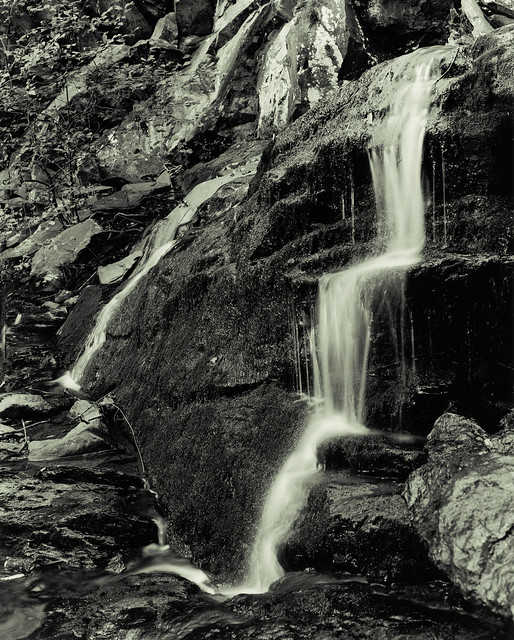
Falls, Buzzard Hill, Appalachian Trail, Virginia, by Reed A. George
Horseman 45FA 4x5 Camera, Wollensak Raptar 135mm f4.7 Lens
EDU 100 film, f/22, 4 sec. exposure
 
I've gone back to basics for this phase in my photography. As I mentioned, a dear friend has given me his father's darkroom, which helped to set me on this path.
 
I'm making a lot of mistakes, learning about limitations, and really enjoying the occasional success.
 
This is a scan of a print I made in the darkroom, with my own two hands. It represents so much more thought, effort, and investment in the process than a similar image I'm sure I could have made with a digital SLR. In fact, I could've made hundreds of similar images with the DSLR in a fraction of the time. And that's just the point; that's not how this image was made.
 
I understand that viewers won't necessarily care, but I do.
 
So much left to learn about this craft...
 
DMC-365.blogspot.com

Sunday, September 25, 2016

Checking in - after a long break

 
My latest post, about shooting black and white film, specifically 4x5, is a reasonable hint at what I've been doing in my photographic life recently.
 
Spurred on by an incredible gift of a fully functional black and white darkroom, and the further gift of a place to set it up, I've been keeping my head down and practicing my large format black and white photography skills. I've come a long way quickly, but this style of photography does not lend itself perfectly to blogging. It's film, paper, and wet chemistry all the way.
 
For now, let me share a tool that's really helping me along, the SP-445 4x5 film developing tank by Stearman Press. (Click Here) to check it out. Once loaded, this is a daylight tank, and allows you to process up to four sheets of 4x5 film in 475 ml of chemical volume. It does a wonderful job.
 
I'm also still shooting digital and smaller format film, of course. But, the joy of printing great big negatives has had me focused on 4x5, and to a lesser extent, medium format. Lots to share, but it's going to take discipline for me to sit and scan images. I'll probably end up scanning silver prints to share my final products.
 
I feel that this is an important new phase in my creative development. I can honestly say that while it's much less forgiving, I really prefer darkroom work to post-processing on my computer. It's hard work getting a good print, but I think that makes it more rewarding, personally.
 
Of course, I'm not prescribing this for anyone else. I'm not sure that I'll always feel this way about going back to the basics, working with big black and white negatives and wet chemistry, but that is not what matters. What matters to me is that I'm learning new aspects of the craft.
 
DMC-365.blogspot.com
 

Wednesday, July 6, 2016

Getting Out and About With the 4x5 Speed Graphic

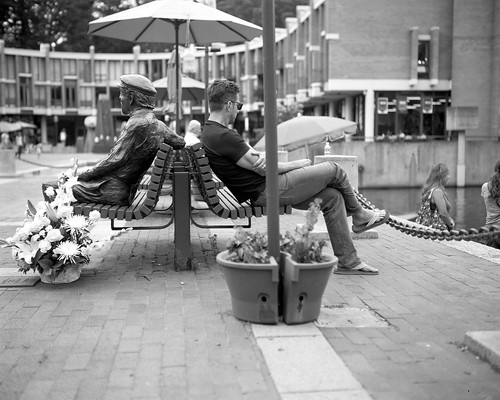
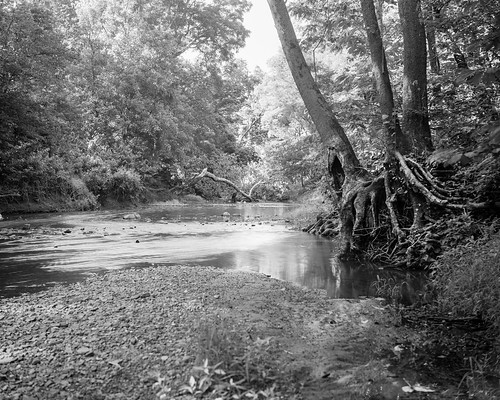
I have a beautiful early Graflex Speed Graphic 4x5 camera. Because it's not so convenient to use, I haven't spent much time with it. I decided to change that over the three day 4th of July weekend. I made a total of ten exposures (on Arista EDU film), and found that five of them are worth sharing. That's a pretty good hit rate compared to smaller formats, where I shoot a lot more images per scene.
 
Here are my five favorites from the weekend:
 
 
I usually set the camera on a tripod, using the ground glass back to frame and focus. I did that for the last three images above. For the first two, I used the rangefinder and shot handheld. Getting the focus right is a challenge, and I missed on some other shots. But, when you get it right, it's pretty nice.
 
In the picture of the house (Thornton House at Manassas National Battlefield), I used the front rise movement of the camera to allow me to keep the camera level to avoid distortion, yet still capture the roof and chimney. Pretty cool.
 
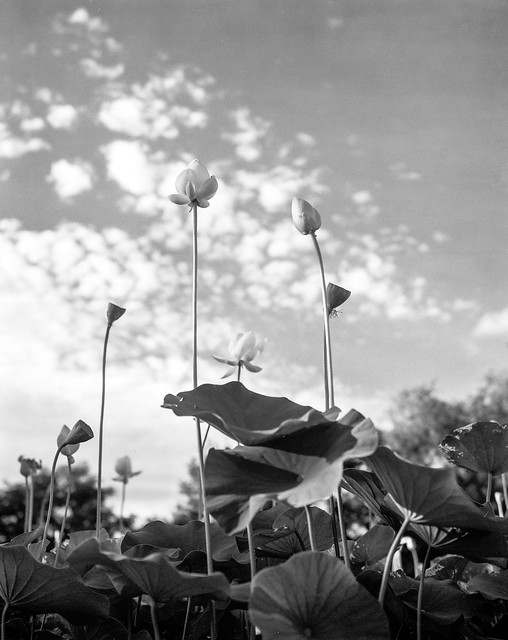
In the shot of the lotus flowers, I threw all concern for distortion to the wind, shooting with the camera nearly on the ground, pointing up at a steep angle.
 
I'm very happy that the Speed Graphic is not my only camera, or even my main one. But, it's instructive and fun to use.
 
DMC-365.blogspot.com

Wednesday, September 9, 2015

Computer Upgrade Brings Up Some Old Images

 
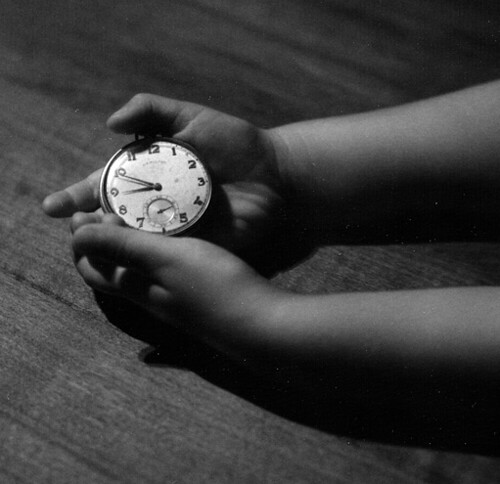
Hands of Time, by Reed A. George
Graflex Speed Graphic 4x5
 
I'm about half-way through migrating all of my images to my new computer. As expected, the process has been difficult, mainly because I'm not much of a computer tech person. But, I've now successfully moved Windows to a fast SSD drive, installed a new hard drive, installed Lightroom and moved over my existing catalog, etc. So, much progress has been made.
 
As I move images over, I'm seeing a lot from about 8-10 years ago, when I started storing them on my computer in earnest. This one is from 2006, I believe. The watch is one of the only things I have to remember my grandfather, who died when I was a child. The hands belong to my daughter, who's just started high school.
 
DMC-365.blogspot.com
 

Tuesday, July 7, 2015

Mat Marrash Is Spreading the Word - On Film, That Is

I met Mat Marrash at last year's Walking Workshop, sponsored by the Film Photography Project (FPP). FPP is a great bunch of people, and I refer anyone and everyone interested in film photography to check out their site. (Click Here) to do that.
 
Mat was one of the organizers of the workshop, and led the large format aspects, including doing a demonstration of 8x10 instant film photography(!) using Impossible Project film.
 
Anyway, Mat continues to spread the word, and has recently held a film workshop at Midwest Camera Exchange in Columbus, Ohio (my home town). (Click Here) to read a little about that experience.
 
Image Source: http://matmarrash.com/blog/2015/5/28/midwest-photo-exchange-festival-of-film
 
Keep spreading the good word, Mat! The film photography world at large appreciates what you're doing!
 
DMC-365.blogspot.com


Saturday, May 30, 2015

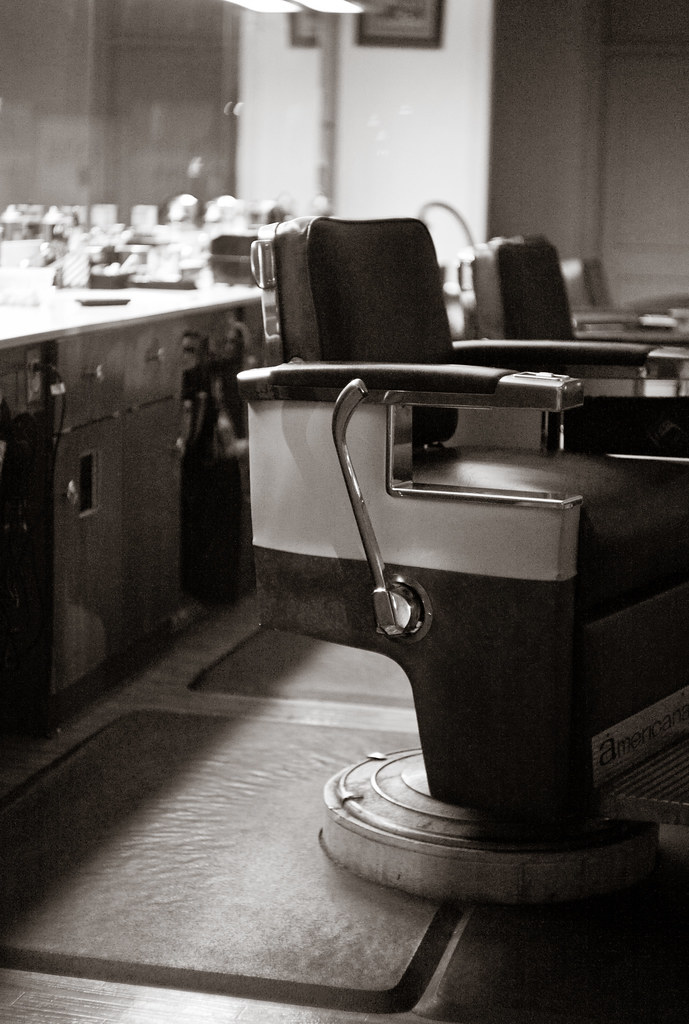
Matt Marash's Large Format Photography and Barber Shop Project

Old Style Barber Chair, by Reed A. George
Leica M8, Canon 50mm f1.4 LTM Lens
 
I met Matt Marash at the Film Photography Project's Walking Workshop 2014 in Ohio. He's associated with the project, and one of his areas of interest is large format photography. At the workshop, Matt was shooting 8x10 instant film. Very cool.
 
Matt has a lot going on photographically. His large format photography website is quite nice. Be sure to check out his barber shop project, which is just a great idea for a photography project. (Click Here) to see it.
 
(Click Here) to find out more about the Film Photography Project. If you're interested in film photography, this is the place for you.
 
DMC-365.blogspot.com
 

Tuesday, December 2, 2014

Evan Leavitt Does It Again

Evan makes incredible pictures with vintage tools and processes. Here's his latest, "Feeling the Passage," made with a paper negative in a 4x5 Speed Graphic:
 
I would be proud to have made this image. It's right up my alley. It reminds me of some of my recent pinhole images.
 
(Click Here) to see some of my pinhole and large format images.
 
(Click Here) to see Evan's original post.
 
DMC-365.blogspot.com
 

Tuesday, November 4, 2014

Lessons from the Forest - My Upcoming Exhibition

I spent some time yesterday printing and preparing for my upcoming photography exhibit, as part of the "Coffee and Critique Exposed: The Exhibit," to be hosted at Glen Echo Park, Maryland, from November 21, 2014 - January 5, 2015.
 
I've been working on a set of photographs related to my meditation practice. I've put together five prints for the show, printed on matte paper. I'm using Epson matte paper at the moment, but may experiment with some other papers before the exhibit hangs on November 13.
 
One thing I learned from the Magnum Days workshop with David Alan Harvey is to make short slideshows of my work, as part of the editing process. Here's one that I made and posted on youtube for this exhibit:
 
 
Lessons from the Forest, by Reed A. George
 
All five images were shot on 4x5 film. The first and final shots were made with a Graflex Speed Graphic, the others with a pinhole camera. I have a lot more to do on this project, but the goal of this series was to share something of the state of mind that I achieve in meditation, and particularly in walking meditation.
 
I hope you find it interesting!
 
DMC-365.blogspot.com


Sunday, June 22, 2014

Engineer Prints Arrived - Pretty Impressive!

A couple of weeks ago, I wrote about a new product from Photojojo - large, low tech monochrome prints. At 3' x 4' in size, these prints are made on lightweight (aka cheap) paper, using large printers designed for engineering drawings.
 
(Click Here) to read my previous post about Engineer prints.
 
Well, I ordered two, with very different images, to see if I like the result. Both images were shot with my 4x5 pinhole camera. Here they are:
 
Trunks, by Reed A. George
Wooden Pinhole Camera (4x5)
Arista EDU iso 400 film
 
In my opinion, this first image is almost perfect for the engineer print technology. It came out looking really great, and the quirky artifacts of the low tech printing really don't detract from the power of the image. I'm 100% pleased with how this one printed.
 
Walking Meditation, by Reed A. George
Wooden Pinhole Camera (4x5)
Arista EDU iso 100 film - 90 second exposure
 
The second image, Walking Meditation, is part of a new project I'm doing. As you can see, it's quite different from my usual work. Not a sharp element in the whole image, it's meant to be much less literal. I wanted this image to give the viewer a feeling, not an answer. The engineer print of this one is a little more difficult to judge. When I first viewed it, I was not pleased with the result, thinking I'd chosen the wrong image to print in this way.
 
Now that both of these huge prints are pinned to my wall, I'm enjoying both of them quite a lot. I'm thinking that I may make an entire exhibition of engineer prints of pinhole images. That in itself could be a fun project.
 
So, I consider this little experiment a success.
 
DMC-365.blogspot.com
 

Thursday, June 5, 2014

"Engineer" (Low-Fi Large Format) Prints from Photojojo

I have a couple of images that I want to print very large. I posted one of them yesterday, which I shot at Audubon Park in New Orleans. I have a very large square frame that I rescued from the trash can, waiting for that shot. Another is a pinhole image that I recently made, which I have not yet shared. It's a much less sharp (obviously, having come from a pinhole camera), more interpretive image that I want to print as large as possible to see if the effect scales.
 
Large prints are very expensive to make. At least photographic quality prints. This morning, I found a post about "Engineer" prints from Photojojo.
 
Image Source: http://photojojo.com/engineerprints/img/tutorial_photos/Engineer-Prints-457_Full1600new.jpg
 
These are apparently made on printers designed for architectural drawings, and on rather lightweight paper. They are 3' x 4' in size, and only in black and white. The description includes this statement about what to expect:
 

"Streaked, striated and wacky black and gray tones combine to create a super unique look that’s no ordinary photo print."

 
So, don't expect a perfect print. However, at $25, and with free shipping, it may just be worth a try with my pinhole image. That shot is made on 4x5 film, so I can make a very large scan of it to send for printing. Yes, I think I'll give it a go. I'll let you know how it turns out.
 
(Click Here) to read more about Engineer Prints from Photojojo.
 
DMC-365.blogspot.com


Wednesday, May 7, 2014

My Entry for Worldwide Pinhole Photography Day 2014

April 27, 2014 was Worldwide Pinhole Photography Day.
 
(Click Here) to read about it and view all of the images. So far, there are over 1,000 images from pinhole photographers in 53 countries posted. No cost, no contests, no awards as far as I can tell, this event has one goal - to get people excited about pinhole photography. All images on the site are 1) shot with a lensless camera, and 2) shot on April 27.
 
So, of course I had to load up my own pinhole camera, a wooden box that is constructed to fit a 4x5 film holder, and participate. You can only submit one image to the page. Here's the one I selected (out of four total I took that day).
 
Network, by Reed A. George
Pinhole Camera, Arista EDU 400 Film (4x5)
2 seconds exposure
 
My pinhole camera has an equivalent f-stop of about f256-f512. Since I bought it used, I don't know the exact size, and have never taken the time to measure it directly.
 
I was out on a hike with my wife and saw this old dead tree. I put the camera at the base of the tree, looking straight up, and in two seconds exposure, I had all the light I needed. I did add some tone to the image in Lightroom before calling it done, but made no other adjustments.
 
Sometimes it's really fun to go back to the basics. In this case, that means pre-digital, pre-auto focus, pre-manual focus, pre-electronics, pre-mechanics, pre-lens optics.
 
DMC-365.blogspot.com
 

Thursday, April 3, 2014

Japan in the 1950s - Cool Picture of Nikon Lens Manufacturing

I saw a post on Rangefinder Forum with a link to The Atlantic Monthly's site, sharing images of Japan in the 1950s. The first image below really caught my attention. It's a Nikon factory worker, assembling rangefinder lenses. Very cool.
 
The second image is a press conference in Japan. Not a Nikon (or any other) rangefinder in sight. Instead, we see movie film cameras, and a lot fo 4x5s, mostly American, if I'm not mistaken. I'm sure I see a lot of Graflex Speed Graphics in that crowd.


Image Source: http://www.theatlantic.com/infocus/2014/03/japan-in-the-1950s/100697/#img12

(Click Here) to see the images on The Atlantic Monthly.
 
Thanks to Rangefinder Forum member VTHokiEE for the post (Click Here) with this link.

DMC-365.blogspot.com

Thursday, March 6, 2014

4X5 Photographer Visits Abandoned Kodak Building in Toronto

Mike B. of the blog "A Year On Film" has posted a nice shot of the entryway and stairs at an abandoned Kodak building in Toronto, Canada.


Image Source: http://blia-yof.blogspot.com/2014/02/returning-to-kodak.html
 
He shot this image through a classic Kodak Ektar 127mm f4.7 lens ("normal" focal length for 4x5), mounted on a Calumet camera. Ironically, he used Ilford FP4+ film instead of Kodak!
 
I love reading about other people like me who enjoy the process as much as the pictures. While I'm sure this image would look great a 4' X 5' on a wall, it's tough to see the advantage of large format film for blog posting. That said, I do see the fun associated with this slow type of photography. I bet it took ten minutes to set up this shot. I think it's very nicely done. Inspires me to get the 4x5 out again soon!
 
DMC-365.blogspot.com
 

Monday, January 20, 2014

The Basics of Photography in a World of Technology

I have recently started testing approaches for a new project. This one will really take me back to the very basics of photography. My test shots so far have been with a 4x5 pinhole camera, and with my Graflex Speed Graphic 4x5. This is slow photography. Real slow. Maybe 1-2 hours per exposure in some cases.
 
I've posted some of Evan Leavitt's photography before. Evan made the image below with an 8x10 portrait camera, on a paper negative. Again, very slow photography. Evan produces some beautiful work, and this one feels along the lines of what I'm pursuing.
 
Image Source: http://evanleavittphotography.wordpress.com/2014/01/10/black-water/
 
(Click Here) to go to Evan's website; there's lots to see.
 
DMC-365.blogspot.com


Saturday, November 30, 2013

150 Years Ago - Civil War Tragedy by Evan Leavitt

Korona Home Portrait Camera 8x10 Paper Negative
"I hope we will never have to shoot at such men again..."
Image Source: http://evanleavittphotography.wordpress.com/2013/11/18/backyard-gettysburg/

I have been watching and enjoying a series of images that Evan Leavitt is making with a large (very large, 8x10) format camera and paper negatives for a while.

(Click Here) to go to Evan's website, Evan Leavitt Photography.

The image above was taken at Griswoldville, Georgia, the scene of a horrific battle between untrained rebel soldiers (old men and boys under the age of fifteen) and a far superior union force. But, I'll leave the store to Evan, he tells it in much greater detail.

(Click Here) to go directly to the Civil War story about Griswoldville on Evan's site.

This happened almost 150 years ago to the day. The place is relatively forgotten today. Evan's image gives me a feel for the forlorn location with a painful history.

DMC-365.blogspot.com


Thursday, January 24, 2013

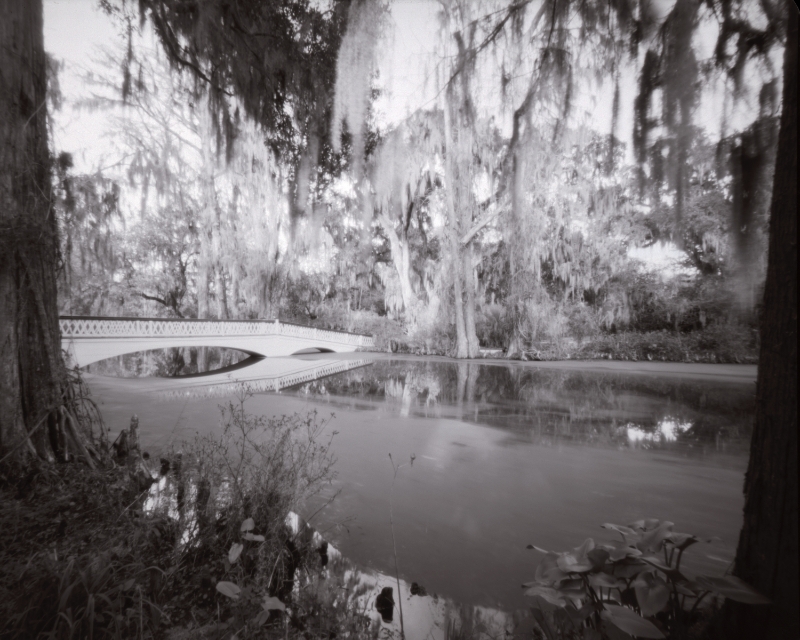
Gorgeous Shot - Magnolia Gardens Bridge by Jon Oman - 8x10 Pinhole Camera

 
Magnolia Gardens Bridge by Jon Oman
8x10 Film, Pinhole Camera
 
I've been thinking about low tech imaging techniques more lately, and even playing around with some plastic fantastic cameras, like the new Lomography Sprocket Rocket that I received as a Christmas present. I also have a nice wooden 4x5 pinhole camera that needs to be used.
 
I found this wonderful shot by Jon Oman, which he posted on Rangefinder Forum.
 
(Click Here) to see Jon's post.
 
I'd love to see a contact print of that giant negative in person. At an exposure time of 5 1/2 minutes, I'm sure the water has a dreamy blurred look to it.
 
(Click Here) to check out Jon's main website.
 
Here's one that I did shoot not too long ago, with a 35mm pinhole camera, which my daughter and I constructed from a cardboard kit. Not nearly the quality of the enormous 8x10 shot above, I still think it's pretty cool.
Reindeer, by Reed A. George
Cardboard 35mm Pinhole Camera
 
DMC-365.blogspot.com


Wednesday, August 15, 2012

Ryan Lussier Reports On Three Months of Shooting Film On Steve Huff's Site

 
Ryan Lussier's Film Work, Contax G2
Kodak Porta 400, Zeiss 50 f/2
Image Source: http://www.stevehuffphoto.com/2012/08/02/three-months-of-shooting-film-and-here-is-what-i-learned-by-ryan-lussier/
 
Ryan Lussier has posted a nice article about using film over the past few month on Steve Huff Photo.
 
(Click Here) to read Ryan's post on stevehuffphoto.com
 
First off, this is no story to restart a controversy over film versus digital. Ryan admits that he likes digital as well. Raised on digital, Ryan is also no old man going back to his youth.
 
Ryan gives some details of how he processes and scans his films, basically the same as I do. Get the negatives developed at the drug store, then take on the scanning at home. He uses a Plustek scanner; I use an Epson V750. One thing I learned from Ryan is a product by Ilford called Antistaticum. It is a cloth for removing dust from negatives. I'll be ordering one today.
 
I also saw another interesting post this morning on GetDpi, from a person who put away their digital camera, grabbed an old 8x10 (really large format!) camera, and some Polaroid film. The results are very cool.
 
(Click Here) to see what old analog technology can do.
 
DMC-365.blogspot.com
 
Do me a favor - buy your Antistaticum, film, or whatever else through my blog's links to Amazon: