Showing posts with label meter. Show all posts

Saturday, February 28, 2015

Some Love for the Leica CL

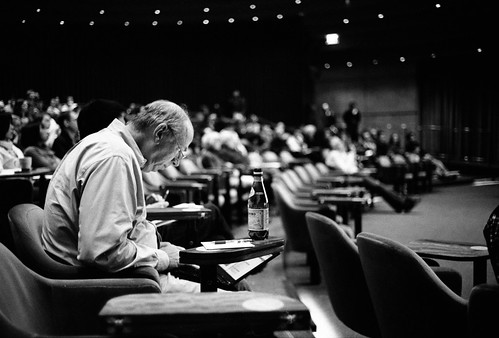
Symposium, by Reed A. George
Leica CL, Minolta Rokkor 40mm f2 Lens
Ilford HP5+ Film
 
I own several Leicas, including a digital rangefinder M9. I own two CLs, the little Leica that came from a fling, if not a marriage, between Minolta and Leica in the 1970s. The CL is not the top of Leica's offerings. It has some drawbacks, primarily the short rangefinder base length, which makes ultra-precise focusing difficult or some would say impossible. Yet, it has some real great features as well. Smaller than other Leica M models, with a built-in meter, the CL is a powerful little tool. And, the lenses designed for use with the CL - the Leica/Rokkor 40mm f2 and Leica Elmar C 90mm f4 are both just wonderful. The 40mm is one of the very best lenses I have ever used. Both lenses are compact like the CL body, and are great for travel. I've never gotten to try the Rokkor 28mm f2.8 that came with the CLE. The CL doesn't have 28mm framelines, so the 40 and 90 are the most often-used lenses.
 
The CL gets little love from the photographic crowd. That's okay. I love mine.
 
(Click Here) to take a look at a 1973 catalog for the CL on The Online Darkroom. Be sure to look at the comments as well. Again, no love for a great little camera.
 
DMC-365.blogspot.com
 

Thursday, January 2, 2014

Introducing My Leica Monochrom ANALOG!

One of the very few cameras that I currently lust over is the Leica Monochrom. It's one of those cameras that only those close to Leica will understand at all. I mean, really. A $7,000 camera that only shoots black and white? But, what a job it does with it. I was convinced of that by David Farkas, one of the LHSA (International Leica Society) Directors at the annual meeting in San Francisco. It really is somewhat of a super-camera, with astounding dynamic range and spatial resolution.
 
I decided to select one of my Leica M film cameras to treat as a Monochrom for a while, to evaluate whether I'm really going to enjoy monochrome-only photography with any camera. I do absolutely love shooting black and white, with either film or digital.
 
I did a similar thing a couple of years ago when considering the purchase of a Leica M9. I committed to shooting my M8 a lot, to help me decide whether or not the M9 was a good investment; it was. I remain happy with that decision.
 
I think referring to this camera as my Monochrom Analog is apt for two reasons: 1) it is the closest thing I have to a camera analogous to the Monochrom, really only because I've decided to commit to shooting only black and white with it for a while, and 2) because analog can be interpreted to mean "non-digital." Both are fitting.
 
My Leica Monochrom Analog, by Reed A. George
 
I shot this picture with my iPad camera, since my computer is currently down for file transfer / recovery operations. So, it doesn't make me unhappy to shoot a film camera for a while. It's my silent protest against the digital world (not digital photography in particular, just my own dependence on digital files for basically everything I do).
 
My Monochrom Analog is made up of my M4-2 film body (my first Leica ever), which is definitely in user condition (meaning it has some cosmetic bumps, scratches, and peeling Vulcanite, but is completely 100% functional), a Voigtlander VCII exposure meter (mounted in the hot shoe), a Leica yellow filter (for when I want to increase sky contrast) and a recently-acquired Leica grip. Quite a nice little package, I must say.
 
I loaded up a roll of Kodak Tmax 400 film in it today, and got outside in the unseasonably nice weather here in Virginia. We'll see how I did in a week or so when I have the film processing done!
 
DMC-365.blogspot.com


Tuesday, August 27, 2013

Skeletons From The Closet Results - August's Agfa Record III Folding 6x9 Camera

This month's camera is a real treat.
 
(Click Here) to read about the Agfa Record III with 105mm f4.5 Solinar lens.
 
So far, this CLA'd beauty has allowed me to resist purchase of a Fujifilm GF670. The only drawback in comparison is that the Agfa does not have the coupled rangefinder of the Fuji, or the integral exposure meter. The Agfa does have a fine uncoupled meter, and an accessory shoe to mount my Voigtlander Meter II, which works perfectly. I am VERY pleased with the image results from the Agfa. On the plus side, the Agfa does not rely on a battery; the Fuji can't even take a picture without one.
 
So, here are some black and white results from the Agfa Record III. The first was a pure coincidence. While I was driving to the National Cathedral in DC, I saw this old building being torn down. After being run off by the construction guy saying "No Parking!," I finally found a spot long enough to get out and get the shot. Handheld, no less.
Tearing It Down, by Reed A. George
Agfa Record III, Kodak Tmax 400 Film
 
The remaining shots were all made at the National Cathedral.
 
Cathedral Gardens, by Reed A. George
Agfa Record III, Kodak Tmax 400 Film
 
Inside the Cathedral, by Reed A. George
Agfa Record III, Kodak Tmax 400 Film
 
The shot above took about 1 second exposure, and was on a tripod.
 
And now for my favorite shot from the roll:
 
Concentric Arches, by Reed A. George

Agfa Record III, Kodak Tmax 400 Film

I just love the symmetry, range of tones, and sharpness of this image. This is one capable camera and lens.
 
All of these shots were processed by my favorite film processor, The Darkroom (thedarkroom.com).
 
DMC-365.blogspot.com