Showing posts with label Monochrom. Show all posts

Tuesday, October 20, 2015

What Do You See?

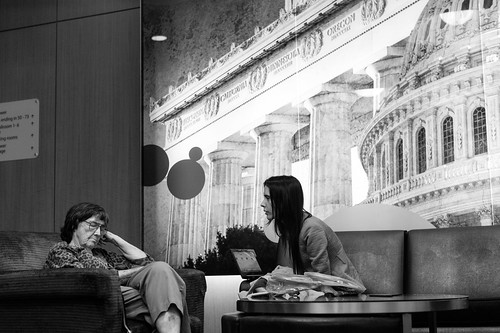
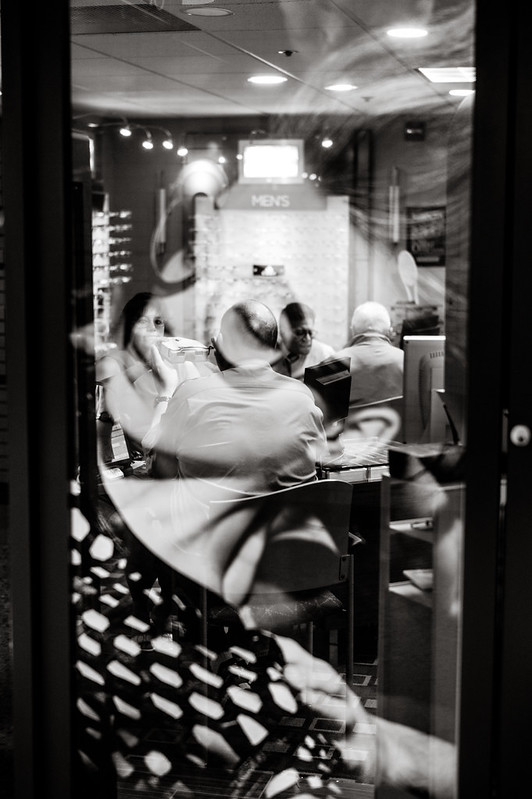
Here's my favorite shot from last weekend's LHSA meeting in Washington, DC.
 
I call it E(ye)nigma.
 
E(ye)nigma, by Reed A. George
Leica Monochrom, 50mm f1.4 Summilux ASPH. lens
iso 1250, f2.4, 1/125 sec.
 
What do you see in this image? I hope you'll see two very different images if you look at it from a distance (or with you eyes squinted a little), and then look close up at some of the details.
 
It's a complicated, busy composition. I know that. That is part of why it works for me.
 
DMC-365.blogspot.com

Sunday, October 18, 2015

I Got to Borrow a Leica Monochrom Camera - and I Liked It!

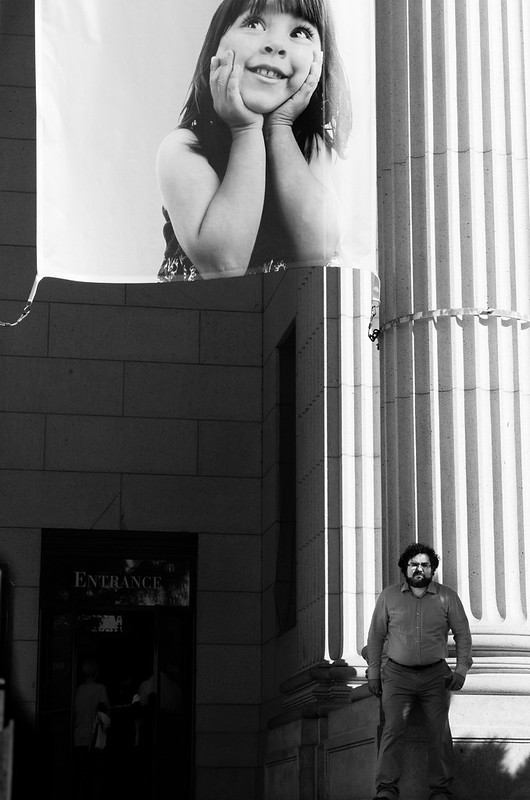
As part of the LHSA (International Leica Society)'s annual meeting in Wahington, DC, Leica camera offered the "Leica On Loan" program to us members. I got to borrow a first version Monochrom camera and 50mm f1.4 Summilux lens. Here are two shots I made with that combo.
 
I am very impressed with the results. Now that the new, improved Monochrom is out, I am really interested in that, too. Purely in an academic sense, that is; I don't have $7,500 laying around...
 
Leica On Loan is a wonderful benefit of being an LHSA member. I thoroughly enjoyed seeing all of my LHSA friends in DC.
 
DMC-365.blogspot.com


Saturday, December 6, 2014

Dreaming in Monochrom(e) - Japanese Lunch and Grocery Shopping With My Wife

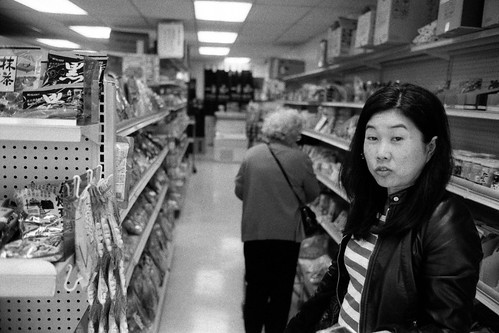
I enjoy having Japanese food with my wife. Recently, we went to the (very) small area in Bethesda, Maryland for lunch and to visit the Japanese grocer. I shot these two images with my Leica M4-2, 35mm f1.4 Summilux, and Ilford Delta 3200 film.
 
 
DMC-365.blogspot.com


Thursday, July 31, 2014

Dreaming in Monochrom - Jake and the Burtones in Lovettsville, VA

I haven't added to my "Dreaming in Monochrom" series in a while. In this series, I am using my Leica M4-2 with black and white film (only). In the beginning, the series was a way for me to explore whether or not I really wanted a Leica Monochrom rangefinder camera. While I love shooting black and white, I do find limiting myself to monochrome images is, well, a limitation. I think the exercise saved me a lot of money.
 
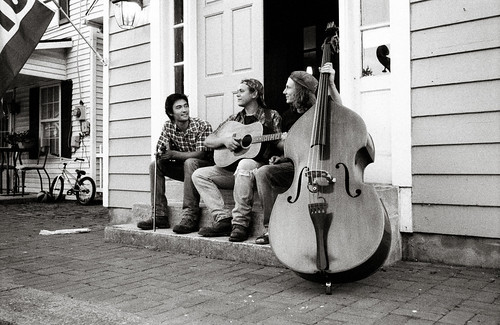
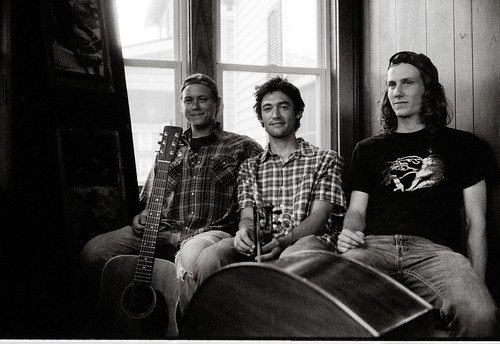
Anyway, that said, I do have a blast shooting black and white film still. Here are a couple of shots of one of my favorite Old Time music bands in the area, Jake and the Burtones. They were playing at the Mad Horse Brewery in Lovettsville, Virginia, and I was able to convince them to pose for a few shots.
 
Jake and the Burtones, by Reed A. George
Leica M4-2, Leica Summilux 35mm f1.4 v.3 Lens
Ilford Delta 3200 Film
 
 
I'm finding that I enjoy shooting images of the bands I know off-stage as much as on-stage at this point. In fact, I'm a little saturated with on-stage shots. That's good, as I'm getting more requests to shoot promo shots as time goes by. An additional skill to add to my favorite photo project.
 
DMC-365.blogspot.com
 

Monday, May 5, 2014

And Now Some Monochrom(e) Results From the Same Challenging Light

Yesterday, I shared my overall negative results with CineStill film. For comparison purposes, I want to show some results from a roll of Ilford Delta 3200 that I shot at the same house concert.
 
All of these were shot with my Leica M4-2 (Dreaming in Monochrom(e) camera). That's the only difference from the CineStill shots, which came from my M6. Same exposure levels, same light, same lenses.


Now, as you can see here, the lighting really was a challenge. Some of these shots show the deep shadows under subjects' eyes, for example. What isn't present is any of the general underexposure, the liquid tracks in the film emulsion, the high levels of dust, or the unexplained spots of light in the frame.
 
On another note, this was one of the first house concerts I've attended. It seems to be fairly common here in the DC area, which is very cool. I've got to perfect my technique for these photographically-challenging yet very fun events.
 
I'm thinking just a light touch of fill flash would have gone a long way in my monochrome pictures. I don't know how the mixed tungsten and flash would work with color film, but I suppose I could add a filter to the flash to match it to tungsten lighting. Hmm. Once I have an acceptable color film, I'll have more ideas to play with. If I can find such a film. If not, I'll perfect it digitally.
 
DMC-365.blogspot.com


Sunday, April 13, 2014

Dreaming in Monochrom(e) - Buddha in Snowstorm

Here are a couple of shots I made with Ilford Delta 3200 film in my Leica M4-2, at a Buddhist temple during a snowstorm. Both were made with the Zeiss C Sonnar 50mm f1.5 lens, one of my favorite lenses.
 
Wat Yarn in Snow, by Reed A. George
 
I selected 1/125-1/250 sec. for my shutter speed, in an effort to catch the falling snowflakes.
 
Parasol, by Reed A. George
 
I like how the statue's eye shows up in this image.
 
I wouldn't normally use high speed film for images like this, but it was what I had with me. I think it worked out pretty well.
 
DMC-365.blogspot.com


Thursday, March 20, 2014

Dreaming in Monochrom(e) - Single Shot I Like

Here's a shot I made of my kid, using the Leica M4-2, Kodak TMax 400 film, and the awesome Zeiss 50mm f1.5 C-Sonnar:
 
I have learned some things from my "Dreaming in Monochrom(e)" project. I started the project to investigate how much I'd enjoy having a modern digital monochrome rangefinder camera, the Leica Monochrom.
 
One thing I learned is that I can do a lot with black and white only. That said, I'm not sure I want my camera to limit me to monochrome only.
 
Using the M4-2 for live music shots has actually changed the way I shot concerts, whether with film or digital. Shooting in low light with TMax 400 pushed two stops and with Ilford Delta 3200, I re-learned at least one style I like for my music photography - high contrast and with grain. So, I am processing some of my digital concert images to emulate that look. An unexpected lesson.
 
As with most of my projects, the answers I find are not absolute. But, they do add to my overall knowledge and enjoyment of photography.
 
DMC-365.blogspot.com


Friday, March 7, 2014

About to Try Ilford Delta 3200 For My Concert Photography

As you may know, I've been shooting some concerts with black and white film in my Leica M4-2 film camera, as part of a series I'm calling "Dreaming in Monochrom(e)." The idea is that I'm exploring using one of my Leicas in monochrome only, exploring how I'd really work with a digital Leica Monochrom if I had one.
 
Anyway, I've been shooting concerts with Kodak TMax 400 black and white film, pushed two stops to iso 1600.
River Whyless, by Reed A. George
Leica M4-2, 50mm Zeiss C-Sonnar f1.5 Lens
Kodak TMax 400 Film Pushed to iso 1600
 
While I'm really liking this new look to my concert photography, I'm finding the extreme contrast that I get by pushing 400 speed film two stops a little bit limiting. So, I've decided to try some Ilford Delta 3200 black and white film. My experience with Delta 3200 in the past was that the negatives can be a little thin; I've had better luck shooting it at iso 1600 than the labeled 3200. Apparently, the native iso is more like 1000, but it's got extremely wide exposure tolerance.
 
So, I think I'll shoot it at 1600 this time.
 
Here's an example concert shot on Delta 3200by Kontantinos Bezios:
 
Image Source: http://kbesios.com/blog/wp-content/uploads/2012/09/20120904-105104.jpg
 
Konstantinos shot this on a medium format Plaubel 67 camera. I think the gray tones are very nice, and I hope to get a similar effect in my Leica.
 
(Click Here) to visit Konstantino's blog and see more of his work.
 
My only question now is whether or not I need to inform The Darkroom (my favorite mail-in film developer) that I shot Delta 3200 at 1600 or not. I tend to think not, as I read a lot of posts about shooting it at 1600 and developing normally.
 
By the way, if you want truly excellent film developing, (Click Here) to visit thedarkroom.com.
 
With any luck, I'll have some interesting new concert photos to share in a week or so!
 
DMC-365.blogspot.com
 

Friday, February 28, 2014

Dreaming in Monochrom(e). I'm Starting to Like This Look for Live Music

I've been using my Leica M4-2 film camera with Tmax 400 film, pushing it to iso 1600 (+2 stops) for shooting live music lately. I'm really starting to like the high constrast black and white look I'm getting.
 
Here are some shots I took recently at the Bright Box, a wonderful venue in Winchester, Virginia.
 
(Click Here) to learn more about Bright Box.
 
This show happened to be opened by one of my favorites, you may recognize Melissa Wright, now in a band called Mink.
 
Mink, by Reed A. George
 
The headliner band this particular evening was River Whyless, who I can add to my list of must-see-again bands.
 
River Whyless, by Reed A. George
 
The third shot is my favorite from the evening. I love how each band member comes across quite individually, yet makes up a part of the whole. I'm pleased with it.
 
I shot three lenses with my M4-2 on this evening: Leica 35mm f1.4 pre-aspheric Summilux, Zeiss 50mm f1.5 Sonnar-C, and Leica 90mm f2.8 Elmarit. I'm really beginning to like the combination of this very light, easily maneuverable kit and the look of pushed black and white film. Of course, it wouldn't work for everything, but in already harshly-lit stage settings, I think it does just fine.
 
Continuing on the path of learning how I may like the new digital Monochrom rangefinder, I do wonder how it would be to shoot at iso 1600 or even higher and get the wonderful low contrast, high dynamic images that camera is capable of. Maybe I'll have to borrow a Monochrom and see!
 
DMC-365.blogspot.com


Tuesday, February 25, 2014

Ashwin Rao on a Year With the Real (Digital) Leica Monochrom

Image Source: http://us.leica-camera.com/photography/m_system/m_monochrom/
 
As you know, I'm playing around a lot with black and white these days, specifically in my Leica M4-2, which I'm using to emulate the modern Leica digital Monochrom rangefinder.
 
Ashwin Rao, frequent contributor to Steve Huff's excellent photography blog, has written up his thoughts after shooting a lot with the new Monochrom. He made over 15,000 exposures with it last year.
 
(Click Here) to read Ashwin's full report on Steve Huff Photo. He includes many, many excellent images.
 
Ashwin writes how constraining himself to monochrome imaging, thinking only in black and white, was at first a major challenge. He says he realized what he had given up by using a camera incapable of rendering color. But then, this challenged turned to "inspiration and motivation."
 
Ashwin prefers to use older rangefinder lenses with his Monochrom. Sound familiar? I happen to love old Leica and rangefinder lenses, so this only bring the Monochrom closer to my heart. Ashwin feels that modern lenses tend to give a surreal look, and that modern aspherical lenses suffer from loss of shadow detail. He feels that maybe the coating of older lenses, which were developed in a monochrome era, are better optimized for black and white. Clearly, color was not the main consideration fifty years ago. Or maybe, he admits, he is drawn to images made with older lenses because he learned to love the look of images he knew from the past.
 
Ashwin reports that the Monochrom is pretty much infallible at up to iso 3200, and 5000 in good light.
 
He also reports that there is so much dynamic range that images can have an overall gray look. This invites lots of post-processing, and leaves plenty of opportunity to fine tune the images to get exactly what he wants.
 
So, after a year, the Monochrom is still his favorite camera. Ashwin commits to continuing to explore this special camera, and share more results as he goes. Onward, Ashwin, and thanks!
 
DMC-365.blogspot.com
 

Tuesday, February 4, 2014

Dreaming in Monochrom(e) - Leica M4-2

More results from my experimentation with shooting my (film) Leica M4-2 exclusively with black and white film.
 
The first few are from the Smithsonian Udvar-Hazy Air and Space Museum, a place that I always find challenging to photograph:


And here are a couple of shots I grabbed at our last Vienna (Virginia) coffee house meeting of local Leica enthusiasts.
 
 
I enjoy establishments that provide large tables that are shared with other parties. It just feels a lot more social to me.
 
All of these were shot with the M4-2 and Kodak TMax 400 film, processed by The Darkroom.
 
(Click Here) to visit The Darkroom. Great processing at great prices.
 
I am thoroughly enjoying this project. In terms of testing whether I really want a digital Leica Monochrom, it's been convincing, but probably not in the way you think. It's convinced me just how satisfied I can be with a great old film camera and black and white film.
 
My digital M9 is going to be coming home from Leica Service USA (where it's getting a checkup and thorough cleaning after quite a lot of use in 2013) in the next couple of weeks. I'm looking forward to having it back, but have been doing just fine with my old M4-2 in the meantime.
 
DMC-365.blogspot.com


Friday, January 31, 2014

Dreaming in Monochrom(e) - High ISO Analog!

I've been playing around, using my Leica M4-2 film camera as a test to see if I really want a Leica Monochrom digital rangefinder. (Click Here) to read more about it.
 
I said at the outset that I understand that shooting black and white film in a Leica M4-2 has its limits in terms of emulating the amazing new Leica Monochrom digital black and white rangefinder. For example, the Monochrom is noted for its great performance at high iso settings.
 
Well, I decided to "push" (quite literally) the high iso limits of the M4-2 by push processing Kodak TMax 400 film to iso 1600. It was quite simple. I just shot at exposure settings for iso 1600 instead of 400, then instructed my favorite processor (The Darkroom, www.thedarkroom.com) to push the film two stops. This cost an extra $2 in processing costs. Pretty reasonable.
 
Here are some results from a concert I attended. I'll start with one of my favorite local performers, Melissa Wright and her band Mink:
 
 
Mink, by Reed A. George
Leica M4-2, Kodak TMax 400 pushed to 1600
 
And a few more, these of the band Dry Mill Road:


Dry Mill Road, by Reed A. George

Leica M4-2, Kodak TMax 400 pushed to 1600

 
All of these shots were made with my Zeiss Sonnar 50mm f1.5 and Leica Elmarit 90mm f2.8 lenses.
 
As you can see, the contrast is pretty high in these shots. They don't have the amazing dynamic range of the modern digital monochrome. But, the film grain is quite nicely controlled in my opinion. In fact, I think these look better than equivalent shots with my digital rangefinder Leica M9 would at iso 1600. I may have to do that comparison to further convince myself. Already this little project is teaching me something about how much I can do with film and the M4-2. I haven't pushed a roll of film in years, and I feel that it frees me up to take the M4-2 along for shooting musical events that I would have only really considered the Nikon D700 for in the past. I'm pleased with that.
 
I also want to continue to extend this, seeing how TMax 400 holds up at 3200 and maybe even 6400. I'm sure it will start to degrade significantly at 6400. But, I think I may be able to pull of 3200 with no real problem.
 
From what I understand, Kodak TMax 3200 is no longer being produced, but Ilford Delta 3200 is. I used the Ilford film in the past, but found the grain to be very high at 3200. I liked that film much better at 1600. Considering that the Ilford 3200 is more than twice the price of TMax 400, I'm not sure I have much motivation to give it another try, especially when I can get this type of performance from the TMax.
 
DMC-365.blogspot.com


Sunday, January 26, 2014

Leica M4-2 (My Monochrom(e)) at the Lincoln Memorial

On the same rainy day that I shot the images of the Vietnam and Korean War memorials, I took a couple of images at the Lincoln Memorial. I like the rainy, somewhat dreary mood that I captured on that day. Both of these were shot with my Leica M4-2, Kodak TMax 400 film, and Leica Summicron 35mm f2 (version 3) lens.


DMC-365.blogspot.com


Saturday, January 25, 2014

More "Dreaming in Monochrom(e)" - Warrenton, Virginia

Today's post includes more images taken with my Leica M4-2 film camera, in my exploration of how much I would use and enjoy a camera dedicated to black and white imaging like the extraordinary Leica Monochrom. I shot these images around Warrenton, Virginia, on a recent weekend walk.
 
For the shot above, I used a yellow filter, which helped to bring out some contrast in the sky and clouds.
 
 
I spent some time in the Warrenton Cemetery, which has a substantial number of Civil War graves, including that of the famous rebel vigilante, John Mosby.


So far, I'm enjoying this little project. I have not felt too constrained with black and white film only in this camera. So far, I've only shot Kodak TMax 400, which is incredibly versatile. I may expand to other films in the near future, but I've been able to do a lot with just this one film.
 
DMC-365.blogspot.com


Friday, January 24, 2014

My First Results of "Dreaming in Monochrom(e)" - War Memorials in the Rain

I've decided to try and emulate a Leica Monochrom in analog form, using my Leica M4-2 and TMax films.
 
(Click Here) to see what I am planning. I understand the differences and limitations in this comparison.
 
Here is my first installment of images for the project. I don't normally go in for photographing the monuments in DC, but on this particular morning, I thought being out in the driving rain and seeing the few visitors hearty enough to be out in it was worthwhile. It turned out to be a good set of conditions for photographing the Korean and Vietnam War memorials, and led me to think carefully about war.
 
One theme that kept coming up in my mind is the notion that "Freedom isn't free." I must admit that I don't fully understand that notion. It's like saying "Happiness doesn't make you happy" to me. Let me be crystal clear: I come from a family with significant veteran experience and respect that service very highly. On the other hand, I basically despise war and all that it entails. How's that for conflicted? Anyway, here are my impressions from that rainy morning walk amongst the names on the wall, and the terribly expressive faces on the statues of Korean War soldiers.
Vietnam Memorial
 
Korean War Memorial
 
All images were made with the Leica M4-2, 35mm Summicron f2 v.3, and TMax 400 film. Processed in typical excellent fashion by The Darkroom (thedarkroom.com).
 
DMC-365.blogspot.com