Showing posts with label voigtlander. Show all posts

Sunday, June 21, 2015

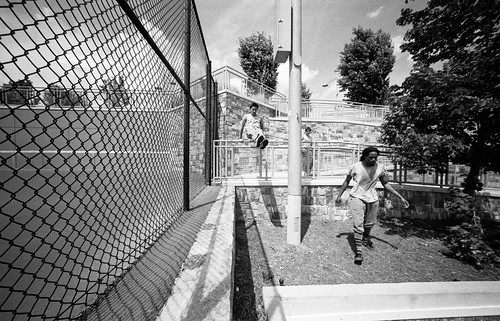
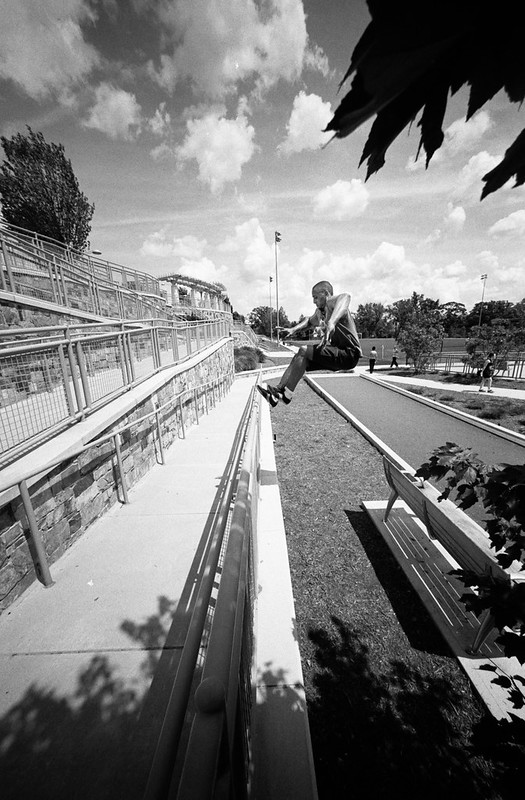
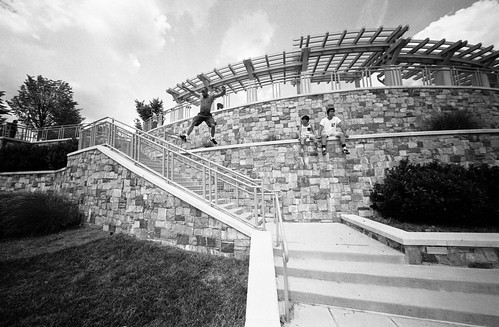
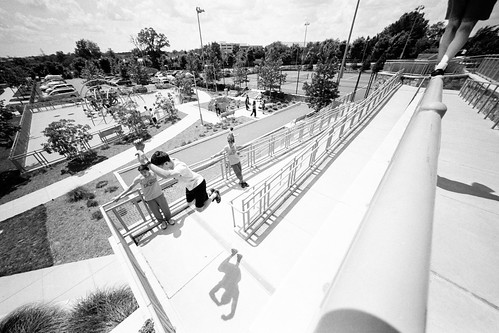
Some Ultrawide (12mm) Film Shots of Parkour

I recently shared a slideshow of parkour images, made with the Nikon Df. (Click Here) to see that post.
 
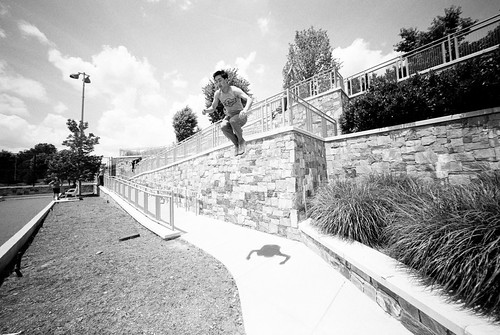
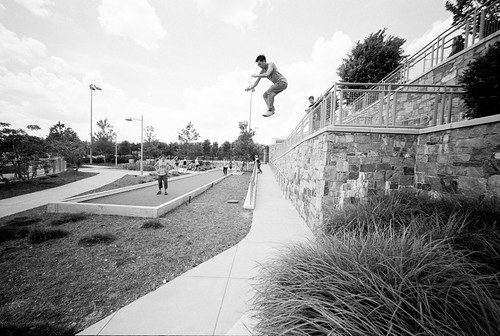
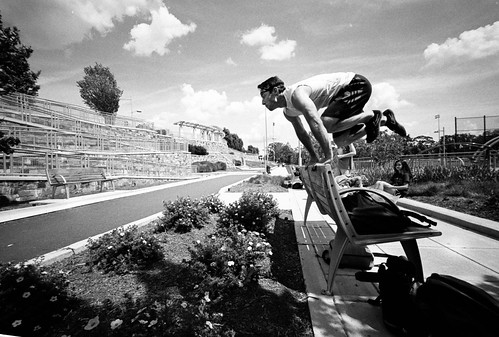
Today, I'll post some images I made at the same event, but these were all shot on the Zeiss SW film camera, with the Voigtlander 12mm f5.6 (LTM) ultra wide angle lens. These were all shot on Ilford HP5+ black and white film. I processed them myself.
 
I loved shooting parkour with this oddball lens. I have also done some fisheye shooting with parkour. (Click Here) to see that. In both cases, the wide angle of view is great for including a lot of the context for the sport. But, it also means that I have to get very close. So close, in fact, that there's a risk of interfering with the practitioner's concentration. That did happen once; thankfully, he thought it was funny. The last thing I want to do is interfere.
 
I think what I'm learning about shooting parkour is that variety is key. These wide angle shots tell a lot about the setting, but have relatively little detail of what the person is putting into the effort.
 
Approaching this with the standard photojournalistic search for a combination of wide, normal, and close up detail shots seems to be in order. I'm about to get a great opportunity to pull together a group of parkour practitioners, specifically to photograph them. My plan will be to get that variety, and to experiment with some ideas with flash, showing motion, etc. I've got some thinking to do.
 
DMC-365.blogspot.com

Friday, June 12, 2015

So What Are You Reading? Agfa APX 400 Film Test

 
The Wide View, by Reed A. George
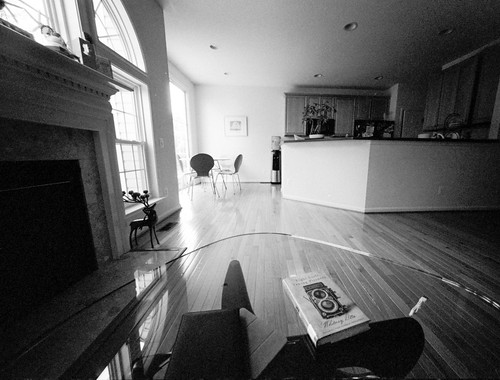
Zeiss SW, Voigtlander 12mm f5.6 Lens
Agfa APX 400 Film
 
I'm testing and getting my shooting parameters down for a new (discontinued) film, Agfa APX 400. My friend Dennis Gallus gave me (!) a 100' roll, which I've started to bulk load. My first roll came out underexposed and possibly underdeveloped (7 mins in D-76, 1:1). After seeing that, I read up about the film online, and found that many people used to shoot it at 200 instead of the indicated 400 speed. I will try that, and believe it will really help.
 
This shot was made with my widest lens, the Voigtlander 12mm f5.6. You can see my current book of choice in the foreground, Eight Girls Taking Pictures, by Whitney Ott. It is a fictional work, telling the story of eight female photographer/artists. I'm enjoying it very much.
 
Thanks again for the film, Dennis! I'll have it all worked out in another roll or two.
 
DMC-365.blogspot.com
 

Thursday, January 2, 2014

Introducing My Leica Monochrom ANALOG!

One of the very few cameras that I currently lust over is the Leica Monochrom. It's one of those cameras that only those close to Leica will understand at all. I mean, really. A $7,000 camera that only shoots black and white? But, what a job it does with it. I was convinced of that by David Farkas, one of the LHSA (International Leica Society) Directors at the annual meeting in San Francisco. It really is somewhat of a super-camera, with astounding dynamic range and spatial resolution.
 
I decided to select one of my Leica M film cameras to treat as a Monochrom for a while, to evaluate whether I'm really going to enjoy monochrome-only photography with any camera. I do absolutely love shooting black and white, with either film or digital.
 
I did a similar thing a couple of years ago when considering the purchase of a Leica M9. I committed to shooting my M8 a lot, to help me decide whether or not the M9 was a good investment; it was. I remain happy with that decision.
 
I think referring to this camera as my Monochrom Analog is apt for two reasons: 1) it is the closest thing I have to a camera analogous to the Monochrom, really only because I've decided to commit to shooting only black and white with it for a while, and 2) because analog can be interpreted to mean "non-digital." Both are fitting.
 
My Leica Monochrom Analog, by Reed A. George
 
I shot this picture with my iPad camera, since my computer is currently down for file transfer / recovery operations. So, it doesn't make me unhappy to shoot a film camera for a while. It's my silent protest against the digital world (not digital photography in particular, just my own dependence on digital files for basically everything I do).
 
My Monochrom Analog is made up of my M4-2 film body (my first Leica ever), which is definitely in user condition (meaning it has some cosmetic bumps, scratches, and peeling Vulcanite, but is completely 100% functional), a Voigtlander VCII exposure meter (mounted in the hot shoe), a Leica yellow filter (for when I want to increase sky contrast) and a recently-acquired Leica grip. Quite a nice little package, I must say.
 
I loaded up a roll of Kodak Tmax 400 film in it today, and got outside in the unseasonably nice weather here in Virginia. We'll see how I did in a week or so when I have the film processing done!
 
DMC-365.blogspot.com


Sunday, August 4, 2013

Nick DeMarco Interprets the Preparation for the Fight With His Leica Cameras

One of the blogs I regularly follow is Nick DeMarco's Rangefinder Chronicles. Today I'll share one of his recent posts, which I think really shows how a photographer can interpret an event, any event, into something new, sharing how he or she sees it.
Image Source: http://rangefinderchronicles.blogspot.com/2013/07/fight-night-with-leica-m-1-before-fight.html
 
Nick shot his Leica M (240) and M7 with fast Cosina Voigtlander lenses at a Thai kickboxing event. This post is specifically about the preparation of the fighters, before battle.
 
(Click Here) to see Nick's entire post with several pictures.
 
I am always interested in how good photographers go beyond simple documentation to put their own thoughts and feelings into their pictures. I particularly like what Nick says about this next image:
 
"...even though it was dark, low contrast and the back of a few heads. The coaches were taking one of the boxers down the fire exit steps for his fight, but somehow it makes me think of taking a prisoner to be hung, or Jesus to his crucifixion."
Image Source: http://rangefinderchronicles.blogspot.com/2013/07/fight-night-with-leica-m-1-before-fight.html
 
I look forward to seeing more images from Nick as he covers the later action.
 
DMC-365.blogspot.com


Thursday, July 25, 2013

Rangefinder Chronicles Blog - Results from Voigtlander Nokton 50mm f1.5 on Leica M3 (Film!)

 
Nick DeMarco's Leica M3 and Nokton
Image Source: http://rangefinderchronicles.blogspot.com/2013/07/the-new-50mm-nokton-f15-vm-on-film.html
 
Rangefinder Chronicles is one of the many blogs I read regularly. Nick's forays into rangefinder (Leica and other) photography are usually quite interesting.
 
In a recent post, he shares a lot of gorgeous film images, shot on his Leica M3 and Voigtlander R3M, both with a new Voigtlander 50mm f1.5 Nokton. I'm impressed with the images.
 
The new f1.5 Nokton is styled after classic Noktons of the past. (Click Here) to read about this lens on cameraquest.com.
 
(Click Here) to see them all.
 
He shot with iso 100 film, in order to allow him to open the lens up all the way, exhibiting its strengths. As he says, why buy a super fast lens if you don't want to shoot wide open? Here's an example I particularly like, partially because it shows the lens performance at wide aperture, and partially because I like the subject (I do mean the cameras; not that the lady is unappealing):
 
Image Source: http://rangefinderchronicles.blogspot.com/2013/07/the-new-50mm-nokton-f15-vm-on-film.html
 
Nick tells us that he has a lot of 50mm lenses, including a Summicron f2 and Zeiss Sonnar f1.5. It's not clear to me what the Nokton does that the Sonnar does not. While both lenses are manufactured by Cosina, I imagine the optical designs to be different. It would be very interesting to see a comparison of the two lenses.
 
In any case, the Nokton does look like a winner. I love seeing it shot on vintage film bodies like the M3. Nice job, Nick!
 
DMC-365.blogspot.com


Wednesday, July 3, 2013

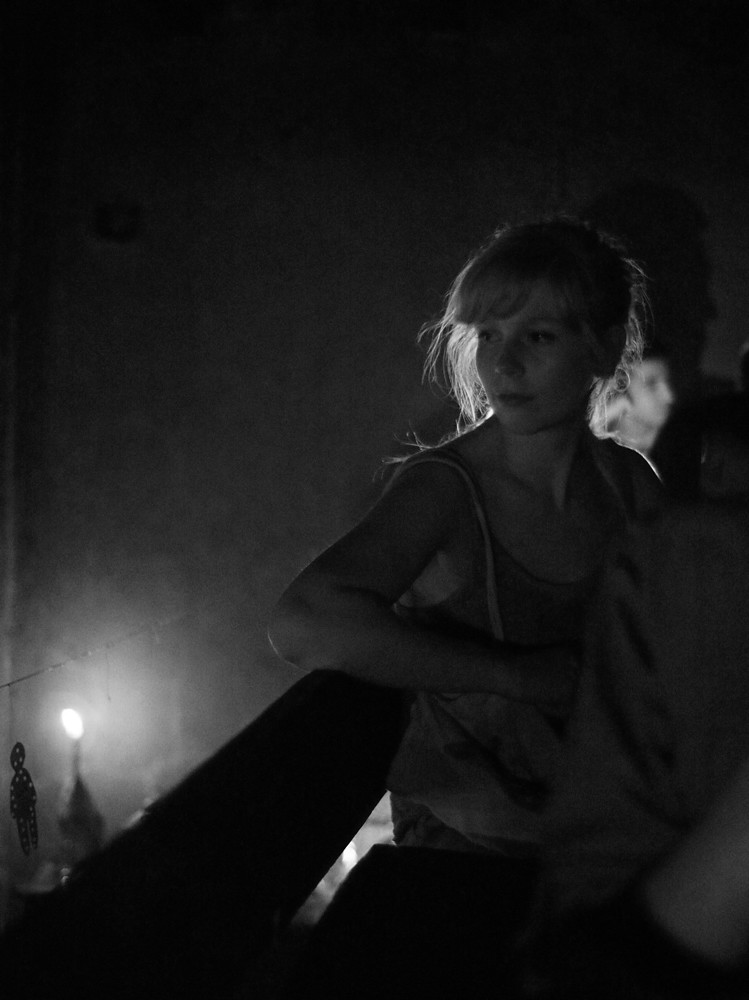
Olympus OM-D and Voigtlander Nokton 25mm f0.95 by Candlelight

 
Image Source: http://www.mu-43.com/f57/sofia-candlelight-48627/
 
Last weekend on a trip to Florida, I shot Micro 4/3 again for the first time after a long break. I've let my Leica interests, as well as my Skeletons From The Closet project, consume my photographic opportunities. In Florida, I shot my Panasonic Lumix DMC-GX1, essentially for the first time. I'll have a few shots to share, soon. Anyway, I think I will make that camera a priority at some level, too. Too many cameras, too little time.
 
Shooting the GX1 got me thinking about what others are doing with Micro 4/3 these days. I came across this post from nickthetasmaniac on mu-43:
 
(Click Here) to see other shots by nickthetasmaniac on mu-43.com
 
He made these images with the Olympus OM-D and Voigtlander 25mm f0.95 lens. I've never tried a lens faster than f1.2. It seems to me that Micro 4/3 is the right place to do that, as you don't rely on the accuracy of a rangefinder with that extremely shallow depth of field that f0.95 would provide.
 
Hope you find the images as interesting as I did.
 
DMC-365.blogspot.com


Thursday, April 18, 2013

Cherry Blossoms From A Different Perspective - Leica M9 and Voigtlander 12mm f5.6 Ultra Wide Heliar

I live in the Northern Virginia, about an hour from Washington, DC. DC's cherry blossoms are really quite impressive, but as in other places, they don't last long. They are currently at their peak, but I just haven't been able to find the energy to get downtown on a weekday evening to shoot them. Maybe this weekend.
 
The good news is that I have some nice cherry trees in my neighborhood. Small, but nice.
 
On the way home from work today, I decided to try to capture them from a different perspective - up high, with an ultra wide angle lens. So, I mounted up my Voigtlander LTM 12mm f5.6 Ultra Wide Heliar lens on my Leica M9, and connected both to a monopod. Then I grabbed a step ladder and headed out. These three shots are the result of putting the camera right into the cherry blossoms with the monopod, and using the self-timer to trigger the shutter.
 
Sakura Up High #1, by Reed A. George
Leica M9, Voigtlander Ultra Wide Heliar 12mm f5.6 Lens
iso 640, f9.5, 1/60 sec.
 
Sakura Up High #2, by Reed A. George
Leica M9, Voigtlander Ultra Wide Heliar 12mm f5.6 Lens
iso 1250, f6.7, 1/180 sec.
 
Sakura Up High #3, by Reed A. George
Leica M9, Voigtlander Ultra Wide Heliar 12mm f5.6 Lens
iso 640, f4.8, 1/90 sec.
 
The Ultra Wide Heliar is a very specialized lens. Advertised as the widest rectilinear (non-fisheye) lens for full-frame 35mm cameras, it's not a lens that gets every day use. It's so wide that you nearly have to touch the subject with the lens for it to take up any significant portion of the image area. It is also pretty slow, with a maximum aperture of f5.6. But, it has basically infinite depth of field, so the fact that focusing is not accomplished through coupling to the Leica rangefinder is really not an issue. Just set the focus and forget it.
 
It also has pretty significant color shifting (magenta and blue at the extreme image edges) and some vignetting (darkening in the image corners). For both reasons, and because I like the composition this way, I decided to crop the images as squares. I set the lens code on the M9 for the Wide Angle Tri-Elmar (16-18-21mm) at 16mm, which is the widest angle lens setting in the camera.
 
I found a website that describes software ("Cornerfix") that elminates the color shifting. They also suggest selecting the 21mm f2.8 lens code in the M9 when using the Ultra Wide Heliar. I'll have to try that.
 
(Click Here) to read about Cornerfix. I have not tried it.
 
You can also see that I applied some negative vignetting to get the white corners. Again, just because I like it that way.
 
A nice diversion for shooting an hour or so after work in the evening. I hope you enjoy the view.
 
DMC-365.blogspot.com
 
My Ultra Wide Heliar is the older Leica Thread Mount (LTM) version. Here's a link to the newer Leica M-mount version. Either is adaptable to Micro 4/3, yielding a nice but not crazy-wide 24mm equivalent field of view.


Friday, January 18, 2013

The Creative Process, or How I Got the Shot

First off, I want to let you know that I'm very proud of the first picture below. I understand that it's not going to win the Pulitzer, but it's exactly the type of image that I strive for, and is pretty elusive. For me, it brings together a lot about my project in the local music scene and why I enjoy it. It was taken during a recording session for the local band "Jake and the Burtones," at Shepherd's Ford studio in Berryville, Virginia.
Jack Pugh of Jake and the Burtones, by Reed A. George
Leica M9, Carl Zeiss C Sonnar 50mm f1.5 Lens
 
Now, I want to analyze what went into the process for me, and how I ended up getting this shot. There were many preparations that allowed this to happen, including a lot of getting to know people and being around at music events, which eventually allowed me to get an invitation to the recording session. Let's leave that important part aside for now, and focus on the photographic approach that I took.
 
The first thing that struck me when I walked into Shepherd's Ford was how the musicians were walled off from each other, in separate little cubes. The second thing, which probably should have been first, was the light. It was a beautiful, promising challenge. Dynamic range was surely going to be part of it. At the north side of the room were big, un-cluttered windows, with dramatic sunlight pouring in at the low angle of winter. Diffused by snow on the ground, it made an enormous, gorgeous warm softbox to light the scene. The first five feet of the room were bathed in this awesome light. Ten feet in, the shadows took over - long, dramatic, every scene full of contrast. But, shooting while facing those windows required overexposing the outdoor light, in order to get any detail on the darker side, like in peoples' faces. This exposure adjustment was a technique learned from the books - sometimes you must compromise exposure in peripheral areas to get it right on your main subject. One approach is to spot meter your main subject, and make exposure decisions from there. The Leica M9 that I was shooting doesn't have a spot meter, so I just metered a characteristically-lit portion of the floor, took a few test shots, and adjusted from there.
 
In trying to capture the true feel of the whole scene, I started with an ultra wide angle lens, the Voigtlander 12mm f5.6 Heliar, and shot to include the cube walls separating the musicians. This is a lens that I don't use often, as it's just amazingly wide, I find composition to be very challenging. The ultra-wide approach was only moderately successful. However, I found that the lens allowed me to include a lot of details from the studio, including the Dolly Parton pin-up on the back wall. I also really liked how the lines of the rafters reached out from the distance to this lens. So, I used the ultra-wide lens and exposure compensation technique to capture the whole band, including lots of information about the studio setting. This was critical for me. I get to shoot these musicians under excellent stage lighting all the time. Just portraits, without environment, could be shot anywhere, at any show. I wanted images that could only be shot here, in the studio, which is a unique and priveleged situation.
Studio Walls, by Reed A. George

Leica M9, Voigtlander 12mm f5.6 LTM Lens

Jake and the Burtones in the Studio, by Reed A. George
Leica M9, Voigtlander 12mm f5.6 LTM Lens
 
Once I had these shots, I could then begin to work on individuals. I would say that I need more work on this type of shooting. The subject photo of this piece (the first picture above) was my one "aha" interaction. Once again using the huge softbox effect of the external windows, I'm sure that it was the light that attracted me to shoot from this particular angle, in front of the bass player, Jack Pugh. I chose the Carl Zeiss 50mm f1.5 C Sonnar lens, both because I needed the wide aperture for the low light shots, and because it has just the right balance of character and sharpness to produce the look I wanted.
 
This was when the magic happened. At first, Jack played it cool, like I wasn't bothering him standing there shooting away while he played. Then I saw him start to sniff and move his face in a funny way. Smirking from behind the camera,I guessed that his nose was itching. Making a series of expressions I chose not to capture out of courtesy, he started to smile. We both cracked up. I thought maybe it was over, time to move on, but decided to hang in and keep shooting. Then I saw the shot develop. We had just been through a tiny shared moment together. His urge to sneeze now abated and he really relaxed, with me still there. It was not the moment of connection when we laughed together that turned out to be the best shot, but the moment after, when it felt like normal again, even with my lens pointed at him. Magic.
 
While I typically shoot my Nikon D700 at live music shows, mainly due to its supreme handling of low light situations, I can honestly say I don't think I could've pulled this shot off with a DSLR. The Leica is just a less threatening thing to have pointed at you.
 
Once the pressure was really off, I shoot a couple of really risky images, using a new toy plastic camera I got for Christmas, the Sprocket Rocket (!) camera by Lomography. This beast shoots 35mm film panoramas, with the image going out and over the sprocket holes in the film.
Break Time, by Reed A. George
Lomography Sprocket Rocket Camera, Lomography iso800 Color Print Film
 
If you're interested in the Sprocket Rocket, click on my Amazon link at the bottom of this post to learn more, and maybe even buy one.
 
Finally, to round out my coverage of the day, I walked with the band down to the banks of the Shenandoah River and got a quick group shot.
 
 
Jake and the Burtones (and Brian), by Reed A. George

Leica M9, Carl Zeiss C Sonnar 50mm f1.5 Lens

I had a great time at this shoot. The Leica M9 was a great choice for shooting in the studio. I also enjoyed playing around with the Sprocket Rocket.
 
Oh yeah. If you want to hear Jake and the Burtones (Click Here)! I can tell you from first hand experience - their new album is going to be great!
 
DMC-365.blogspot.com


Wednesday, January 16, 2013

I Find Ultra Wide Angle Lenses Difficult to Shoot With


Image Source: http://www.productreview.com.au/p/voigtlander-ultra-wide-heliar-12mm-f-5-6.html
 
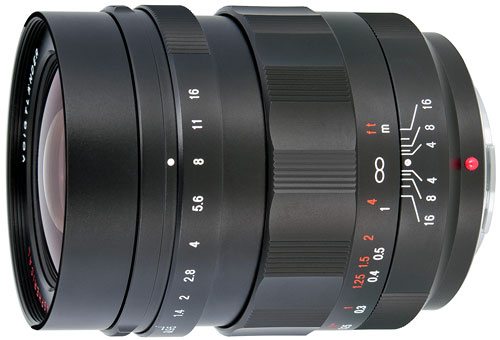
I have one of these lenses - an ultra wide 12mm f5.6 in Leica Thread Mount (LTM). This lens has an unbelievably wide field of view, especially for a non-fisheye.
 
I have written many times about how wide angle shooting in general challenges me. This lens takes it to another level. The challenge is in composition, mainly. Focus is easy. In fact, the depth of field is so large on this lens (due to the short focal length and small aperture) that you don't need to focus. Everything from 2 feet to infinity is in focus, even at the widest aperture of f5.6.
 
I recently used the 12mm on my Leica M9 while shooting a recording session for my friends in the band "Jake and the Burtones."
 
(Click Here) to see all of the pics from the recording session.
 
Why did I choose this lens? Well, I will admit that I rarely shoot this lens at all. However, I had a hunch that there would be some tight quarters in the studio. The wide angle perspective allowed me to shoot much of what was in the room at very close quarters. In the shot below, I'm literally about two feet from the tables in the foreground, and maybe six feet from the band members. Looks a little further away, doesn't it?
 
Ultra wide angle lenses are great for shooting interiors. However, the relatively slow f5.6 aperture means high iso and relatively slow shutter speeds. In the case below, I shot at f5.6 handheld. It was a stretch.
Recording Session, by Reed A. George
Leica M9, Cosina Voigtlander 12mm f5.6 LTM Lens
 
As I said, composition is a real challenge with this lens. In the shot above, the white paper on the right was not my subject. But, it was close enough to become a major portion of the image. The rafters above are pretty distorted by the optics, but I think they look interesting. So, they're an important part of the composition for me. I love seeing Sam, the mandolin player, up in the extreme top left corner. Isn't that cool? And how about Dolly Parton on the back wall? Some features remain big even with ultra wide angle...
 
As you can see, in order to get any light on the band members, I had to completely overexpose the light coming through the windows behind them. Again, I think this adds to the composition, rather than taking away. I love how the shadows are cast across the floor - thank you winter sunlight.
 
I have considered selling this lens many times, as I don't use it much at all. I think the maximum aperture of f5.6 limits how and where it can be used. And, it's just plain difficult to use well. The hood that came with it vignettes terribly if you don't have it perfectly aligned. If I wasn't lazy, it already would have been sold.
 
This past weekend was the most I've ever used this lens. Now that I'm shooting more musical performances, and especially backstage, I think I'll keep it and use it more. It's not something you want to use all the time, but it does add a unique perspective to shots at close quarters. And it works pretty well on the M9.
 
Because the camera rangefinder is not meant for such wide imaging, you have to use an accessory finder to frame with this lens. Again, however, it's almost true that anything you see in front of the camera will be in the image.
 
There's also a newer version of this lens, with the Leica M mount (see the Amazon link below). Mine requires an LTM to M adapter, but that works just fine.
 
DMC-365.blogspot.com


Saturday, December 29, 2012

Cosina Voigtlander Factory Video

Video Source: http://m.youtube.com/#/watch?v=Voo3pCvYODI&desktop_uri=%2Fwatch%3Fv%3DVoo3pCvYODI
by Terry Sham Studio
 
Before I became interested in working in biomedical research, I was a manufacturing geek. I also lived and worked in a factory in Japan for a year, as part of a US Department of Commerce fellowship. So, naturally, I was interested in seeing a video about the factory that makes Cosina Voigtlander lenses.
 
This video on YouTube, by Terry Sham Studio, shows much of the lens manufacturing process, as well as some assembly of camera lenses. The audio is in Japanese. My Japanese is rusty (and was not that strong to begin with), but I can get a few of the points. They talk about how actual manufacturing of lenses in Japan (as opposed to China or Malaysia) is pretty rare at this point. They also talk about making OEM lenses for other companies. You can see from this video that Cosina's expertise is in mechanical and optical manufacturing, as opposed to electronics, which helps one to understand why they offer manual focus lenses. You can also see that they produce pretty large numbers of lenses in this factory, with batch processing of components. As always in modern Japanese factories, inspection and testing are an important part of the process.
 
I found this to be an interesting video. I hope you enjoy it as well.
 
DMC-365.blogspot.com
 
 
DMC-365.blogspot.com
 

Saturday, August 4, 2012

Luminous Landscape Article on Emotion in Photography - by William Neill

 
Goodbye Sunset, by Reed A. George
Leica M8, Voigtlander 28mm f1.9
iso 320, f stop not recorded, 1/250 sec
 
I just read this great piece on Luminous Landscape about how emotion can, does, and should affect every artist's work. Bill Neill describes how he fell into a 5' deep water hole with all of his camera gear at Zion National Park. The next day, he took a beautiful shot of water's effect on the desert floor, with the gear he was able to salvage.
 
(Click Here) to read his article on Luminous Landscape.
 
In my own experience, when emotion does affect me, it results in my most meaningful photographs. Of course, since I associate the emotion with the image, it is probably most meaningful to me. I have no real way of saying if that emotion translates to others.
 
In the shot above, I was driving around rural Maryland on my own, looking for something to photograph. I knew that my Grandma was quite ill, and it wouldn't last long. That said, we'd had a few false alarms already, so it was hard to tell just how serious it was. I heard later that night that she had passed on. This was Grandma's final sunset, even though she didn't get to see it. I literally caught it out of the corner of my eye, quickly pulled over, and shot it. It is not an ideal shot - a nice barn in the foreground would have helped. However, it was a vanishing instant, and was gone before I could relocate or recompose. For me, the shot has incredible meaning. I don't expect others to feel it. Actually, I'm quite happy experiencing that on my own.
 
This is why photography means something to me. I have no other way to communicate, or even remember the true feel of emotion at times like that.
 
DMC-365.blogspot.com


Saturday, July 7, 2012

ePhotoZine Posts Sample Shots From Olympus 75mm f1.8 on OM-D

 
ePhotoZine's Oly 75mm f1.8 sample
Olympus 75mm f1.8 on Olympus OM-D, iso 320, f1.8, 1/160 sec
Image Source: http://www.ephotozine.com/article/olympus-75mm-m-zuiko-digital-f-1-8-lens-sample-photos-19553?utm_source=feedburner&utm_medium=feed&utm_campaign=Feed%3A+Ephotozine+%28ePHOTOzine%29
 
 
I am thinking very hard about reasons for and against buying the new Olympus 75mm f1.8 lens for Micro 4/3 cameras (like my Panasonic Lumix DMC-G3). Having shot with my Voigtlander 75mm f2.5 lens in Leica Thread Mount on the G3 recently, I'm pretty convinced the focal length is what I need for music photography.
 
(Click Here) to see my concert pics with the G3 and Voigtlander 75mm f2.5 Color-Heliar.
 
Because the new Olympus lens is so fast (in light gathering, f1.8), I wondered if the depth of field at that f-stop would be so shallow as to not be useful for portraits and people pictures. Depth of field is reasonable on my Voigtlander lens at f2.5, but what about f1.8? Well, ePhotoZine's picture above answers that question. It seems to have just the right amount of depth of field at f1.8.
 
It doesn't look good for me talking myself out of the new Olympus lens. :)
 
DMC-365.blogspot.com


Monday, May 14, 2012

New Voigtlander 17.5mm f0.95 Micro 4/3 Lens

Cameraquest, United States distributor for Cosina (aka Voigtlander) is now taking deposits for a new native Micro 4/3 mount 17mm f0.95 (super fast!) lens.
(Click Here) to see it on Cameraquest's website.
 
Voigtlander 17.5mm f0.95 Micro 4/3 Lens
Image Source:
http://www.thephoblographer.com/2012/02/06/voigtlander-announces-new-17-5mm-f0-95-lens-for-micro-four-thirds-35mm-equivalent/
 
At $1,249, you may want to make the $100 deposit, then get a loan for the remaining balance. Just kidding. This is a lens for people who love fast lenses (meaning it gathers a lot of light, and can basically take pictures in the dark). Those never come cheap. It is a manual focus lens.
 
At 17.5mm focal length, this lens will have an equivalent field of view that a 35mm focal length lens would on full-frame 35mm cameras. So, it makes me think of a Leica Summilux 35mm (which is an f1.4). The new Voigtlander lens gathers more than 2 times as much light, making it the fastest commercial 35mm equivalent lens I've ever seen.
 
(Click Here) to read a brief user review of the lens, used on a Lumix DMC-GH2, by Daisuki Photo. Note that the author used a 3X neutral density filter to bring the light levels down low enough to open the lens aperture up, very useful for this type of testing.
 
Also be sure to catch the author's note on how he likes the new Fuji XPro-1 versus his GH2. Interesting.
 
I have been thinking about trying a Voigtlander lens for Micro 4/3. They also have the Nokton 25mm f0.95 manual focus lens. But, I'm so happy with my Pana-Leica Summilux 25mm f1.4, which is has autofocus, that I just don't really need to look further. I use the Lumix 20mm f1.7 for a rough equivalent to 35mm, and am also pleased with it. So, I can't really see laying out this kind of money for a manual focus lens. They're both really specialty lenses in my opinion. If you really need that amazing light gathering capability, go for it. I don't think I do. I considered whether either would help my concert photography, which is normally pretty challenging light. But, manual focus would be a bigger disadvantage than the extra speed would be an advantage. In my opinion, of course.
 
DMC-365.blogspot.com