Showing posts with label Rokkor 40mm f2. Show all posts

Saturday, February 28, 2015

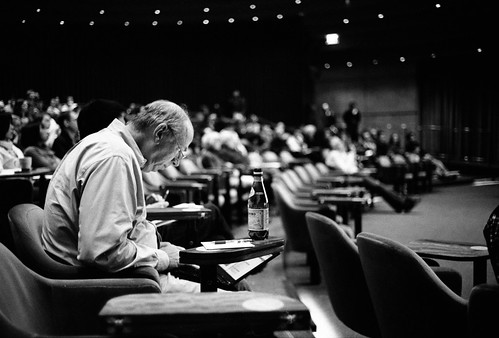
Some Love for the Leica CL

Symposium, by Reed A. George
Leica CL, Minolta Rokkor 40mm f2 Lens
Ilford HP5+ Film
 
I own several Leicas, including a digital rangefinder M9. I own two CLs, the little Leica that came from a fling, if not a marriage, between Minolta and Leica in the 1970s. The CL is not the top of Leica's offerings. It has some drawbacks, primarily the short rangefinder base length, which makes ultra-precise focusing difficult or some would say impossible. Yet, it has some real great features as well. Smaller than other Leica M models, with a built-in meter, the CL is a powerful little tool. And, the lenses designed for use with the CL - the Leica/Rokkor 40mm f2 and Leica Elmar C 90mm f4 are both just wonderful. The 40mm is one of the very best lenses I have ever used. Both lenses are compact like the CL body, and are great for travel. I've never gotten to try the Rokkor 28mm f2.8 that came with the CLE. The CL doesn't have 28mm framelines, so the 40 and 90 are the most often-used lenses.
 
The CL gets little love from the photographic crowd. That's okay. I love mine.
 
(Click Here) to take a look at a 1973 catalog for the CL on The Online Darkroom. Be sure to look at the comments as well. Again, no love for a great little camera.
 
DMC-365.blogspot.com
 

Wednesday, February 25, 2015

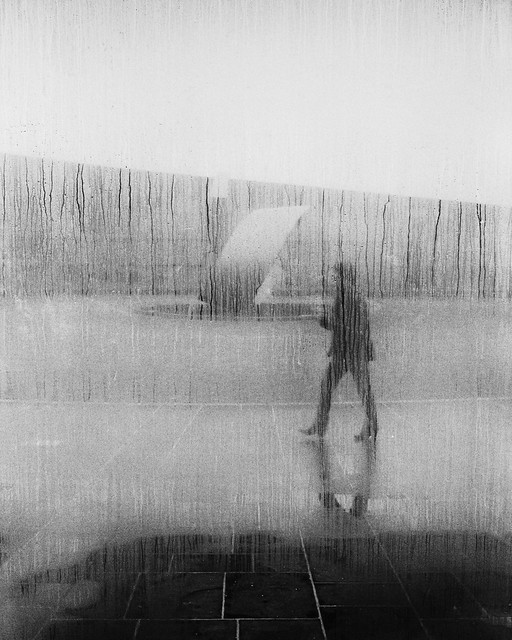
Obscured

I made this shot recently at work. I was shooting my Leica CL and Rokkor 40mm f2 lens, one of my all-time favorite combinations.
Obscured, by Reed A. George
Leica CL, Minolta Rokkor 40mm f2 Lens
Ilford HP5+ Film, Developed in Kodak D-76
 
I've recently gotten back into bulk loading 35mm film, with a couple of my friends. It's weird, but at current prices, Kodak's products cost the same per exposure in bulk (100' rolls) as they do packaged into single rolls. So, there's no advantage to bulk loading Kodak at the moment. Ilford's products are still priced so as to make bulk loading economical. At $54 per 100' roll of Ilford HP5+ (Adorama), I'm paying $3 per roll of 36 exposures. You get 18 rolls of 36 exposures from a bulk roll.
 
I'm also back to processing my own black and white film. I figure that with the relatively little time I have available for shooting, bulk loading will force me to focus on shooting black and white for a while, which is a good thing. So, I'll take the much cheaper route of processing my own film, since it will be mostly black and white anyway. To be honest, I really enjoy the hands-on processing of my film, anyway. It's good to smell the fixer once in a while.
 
The fact that my friend Dennis gave me 20 rolls of Gekko 100 black and white film, and a 100' roll of Agfa black and white 400 speed film only adds to my rationale.
 
So, get ready for a lot of black and white film shots from me! Hope you enjoy.
 
DMC-365.blogspot.com
 

Sunday, February 15, 2015

Lest You Think Gekko 100 Can't Make Sharp Images

Recently, I've posted a few images made on the expired Gekko 100 black and white film that my friend Dennis Gallus sent to me. Some of them are less than tack sharp (see yesterday), but that's due to me, not the film. Here's an example of what the film can produce:
 
Tones and Sharpness, by Reed A. George
Leica CL, Rokkor 40mm f2 Lens, Gekko 100 Film
Developed in D-76 for 7 Minutes
 
Just to show what it can do.
 
DMC-365.blogspot.com


Saturday, February 14, 2015

The Crossing

The Crossing, by Reed A. George
Leica CL, Rokkor 40mm f2 Lens, Gekko 100 Film
 
One of the things I like about film is the stochastic - the thing that can't necessary be repeated. Of course, that random nature goes against one side of photographic purpose, which is to document accurately. On the other end, it makes for some very interesting happy accidents, like in this case. I think this image has an apocalyptic feel. And I like it.
 
DMC-365.blogspot.com

Thursday, February 12, 2015

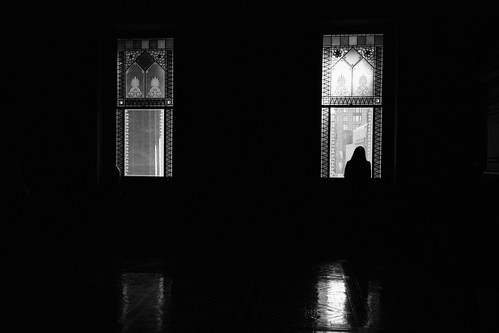
Mystery

Mystery, by Reed A. George
 
Another image made with the Leica CL and Gekko 100 film. When exposing it, I knew that no film could represent the full range of light levels in the scene. So, I had to make a decision - would I expose for the interior, letting the outside light go to pure white (which may have been interesting), or expose for the highlights, letting the inside go black?
 
Obviously, I chose the latter. I love seeing the structure in the window glass and especially the buildings outside. I also like the mystery of the darkness inside.
 
DMC-365.blogspot.com
 

Wednesday, February 11, 2015

In Cars - On Composition

I believe that once you've learned the mechanics of photography - exposure, depth of field, focusing, etc., you can begin to look at the less concrete aspects of making good photographs. However, I think there are some concepts that bridge the gap between purely technical and artistic: lighting and composition, for example.
 
I shot a couple of rolls of Gekko 100 black and white film (donated to me by my good friend Dennis Gallus) last weekend. While doing the embassy row walk in DC, I shot two pictures from the Dumbarton Bridge. Here they are, side by side.
 
Two Compositions, by Reed A. George
Leica CL, Rokkor 40mm f2 Lens, Gekko 100 Film
 
Can you see the difference that the location of the cars in the scene makes? To my eye, the line of cars in the image on the left leads the viewer into and up the entrance ramp on the left. In the image on the right, the line of cars leads the eye in a curve to the right, and back to the bridge in the distance. Other than the placement of the cars, these images are nearly identical.
 
I feel that I have mastered the purely technical aspects of photography. Composition and lighting continue to challenge me, and perhaps always will. That's okay; it's part of the fun. I'm just scratching the surface of the higher "artistic" aspects of photography.
 
Here's a fun car shot, made the same day, from the new Metro Silver Line that runs from Reston, VA into DC.
 
Zoom Zoom, by Reed A. George
Leica CL, Rokkor 40mm f2 Lens, Gekko 100 Film
 
 
DMC-365.blogspot.com
 

Friday, February 14, 2014

Is 40mm (or Equivalent) the Most Natural Field of View?

I have always liked the 40mm field of view on a 35mm camera. It's a nice middle point between 35mm (which I'm learning to love, but initially felt a little too wide) and 50mm (which has always been my standard focal length, but can be a little tight).
 
I first discovered the 40mm focal length with my Leica CL and Rokkor 40mm f2 lens that was designed for it. A world-class lens, the Rokkor (or otherwise branded 40mm Leica Summicron) is about as good a lens as I could hope for.
 
I rediscovered the focal length with the Lumix 20mm f1.7 on my Panasonic Micro 4/3 cameras (giving the same field of view as a 40mm on 35mm format). Here's an example shot with the 20mm f1.7:
 
Perfect Field of View?, by Reed A. George
Panasonic Lumix DMC-GF1, Lumix 20mm f1.7 Lens
iso 100, f8, 1/80 sec.
 
(Click Here) to read a great post on mu-43.com to see what other people think. Be sure to click on the link to read a related piece by Mike Johnston.
 
Not being a real wide angle shooter most of the time, I find the Leica CL's standard 40mm and 90mm focal lengths to be an excellent choice for a two prime lens travel kit. If I pick either 35mm or 50mm as my standard lens, I feel that I need to carry three lenses (35, 50, 90). The biggest issue I have with the 40/90 two lens kit is that my CL is the only rangefinder camera I own with 40mm framelines. Of course, the Micro 4/3 format fixes that with the electronic viewfinder (EVF).
 
DMC-365.blogspot.com


Saturday, December 7, 2013

Self Portrait, In the Shadow

Me, by Reed A. George
Leica CL, Minolta Rokkor 40mm f2 Lens, Kodak Tmax 400 Film
 
There's one side of the camera lens that I distinctly prefer to be on - behind it. However, I did include myself in this image.
 
I loved the crazy shadow shape on the deck of this housing unit overlooking the Potomac River at Georgetown University. I can't decide if it looks like I'm ascending to that shape, or being oppressively threatened by it. It's graphic; you have to give me that.
 
DMC-365.blogspot.com


Wednesday, November 27, 2013

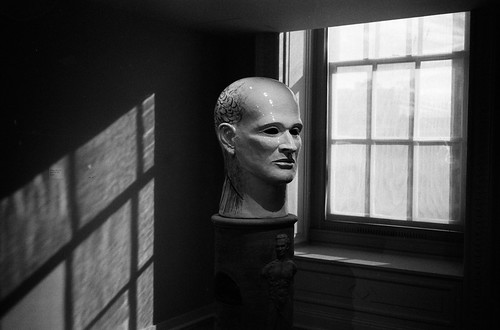
Look Deeper

 
Look Deeper, by Reed A. George
Leica CL, Minolta Rokkor 40mm f2 Lens
Kodak TMax 400 Film
 
 
DMC-365.blogspot.com


Monday, November 25, 2013

Street Photography Tip - Look for Interactions Between People

People have different definitions for "street photography." Some say it must be taken outside, others say it must include a street(!). I don't get hung up on technicalities. When I say that I enjoy street photography, I mean candid (mostly) images of people, going about their lives. Sometimes I talk with people before photographing them; I would call that street portraiture. In any case, today's example is a candid.
 
Street photography without a human element falls flat for me. I need to see people doing something. Not always interacting with others, but something. Interaction is usually one of the most powerful behaviors to capture in my opinion.
 
What's the Special Today?, by Reed A. George
Leica CL, Minolta 40mm f2 Rokkor Lens, Kodak TMax 400 Film
 
In the shot above, I actually liked that the dining booth seat separated me from the lady in glasses, obscuring most of her face. I think this focuses the attention on her eyes, always the photographically most important feature on someone's face. I prefocused my CL, made a quick guess at the exposure, then anticipated their interaction. I lifted the camera to my face for less than a second, releasing the shutter right as she looked up into the server's eyes. No one took notice.
 
I knew I had captured the exact moment that I wanted. That's not always (or even usually) the case. All I had to do now was wait to see the negative come back from The Darkroom (my favorite film processor).
 
(Click Here) to read about The Darkroom's processing services. I use them almost exclusively at this point for my film developing. Quick service (online images are usually up within a day of them receiving my film), excellent quality, great prices ($10 per roll). Give them a try.
 
DMC-365.blogspot.com


Wednesday, March 13, 2013

Fred Bonatto Shares Bosnia on getdpi.com With His Leica M8

I always really liked the Leica M8. Yes, it had a cropped sensor. Yes, you had to use UV/IR filters. Yes, lens coding was a pain, especially for people like me who don't have the latest (coded) lenses. But, it sure could make a nice image when all the right pieces were in place.
 
Fred Bonatto (username bonatto on getdpi.com) has shared some images from Bosnia, taken with his M8.
 
 
Image Source: http://www.getdpi.com/forum/leica-m-x-r/44317-bosnia-m8.html
 
(Click Here) to read bonatto's post, and see several more excellent Leica M8 images.
 
Here's one that I shot with my M8. I sold my M8 when I got the M9.
 
Eric Felton Orchestra, by Reed A. George
Leica M8, Minolta Rokkor 40mm f2 Lens
iso 640, f2, 1/90 sec.
 
The M8 delivered beautiful, not-overstated color. But, I think it really excelled at black and white.
 
In my humble opinion, the M9 does everything that the M8 did, and much more. Full frame, no filters required, manual lens settings (or coding, if you need them). The M8 was capable of magic when things were all correct; the M9 is capable of magic any time.
 
DMC-365.blogspot.com


Monday, December 17, 2012

Barcelona's Placa De Sant Felip Neri

 
Placa De Sant Felip Neri, Barcelona, by Reed A. George
Panasonic Lumix DMC-G3, Pana-Leica Summilux 25mm f1.4
iso 1600, f5, 1/320 sec
 
Placa De Sant Felip Neri, located in the Barri Gotic neighborhood of Barcelona, is a special place with a deep history. Originally the site of a Jewish cemetery, a baroque church was built here in the mid 1700s and still stands.
 
On January 30, 1938, during the Spanish Civil War, a bomb fell on the square, killing 42 civilians, including 20 children who were taking shelter in the basement of the church. In the images below, you can see the significant damage that the bomb did to the stone walls of the square.
 
While the shot above was taken with the Lumix DMC-G3, the remaining pictures in this post were taken at night with my Leica CL, Minolta Rokkor 40mm f2 lens, and Kodak Tmax 400 film. I did not use a tripod, and most were shot at 1/15 second exposure.
 
My goal was to capture the feeling that the place gave me as darkness fell. It is not a sinister place, but certainly has a dark history.
 
 
There is still an elementary school in the square. The children in these pictures were meeting their parents, and playing before walking home. While the pictures look dark and threatening (which was my intention), the kids were quite happily running around the square.
 
 
If the soul exists, many have flown skyward from this place. Remnants of those flights persist. Like a tidepool that stays intact after the tide has receded, this place holds memories for those old enough to remember, only vague shadows and moods for those too young.
 
I thoroughly enjoyed trying to capture the impression Placa De Sant Felip Neri made on me. The Leica CL was the perfect tool for it, even though I had to work carefully with iso 400 film and low light levels.
 
DMC-365.blogspot.com


Sunday, December 9, 2012

Felix at efix:photography: "Goodbye M8, hello CL!"

 
Leica CL and Zeiss Biogon 28mm f2.8 ZM Lens
 
I just found a new (to me) blog, called efix:photography. The operator, Felix, has just sold his beloved Leica M8, as did I.
 
I was lucky enough to replace mine with an M9. Felix, for reasons of his own, went a different and I think very productive way - he purchased a Leica CL film camera.
 
(Click Here) to read the post on efix:photography
 
The Leica CL, which was produced through a collaboration of Leica and Minolta, is an excellent camera. It has a slightly shorter rangefinder base than the other Leica M bodies, which means that theoretically it is harder to focus to high accuracy. I have never had any problem with this in real experience. The CL is the most compact Leica rangefinder camera, and will mount any Leica M lens. Back in the day, it came with a 40mm f2 Summicron (sometimes labeled as a 40mm Rokkor by Minolta). That's what I have attached to mine. The 40mm lens is just plain spectacular. The finder on the CL has lines for 40mm, 50mm, and 90mm lenses. There is also a CL-matching 90mm f4 that is tiny and super sharp. I don't have that one. Another important feature of the CL is a built-in exposure meter. This makes it a very self-contained, easy to use camera.
 
The 40mm Summicron, by the way, is a wonderful "normal" lens for the M8, with it's 1.33X crop factor. This gives it a field of view equivalent to ~53mm on a full frame 35mm camera when used on the M8. The 40mm Rokkor f2 was my most-used lens on the M8.
 
How much do I like the CL? Well, I'm leaving soon for a trip to Barcelona (I'll be back by the time this posts), and am relying on Lumix Micro 4/3 cameras for the trip. However, I do have the CL and 40mm Rokkor in my bag as well. It's the only non-Panasonic camera going with me on this trip. I have a few rolls of Tmax 400 in the bag as well. I know I'll use the CL while I'm there.
 
So, check out Felix's blog, and watch for what he's going to produce with his new camera - the Leica CL!
 
Here's a sample shot from my CL:
 
Chinese New Year Antics, by Reed A. George
Leica CL, exposure unrecorded
 
DMC-365.blogspot.com