I recently had the opportunity to participate in a media event for the World War II Memorial Flyover, an event where dozens of war era aircraft flew in various formations over the National Mall in Washington, DC.
(Click Here) to read about the event, which took place on Friday, May 8, 2015.
On the day before the event, my associate, Rob, and I got to go to a local regional airport and witness the take-off of several of the airplanes that would take part in the event.
I brought along my Nikon D700, 35-70mm f2.8, and 70-300 f4.5-5.6 AF-S G lenses. All of the images below were made with the 70-300.
The event began with a short press conference, and then we were allowed out on the tarmac. Preparations for the day's flights were underway.
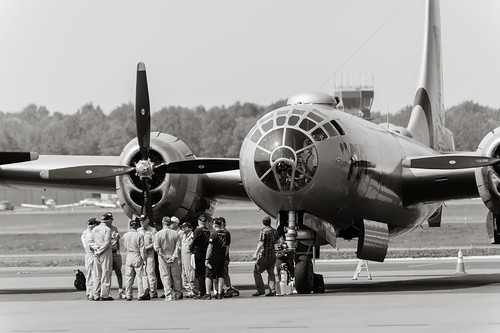
B-29 Superfortress, by Reed A. George

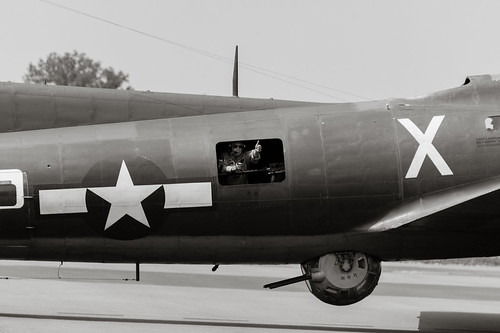
B-17 Crewmembers, by Reed A. George
Then, the engines started to crank.
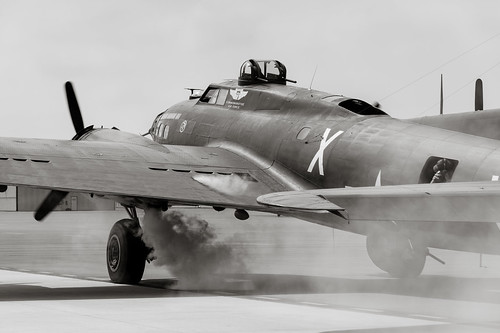
Cranking up, B-17, by Reed A. George
We were warned about the noise, oil, and propwash (wind) that would result when this happened, and the B-17 didn't fail to deliver. It was quite a thrill to be so close to these aircraft.

B-29 Cranks Up, by Reed A. George
As the planes taxied for takeoff, we got some close up views of them in motion.
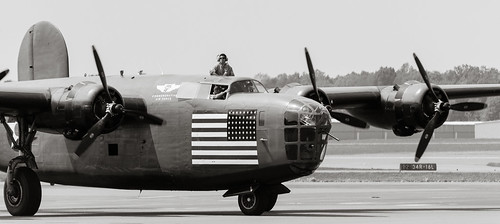
B-24 Liberator on Taxi, by Reed A. George
Here's my favorite shot from the day:
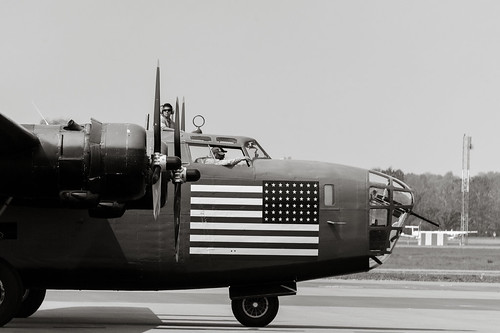
Between the Props, by Reed A. George
I used a gradual neutral density (ND) filter on my 70-300, to prevent the pure white skies from overexposure. It's a subtle effect, but I think it helped. Sure would have been nice to have a cloud or two.
Once all of the aircraft were lined up for takeoff, the staff lifted the barrier tape and let those of us with media passes out closer to the runway. At this point, having captured decent sharp images of all of the airplanes on the ground, I started thinking about what made this event unique. It wasn't the aircraft alone. I had photographed some of the crew, which I cannot see on a normal trip to my local Air & Space Museum (yes, I know I'm lucky, not everyone has the Udvar-Hazy Museum ten miles from their home). The real unique point, though, was to see these old beasts in flight. Asking Rob to be sure and capture sharp images of them taking off, I decided to try some panning, in an attempt to show the motion in my images.
I consider myself to be pretty good at panning, matching the angular speed of my moving camera to that of the object I'm tracking. Doing that with these big aircraft turned out to be really challenging. I set the 70-300's VR to "Active," which is supposed to be designed for panning. Every shot came out blurry. Not just most, all of them. Finally, turning VR off completely, I was able to capture one decent panning shot of the B-29. Here it is.
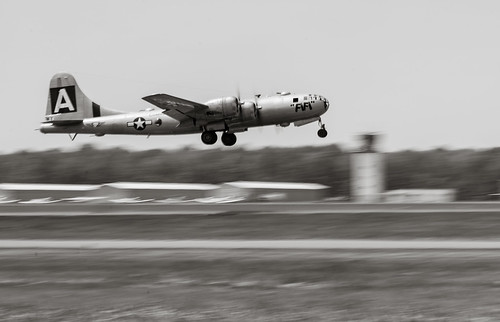
Superfortress Takes Off, by Reed A. George
So, I worked hard for it, but feel that I captured most of the feeling of the event that I was after. What an incredible opportunity.
I hope that many of our remaining World War II veterans were able to see or watch the live feed of this event. It's really something to see these 70 year old airplanes still in prime running (flying) condition.
DMC-365.blogspot.com