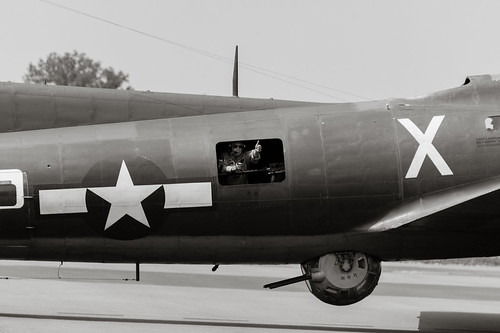
Showing posts with label World War II. Show all posts

Friday, May 22, 2015

In Honor of our World War II Veterans - DC Mall Flyover

I recently had the opportunity to participate in a media event for the World War II Memorial Flyover, an event where dozens of war era aircraft flew in various formations over the National Mall in Washington, DC.
 
(Click Here) to read about the event, which took place on Friday, May 8, 2015.
 
On the day before the event, my associate, Rob, and I got to go to a local regional airport and witness the take-off of several of the airplanes that would take part in the event.
 
I brought along my Nikon D700, 35-70mm f2.8, and 70-300 f4.5-5.6 AF-S G lenses. All of the images below were made with the 70-300.
 
The event began with a short press conference, and then we were allowed out on the tarmac. Preparations for the day's flights were underway.
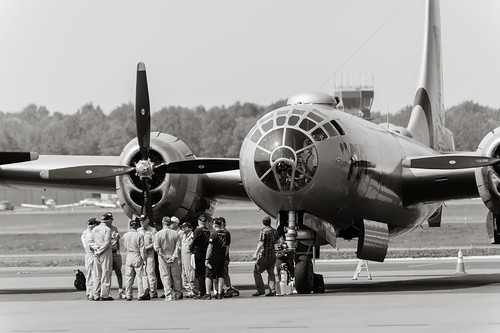
B-29 Superfortress, by Reed A. George
B-17 Crewmembers, by Reed A. George
 
 
Then, the engines started to crank.
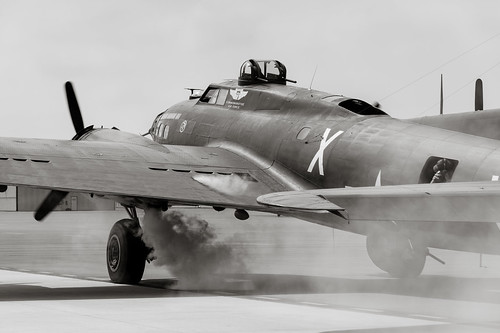
Cranking up, B-17, by Reed A. George
 
We were warned about the noise, oil, and propwash (wind) that would result when this happened, and the B-17 didn't fail to deliver. It was quite a thrill to be so close to these aircraft.
 
B-29 Cranks Up, by Reed A. George
 
As the planes taxied for takeoff, we got some close up views of them in motion.
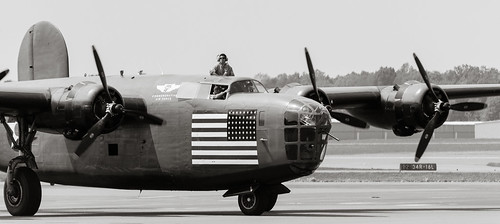
 
B-24 Liberator on Taxi, by Reed A. George
 
Here's my favorite shot from the day:
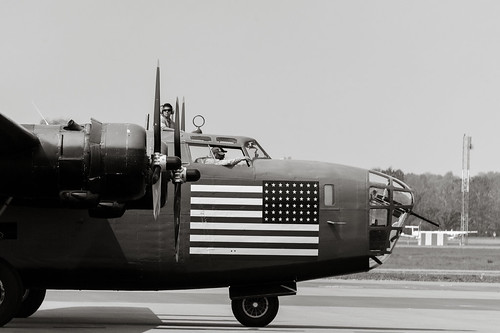
Between the Props, by Reed A. George
 
I used a gradual neutral density (ND) filter on my 70-300, to prevent the pure white skies from overexposure. It's a subtle effect, but I think it helped. Sure would have been nice to have a cloud or two.
 
Once all of the aircraft were lined up for takeoff, the staff lifted the barrier tape and let those of us with media passes out closer to the runway. At this point, having captured decent sharp images of all of the airplanes on the ground, I started thinking about what made this event unique. It wasn't the aircraft alone. I had photographed some of the crew, which I cannot see on a normal trip to my local Air & Space Museum (yes, I know I'm lucky, not everyone has the Udvar-Hazy Museum ten miles from their home). The real unique point, though, was to see these old beasts in flight. Asking Rob to be sure and capture sharp images of them taking off, I decided to try some panning, in an attempt to show the motion in my images.
 
I consider myself to be pretty good at panning, matching the angular speed of my moving camera to that of the object I'm tracking. Doing that with these big aircraft turned out to be really challenging. I set the 70-300's VR to "Active," which is supposed to be designed for panning. Every shot came out blurry. Not just most, all of them. Finally, turning VR off completely, I was able to capture one decent panning shot of the B-29. Here it is.
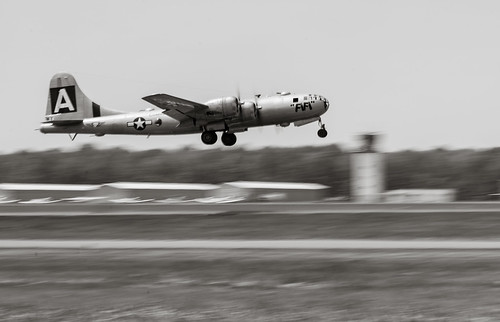
Superfortress Takes Off, by Reed A. George
 
So, I worked hard for it, but feel that I captured most of the feeling of the event that I was after. What an incredible opportunity.
 
I hope that many of our remaining World War II veterans were able to see or watch the live feed of this event. It's really something to see these 70 year old airplanes still in prime running (flying) condition.
 
DMC-365.blogspot.com

Tuesday, December 16, 2014

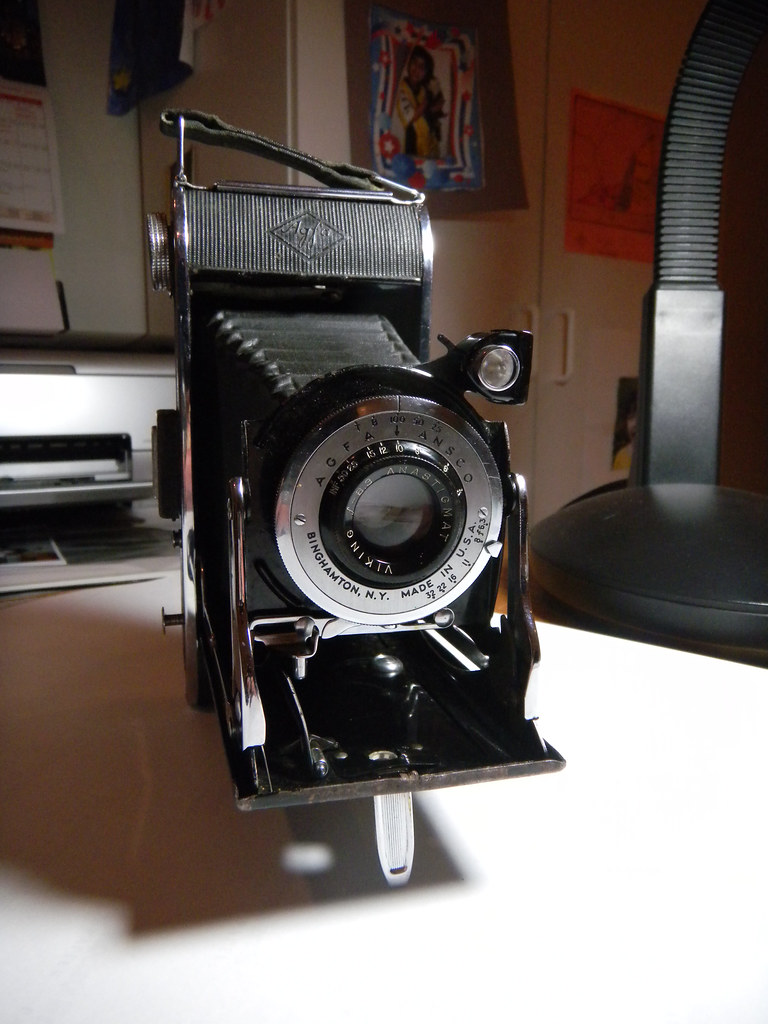
Grandpa's World War II Agfa Viking

I thought I had written about this a few years back, but it seems I forgot to post it.
Back in December of 2010, my Grandfather gave me his Agfa Viking camera. He picked it up during World War II, during which he was stationed in Japan and the Phillipines. He seems to remember trading a 35mm Japanese camera for it. Who knows what that may have been?
Anyway, once I got it, I saw that the shutter seemed to be working fine, and the lens turned to allow focusing (it's very common for the cell to get locked in place over so many years). Then I found the aspect that threatened to prevent me from using this old jewel - it is designed for 616 film, which is no longer available.
Grandpa's Agfa Viking
 
Undaunted, I hand-fabricated a thin plastic mask that allows 120 film (not as wide as 616) to ride in the correct film plane in the camera. I then modified some 120 spools to fit into the Viking. It's not perfect, and sometimes the spools slip during film transport. I measured out which exposure numbers on the 120 film backing would indicate sufficient travel. I can now use the red window on the back to make sure I've wound the film on far enough to avoid overlapping images.
 
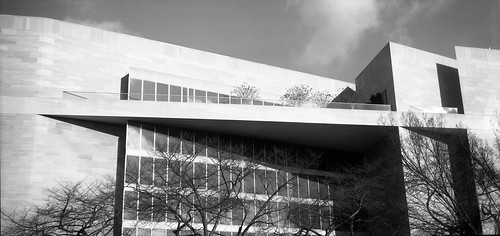
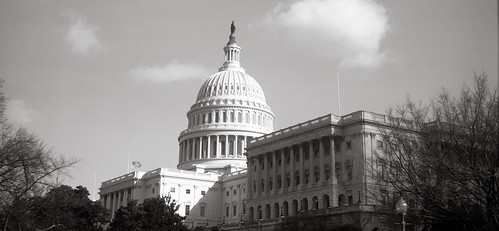
This configuration results in a panoramic aspect ratio. Here are two shots I made in Washington, DC with the Viking:
Success!
 
As I said, it's a little fiddly to use, and frankly I have enough medium format folders that were designed for 120 film that I haven't gone back and used the Viking since that maiden voyage. But, it was great fun challenging myself to be able to shoot it at all. Pretty impressive images, if you ask me.
 
That said, I hope that someday the Film Photography Project (FPP), or someone else, will reintroduce 616 film for us niche camera owners. Probably hoping against hope. I'm not sure how many cameras were sold that used this particular format film. But then again, who would have guessed that FPP would be marketing 620 film? They are!
 
(Click Here) to check out FPP.
 
DMC-365.blogspot.com
 

Thursday, November 20, 2014

What You May Have Found in a Photojournalist's Bag in 1945

As you probably can see, I love vintage cameras. I've put together a nice Leica kit, all with equipment that was made before or during World War II. Here it is.
It includes:
  1. Leica IIIC (stepper) camera
  2. 5cm f2 Summitar (uncoated) normal lens
  3. 3.5cm f3.5 Elmar (uncoated) wide angle lens, with auxiliary finder
  4. 9.0 cm f4 Elmar telephoto lens (black), with auxiliary finder
The 9.0 cm Elmar and IIIC body were made during the war years; the other two lenses were made earlier.
This is a very capable kit, still today. Covering wide to long focal lengths, it all fits in a small camera bag, and doesn't weigh much at all. It's a blast to use.
 
DMC-365.blogspot.com


Sunday, October 26, 2014

How A Shot Develops - Mamiya Universal Press (MUP) at the World War II Memorial

I had a couple of hours free this morning, so I packed up my MUP and drove into Washington, DC, to the World War II memorial. Planning to capture some people out in the fall color, I spent a little time doing that, and then walked over to the memorial itself. I saw a nice composition in my mind, with the columns and wreaths of the memorial (one for each state) tapering off into the background, and nice contrasty light separating them from the foreground. A steady parade of people, including veterans, mostly in wheelchairs, was coming up the walkway.
 
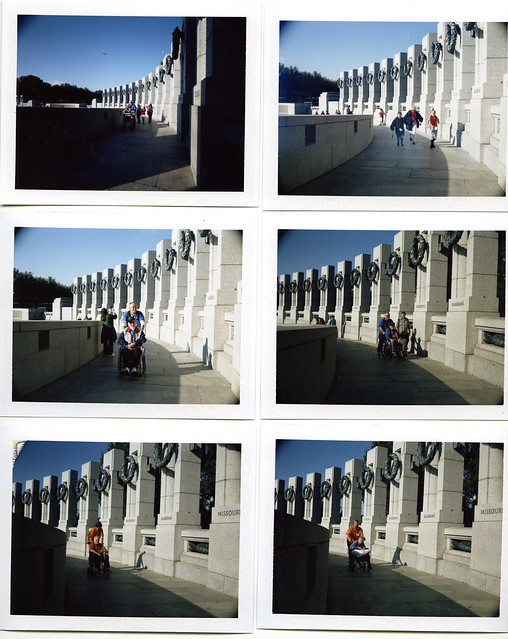
I set up the MUP on a tripod, changed the film back to my Polaroid back, which was loaded with Fuji FP100C color pack film, and started shooting. I shot a total of six images. They're shown in the contact scan below, and are in order from left-to-right, top-to-bottom.
"Contact Scan," by Reed A. George
 
You may notice the wider perspective in the first shot. It was made with the Mamiya 50mm lens, which is very wide on the MUP, especially with the oversized image of the pack film. Notice the vignetting in the corners, which is normal, since the MUP is designed for 6x9 image size and the pack film is larger than that. After the first shot, I changed lenses to the 100mm f3.5 "normal" lens for the MUP.
 
I was shooting at about 1/250 sec and f16 throughout the series.
 
I also slowly moved my tripod to the left as the series developed.
 
In the beginning, the veterans that were being escorted up the walkway were just too far away. I wasn't trying to make portraits of them, but wanted to capture some detail of them in the context of the memorial.
 
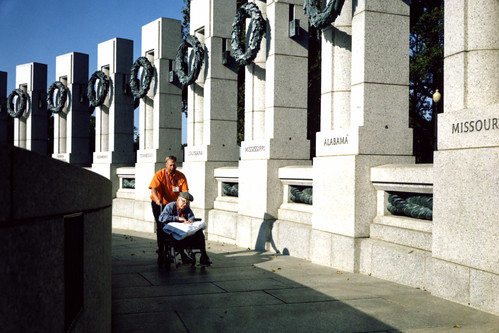
I consider the final two images to be pretty good, but the last one (bottom right in the contact scan) goes furthest in telling a little story of our remaining World War II veterans and the memorial that reminds us all of what they gave for their country.
 
Here it is, scanned at higher resolution:
Final Shot, by Reed A. George
 
Remember that these instant films are not really designed to be enlarged, so the image you see on your screen is probably much larger than intended by the engineers at Fujifilm. I think the color came out very nice, and there's enough detail to see what's going on here.
 
I've become very interested in how a decent photograph develops through the shooting process. This interest was sparked by starting to read the excellent book Contact Sheets by Magnum press. I highly recommend this book. Be sure to read the introduction, as it discusses a lot of aspects of contact sheets, like the fact that many photographers, including Henri Cartier Bresson, were not in favor of sharing them with viewers.
 
If you decide you want this book, please buy your copy by clicking on the Amazon link below. You'll get a great book for the same price as going directly to Amazon, and help support my blog in the process!
 
DMC-365.blogspot.com


Wednesday, July 2, 2014

Washington DC - World War II (WWII) Leica at the WWII Memorial

My friends and I went to the WWII memorial on the mall in Washington, DC on Memorial Day. Expecting the normal events held here every year, we were more than a little let down to learn that they'd taken place the day before.
 
I had loaded up two of my wartime Leica IIIC cameras, one with TMax 100 black and white film and matching Elmar 5cm f3.5 lens, the other with TMax 400 and a 1937 Elmar 3.5cm f3.5 lens. These results are from the 5cm Elmar and TMax 100; the other camera is still loaded, as I didn't finish the roll.
 
Military School Students, by Reed A. George
Wartime Leica IIIC, Leica Elmar 5cm f3.5 Lens, Kodak TMax 100
 
True WWII Veteran, by Reed A. George
Wartime Leica IIIC, Leica Elmar 5cm f3.5 Lens, Kodak TMax 100
 
These old Barnack cameras are a lot of fun to shoot. I always enjoy seeing the images they can produce. I also think it was fitting to use two cameras that were most likely sold to Allied soldiers during the occupation of Europe at the end of the war for this event.
 
DMC-365.blogspot.com
 

Sunday, February 2, 2014

Quick Test of my New Wartime Leica IIIC

 
Wartime Leica IIIC
 
A few years ago, I purchased a beautiful Leica IIIC wartime model (ca. 1942) from a friend of a friend. At the same time, I got an uncoated LTM Summitar 5cm f2 lens (1939). Both the camera and lens turned out to be favorites of mine. The wartime IIICs are characterized by a little step up on the top plate, where the rewind lever sits. Therefore, these cameras are sometimes referred to as "steppers." I always have my eyes open for these models, both because the wartime IIICs are usually in better shape than postwar cameras, due to issues with chrome plating after the war, and because they really are little pieces of history. They don't come up for sale all that often.
 
Recently, I saw the camera above on one of the forums, another wartime IIIC from 1945-46, with a matching Elmar 5cm f3.5 collapsible lens from 1945. I paid a little more than I should have for it (not really bad though, as these cameras go for very little money these days). I had to have it serviced by Youxin Ye to get the slow speeds working, but that's really an investment rather than a cost. Youxin also recovered the camera and cleaned up the Elmar very nicely. It's now all fixed up and working well.
 
In order to just do a quick test of this new camera and lens, I popped in a cheap roll of Walgreens 200 speed color print film and gave it a shot. You'll see that this film is quite grainy for 200 speed, but otherwise I guess it's okay. All of these were shot with the Elmar that came with the camera.


I tried to use a variety of shutter speeds to make sure the shutter's operating properly. I don't see any problems here at all.
 
So, I've now got a second wartime Leica and matching Elmar 5cm f3.5 lens. Checking with the expert on these cameras, Jim Lager, who I met through my membership in the LHSA (International Leica Society), I learned that this camera was most likely sold to an Allied soldier at the end of World War II. The serial number indicates that it was made late in the wartime camera production era.
 
Surprisingly, I've now found an even higher serial number IIIC on the same forum, and purchased it. The seller tells me that this one fires well at all speeds, so hopefully it won't need the same level of service as the one pictured here. Again, this younger stepper IIIC was probably sold to a US or Allied soldier at the very end of the war. I'll share pics when it arrives.
 
DMC-365.blogspot.com


Monday, June 17, 2013

Sad News - Wayne Miller, Magnum Photographer, Dies at 94

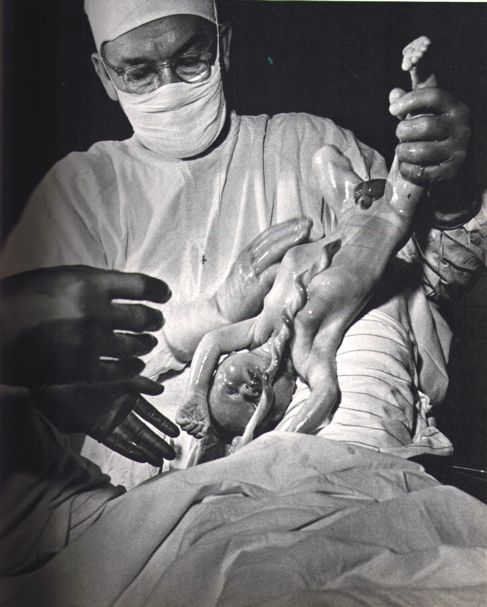
Image Source: https://www.google.com/search?q=wayne+miller+photographer&client=safari&hl=en&source=lnms&tbm=isch&sa=X&ei=_aC0UcnpCdal4AP0xIGwBQ&ved=0CAoQ_AUoAA&biw=1024&bih=644#biv=i%7C25%3Bd%7Cb2oVpf6LZkPjBM%3A
 
Wayne Miller, celebrated Magnum photographer, who covered subjects ranging from World War II in the Pacific to child care (for Dr. Spock's books) recently passed away at 94 years of age.
 
My personal friend, who I met in a way completely unrelated to photography, is Mr. Miller's son. In fact, that's my friend being delivered in the image above. As I understand it, his grandfather is the doctor delivering him, and of course, his father, Wayne Miller, took the shot.
 
We have lost a treasure. Do a search of Mr. Miller's work to be inspired to shoot more, shoot better.
 
(Click Here) to read the story at the NY Times.
 
DMC-365.blogspot.com