Showing posts with label tea. Show all posts

Monday, April 13, 2015

Today's Image From Japan - Lumix DMC-LX100

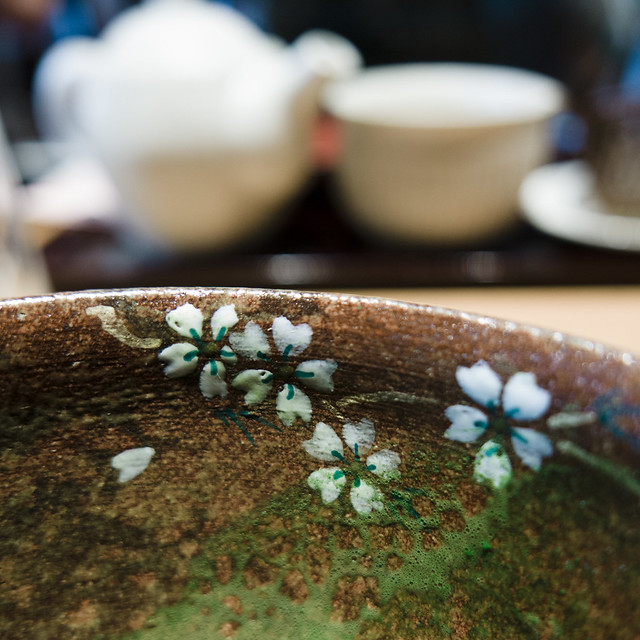
Matcha Tea, by Reed A. George
Panasonic Lumix DMC-LX100
iso 400, f1.7, 1/60 sec.
 
We wrapped up our last day in Kyoto with some very nice Japanese tea and sweets.
 
DMC-365.blogspot.com
 

Tuesday, January 6, 2015

Making Tea - A Quick Slideshow

I was looking for something to photograph this evening, and decided to try out the new Teavana tea infuser that I got for Christmas. I set up a black cloth background, put the Nikon Df on iso 200 with my 28mm f2.8 lens and 3-stop ND filter. With this setup, at f16, I could leave the shutter open for minutes at a time without ambient light showing up in the pictures. I then proceeded to "paint" my subjects with a small flashlight, making images at various points in the tea making process.
 
Here's how it turned out:
 
Relaxing Holiday Tea, by Reed A. George
 
Just a little diversion for an afternoon. I learned a few things from this. First, I needed to be more careful about spots on the glass infuser. Second, I needed to pay close attention to the flashlight being directly reflected from the ceramic and glass surfaces. But, it's definitely something I could perfect in a second shooting, if I decided to. I see now why product photography is painstaking and difficult. But, it's actually pretty fun.
 
DMC-365.blogspot.com
 

Thursday, May 8, 2014

I Like Tea - and Found a Nice New Place to Drink It

I've been on a bit of a tea kick lately. There's so much variety in tea - green, black, fermented (Puerh), and from so many interesting locations. And, I'll admit, I like the more subtle caffeine boost, as compared to coffee (which I still love, too).
 
I also believe that social networking is not the only thing killing real socialization, at least not directly. Where I live (Northern Virginia), now that book, camera, and music stores are a thing of the past, there is a dearth of places for people to meet in person, especially any not associated with drinking alcohol. Well, I found such a place. It's called Ching Ching Cha, and it's located in the Georgetown section of Washington, DC.
 
(Click Here) to go to Ching Ching Cha's website.
 
My wife is from Japan, where public places to meet and have a hot beverage with friends are not rare at all. So, I didn't have a hard time convincing her to go have tea with me. I brought along one of my favorite cameras from the "Skeletons From The Closet" series of last year, the Minolta Autocord medium format TLR. Here are a few images I made there.
 
 
Ching Ching Cha Tea House, by Reed A. George
Minolta Automat, Kodak Porta 400 Film
 
For all but the second image, I used my Rolleinar 1 closeup lenses, which mount to the front of the Autocord lenses perfectly, as the Minolta shares the bayonet filter mount with Rollei Bay 1 cameras. The Rolleinars significantly reduce depth of field, which I must admit was a challenge for me. I didn't exactly nail the focus on the shots of my wife. But, it's pretty close. The big medium format negative is pretty forgiving.
 
I'm glad to know about Ching Ching Cha, and will certainly be a repeat customer.
 
DMC-365.blogspot.com

Saturday, November 23, 2013

My Education in Tea, October WLL Results (Summicron 50mm f2 v.3)

One of my friends recently got me into trying some fine and exotic teas (thanks, Bill!). While I was in San Francisco, I decided to do something special, and stopped into the Ten Ren's Tea shop in Chinatown. Yes, I know it's a big potential tourist trap, but I found it to be a very enjoyable experience. And yes, they did succeed in selling me some fine teas.
Ten Ren's, San Francisco, by Reed A. George
Leica M9, Leica 50mm Summicron f2, v.3 Lens
iso 400, f2.4, 1/4000 sec.
 
Here's what the tasting room looks like from above. A selection of teas is stored in glass containers (at the front of the serving stone) for you to see and smell the differences between different types of leaves. Notice the lady at top right, taking notes.
Tea Room From Above, by Reed A. George
Leica M9, Leica 50mm Summicron f2, v.3 Lens
iso 640, f2, 1/60 sec.
This is Mary, the very classy and friendly lady who served me my selections.
 
Mary, by Reed A. George
Leica M9, Leica 50mm Summicron f2, v.3 Lens
iso 640, f2.8, 1/60 sec.
I told Mary that I was interested mainly in two types of tea - green and Pu-erh, which I'd heard about but never tasted. Mary served me two different greens - the first from the most famous green tea fields in Taiwan (Formosa), the second a Dragon Well variety. I preferred the Dragon Well, as it tasted a little less "earthy" (also read, "grassy") to me.
 
Next, we moved on to Pu-erh, which is fermented tea. Unlike other types of tea, where the leaves should be kept as fresh as possible, and where storing 1-2 years in proper (cool, dark) conditions is a maximum, Pu-erh gets better with age. Mary had Pu-erh teas from 10-60 years old. I believe the one I tried was 30 years old. The brewing process is different from green teas. First, you use boiling water (green teas should be brewed at a lower temperature, around 85 degrees C), you also throw away the first brew, which is essentially a rinse of boiling water. Finally, you brew it approximately two times longer than greens.
 
The most important thing I learned from Mary is this - you can reuse your tea leaves many times throughout a single day. For greens, 4-5 uses is normal. For Pu-erhs, it can be 15 times or more. That's an important tip. I also learned that as you reuse them through the day, the caffeine content is reduced with each brewing. You can further reduce caffeine by shortening the brewing time. So, by the afternoon when you've brewed several times, your tea is essentially nearly decaffeinated. I like how using the tea throughout the day automatically lessens the caffeine, so you can finish up in the evening with very low amounts of it.
 
So, I must say that I thoroughly enjoyed the experience. I got an education along with experiencing some very nice, high end teas. Did it cost me some money in the end? Yes, I bought two teas and some ginseng powder, which Mary suggested adding to evening teas to help you sleep. But, I get to continue to enjoy those teas for months to come (maybe years for the Pu-erh tea I bought). Well worth the expense.
 
Tea Education, by Reed A. George
Leica M9, Leica 50mm Summicron f2, v.3 Lens
iso 640, f2.4, 1/60 sec.
DMC-365.blogspot.com