Showing posts with label feature. Show all posts

Friday, November 28, 2014

50 Years of Nikon - Slideshow - Historic Corncrib

Here is a brief slideshow of images I took of an old farm building near where I work. I was able to convince my coworker and friend Wendye to let me photograph her there.
 
 
If you have trouble getting it to load, just (Click Here).
 
I shot all of these images with Nikon - the first of my "50 Years of Nikon SLRs" posts. This includes images from my early Nikon F film SLR, and my new Nikon Df DSLR. It's a lot of fun shooting these two cameras, separated by 50 years of Nikon history, going into the 50th year of my own life.
 
The music is from my friends The Woodshedders. Enjoy!
 
DMC-365.blogspot.com
 

Sunday, November 2, 2014

Fifty Years of Nikon

Camera images from nikonusa.com
 
I am turning 50 years old in December, just two months away. I'm not too hung up on age, but 50 is a big one. Half a century.
 
I just pulled the trigger on the purchase of a Nikon DF (sold refurbished direct from Nikon). I thought long and hard about that investment, since I already have attention deficit problems with my existing cameras, and like to focus on particular cameras, at least for some period of time. But, the DF is just too attractive for a photographer like me. Familiar controls, real knobs instead of (or in addition to) menus, married with amazing digital sensor technology, and the ability to use any of my Nikkor lenses to boot.
 
So, I'm thinking that I may pair up my new DF with a camera that was around and in use when I was born, my Nikon F film SLR with plain prism. I don't know exactly what the project will be yet, but it will take advantage of fifty years of Nikon SLR technology, in my 50th year of life.
 
Stay tuned!
 
DMC-365.blogspot.com
 

Friday, August 15, 2014

Planning My Next Theme - Maybe

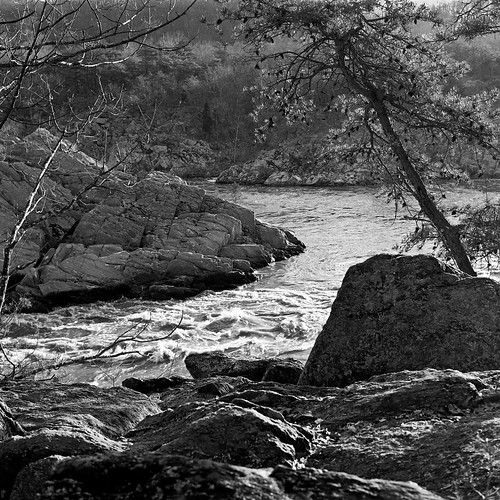
Great Falls, VA, at About 17 Degrees Fahrenheit, by Reed A. George
Rolleiflex
 
Well, if you've followed the twists and turns of this blog for a few years, you've seen it change quite a lot. If not, I can tell you that my focus shifted from mainly Panasonic/Lumix/Micro 4/3 gear in the first year to a prolonged emphasis on Leica, and on old film cameras. Recently, I've been thinking more about the creative process and how it relates to gear and format.
 
I think all of this has been useful for me, and I don't plan to drop any of it. I still shoot Lumix when the mood strikes me, and have zero problem relying on a full Micro 4/3 kit for much of my travel. I'll never lose the love for my Leicas. However, lately, some friends and I have been leaning more toward medium format film cameras for our weekend outings.
 
In my Skeletons From The Closet series, I used several of my old medium format cameras. My friends Charlie and Alain are Rolleiflex users. I love my Rolleiflexes as well. I recently picked up (through the favor of another friend) a wondrous Mamiya Universal Press camera kit. I also really enjoy medium format folding cameras, and my Bronica ETR (6x4.5 format) kit has been sitting idle for far too long.
 
So, I may just have to start a new emphasis on medium format film shooting. In fact, my first couple of rolls through the Mamiya are on their way to The Darkroom as I write this.
 
Don't know about The Darkroom? (Click Here) for the best film processing I've ever found.
 
As I've learned that focusing on just one type of equipment is only satisfying for a finite period of time, I'll figure out how to make the best creative use of this type of gear. I won't limit myself to one camera or maker. I will commit to the "slow photography" movement, at least for this part of my shooting. With a Mamiya Universal, you don't have much choice but to commit to slow photography. :)
 
Anyway, that's my thought at this point in time. Again, this will not be an exclusive focus. I surely won't be traveling with just a Mamiya Universal very often. But, it could be a new dimension to add to my subjects.
 
Input always appreciated! Drop me a comment with your thoughts.
 
DMC-365.blogspot.com
 

Friday, April 18, 2014

Dreaming in Monochrom(e) - Ilford Delta 3200 Film at a Concert

A few weeks ago, I posted digital pictures from a Keel Power Trio concert at Gypsy Sally's in Washington, DC. They were all shot on the Nikon D700, and processed in Lightroom to emulate Ilford Delta 3200.
 
(Click Here) to see that post.
 
I also shot my "Dreaming in Monochrom(e)" camera, the Leica M4-2, loaded with the real deal, actual Ilford Delta 3200 film. Here are the results:


Larry Keel Power Trio, by Reed A. George
Leica M4-2, Carl Zeiss C-Sonnar 50mm f1.5 Lens
 
Man, I really love shooting the M4-2, and Delta 3200 opens up a lot of opportunities for low light shooting. I typically shoot it as if it were rated at 1600, and have it processed normally at The Darkroom (thedarkroom.com).
 
This "Dreaming in Monochrom(e)" project has taught me so much. First, it reopened my ability to shoot film at live music events. It also refocused me on a style of monochrome images that I think fit my chosen type of music very well. In fact, it even transformed how I process my digital images from these events.
 
But the experience is giving me the distinct feeling that restricting any given camera to black and white only may not be for me. While I love shooting the M4-2 with TMax 400 or Delta 3200, I sometimes leave it at home because I've temporarily dedicated it to this project and am not using it for color. I would not be happy with a several thousand dollar digital Leica Monochrom that I couldn't carry without reservation any time I want.
 
I feel very fortunate to be around such great musicians. What could be better than bringing together two passions - live music and photography?
My Friend, Polly, by Reed A. George
Leica M4-2, Carl Zeiss C-Sonnar 50mm f1.5 Lens
 
 
DMC-365.blogspot.com
 

Sunday, April 13, 2014

Dreaming in Monochrom(e) - Buddha in Snowstorm

Here are a couple of shots I made with Ilford Delta 3200 film in my Leica M4-2, at a Buddhist temple during a snowstorm. Both were made with the Zeiss C Sonnar 50mm f1.5 lens, one of my favorite lenses.
 
Wat Yarn in Snow, by Reed A. George
 
I selected 1/125-1/250 sec. for my shutter speed, in an effort to catch the falling snowflakes.
 
Parasol, by Reed A. George
 
I like how the statue's eye shows up in this image.
 
I wouldn't normally use high speed film for images like this, but it was what I had with me. I think it worked out pretty well.
 
DMC-365.blogspot.com


Thursday, March 20, 2014

Dreaming in Monochrom(e) - Single Shot I Like

Here's a shot I made of my kid, using the Leica M4-2, Kodak TMax 400 film, and the awesome Zeiss 50mm f1.5 C-Sonnar:
 
I have learned some things from my "Dreaming in Monochrom(e)" project. I started the project to investigate how much I'd enjoy having a modern digital monochrome rangefinder camera, the Leica Monochrom.
 
One thing I learned is that I can do a lot with black and white only. That said, I'm not sure I want my camera to limit me to monochrome only.
 
Using the M4-2 for live music shots has actually changed the way I shot concerts, whether with film or digital. Shooting in low light with TMax 400 pushed two stops and with Ilford Delta 3200, I re-learned at least one style I like for my music photography - high contrast and with grain. So, I am processing some of my digital concert images to emulate that look. An unexpected lesson.
 
As with most of my projects, the answers I find are not absolute. But, they do add to my overall knowledge and enjoyment of photography.
 
DMC-365.blogspot.com


Friday, March 7, 2014

About to Try Ilford Delta 3200 For My Concert Photography

As you may know, I've been shooting some concerts with black and white film in my Leica M4-2 film camera, as part of a series I'm calling "Dreaming in Monochrom(e)." The idea is that I'm exploring using one of my Leicas in monochrome only, exploring how I'd really work with a digital Leica Monochrom if I had one.
 
Anyway, I've been shooting concerts with Kodak TMax 400 black and white film, pushed two stops to iso 1600.
River Whyless, by Reed A. George
Leica M4-2, 50mm Zeiss C-Sonnar f1.5 Lens
Kodak TMax 400 Film Pushed to iso 1600
 
While I'm really liking this new look to my concert photography, I'm finding the extreme contrast that I get by pushing 400 speed film two stops a little bit limiting. So, I've decided to try some Ilford Delta 3200 black and white film. My experience with Delta 3200 in the past was that the negatives can be a little thin; I've had better luck shooting it at iso 1600 than the labeled 3200. Apparently, the native iso is more like 1000, but it's got extremely wide exposure tolerance.
 
So, I think I'll shoot it at 1600 this time.
 
Here's an example concert shot on Delta 3200by Kontantinos Bezios:
 
Image Source: http://kbesios.com/blog/wp-content/uploads/2012/09/20120904-105104.jpg
 
Konstantinos shot this on a medium format Plaubel 67 camera. I think the gray tones are very nice, and I hope to get a similar effect in my Leica.
 
(Click Here) to visit Konstantino's blog and see more of his work.
 
My only question now is whether or not I need to inform The Darkroom (my favorite mail-in film developer) that I shot Delta 3200 at 1600 or not. I tend to think not, as I read a lot of posts about shooting it at 1600 and developing normally.
 
By the way, if you want truly excellent film developing, (Click Here) to visit thedarkroom.com.
 
With any luck, I'll have some interesting new concert photos to share in a week or so!
 
DMC-365.blogspot.com
 

Saturday, February 8, 2014

So, Now That It's Over, What Did I Learn From SFTC?

For the entire year of 2013, I selected a different old camera from my collection and shot it for a month, sharing the results and my thoughts here on DMC-365. So, what did I learn? Well, I learned that I still have a lot to learn, for one thing.
 
A natural outcome of revisiting so many cameras that have been in my camera closet for a long time would be to identify a favorite, or maybe more than one. That happened in some cases. In other cases, more exploration is needed.
 
For example, while I did shoot a few different SLRs (Pentax K1000, Nikomat Ftn, Nikon F2), I have yet to identifiy a favorite. The F2 is certainly up there. But, the K1000 was the camera I learned with, and I still love the Pentax line, including an ME and Spotmatic, which I didn't even include in the SFTC series. And then there's the Nikon FM2. So, no conclusion is possible there, not yet.
 
For twin lens reflexes (TLRs), the same is true. The Minolta Autocord was a wonderful, pleasant surprise.
The Autocord Rocks
 
The Autocord is pure pleasure to look through. But, is it better than my Rolleiflex T? Probably not. I'm still on a quest for the perfect TLR. At this point, I own a few (2 Rolleiflexes, a Rolleicord, the Minolta Autocord, and two Ricohs). They're all f3.5 cameras. I'm thinking that a Rolleiflex with Zeiss Planar f2.8 lens may be the ultimate for me. In the meantime, I'm enjoying my Rolleicord with Rolleikin 35mm insert, and can have lots of fun with my existing TLRs.
 
So, did I learn anything conclusive at all? Yes. In the class of fixed lens 35mm rangefinder cameras, I now have a clear favorite. The Konica S1.6. Absolutely amazing lens. I will never hesitate to grab this camera.
 
The Konica S1.6 is sublime.
 
And, in the medium format (120) folding camera class, the Agfa Record III is the clear winner. Now this is interesting, as the Agfa wins more on features than by standing out from the others in image quality. My Zeiss folders are real optical performers, especially the one with a Tessar lens. The Record III has the gorgeous Solinar lens, which I think matches the Zeiss offerings. But, more importantly, it has a built-in (if uncoupled) rangefinder, and an accessory shoe that I can use to mount an exposure meter. This makes it really easy to use compared to most of my other folders.
 
The Agfa Record III - Most Useable Medium Format Folder
 
So, in addition to having a hell of a lot of fun shooting old cameras, I did learn a few things.
 
I hope my readers picked up an interesting point or two, as well.
 
DMC-365.blogspot.com


Tuesday, February 4, 2014

Dreaming in Monochrom(e) - Leica M4-2

More results from my experimentation with shooting my (film) Leica M4-2 exclusively with black and white film.
 
The first few are from the Smithsonian Udvar-Hazy Air and Space Museum, a place that I always find challenging to photograph:


And here are a couple of shots I grabbed at our last Vienna (Virginia) coffee house meeting of local Leica enthusiasts.
 
 
I enjoy establishments that provide large tables that are shared with other parties. It just feels a lot more social to me.
 
All of these were shot with the M4-2 and Kodak TMax 400 film, processed by The Darkroom.
 
(Click Here) to visit The Darkroom. Great processing at great prices.
 
I am thoroughly enjoying this project. In terms of testing whether I really want a digital Leica Monochrom, it's been convincing, but probably not in the way you think. It's convinced me just how satisfied I can be with a great old film camera and black and white film.
 
My digital M9 is going to be coming home from Leica Service USA (where it's getting a checkup and thorough cleaning after quite a lot of use in 2013) in the next couple of weeks. I'm looking forward to having it back, but have been doing just fine with my old M4-2 in the meantime.
 
DMC-365.blogspot.com


Monday, February 3, 2014

One Lens That Didn't Make It Into Whole Lotta Leica Last Year - Leica LTM Summarit 5cm f1.5

Autumn Color, by Reed A. George
Leica M9, Summarit 5cm f1.5 LTM Lens
iso 200, f6.7, 1/60 sec
 
One of the lenses that didn't make it into my monthly feature of Whole Lotta Leica (WLL) last year was actually the second Leica lens I ever owned. Come to think of it, my first Leica lens, the 90mm f4 Elmarit didn't make it either. Both of these lenses are in great shape, but have a little haze that needs to be dealt with.
 
Here's my Summarit:
Leica Summarit 5cm f1.5 LTM Lens (ca. 1953)
 
These lenses are notorious for coming with lots of "cleaning marks," aka scratches, on the front element. The coatings were apparently quite soft, and they are easy to scratch. Mine has essentially no marks on the elements, but does have some haze. I have hesitated to send it for cleaning, worried that it will come back with scratches. So, I live with the haze. The lens renders very interesting images, with lots of center sharpness and wonderful bokeh (out of focus areas).
 
For me, the Summarit is a special lens, not one I'd want to rely on every day. However, it can produce some very special results.
 
What got me thinking about this? A post on Rangefinder Forum, by member "tester."
(Click Here) to read tester's thoughts on the lens on Rangefinder Forum, and see some very nice example images shot with his (her) Summarit.
 
DMC-365.blogspot.com


Sunday, January 26, 2014

Leica M4-2 (My Monochrom(e)) at the Lincoln Memorial

On the same rainy day that I shot the images of the Vietnam and Korean War memorials, I took a couple of images at the Lincoln Memorial. I like the rainy, somewhat dreary mood that I captured on that day. Both of these were shot with my Leica M4-2, Kodak TMax 400 film, and Leica Summicron 35mm f2 (version 3) lens.


DMC-365.blogspot.com


Saturday, January 25, 2014

More "Dreaming in Monochrom(e)" - Warrenton, Virginia

Today's post includes more images taken with my Leica M4-2 film camera, in my exploration of how much I would use and enjoy a camera dedicated to black and white imaging like the extraordinary Leica Monochrom. I shot these images around Warrenton, Virginia, on a recent weekend walk.
 
For the shot above, I used a yellow filter, which helped to bring out some contrast in the sky and clouds.
 
 
I spent some time in the Warrenton Cemetery, which has a substantial number of Civil War graves, including that of the famous rebel vigilante, John Mosby.


So far, I'm enjoying this little project. I have not felt too constrained with black and white film only in this camera. So far, I've only shot Kodak TMax 400, which is incredibly versatile. I may expand to other films in the near future, but I've been able to do a lot with just this one film.
 
DMC-365.blogspot.com


Friday, January 24, 2014

My First Results of "Dreaming in Monochrom(e)" - War Memorials in the Rain

I've decided to try and emulate a Leica Monochrom in analog form, using my Leica M4-2 and TMax films.
 
(Click Here) to see what I am planning. I understand the differences and limitations in this comparison.
 
Here is my first installment of images for the project. I don't normally go in for photographing the monuments in DC, but on this particular morning, I thought being out in the driving rain and seeing the few visitors hearty enough to be out in it was worthwhile. It turned out to be a good set of conditions for photographing the Korean and Vietnam War memorials, and led me to think carefully about war.
 
One theme that kept coming up in my mind is the notion that "Freedom isn't free." I must admit that I don't fully understand that notion. It's like saying "Happiness doesn't make you happy" to me. Let me be crystal clear: I come from a family with significant veteran experience and respect that service very highly. On the other hand, I basically despise war and all that it entails. How's that for conflicted? Anyway, here are my impressions from that rainy morning walk amongst the names on the wall, and the terribly expressive faces on the statues of Korean War soldiers.
Vietnam Memorial
 
Korean War Memorial
 
All images were made with the Leica M4-2, 35mm Summicron f2 v.3, and TMax 400 film. Processed in typical excellent fashion by The Darkroom (thedarkroom.com).
 
DMC-365.blogspot.com
 

Sunday, January 19, 2014

Final Whole Lotta Leica Results From 2013 - December's Elmar 3.5cm f3.5 LTM

I have to admit that while the WLL series was a lot of fun in 2013, I kind of lost steam toward the end of the year. Maybe that's because I achieved what I'd hoped to with the series already, and in the last few months it was more a matter of completing a personal challenge I'd assigned myself, and finishing up the full year.
 
In December, I matched the tiny little (almost comically little) Elmar 3.5cm f3.5 LTM lens and LTM-M adapter with my Leica M9.
 
(Click Here) to see and read about the lens, manufactured in 1937.
 
I really only got out with it a little over one weekend in NYC. Here are some results, first from a very early morning walk to Grand Central Station. Keep in mind I was shooting with a maximum aperture of f3.5 in very low light, handheld.
 
Grand Central at the Holidays, by Reed A. George
Leica M9, Leica Elmar 3.5cm f3.5 LTM Lens
iso 800, f4, 1/15 sec.
 
Overnighting at Grand Central, by Reed A. George
Leica M9, Leica Elmar 3.5cm f3.5 LTM Lens
iso 800, f4, 1/15 sec.

 
Waiting on the First Morning Train, by Reed A. George
Leica M9, Leica Elmar 3.5cm f3.5 LTM Lens
iso 800, f4, 1/45 sec.

Zaro's Bakery, by Reed A. George
Leica M9, Leica Elmar 3.5cm f3.5 LTM Lens
iso 800, f4, 1/45 sec.

 
Preparing the Deliveries, by Reed A. George
Leica M9, Leica Elmar 3.5cm f3.5 LTM Lens
iso 800, f4, 1/45 sec.
Harlem Departures, by Reed A. George
Leica M9, Leica Elmar 3.5cm f3.5 LTM Lens
iso 800, f5.7, 1/25 sec.

 
Pershing Square at Daylight, by Reed A. George
Leica M9, Leica Elmar 3.5cm f3.5 LTM Lens
iso 800, f4, 1/25 sec.

 
135, by Reed A. George
Leica M9, Leica Elmar 3.5cm f3.5 LTM Lens
iso 800, f4, 1/25 sec.


The remaining images were made on our various escapades around the city.
 
'Tis the Season, by Reed A. George
Leica M9, Leica Elmar 3.5cm f3.5 LTM Lens
iso 640, f4, 1/500 sec.
Trying on Hats, by Reed A. George
Leica M9, Leica Elmar 3.5cm f3.5 LTM Lens
iso 400, f4, 1/90 sec.
Come Here Little Pigeon!, by Reed A. George
Leica M9, Leica Elmar 3.5cm f3.5 LTM Lens
iso 640, f4, 1/500 sec.
 
Elvis With His Backpack, by Reed A. George
Leica M9, Leica Elmar 3.5cm f3.5 LTM Lens
iso 640, f4.8, 1/350 sec.
Inside the NYC Public Library, by Reed A. George
Leica M9, Leica Elmar 3.5cm f3.5 LTM Lens
iso 640, f4.8, 1/30 sec.
And here's my favorite of this set:
 
The Reading Room, by Reed A. George
Leica M9, Leica Elmar 3.5cm f3.5 LTM Lens
iso 640, f4, 1/45 sec.
 
One of my observations about using this lens, and all of my Elmars, is that because the f-stop is adjusted by a tiny little tab at the front of the lens, and the f-stop numbers are printed very small there, and in this case are not even the modern standard f-stop numbers (e.g. no f5.6, you have to kind of guess between 4.5 and 6.3), I usually don't adjust my f-stop while shooting. For me, it means putting on my glasses, guessing where to set it, and that all takes too long. So, as you can see, I took a lot of images at f4. That's not really a problem, just an observation.
 
Another observation is that this lens is so small, it feels quite strange on an M style body. I would much prefer to use it on a little Barnack body, as was intended when it was designed.
 
I mentioned above that by this point in the year-long monthly WLL series, I had kind of already met my own goals with the project. What did I mean by that? Well, I'd drawn a few conclusions about using a wide range of "normal" focal length lenses, from a wide range of dates (1937-modern) on the M9 body:
 
  1. Each and every lens has a strength, somewhere.
  2. No lens has it all.
  3. I tend to use fast lenses on my M9, but need to keep in mind that some of the slower lenses, like this month's f3.5 Elmar, can make their own unique, nice images.
  4. Uncoated lenses can make very special images
  5. I have a subjective feeling that the older lenses are more pleasing to me when shooting film, and perhaps even more when shooting black and white film.
So, I didn't really end up with a list of favorites (though there were a few highlights), and I'm certainly not getting rid of any of the lenses I used in the WLL series this year. But, I am more likely to put an old Elmar on a matching Barnack body and shoot film with it than to pair it up with the digital M9.
 
In terms of highlights, the Zeiss Sonnar 50mm f1.5 definitely meets that definition. A modern lens with a classic Sonnar design, this fast lens is really amazing. Also, both of my 1970s era Summicrons (35mm and 50mm f2) did a wonderful job for me. The Canon 50mm f1.4 LTM lens is also a standout from the crowd.
 
I hope you've enjoyed seeing what each of these lovely lenses can do on the Leica M9. I had a blast exploring them.
 
DMC-365.blogspot.com