Showing posts with label DSLR. Show all posts

Monday, May 30, 2016

Triptych - Youth and Humor

Youth and Humor
Nikon Df, Nikkor 85mm f1.8 AF-S Lens
 
 
I accompanied my friend, Charles Arnhold, to one of his regular haunts this weekend. Charlie is doing a project on the place, Cafe Amouri, in Vienna, Virginia. (Click Here) to check out the cafe's website. Great coffee.
 
These are Charlie's friends, Anna and Jayna, having a little fun on the sidelines.
 
DMC-365.blogspot.com

Saturday, February 20, 2016

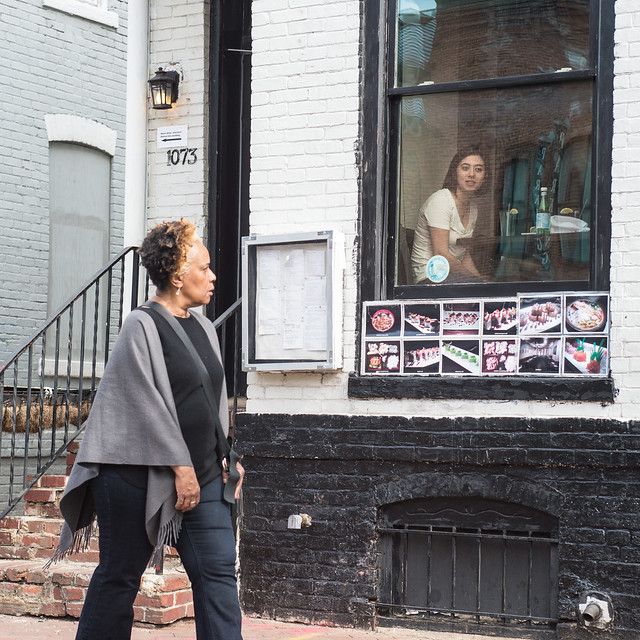
Georgetown (less cynical)

Georgetown Street Scene, by Reed A. George
Nikon Df, Nikkor 35-70mm f2.8 AF-D at 70mm
iso 400, f5.6, 1/500 sec.
 
Shot through open passenger window while stopped in traffic.
 
DMC-365.blogspot.com

"Sightseeing"

"Sightseeing"at the Lincoln Memorial, by Reed A. George
Nikon Df, Nikkor 35-70mm f2.8 AF-D at 40mm
iso 400, f5.6, 1/800 sec.
 
 
DMC-365.blogspot.com

Monday, February 15, 2016

Snowy President's Day in Virginia


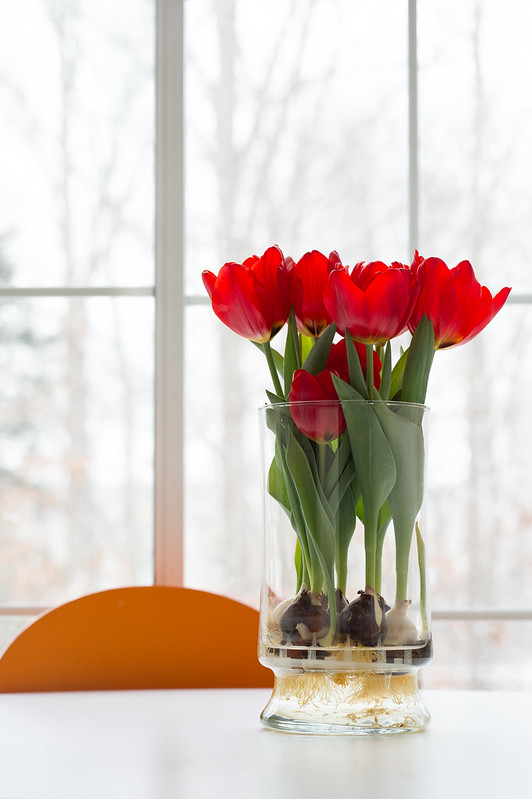
Valentine Flowers in Snow
Nikon Df, Carl Zeiss 85mm f1.4 Milvus Lens
iso 800, f5.6, 1/250 sec.
 
I have the great fortune of trying out two of the Zeiss Milvus lenses, the 85mm and 50mm f1.4, on loan. They are absolutely gorgeous.
 
DMC-365.blogspot.com
 

Monday, September 21, 2015

Learning the Nikon D810 - My Menu Settings

D810's "My Menu"
 
I've been using my new Nikon D810 almost exclusively for shooting birds with my 200-400mm f4 lens so far. Clearly, it's good for so much more in addition.
 
So, I've decided to figure out how to use all of the functions, and how to remember which are important to think of regularly as I change shooting conditions.
 
Among the features are Shooting and Custom Setting "Banks." These allow you to save settings for different applications and quickly switch between them. The big problem (unbelievable, really), is that if you're in a bank and change a setting, it remains changed, even after you turn off the camera. Basically they really only represent whatever your settings were last in that bank! Yes, you can get around this, if you can remember to reload settings each and every time you shoot. This requires not only a good memory, but also that you use the same memory card (where the settings are stored) every time, and don't format it. Not so useful.
 
A better option is to use "My Menu." This feature allows you to identify up to 20 settings from the menu system, which you want quick access to at any time. I went through every menu and selected which features I think I'll need regularly. Here they are:
 
  1. ISO sensitivity settings
  2. e3 Flash contrl for built-in flash
  3. e4 Exposure comp. for flash
  4. Image quality
  5. Battery info
  6. NEF (RAW) recording
  7. Manage Picture Control
  8. d13 Battery order
  9. d5 Electronic front-curtain shutter
  10. d4 Exposure delay mode
  11. c4 Monitor off delay
  12. c3 Self-timer
  13. c2 Standby timer
  14. b6 Center-weighted area
  15. a8 Number of focus points
  16. a4 AF activation
  17. a1 AF-C priority selection
  18. Long exposure NR
 
That still leaves two more features, should I decide to add them.
 
These are by and far the features that I'll use most. By having them in My Menu, I will only have to find them in a list of 18, rather than searching through the entire menu system when I need them. Win.
 
So, while I may not use the settings banks, My Menu will be key for my use of the D810.
 
DMC-365.blogspot.com
 

Thursday, September 17, 2015

Exciting New Lenses from Zeiss - Milvus Line for DSLRs

 
Zeiss makes absolutely wonderful lenses. For Nikon camera bodies, the ZF lenses are all manual focus, and are unquestionably at the top of optical performance.
 
Not too long ago, they came out with the Otus 55mm f1.4 and 85mm f1.4 lenses for Nikon and Canon DSLRs. The Otus lenses are advertised as providing medium format image quality on the 35mm sensor size. They also cost at least $4,000. I'd love to try one.
 
Now, Zeiss has come out with the Milvus line. Announcing the full lineup all at once, there are Milvus models in the following focal lengths and maximum apertures: 21mm f2.8, 35mm f2, 50mm f1.4, 85mm f1.4, 50mm f2 Macro, and 100mm f2.8 Macro. Again in manual focus, the Milvus lenses are more reasonably priced, listing for less than $2,000 each on preorder at Adorama. They should be shipping in October.
 
So, what's special about the Milvus lenses? They're designed specifically for the new high pixel count sensors, with low light scattering, precision manual focus across the full focus range, and weather resistance.
 
(Click Here) to read more about the Milvus lenses on Zeiss' website.
 
It's great that Zeiss keeps bringing us high quality optics for various camera systems. I love the variety they're offering.
 
DMC-365.blogspot.com
 

Thursday, August 6, 2015

lions, tigers, and... BEARS! Oh, My.

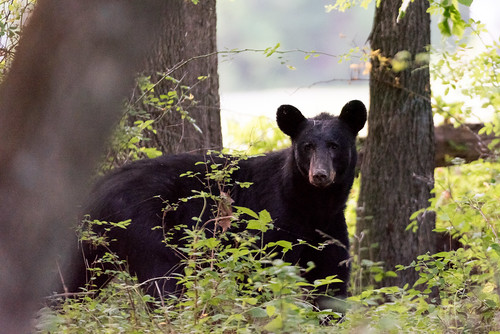
Okay, no lions or tigers, but on the drive in to my local kayaking spot here in Northern Virginia this weekend, I did see foxes (4), deer (dozens), and a black bear!
 
Black Bear (Ursus americanus) in Suburbia, by Reed A. George
Nikon D810, Nikkor 200-400mm f4 AF-S VR Lens
iso 3200, f4, 1/125 sec.
 
Keep in mind, this is in Northern Virginia, where the townhouses and strip malls are rapidly gaining on the trees in number. It was a pleasant surprise to see this beautiful animal here. Also a little troubling. I'm concerned for his (her?) future.
 
It was just after 6:00 AM, and the light was low there in the early morning shade. I didn't have time to make adjustments, other than to crank the iso up as far as I felt comfortable with. Luckily, that got me to a shutter speed where one or two exposures came out sharp, even though I was handholding the big 200-400mm lens, zoomed to 400mm.
 
The approximate focus distance is 29.9'. That bear could cover that distance in less than one second. Thankfully, he didn't.
 
DMC-365.blogspot.com
 

Tuesday, August 4, 2015

Nikon D810 and Df - The Best Combination Available Today?

Well, I've been thoroughly enjoying my Nikon Df for some time now. The low light capabilities of this camera are spectacular.
 
I've recently purchased a Nikon D810, specifically to take advantage of the increased resolution (36 megapixels) for nature photography. Mounted on my Nikkor 200-400mm f4 AF-S VR G lens, the D810 should allow me more freedom in cropping, which is always useful in wildlife photography, especially with active species like birds.
 
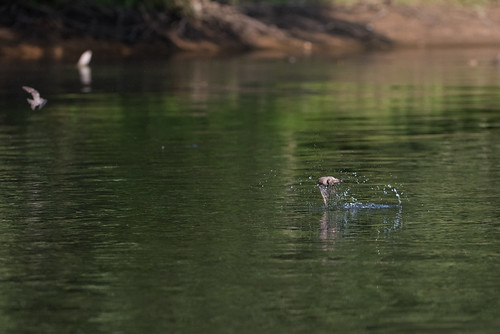
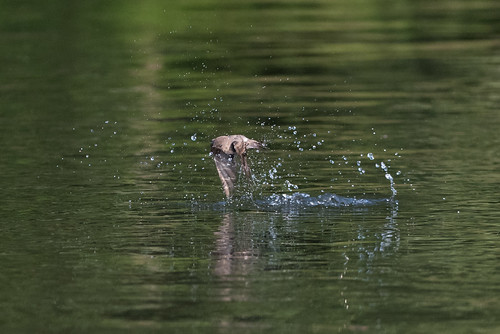
I've only had my D810 out a couple of times so far. One was this morning, shooting birds on a kayak outing. Here's a tightly-cropped shot of a swallow hitting the water surface.
And here's a 100% blow-up (cropped even more).
What I've found so far is that while the D810 does allow significant cropping, it doesn't handle high iso noise nearly as well as the Df. Of course, that's well-known in the Nikon crowd, and makes perfect sense, given the much higher number of pixels crammed into the same sensor real estate as the Df. The shots above were made at iso 1600, and noise is quite visible on my screen, looking at the images in Lightroom.
 
Here's a snapshot of DxO Lab's comparison of the two cameras:
 
Image Source: http://www.dxomark.com/Cameras/Compare/Side-by-side/Nikon-Df-versus-Nikon-D810___925_963
 
As you can see, the D810 wins in overall score, color depth, and dynamic range. But, it performs significantly worse in low light (high iso). Again, no new information here, but it's helping me to form my opinion of this pair of cameras and how best to use them.
 
Basically, the D810 will fill my need for high resolution and cropping ability when shooting wildlife in good light. Or anything else in good light, for that matter. The Df will remain my go-to camera for more challenging lighting situations, and when cropping is not as necessary.
 
So, I think that for me, yes, this is the best combination of Nikon bodies available today.
 
I have to get the D810 out in the field again, and shoot at lower iso settings. I'm sure that's going to really impress me.
 
DMC-365.blogspot.com


Thursday, July 30, 2015

Freaky Dolls at The Gilded Flea

My friend Dwayne Brooke, guitarist and creative genius, owns a fun antique shop in Harpers Ferry, West Virginia, called The Gilded Flea. (Click Here) to check them out.
 
I recently stopped in, while my Mom was in town. Of course, Mom found some treasures. But what intrigued me were these two uber-creepy dolls.
 
Cracked, by Reed A. George
Nikon Df, Nikkor Pre-AI 55mm f1.2 Lens
iso 400, f1.2, 1/60 sec.
 
Mom tells me the doll below has "sleep eyes." I'd say it looks more like out of body experience or possessed eyes, but that's just me.
 
Sleep Eyes, by Reed A. George
Nikon Df, Nikkor Pre-AI 55mm f1.2 Lens
iso 400, f1.2, 1/60 sec.
 
DMC-365.blogspot.com

Tuesday, July 28, 2015

So, Which of My Lenses Are Best on the Nikon D810?

 
Nikon
 
The advent of the D810, and its predecessors the D800 and D800E, caused many photographers to find the limits of their lenses. It used to be rare that the sensor was good enough to have the lens be the limiting factor in image quality, or acuity. Now, it's not rare at all.
 
So, which lenses from my (rather extensive) kit of Nikkors will work well on the D810 that's on its way to me in the mail?
 
I found a nice list on the DxO page, which lists the top choices for prime and zoom lenses for the D810. Testing over 100 lenses on the D810, they've compiled a list of the ones they found most suited to the new super-sensor. (Click Here) to read the full list.
 
As expected, my new 28mm f1.8 AF-S G lens, my most modern lens, makes the list. Importantly, so does the AF-S 200-400mm VR, though they tested the version 2 of this lens; mine is version 1. As the 200-400 is likely to be my most-used lens on this new camera, that's important to me. Another modern lens in my kit, the 70-300mm f4.5-5.6 VR zoom made it on the list. That's good.
 
Then there were a couple of surprise entries from my older lens selection: the 85mm f1.8 AF-D and the 50mm f1.4 AF-D (which I use all the time). Great to see those there, as well.
 
So, I feel that in addition to the 200-400, which will be my nature workhorse, I've got a full set of wide (28mm), normal (50mm), short telephoto (85mm), and long compact zoom (70-300) to choose from with this camera. I'll certainly use other Nikkors on the D810, but with these, I know that I can expect the very best results.
 
DMC-365.blogspot.com
 

Monday, July 27, 2015

Well, I'm Going For It - Nikon D810

Nikon
 
I have long said that my Nikon D700 is the single best-performing camera I've ever owned. Not the highest fun-factor (as I love my rangefinders and old film cameras), but best at getting the shot, and in the most high quality way. So, I have not upgraded it, even after several years. I did add the Nikon Df, which is just a different beast, and brings the fun factor up considerably with its retro design, ability to take non-AI lenses, and smaller size.
 
What I did upgrade was my telephoto lens choice. Selling the spectacular 500mm f4 AiP manual focus lens, I invested in the first version AF-S 200-400mm f4 VR lens. Having fast autofocus significantly improves my chances of capturing great nature photographs. On the D700, the 200-400 really sings.
 
So why upgrade to the D810? Well, really for one reason, and one reason only - resolution. I will be able to shoot the D810 in DX crop mode and still produce 15.4 megapixel images. That is higher than the D700 at full frame, and turns my 200-400 telephoto into the equivalent of 300-600mm, without the 1.4X tele-extender! That's powerful. Or, I can shoot in full-frame (36 megapixel) mode, and crop in post-processing. That's really going to increase the number of bird-in-flight images that will be useful and printable at large sizes.
 
Resolution is the only reason that I know now. I have a feeling I'll find other reasons to love the D810.
 
I bought mine refurbished by Nikon. The cost savings was significant - I paid $2,550 at Adorama, including a third party "drops and spills" 3 year extended warranty. The camera lists for almost $3,300.
 
I don't expect the D810 to become my most-used camera; I love the Df and know the D810 won't replace it. I do expect the D810 to be my go-to nature and wildlife camera.
 
DMC-365.blogspot.com
 

Sunday, July 26, 2015

Here's Something I've Been Thinking About - the Nikon D810 in Crop Modes

 
I am now the proud (half) owner of a Nikkor 200-400mm f4 AF-S VR G lens. Half, because I co-own it with a good friend of mine.
 
I always laugh when someone asks me what gear to buy to do a little nature photography, especially bird photography. Now that I have the 200-400, typically attached to my D700, I find myself thinking about what I could do with a D800 or D810 - so many more pixels that would allow me to use the crop modes (1.2 or 1.5) that are built into the camera, and still end up with images with sufficient resolution to print big.
 
At 1.2 crop, the D810 produces 25 megapixel images, and at 1.5 crop (same as DX sensors), the images are 16 megapixels. That's a serious advantage over the D700, with its 12 megapixels at full frame.
 
I love my D700, but a D810 may just be the perfect match for the 200-400 lens for nature photography.
 
(Click Here) to read a post by Kirk Tuck on the Visual Science Lab about this very subject.
 
DMC-365.blogspot.com


Wednesday, July 22, 2015

Lens Comparison: Nikon Nikkor 55mm f1.2 Non-AI Versus 50mm f1.2 AIS

Not long ago, I purchased a near-mint Nikkor 50mm f1.2 AIS lens from my friend. This super-speed manual focus lens is still made by Nikon, and is simply beautiful. I've posted a few shots from it. (Click Here) to see some photos I made with it in the darkness, during a fire.
 
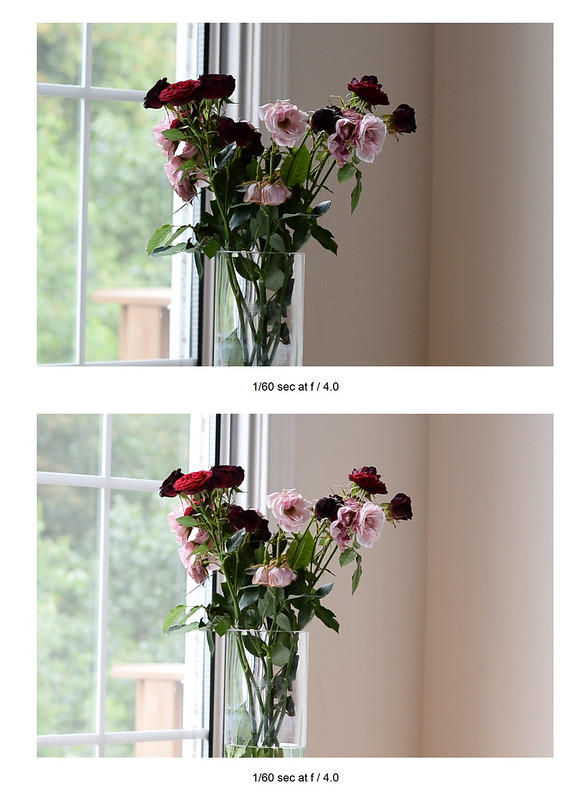
Well, for no reason other than curiosity, I just bought a much older (1970s vintage) Nikkor 55mm f1.2 Pre-AI lens. With the older lens at about half the cost of the AIS lens, I was very interested to see how the two compare. So, I mounted the 55mm lens on my Nikon Df, set the iso to 160, and began to shoot from a tripod. I shot at f1.2, 1.4, 2, 2.8, 4, 5.6, and 8. You can click on any of the following images to see them full size on flickr.
 
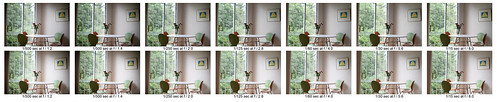
Here's what the whole scene looked like (top row: 55mm f1.2 Non-AI, bottom row: 50mm f1.2 AIS):
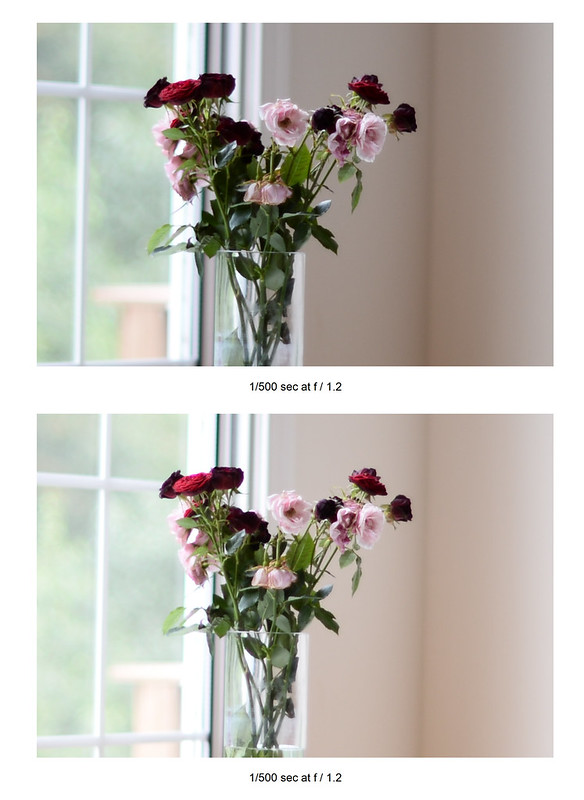
(Click Here) to go to the full flickr set, where you can get a much better idea of how these lenses compare. Be sure to look at how the vignetting decreases on both lenses as I stop down, look at the focus points (the flowers), out of focus areas (like the lemon painting on the wall at right), and how out of focus highlights are rendered. Here are a couple of selected comparisions, at f1.2 and f4:
f1.2, 55mm Non-AI on Top, 50mm AIS on Bottom
f4, 55mm Non-AI on Top, 50mm AIS on Bottom
 
I need to look at these more closely, but immediately conclude that the sharpness doesn't differ much at all. I also see that the 55mm lens seems to let less light in at the same f-stop as the 50mm lens. This could be do to the more modern coatings on the 50mm AIS lens.
 
If you're interested in these super-fast Nikkor lenses and their history, (Click Here) to read more on Nikon's website. Great information!
 
I plan to enjoy both of these lenses. The non-AI lens will be fun to put on a matching-age Nikon F2 and shoot some film with.
 
DMC-365.blogspot.com

Tuesday, July 14, 2015

Ice Cream, Anyone?

 
Ice Cream, by Reed A. George
Nikon Df, Nikkor 28mm f1.8 AF-S G Lens
iso 500, f2, 1/125 sec.
 
I shot this at a recent live music festival. My new, latest-technology Nikkor 28mm lens is pretty nice. At f2, focused on the ice cream cone, and this close to my subject, the nice lady serving me is slightly out of focus. Honestly, my attention was fully on the ice cream, and that's where the emphasis is in the picture.
 
DMC-365.blogspot.com
 

Monday, July 13, 2015

Summer Leaves

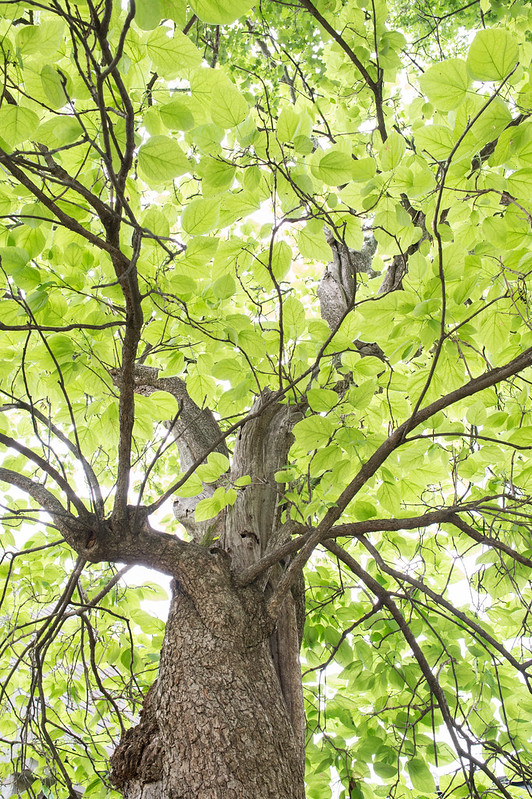
There's something about trees. They have this incredible range of dimension, from the microscopic detail of leaf structure, to the sometimes impressively large structure of the trunk and root system. There's a lot going on inside this one living organism, and even more just outside.
 
Photographers, including me, love to shoot the autumn leaves. I found this tree, which happens to be at its peak summer health, equally interesting
 
Summer Leaves, by Reed A. George
Nikon Df, Nikkor 28mm f1.8 AF-S G Lens
iso 3200, f5.6, 1/125 sec.
 
I spot metered a point on the gray tree bark to get this exposure. Of course, that meant blowing out the highlights in the white sky around the leaves, but that's okay.
 
DMC-365.blogspot.com
Thursday, June 18, 2015

How to Take a Unique Car Show Image? Go at Night!

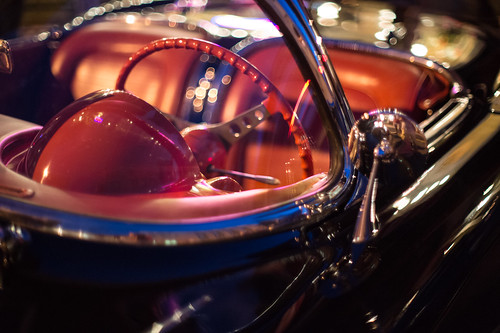
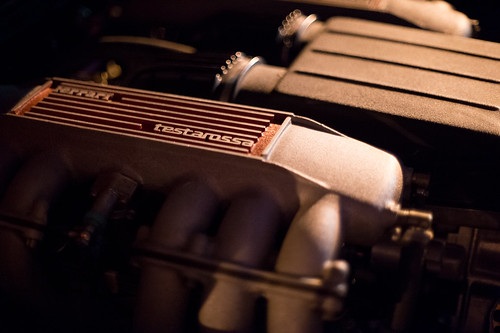
My friends Dennis Gallus, James McKearney, and I have been frequenting a couple of annual car shows for a few years now. This year, with Dennis moved off to Arizona and James spending more time in Boston, I didn't even know when the Leesburg car show was scheduled. It just so happened that I took my daughter into town to enjoy the evening air and came upon it, just after dark.
 
These are some of the most memorable shots I've ever made there, and it's in large part due to the darkness.
 
Night at the Carshow, by Reed A. George
Nikon Df, Nikkor 50mm f1.2 AIS Lens
 
Later on in the evening, we got a surprise, which I'll cover in a future post.
 
DMC-365.blogspot.com
 

Tuesday, May 26, 2015

Nikon 200-400mm f4 AF-S G VR Lens for Birds - The Warbler

My friend and I have just invested together in a very expensive lens - the Nikkor 200-400mm f4 AF-S G VR (version 1). Last weekend, I took it out in my kayak along with my super-sturdy Gitzo tripod and gimbal head.
 
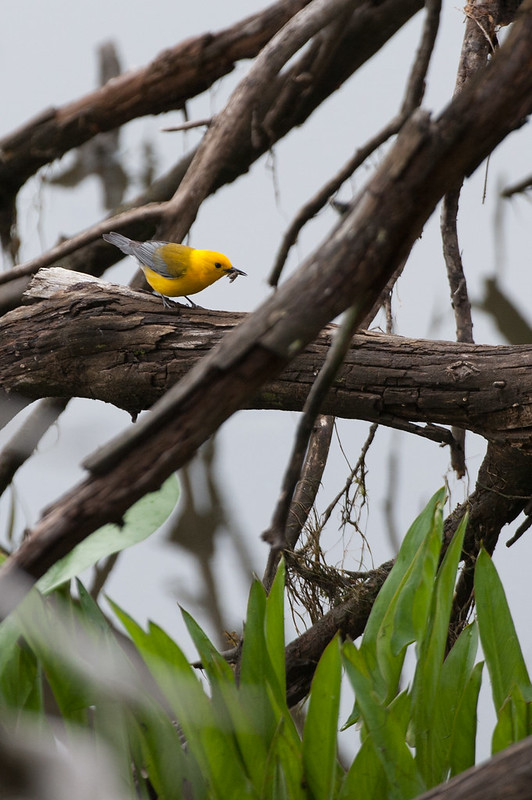
While I was waiting for large birds to fly by where I'd set up the tripod, this colorful little guy showed up.
Prothonotary Warbler, by Reed A. George
Nikon D700, Nikkor 200-400mm f4 AF-S G VR Lens
iso 720, f5, 1/1000 sec.
 
I had the D700 set to auto-ISO, so that I could set a fast (1/1000) shutter speed and the f-stop I wanted, letting the camera adjust ISO. As you can see, the warbler has an insect in his beak, a nice additional feature for the image.
 
Here's another shot of the same warbler.
 
Prothonotary Warbler, by Reed A. George
Nikon D700, Nikkor 200-400mm f4 AF-S G VR Lens
iso 1600, f5, 1/1000 sec.
 
We also purchased the Nikon TCIIE 1.4X teleconverter with our lens. I could have used it here. Both of these shots are cropped from larger compositions (hey, he's a pretty small bird!). I did get a chance to try the lens and converter together. I'll post some of those shots in the coming days.
 
This is one amazing lens.
 
DMC-365.blogspot.com
 

Sunday, May 24, 2015

Northern Water Snake - Nikkor 300-400mm f4 AF-S VR G Lens

I went kayaking today, for the third weekend in a row. Get it, in a row? Sorry about that. I think I'm a little punchy after so much exercise.
 
Today, I had the distinct pleasure of testing out a new telephoto lens, the amazing Nikkor 200-400mm f4. This is not an easy lens to handle, but mounted firmly on a gimbal head and super-heavy tripod, I was able to get it to shine, including with the Nikon TC14EII teleconverter. The focus is super-fast and accurate.
 
 
Northern Water Snake (Nerodia sipedon), by Reed A. George
Nikon D700, Nikkor 200-400mm f4 AF-S G VR Lens
Nikkor TC1.4EII Teleconverter (final focal length 360mm)
iso 2200, f8, 1/1250 sec.

I got some really nice bird shots today as well, including some really sharp shots of birds in flight. But, I'm too tired to process them tonight. So, you'll have to live with this teaser shot of a northern water snake until I get some sleep.
 
DMC-365.blogspot.com



Tuesday, May 19, 2015

Use Nikon Autofocus? You MUST Watch this Video by Steve Perry

I have been shooting some wildlife recently with my Nikon cameras. With the spring weather finally here, I love to get out in my kayak and photograph birds and other wildlife.
 
My current telephoto lenses are a 300mm f4 AF-I (very old autofocus lens) and a 500mm f4 Ai-P (manual focus). Both are excellent optics, but are a bit dated. I have worked on my manual focus technique with the 500mm, and can even catch the occasional sharp image of a bird in flight.
Bald Eagle in Flight, by Reed A. George
Nikon D700, Nikkor Ai-P 500mm f4 Manual Focus Lens + 1.4X Teleconverter
iso 1600, f5.6, 1/1000 sec.
 
Of course, things get easier with autofocus, especially Nikon's modern AF-S lenses. I'm about to get my hands on a lovely 200-400mm f4 AF-S VR lens, so I'm reading up on autofocus technique.
 
Here's an outstanding 12 minute video by Steve Perry, showing some of the key concepts for successful autofocus with Nikon DSLRs:
 
If you have problem with getting to the video, (Click Here).
 
One of the techniques that Perry practices is "back button" AF. This means using only the back AF-on button to focus, and not the typical half-press of the shutter release. With the camera set to continuous AF (AF-C), you simply let your finger off of the back button when you want to lock in focus, or keep pressing to follow and focus on a moving subject. Really helpful.
 
Just to try it out, I took my D700 and 70-300mm AF-S VR lens out tonight and gave it a shot with some flying geese. It worked really well. I literally can't wait to get my hands on that 200-400!
 
DMC-365.blogspot.com
 

Wednesday, May 13, 2015

Some Wildlife From my Kayak - Nikon Df and Nikkor 300mm f4 AF-IF Lens

I have an older Nikkor internal focus 300mm f4 lens. I have been tempted to upgrade it to the AF-S version, but mine is so good, I just haven't seen a reason to do it.
 
Yesterday, I loaded my Nikon D700 and 500mm f4 Ai-P (manual focus) lens and matching gargantuan Gitzo tripod that I picked up very used and very cheap, along with my Nikon Df and 300mm f4 and Tamron AF 1.4X tele-extender into my kayak and paddled out. I ended up never using anything but the Df and 300mm. Instead of setting up my tripod near my favorite osprey nest (even though the birds are on the nest), I decided to paddle further up the creek and explore.
 
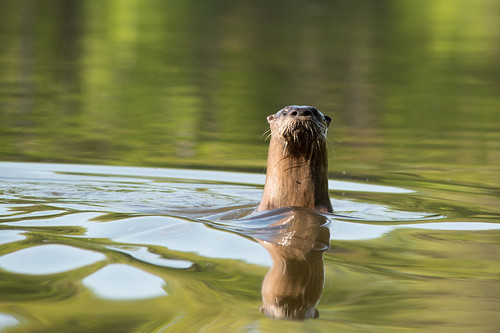
Stopping to rest in the shadow of a steep bank, not five minutes later I saw a swirl in the water, followed by a head coming to the surface. Thinking that it was likely a beaver, I started shooting. The sound of the camera clearly alarmed the animal, who quickly went under water, then returned to the surface looking straight at me. It was a river otter! The first one I've ever seen in the wild. He actually raised high out of the water to get a good look at me. I was ready, with my Df set to lock exposure with the rear button, meter set to spot metering, and auto-focus ready to go. Here's one of the shots I got.
 
 
River Otter, by Reed A. George
Nikon Df, Nikkor 300mm f4 AF-IF Lens
iso 1100, f8, 1/1000 sec.

Another otter passed through very quickly a minute later.

I had the camera in auto-ISO mode, and exposure in M. So, I had a fast shutter speed and optimal f-stop already set. The camera chose the ISO. With the Nikon Df, I could shoot with confidence, without worrying about digital noise from the relatively high ISO setting.
 
I've printed this image at about 10"x15" and it looks just great.
 
I've got some more images from the morning kayak trip, and will share them in later posts.
 
DMC-365.blogspot.com