
Blogger's Morning
Lumix DMC-LX5, iso100, f5.6, 1/60 sec, 16:9 ratio
This is just a quick grab shot that I think epitomizes my mornings - coffee, blog writing, journaling. Could be worse...
DMC-365.blogspot.com


Sunrise at the Old Stone House, Manassas National Battlefield, Virginia
Lumix DMC-G3, 20mm f1.7 lens, iso 400 f6.3, 1/125 sec

Closeup of Window, Old Stone House, Manassas National Battlefield, Virginia
Lumix DMC-G3, 20mm f1.7 lens, iso 400 f6.3, 1/320 sec
There were two major battles here, approximately one year apart (1861-1862). They are referred to as First and Second Manassas by the South, or First and Second Bull Run by the North, who preferred to call battles by the names of nearby rivers.
The Old Stone House was a battlefield hospital in both battles, and sustained significant damage in the war. There are inscriptions in some of the walls, written by wounded soldiers.
Even though I have visited this site many times, on this visit I discovered something new - a cannonball embedded in the exterior brick wall.

Cannonball placed in exterior wall of the Old Stone House
Lumix DMC-G3, 20mm f1.7 lens, iso 160 f1.7, 1/2500 sec
Apparently, when the house was rebuilt at some point after the war, perhaps after 1912, the cannonball was placed in the wall where it actually sustained a hit during the battle.
Here is an HDR shot of the interior, through a rear window:

DMC-365.blogspot.com

Learning From Our Past
I took this picture a few years ago. While it was not taken with a Lumix camera (Nikon D200), I felt it was woth posting today, in memory of Dr. King.
We can all learn something from that man.
DMC-365.blogspot.com
Okay, so you've been watching how the capability of very compact cameras has been increasing quickly, blurring the lines between compact and SLR, amateur and "pro" equipment. These changes are real. For example, the Lumix DMC-LX5 has many features and image quality previously restricted to more expensive (and heavier, larger) cameras.

But, the compactness and lightness of these new models is both blessing and curse. Okay, mostly blessing, speaking as someone whose back has suffered from 40 lb camera bags. One drawback is that the new cameras are so small, it's very difficult to hold them still during exposure, which is necessary to avoid blurring of the image when using slower shutter speeds. Also, using an LCD display to frame your shot, with your arms extended, puts you in a less stable position to begin with. So, how do you eliminate your own motion during shooting and get those sharp images you want?
In a lively forum entry on dpreview.com, user Rick880 asked this very question. Here is a link (click here), but I will save you some reading time by summarizing the ideas for you:
First off - the old standard - a good tripod and cable release. The small camera blessing applies here, as you can get away with a very compact tripod, with so little weight to stabilize. Cable releases are available for some models, but not all. In the case of the DMC-LX5, Richard Franiec's website (click here) offers this nice adapter that uses a standard screw-in cable release. You can order the product directly via email/Paypal.
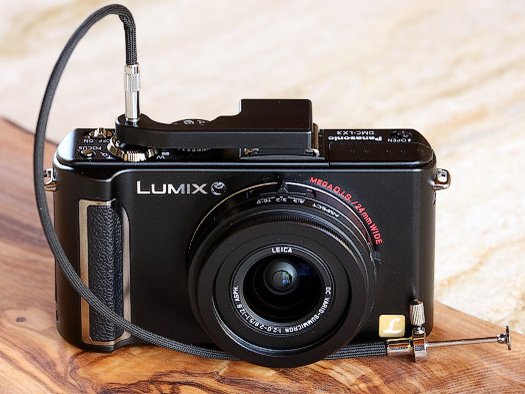
Photo source: http://www.kleptography.com/rf/lx3_04.jpg
But, a even a small tripod may be more than you want to carry.
A second approach is to use something - the neck strap, a string or chain connected to the camera, usually through the tripod mount on the bottom of the camera, and pull it tight while you've got the camera in shooting position. This lends some stiffness to your body and arms, which can significantly reduce motion. Here's an example of a homemade version from instructables.com:

"String Tripod"
Image Source: http://www.instructables.com
/image/F1N2WJVF0ZSTF17/String-Tripod.jpg
A third method is to use the camera's internal timer to trigger the shutter. This removes the tendency to move the camera when pushing down on the shutter release with your finger. However, it requires a subject that will wait a few seconds for your timer to go off, without missing the shot.
Fourth, most new compacts have a "burst" mode, where they will take multiple images in rapid succession. If you take several pictures, you can usually find one that's very sharp. This has the same disadvantage, in that it's only useful if your subject is holding still.
Finally, some advanced compacts, the DMC-LX5 included, have optional viewfinders (the LVF1 in the case of the LX5). This may be the best way to avoid that "arm's length" motion, by bringing the camera back to your eye, which is where it belongs in my opinion. You are much more stable in this position than with your arms extended, camera at the far end.
I hope you find these tips helpful. These little cameras really are amazing - don't let their small size be a disadvantage!
DMC-365.blogspot.com
I am working on a photography project about the 150th anniversary (sesquicentenial) of the United States civil war. Living in Northern Virginia, I am in a prime location. I am an hour or less from several major battlesites, including Manassas (Bull Run), Antietam, and Gettysburg. This project will last over the coming four years.
On May 23, 1861, under the command of Thomas (soon to be "Stonewall") Jackson, confederate forces appropriated a large set of railroad equipment, including locomotives, cars, tools, and track, from the B&O Railroad for use in the rebel cause. As a result of damage to the tracks, the equipment had to be moved overland. For a full description, see: http://en.wikipedia.org/wiki/Jackson's_operations_against_the_B%26O_Railroad_(1861) Pictured here is reenactor and historian Arthur Candenquist who presented on the Great Train Raid at Zion Church in Aldie, Virginia on November 13, 2011. He was dressed as, and spoke from the perspective of Confederate Captain Thomas R. Sharp.


Captain Sharp's Boots
Lumix DMC-GF1, Pana-Leica 45mm f2.8 Macro-Elmarit
iso800, f2.8, 1/125 sec
DMC-365.blogspot.com

