Showing posts with label BW. Show all posts

Sunday, June 30, 2013

A Shot That's Close to My Heart - From Leica IIIC

Intensity, by Reed A. George
Leica IIIC, Leica Summitar 50mm f2 Lens
 
I recently picked up a nice Leica IIIC for an amazing low price. Knowing that it had been purchased from Leica repairman extraordinaire, Youxin Ye, I could be confident that it would work well. It does.
 
Here's a shot from my first roll through the IIIC. I shot it at a music festival, where my daughter did me the pleasure of accompanying me. That's asking a lot of a twelve year old. But, we're still buddies, and always will be.
 
This is the online scan provided by The Darkroom, who processes my film. (Click Here) to visit The Darkroom for excellent, fast, cost-effective processing of your film.
 
I absolutely love shooting the old Barnack screwmount cameras, like this IIIC. Prices on these cameras have dropped, so you can own and shoot a piece of Leica history for a very reasonable price these days. This new IIIC has the special sharkskin covering, which was only used for a short period in Leica production. I'm happy to have it in my collection.
 
DMC-365.blogspot.com


Tuesday, December 25, 2012

Christmas Time in the City

 
Skating Rink, Washington, DC, by Reed A. George
Leica M9, Carl Zeiss Sonnar C 50mm f1.5 Lens
iso 640, f1.5, 1/125 sec
 
A couple of days ago (on December 23), I took advantage of the nicest weather we will have over the holiday break and drove into DC to spend some time in the city. The ice skaters were out in full force. As the sun set on the horizon, I was waiting for the lights to come on around the rink. Very soon after, I caught this moment. I love the lines of the lights and the hand rail, and the wistful look on the young lady's face. It's Christmas Time in the City.
 
It occurs to me that my M9 has achieved what my M8 never did. Not only is it as capable as my other Leicas (and more capable in many ways), it is just as fun to use. I suppose that the crop factor math always in my head, UV/IR filters, and necessity of lens coding were just enough to keep the M8 from getting there with me. The M8 is also a very capable camera, and the image quality is great. It just never felt as good as my M4-P, for example. The M9 does.
 
DMC-365.blogspot.com
 
 
DMC-365.blogspot.com
 
DMC-365.blogspot.com
 

Saturday, June 23, 2012

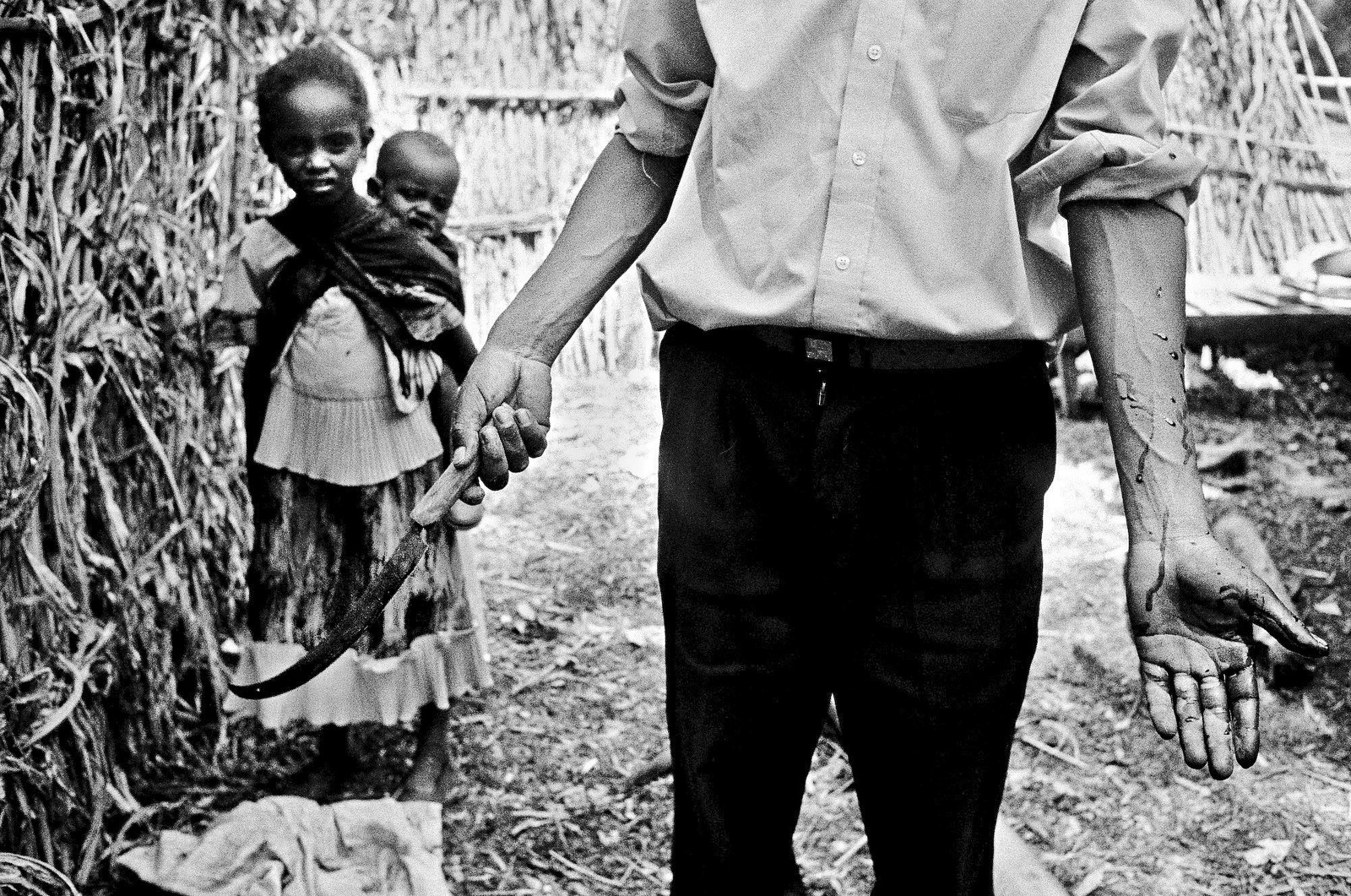
Just Go Shoot, by Aaron Hardin on Steve Huff Photo

Photo By Aaaron Hardin
Image Source: http://www.stevehuffphoto.com/wp-content/uploads/2012/06/HARDIN-Ethiopia-2.jpg

I personally need to hear this message, repeatedly, often - "JUST GO SHOOT!" It really helps when it's accompanied by great photos, as it is here on Steve Huff's blog, in a brief, inspiring piece by photographer Aaron Hardin (aaronhardinphoto.com)

(Click Here) to read the post on stevehuffphoto.com

Aaron admits that he also gets his mind diverted by new equipment (the Leica M9, in his case), but is able to pull away and use what he already has to make beautiful pictures. In this case, he photographed in Ethiopia with a single film body (Leica M4-P), 35mm lens, and a bag of film. No back-up equipment.

Personally, I'm hesitant to attend a local event without a back-up camera body on hand. How often do I need a back-up? Very rarely. Especially if I'm restricting myself to a single lens.

I currently find myself strategizing which new lenses to buy for my Lumix Micro 4/3 kit - at the moment I'm fixated on the Lumix 12-35mm f2.8 and the Olympus 75mm f1.8. At the same time, I'm considering whether to broaden the scope of my blog sometime in the future, to regularly include equipment other than Panasonic. I already include other equipment, but try to keep a Panasonic-related theme. If I decide to broaden that focus, Micro 4/3 may not be where I want to add equipment. So, as you can see, I'm preoccupied with equipment. This is nothing new; I'm a self-described gear head.

But, I need to become equally obsessed with shooting great projects. Luckily, I'm persistently pursuing a couple of projects. For example, this weekend will add another piece to my local music project, with a festival on the shores of the Shenandoah River.

Obsession is not a bad thing. In fact, it's a common theme amongst highly successful people. I just need to keep mine focused on the photography, as well as the equipment.

Here's something for me to keep in mind: I have the same Leica M4-P and 35mm lens in my collection. When was the last time I took just that combination out and used it consistently? Well, let's just say it's not my normal mode. I will think about that.

Thanks for reading through my self-counseling!

DMC-365.blogspot.com

And, if you want to spend the same on a single lens that you'd spend on a whole kit:


Sunday, June 10, 2012

A Shot I Just Happen to Like

Small Town At Dusk, by Reed A. George
Small Town at Dusk, by Reed A. George
Panasonic Lumix DMC-G3, Pana-Leica Summilux 25mm f1.4
iso800, f3.5, 1/40 sec
 
 
I'm not in the mood to search the news this morning, so I thought I'd just share a shot that I happen to like. You know how sometimes you take an image, think nothing of it, but then it keeps popping up in your mind? Well, this is one of those for me.

I was with my daughter in Winchester, Virginia, and we showed up a little early for a music event. So, we walked the pedestrian street downtown, and I convinced her to pose for this shot.

How's that for using leading lines in composition? I like how the line of lamps on the brick wall mirrors an imaginary line from the vanishing point to her face. The line to her face is an implied line, one that's not really even there, but it leads the eye to her. I also like the vertical line of the painted sign on the brick wall. It puts her at an apex, a center of attention. So, I feel that it brings the viewer's focus to her, without having to make her a major fraction of the area of the image. No closeup needed. And, it will always remind me of a pretty carefree evening, walking hand-in-hand with her in smalltown, America.

Someday soon, she'll be too cool to be seen in public with her old man. But, I've got this image to help remember these days.

DMC-365.blogspot.com


Tuesday, April 17, 2012

Civil War in Virginia - Shot With Panasonic Lumix 14-42mm Kit Lens

 
Union Soldier at Mount Zion Church, by Reed A. George
Union Solder at Mount Zion Church, Aldie, Virginia, by Reed A. George
Panasonic Lumix DMC-G3, Lumix 14-42mm f3.5-5.6 Kit Zoom
iso160, f5.5, 1/400 sec

I recently attended a local civil war event with my good friend Stan. Stan happens to be an avid Nikon photographer, and a Historian.

We attended an event entitled "Mosby: A Scout Along the Turnpike," which included three distinct historical sites here in Northern Virginia. The first stop for us was at the historic Mount Zion Church in Aldie, where we received detailed descriptions from re-enactors (one playing John S. Mosby, the famous guerilla leader fighting for the confederacy in the area, and another playing a Union soldier, above). The church, built in 1851, at various times in the civil war served as the first rendezvous site for Mosby and his Rangers, a field hospital, a barracks, a prison, and an actual site of military action. Union troops convalescing in the church as field hospital left graffiti on the walls that remains today. Also at this first site was a nice display of period-style weapons, like those shown below.


Muzzle Loader, by Reed A. George
Muzzle-loading Springfield Rifle, by Reed A. George
Panasonic Lumix DMC-G3, Lumix 14-42mm f3.5-5.6 Kit Zoom
iso160, f7.1, 1/500 sec


Colt and Remington Style PIstols, by Reed A. George
Colt and Remington-Style Pistols, by Reed A. George
Panasonic Lumix DMC-G3, Lumix 14-42mm f3.5-5.6 Kit Zoom
iso160, f7.1, 1/500 sec

The next stop on our tour was the Aldie Mill. The mill was owned and operated during the civil war by John Moore, who was genuinely against Virginia's secession from the Union, which put him in a bad situation with his mostly-rebel neighbors. He explained how because there was no room for neutrality in this part of the country during the war, both armies caused him problems at one time or another.

Miller John Moore, by Reed A. George
Panasonic Lumix DMC-G3, Lumix 14-42mm f3.5-5.6 Kit Zoom
iso400, f6.3, 1/350 sec

The old mill is still operational, and was running for the event. Here are a couple of shots from inside the mill.
 
Mill Works, by Reed A. George
Panasonic Lumix DMC-G3, Lumix 14-42mm f3.5-5.6 Kit Zoom
iso800, f4, 1/40 sec
 
 
Grain Detail, by Reed A. George
Panasonic Lumix DMC-G3, Lumix 14-42mm f3.5-5.6 Kit Zoom
iso200, f5.3, 1/160 sec

The final highlight of the Mill site was a slave's tale of the "Aldie Races," where Union soldiers nearly freed Aldie slaves. They had a glimpse of freedom before being returned to their Rebel owners.

Glimpse of Freedom, by Reed A. George
Panasonic Lumix DMC-G3, Lumix 14-42mm f3.5-5.6 Kit Zoom
iso200, f5.4, 1/50 sec

The final stop on our tour was at the Caleb Rector House at Atoka. In this house, John Mosby formed his group of rangers in 1863. Our interpretor at this site impressed upon us how similar Loudoun County is today to what the Rangers knew 150 years ago. He stated that you could drop any one of the rangers in Western Loudoun County today, and they would know exactly where they were.

Rector House Interpreter, by Reed A. Georeg
Rector House Interpreter, by Reed A. George
Panasonic Lumix DMC-G3, Lumix 14-42mm f3.5-5.6 Kit Zoom
Nissin Di466 flash (bounced)
iso160, f5.6, 1/160 sec
 
That wrapped up our civil war lesson for the day. It is great fun to have access to motivated historians with a depth of knowledge of our local history. Each site has its own special charms. For me, the mill is really something. The fact that it is still operational after all this time is very impressive.
 
That said, the church is also deeply interesting, with a cemetery that holds remains of both Union and Confederate soldiers within its walls, and approximately 60 unmarked African American graves just outside. While the Primitive Baptists allowed African Americans to worship in the church, they were always separate, with the whites seated downstairs, and the African Americans upstairs. This separation extended to the burial grounds.
 
Now on to the photographic discussion. I decided to limit myself to a single lens on this trip, the Panasonic Lumix 14-42mm f4-5.6 kit lens. I must admit, I regretted this during the day, and it cost me some nice available light shots inside all three sites, particularly the mill. I found the slowness of the f-stop particularly limiting; it has been a long time since I used a kit zoom for any length of time. And this was a bright sunny day, so conditions don't get much better for a lens of this type.
 
I find the image quality acceptable, but qualitatively lower than I would have gotten with the much more expensive Lumix 14-140 f4-5.8. That's not surprising, given the difference in price. However, since I have the 14-140, the only advantage of the 14-42 would be size, which to me is not worth the trade off in image quality. The 14-140 is not that big, after all. And, if I want small, I'll go for the Lumix 20mm f1.7.
 
In summary, I'll say that the 14-42 is acceptable for a kit lens, but any other native Micro 4/3 lens will yield better image quality. I'll also say that over-constraining myself was instructive, but did cost me a decent image or two.
 
For comparison, and a nice post about the Nikon 18-55mm kit zoom, see this post by my friend Graham Serretta over on Nelson Foto:
 
(Click Here) for the post on Nikon's kit lens.
 
I hope you find the history interesting, and the photography notes useful. It was a great day out for me!
 
DMC-365.blogspot.com


Wednesday, April 11, 2012

Kirk Tuck (Visual Science Lab) Returns, Renewed!

 
Martin Burke, by KirkTuck
 
Actor Martin Burke, by Kirk Tuck
Image Source: http://visualsciencelab.blogspot.com/2012/04/were-back-both-of-us-now-howdy.html#comment-form

Kirk Tuck, blogmaster at the Visual Science Lab (visualsciencelab.blogspot.com) recently took a break from writing. I must admit I was a little worried about what that meant. I've come to enjoy his blog regularly, and didn't want to see it go away.

Well, not to worry. Kirk is back, and with renewed creative drive. In this first entry since returning, Kirk discusses how he's working to add his own creative edge back to his professional photography work.

(Click Here) to read Kirk's story.

In addition to his current professional digital equipment, Kirk is now carrying a Hasselblad and single roll of black and white film. When he's met the needs of the job, he then plans to grab the 'blad and do a little more with his subjects - for his own development.

While I am not a professional by any means, I can understand Kirk's point. Focus is important, but I am feeling some loss by focusing so narrowly on Panasonic products. As you may know, I did sprinkle in a little film work recently, on an outing with fellow blogger Aboud Dweck. I need to do more of that.

I just returned from a trip to Japan, which was exclusively shot with Panasonic equipment. It served me very well. But, as I will write in the near future, I had the experience of going to a flea market in Tokyo, where I found a piece of gear from the past that really got the gears turning for me. It reminded me of a part of photography that I have not been focused on. So, you may see more from some of my other gear in the coming weeks and months.

I will not lose my focus on Panasonic equipment; it really is a great set of tools. However, if focus is important, variety is the spice of life. And I like things a little spicy.

DMC-365.blogspot.com

Support this blog by buying your Amazon items through the link below:


Wednesday, April 4, 2012

Masao Horino Photography Exhibit in Tokyo

Gas Mask Parade by Masao Horino
 
 
Gas Mask Parade, Tokyo, by Masao Horino
Image Source: http://www.55museum.com/?p=16105
 
Back on March 23, I wrote about a couple of exhibits at the Tokyo Metropolitan Museum of Photography, which I hoped to visit on my trip to Tokyo.

Well, it just so happened that I found the perfect day to go - typhoon rain and winds were headed for Tokyo, and people were warned to leave work early to avoid the weather. So, I took the Hibiya subway line to Ebisu Station, and viewed the Masao Horino exhibit.

Horino lived from 1907-1998, but stopped photographing and exhibiting after WWII. The exhibit gave a great feel for his whole career, which began in the mid 1920s, photographing actors and actresses in a small theater in Tsukiji, Tokyo. These are classic posed images, both head shots, and full body shots of performers. One characteristic that came to me right away is that the subjects were always looking outside the frame. It made for a somewhat impersonal style, but may have been due to cultural norms.

In the 1930s, Horino began experimenting with photography of mechanical structures, reportedly in order to find new applications for his cameras. I can identify with that. This is when his bridge images, including the one posted in my March 23 post, were done.

Also in the 1930s, Horino began experimenting with montages (multiple images on a single page, sometimes with a modest amount writing) and overlaying exposures from multiple negatives onto a single print. In this style, he did a series called "Flowing Through the Capital: Sumida River Album." In this series, he photographed people and their association to the river.

In 1932, Horino declared that his experimentation was concluded, and that he was taking his "first step as an artist," focusing largely on photojournalism. I get the distinct feeling that the war affected Horino deeply; some of his most striking pictures of that era included the gas mask parade in Tokyo, shown above, and a celebration parade in honor of kamikaze (suicide bomber) pilots. As mentioned before, after the war, Horino stopped exhibiting his work, claiming that it was lost in the war.

A few of his best works, in my opinion, are:
  • "The Beggar," 1932 - in this case, the straggly-looking man is looking directly into the lens.
  • "Coffee Break," 1933 - two boys and a dog at a table. The interplay between the three characters is really something to see.
  • and the very best, in my opinion, is "Beach" ("Nagisa" in Japanese), taken somewhere between 1934-38. This image shows a girl sitting on a high bluff above the beach, waving to several people on horseback far down below.

I have got to see if I can find some of Horino's images online. Horino is not well-known, partially because he disappeared from the scene after the war. His work is certainly worth seeing.

(Click Here) for a few more of Horino's images.

The typhoon came in, as promised. It rained cats and dogs, and the wind was fierce all night long. In some parts of the country, buses and trucks were blown over, and buildings were destroyed. If my conversions from meters per second are correct, the maximum winds were about 80 mph. By morning, skies were clear and sunny.


Running For It, By Reed A. George
Running For It, by Reed A. George
Panasonic Lumix DMC-G3, Pana-Leica 45mm f2.8 Macro-Elmarit

DMC-365.blogspot.com


Sunday, March 4, 2012

End of Winter Photos From Manassas National Battlefield

Field Hospital Floor, Thornberry House, Manassas, VA, Shot With Lumix DMC-G3
Thornberry House, By Reed A. George
Panasonic Lumix DMC-G3, Lumix 14mm f2.5
iso160, f8, 1/400 sec

Yesterday, I took a walk around the Thornberry House at Manassas National Battlefield. For another post on Manassas, with a little background information about the battles, (Click Here) for my previous post on the Old Stone House.
 
The Thornberry House, pictured above, was an impromptu field hospital for the Union Army during both battles. Those floors and walls have seen the unspeakable horrors of the war and the wounded.


Thornberry House Trees, Shot With Lumix DMC-G3
Thornberry House Trees, By Reed A. George
Panasonic Lumix DMC-G3, Lumix 14mm f2.5
iso160, f8, 1/40 sec

I decided to focus on using a wide angle lens this weekend. At this time of year in Virginia, it is difficult to find a wide field of view outside with anything of interest to photograph. With the leaves down, all looks dull gray and brown. But, I managed a couple of shots.

This is a very contemplative place for me. I can imagine the 15,000 soldiers crossing the creek and coming up the hill, headed for the main battlefield in Manassas. Harder to imagine, for me, they also retreated from here, fewer men, many wounded, some never made it past this point.

Winter Contemplation, by Reed A. George, Lumix DMC-G3
Contemplation, by Reed A. George
Panasonic Lumix DMC-G3, Lumix 14mm f2.5
iso160, f8, 1/320 sec

I always feel a little haunted after visiting this place, but also a little more informed. Now it is a very quiet place, as it should be.

DMC-365.blogspot.com


Saturday, February 18, 2012

Antietam National Battlefield In Winter, Lumix DMC-G1 and 20mm f1.7

Mumma Farm, DMC-G1, Lumix 20mm f1.7
View from Mumma Farm, Antietam, Sharpsburg, Maryland
by Reed A. George
Panasonic Lumix DMC-G1, Lumix 20mm f1.7
iso100, f16, 1/100 sec

On September 17, 1862, one of the bloodiest battles of the United States Civil War began here at Sharpsburg, Maryland.  This view is from the Mumma Farm, which was deliberately burned by Confederate forces, to prevent Union sharpshooters from gaining the advantage of the shelter.  The Mumma family had already fled, and returned to rebuild the farm in 1863.

Mumma Farm Detail, DMC-G1, Lumix 20mm f1.7
Detail - Mumma Farm Outbuilding
by Reed A. George
Panasonic Lumix DMC-G1, Lumix 20mm f1.7
iso100, f3.5, 1/200 sec

 I walked the Bloody Lane Trail at Antietam in December, 2009.  From the Mumma farmhouse, the trail leads over the bald hillside where 10,000 Union soldiers marched to the Sunken Road, an old farm wagon road, already occupied by some 2,200 Confederates.  After the battle, there were so many dead from both sides, the road was renamed "Bloody Lane."
 
 
Bloody Lane Approach, DMC-G1, Lumix 20mm f1.7
 The Union Approach to Bloody Lane
by Reed A. George
Panasonic Lumix DMC-G1, Lumix 20mm f1.7
iso100, f16, 1/80 sec

In total, there were nearly 100,000 soldiers involved in the battle here; 23,000 were killed.  While the Union held the field at the end of the fighting, both sides took horrendous damage, and the line of possession changed very little as a result.

Antietam Sunset, DMC-G1, Lumix 20mm f1.7
Sunset Over Split Rail Fence of Antietam
by Reed A. George
Panasonic Lumix DMC-G1, Lumix 20mm f1.7
iso100, f8, 1/1300 sec

DMC-365.blogspot.com

Please support this blog.  Click below to order your products from Amazon:


Monday, January 30, 2012

One of My Images That Sticks in My Mind

 
Chilled Milk
Chilled Milk
Lumix DMC-G1, 14-140mm f4-5.8 at 14mm, iso400
f5.6, 1/80 sec.
 
I can't say why I like this one, but I do.  Hope you enjoy it too.
 
DMC-365.blogspot.com

Friday, January 20, 2012

The Crooked Mile - One of My Shots

The Crooked Mile - Shot With Lumix DMC-g1, 14-140 Zoom
The Crooked Mile
Lumix DMC-G1, Lumix 14-140mm f4-5.8 at 14mm
iso200, f16, 1/25 sec
 
This shot was taken in Solomons, Maryland.  I opened my zoom as wide as it would go, closed down the aperture to f16 for maximum depth of field, and got down low for a perspective that hopefully draws you into the scene.  
 
The walkway is as ricketty as it looks; I did not venture further out onto it.
 
DMC-365.blogspot.com

Monday, January 16, 2012

Learning From Our Past

 Learning From Our Past

I took this picture a few years ago.  While it was not taken with a Lumix camera (Nikon D200), I felt it was woth posting today, in memory of Dr. King.

We can all learn something from that man.

DMC-365.blogspot.com