Showing posts with label creative photography. Show all posts

Wednesday, June 3, 2015

Ribbon High in the Branches

 
White ribbon high in the branches above,
But how?
A balloon held too loosely in the spring breeze?
No evidence to say so,
But normal silk doesn't often fly to such heights.
What luck, to have been caught at the apex of its path,
We should all be so fortunate.
 
Before me, the gladiator, the eagle, the mounted warrior victorious,
all too captured at their peak.
But do they know?
Is it not just as well to know you've attained it,
and always have the memory,
as imperfect or even embellished?


DMC-365.blogspot.com
 

Monday, April 20, 2015

Another Shot at Light Painting Cherry Blossoms with the Nikon Df

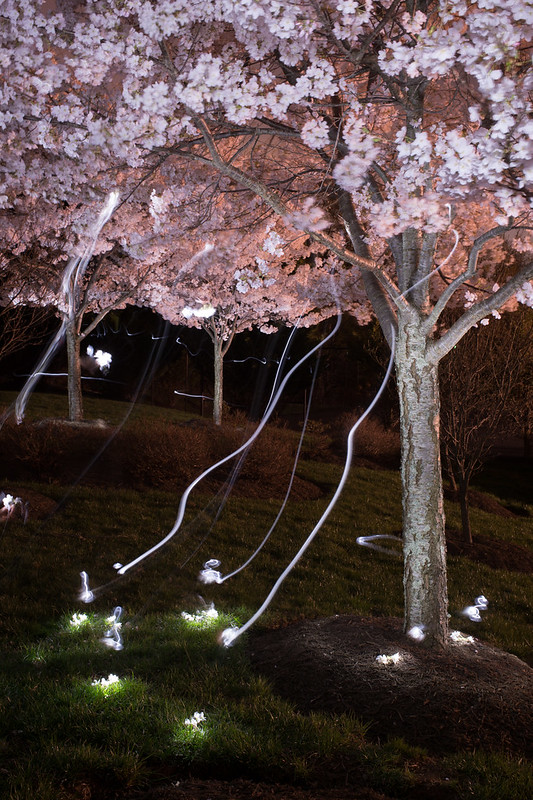
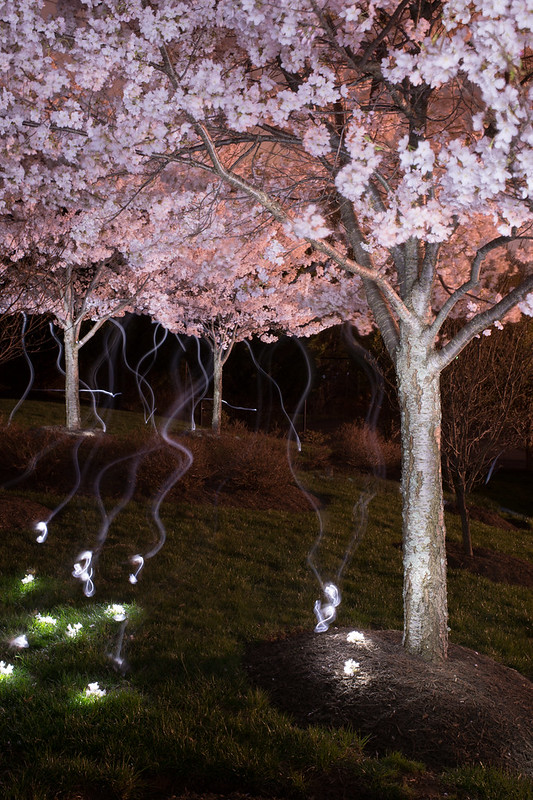
Referring to my post from two days ago, I decided to get back out with the cherry blossoms after dark one more time this year. Fighting my allergies, last remaining vestiges of jet lag from the Japan trip, and worries that my neighbors would wonder why this crazy guy was shining his flashlight up into the trees for an hour or so, I went for it. Here are my favorite light painting shots of the cherry trees this spring.
 
Falling Blossoms #1, by Reed A. George
Nikon Df, Nikkor 35mm f2 AF-D Lens
iso 100, f11, 479 seconds
Falling Blossoms #2, by Reed A. George
Nikon Df, Nikkor 35mm f2 AF-D Lens
iso 100, f11, 357 seconds
 
Yes, it took me 6-8 minutes per shot to do all of the light painting you see here. I had to paint the trunks of all three trees, then the branches. Then, I did the falling blossoms (several per tree). All with one flashlight. I think it was worth it. I feel that I succeeded in making something unique if not beautiful. At least they're not just one more series of straight shots of cherry trees. And through the process, I learned some of what not to do as well as what kind of works in this type of photography.
 
DMC-365.blogspot.com
 

Wednesday, December 4, 2013

Different Takes on Autumn Leaves

As I wrote earlier in the season, I've tried to avoid taking the same autumn leaf pictures that I (and many other) photographers take each and every year. For example, I used the kit zoom on my new Panasonic Lumix DMC-GX7 to add some motion blur to shots that would otherwise have been quite static. I made threes separate posts about that:
 
(Click Here) to see my first post on leaves in motion.
 
(Click Here) to see where I developed the concept a little further, with a set that make me feel like I'm being pulled through the treetops up into the clouds.
 
And finally, (Click Here) to see my favorite of the series, where I attempted to get the best combination of detail in the leaves, blur from camera motion, and color.
 
Well, today's images take a less drastic departure from "normal" fall color photography, but I hope still show something a little unique. As in all three posts above, I shot these with the DMC-GX7 and the much-improved 14-42mm Series II kit lens.
 
On my way to have lunch with my lovely wife, I looked to the side of the road and saw this tree. The most important element that drew me to photograph it was not the tree, however, it was the way the leaves on the ground appeared. Because the ground slopes upward behind the tree, the fallen leaves provided a partial background for the image.
 
 
Ground As Background, by Reed A. George
Panasonic Lumix DMC-GX7, Lumix Aspheric 14-42mm f3.5-5.6 Series II Lens at 14mm
iso 200, f8, 1/125 sec.
 
I like the shot above, but it's quite conventional, other than the ground sloping up. Looking for a different perspective, I used the rotatable finder on the GX7 to get down low. I took several shots that way, but nothing that really looked different to me. Finally, I started playing with selective focus from the low angle. Here's an example of what I came up with:
 
Drawn to the Front, by Reed A. George
Panasonic Lumix DMC-GX7, Lumix Aspheric 14-42mm f3.5-5.6 Series II Lens at 24mm
iso 200, f8, 1/125 sec.
 
This shot has only a narrow band of leaves at the very bottom of the image in focus. Personally, I like how it sort of asks a question of the viewer. At first glance, it just looks like a blurry picture of a tree, and at that point, some may stop looking. Looking closer however shows that the leaves at the bottom are perfectly sharp. This draws the attention to the leaves on the ground, which were the element that drew me to the scene in the first place. The tree itself takes on only secondary importance. One could argue about which image is more "pretty," if either fit that bill; I can say that the second shot better communicates how I felt about the scene.
 
DMC-365.blogspot.com


Wednesday, November 27, 2013

Look Deeper

 
Look Deeper, by Reed A. George
Leica CL, Minolta Rokkor 40mm f2 Lens
Kodak TMax 400 Film
 
 
DMC-365.blogspot.com


Saturday, November 2, 2013

Another Autumn Leaves Series, With Motion

This will mark my third small series of fall leaves in motion. As I said before, I did push myself to keep pursuing the idea, tweaking it as I went, to see how far I could push it. Of course, it could go further, but I think the following three images represent something of an accomplishment for me.
 
These shots were all made with the new Panasonic Lumix DMC-GX7 and 14-42mm f3.5-5.6 Series II kit lens. What I feel I've learned so far in this exercise is to play with the level of realism and abstraction, which I actually think I came close to in my previous mini-series (on November 1). I really like those previous images, but did push a little further.
 
This time, I paid more attention to color. The shots from the previous post are pretty bland, color-wise. I think these below pull together my intention in terms of both the level of abstraction and in fall color. I know these won't be attractive to everyone, but I am somewhat satisfied with where the exercise took me. Now you can judge them for yourself.
 
Color and Motion 1, by Reed A. George
Panasonic Lumix DMC-GX7, 14-42mm f3.5-5.6 Series II Kit Lens
iso 200, f22, 0.4 sec.
 
Color and Motion 2, by Reed A. George
Panasonic Lumix DMC-GX7, 14-42mm f3.5-5.6 Series II Kit Lens
iso 200, f22, 0.2 sec.
 
Number 2, above, is probably a little too swirled to stand on its own, in my opinion. In the context of the other two, I think it works.
 
Color and Motion 3, by Reed A. George
Panasonic Lumix DMC-GX7, 14-42mm f3.5-5.6 Series II Kit Lens
iso 200, f22, 1/8 sec.
 
If I had to pick one (I don't have to), I'd pick number 3. I love the color. I think it's right at the edge of complete abstraction, but it still says "autumn" to me. But, I think the three in this series hang together pretty well.
 
One thing I'm learning right now is to give my images time before being done with them. I've been playing with this project quite a lot, and living with the images, thinking about them. I think I'll probably print these three, and see if I'm done. At some point, the leaves will all be down, and I'll be finished by definition.
 
One thing I think is that I could crop all three of these to square images. All of them could lose some empty space on the left side. It would change the character a lot, moving the swirl center away from the center of the frame. I'll give that a try before calling it done.
 
DMC-365.blogspot.com


Friday, November 1, 2013

Pulled Skyward - Autumn Leaves With a Twist (Lumix DMC-GX7)

I've been feeling that I'm at a creative plateau for quite some time. I'm trying some things that are new, if not to the photographic world, at least to my portfolio.
 
Autumn leaves are not so impressive in my part of the world this year, at least not yet. So, I decided to try adding some motion to those same old fall pictures I take every year. On October 30, I posted a set of five images of leaves with motion, starting with simple lines, then moving on to rotations.
 
I really enjoyed looking at those images. I could hear the photographic mentor in my head saying:
 
Good. Nice start. Now go spend some time with it. See how far you can take it.
 
So, I went out for another session. As I was walking out to the small stand of trees that are my subject, I started thinking about the degrees of freedom I could play with in motion while the shutter is open. I came up with several: f-stop, shutter speed, lateral (x,y) motion, angle (of the sensor, in-plane rotation), and angle of view (zoom). So, I played with them all.
 
Here are three images that show one theme that came out. I call it "Pulled Skyward." The threads of white (there was no fog; it was a perfectly clear day) remind of a spirit being pulled up through the trees.
 
Pulled Skyward 1, by Reed A. George
Panasonic Lumix DMC-GX7, 14-42mm Series II Kit Zoom
iso 200, f22, 0.4s sec.
This first one is very nearly completely abstract. For me, abstract means that you can't really tell what the actual subject was. And, for me, it's a little too abstract to stand on its own. Hopefully the next two will give it some context, and help it to remain in the collection.
Pulled Skyward 2, by Reed A. George
Panasonic Lumix DMC-GX7, 14-42mm Series II Kit Zoom
iso 200, f20, 0.4s sec.

Number two clearly shows that we're looking up into the treetops. The white streaks show nicely.
Pulled Skyward 3, by Reed A. George
Panasonic Lumix DMC-GX7, 14-42mm Series II Kit Zoom
iso 200, f20, 0.4s sec.
 
Number 3 is my favorite of this set. I feel like I am being pulled up through the trees. The white streaks are just prominent enough to connect me to the treetops. However, I do feel that all three go together well.
 
If you know my photography, hopefully you'll recognize that this is a real departure for me. I'm somewhat of a photographic realist. I enjoy razor sharp images of interesting subjects, or street scenes where you can see multiple things going on. These are much more symbolic than my normal work.
 
It's good to stretch the mind.
 
I have a different set of images from this session, with a different color palette. I'm still working on those.
 
To those of you looking for how technically well the new DMC-GX7 and Series II kit zoom work, how sharp they are, sorry. I feel drawn in this direction at the moment, and the sharp, realistic images will have to come later.
 
DMC-365.blogspot.com


Thursday, October 31, 2013

"Why I Killed Street Photography" - Great Post by A.D. DeMesa on Eric Kim's Blog

 
I Guess This Is Street?, by Reed A. George
Agfa Record III, 6x9 Folding Medium Format Camera
 
 
I read a very interesting introspective post by A.G. DeMesa, a Manila-based photographer, who wrote a guest piece on Eric Kim's street photography blog.
 
Basically, A.G. is talking about breaking free of restrictions, any restrictions, imposed by trying to shoot in a particular style or genre. He has a significant body of work (10,000 images) to look back on, which helped him decide to "Kill" street photography. DeMesa refers back to historic photographers (Meyerowitz, Frank, Moriyama and others) and how they each pursued something new, different from the accepted styles of their times. Now he's doing the same.
 
I particularly like this quote:
 
"That was it. All of them had one thing in common: It was about seeing something. No dogma, no photographic gods, no one true photography. That is what I’m going to do."

 
Yes. Now if only I could decide what it is that I'm seeing, and communicate it.
 
(Click Here) to read DeMesa's post on Eric Kim's blog.
 
I've been considering taking a 1-on-1 skype or Google+ street workshop with Eric Kim. I just need to find a time when I know I'll be able to get out and shoot.
 
DMC-365.blogspot.com


Wednesday, October 30, 2013

Autumn Leaves in Motion

Autumn is coming slowly here in Northern Virginia this year, or at least it feels that way. Lots of browns amongst the yellow and orange trees.
 
I was out playing around with my new Panasonic Lumix DMC-GX7 yesterday, and decided to put some motion into my images. Nothing new here, but I think they're interesting. I started by putting the camera on shutter priority exposure (S), picking the lowest speed I could use without serious overexposure. First, I tried moving the camera linearly, upward, to follow the lines of the trees.
 
 
Leaves in Motion 1, by Reed A. George
Panasonic Lumix DMC-GX7, 14-42mm Series II Kit Zoom
iso 200, f22, 1/6 sec.
 
This first shot has a little mood to it, I think. While the sky was actually completely clear and blue, the blur gives it a little feel of fog. I think there are multiple smaller images within this one. I could imagine cropping to just the lower 1/3 of the image, for example. Actually, I can see three images, each 1/3 of the vertical height of the original. I think I'll give that a try.
 
Here's another with upward movement, this time with some branches that go off the vertical quite a bit.
 
Leaves in Motion 2, by Reed A. George
Panasonic Lumix DMC-GX7, 14-42mm Series II Kit Zoom
iso 200, f22, 1/6 sec.
 
Then, I started rotating the camera around different centers in the image. Here are my three favorites:
 
Leaves in Motion 3, 4, 5, by Reed A. George
Panasonic Lumix DMC-GX7, 14-42mm Series II Kit Zoom
iso 200, f22, 1/6 sec.
 
I realize that these are the first images I've shared from the new GX7, and they don't help much if you're trying to see the capabilities of the camera or new kit lens. I promise to share some sharp, more traditional images soon. But for now, I can say that I am enjoying the new camera, and the lens is quite impressive for what it is.
 
DMC-365.blogspot.com


Thursday, August 29, 2013

Mixed Media - Printing on Brushed-On Emulsion by Andrew Kaineder

 
Image Source:
http://www.lostateminor.com/2013/08/19/andrew-kaineder-professional-doer/?utm_source=feedburner&utm_medium=feed&utm_campaign=Feed%3A+LostAtEMinor+%28Lost+At+E+Minor%29
 
Not so excited with any equipment news recently, I'm once again widening the net in my search for interesting photographic subjects. I found this one on "Lost at E Minor," a broad creativity site.
 
(Click Here) to check out Lost at E Minor.
 
Andrew Kaineder and colleagues paint a liquid emulsion onto a surface, and then expose it, presumably from a negative. In the case above, the emulsion is painted onto paper, yielding one-of-a-kind character to each piece, and plenty of imperfection.
 
I'm not sure how I feel about the concept of making a photographic piece "one-of-a-kind." In some ways, I understand that increasing the value of a print, because no one else can have exactly the same print. However, is it merely a grasping at making photography more like painting, for example? One of the primary characteristics of photography is that it can be reproduced. Digital technology makes this even more true. I remember when digital audio came about and how it affected my friends who were into recording live performances (in their case mostly the Grateful Dead). It was an amazing piece of fortune to be able to duplicate a recording an unlimited number of times without ever losing a drop of sound quality. So, is that a bug or a feature?
 
I can also imagine the texture of Andrew's print. That is a little easier to appreciate for me.
 
I like to challenge and be challenged by new creative ideas like this.
 
DMC-365.blogspot.com
 
 
https://affiliate-program.amazon.com/gp/associates/network/build-links/individual/get-html.html?ie=UTF8&asin=B00023JE3E&marketplace=amazon


Thursday, August 22, 2013

Creepy Shot With the Whole Lotta Leica August Lens - Summicron 35mm f2 Version 3

 
Confederate Dead, by Reed A. George
Leica M9, Leica Summicron 35mm f2 Lens Version 3
iso 160, f13, 1/30 sec.
 
I took the day off today, and drove out to the Shenandoah National Park for some hiking and photography. It was a foggy morning. On the way out, I passed by the Groveton Confederate Cemetery at the Manassas National Battlefield. I walked around the cemetery a little with my M9 and tripod, and made a few shots. I almost missed this one.
 
On the way back to my car, I started looking more closely at the numerous spider webs in the tall grass. Finally, I put it together in my mind, and decided to find a nice one in front of the iron cemetery fence. This one was in a very good spot, in my opinion.
 
I converted the image to monochrome using SilverEfex Pro 2. I also selected a selenium tone, which is uncommon for me. Creepy effect, huh?
 
DMC-365.blogspot.com


Sunday, July 21, 2013

Creative Idea by Paul Hampton - Preserve Those Little Things You Love

I'm busy re-populating my RSS feeds, now in Feedly, since Google Reader is no more. I haven't figured out how to upload my old Google Reader backup file, so I'm starting from scratch, which may be good anyway. I will admit I'd sort of gotten tired of the same several hundred (!) blogs and forums I had on my list.
 
So, here's some inspiration from Paul Hampton, who photographed his possessions, at least some that matter to him.
 
(Click Here) to see the original post.
 
Image Source: http://www.photographyserved.com/gallery/Possessions/7608529
I like this idea very much. I remember a couple of years ago I finally had to disassemble the bulletin boards that hung in my late brother's room from thirty-some years in the past. I had moved them, intact, countless times over those years. Finally, I took everything off, scanned it on my Epson flatbed scanner, and put it into a big envelope, discarding the boards themselves. Interesting stuff there - ticket stubs from the Led Zeppelin concert that he attended, and I was too young to attend. Various pictures of friends - some still around, some not, in their high school days. Anyway, I at least documented them. Paul's idea is much more artistic. I wish I'd thought to do this with my record collection before it vanished a few years back. Anyway, I hope you like the idea, too.
 
DMC-365.blogspot.com


Thursday, May 30, 2013

Some Fun With the Lumix DMC-LX7 and Snapseed

I am on the airplane, returning home from a visit with my parents in Oklahoma. I didn't do a lot of photography on this trip, but did get out for a morning hike at Roman Nose State Park, near the town of Watonga. Here's a simple shot I made of a butterfly at Roman Nose.
 
Backlit Butterfly, by Reed A. George
Panasonic DMC-LX7
 
Certainly what caught my eye in this instant was the backlighting, with the pattern showing through the thin translucent wings.
 
I thought I'd play around with this shot on my iPad, using Google's Snapseed program. Here's what I came up with:
 
After Snapseed Adjustments
 
In order to get this effect, I used one of Snapseed's vintage film colorations, cropping, and of course a custom frame. I tried not to overdo it. I find it reminiscent of cheap color print film and drugstore processing. Kind of fun.
 
DMC-365.blogspot.com


Friday, May 24, 2013

It is Great Having a Leica Store Nearby - Leica Akademie - "The Truth About Photographs"

Image Source:
http://www.cvent.com/events/the-truth-about-photographs-developing-a-distinctive-visual-style-
/event-summary-5fc7d01fea244ac2b7d2fd4e38ec4ce1.aspx
 
I recently signed up for a Leica Akademie course, "The Truth About Photographs," to be held at the new Leica store in Washington, DC on June 7-9, 2013.
 
(Click Here) to read about the course.
 
The course is led by Quinton Gordon, and focuses on the creative aspects of developing your own style in photography.
 
(Click Here) to see Quinton's website. I always like to see the instructor's work before deciding to take a workshop. Quinton's work looks in line with the subject of the course.
 
Here is the list of topics, directly from the course description:
 
  • Seeing the light.
  • Working in three dimensional space.
  • Developing complexity in your images.
  • The elements of winning images.
  • The benefits of limitations.
  • The significance of editing.
  • Finding your distinctive style.
 
The course is limited to twelve participants, and runs from Friday afternoon until Sunday afternoon. This will be a great little creative retreat for me.
 
While I'm on the subject, I want to say how nice it is to have the Leica store nearby. In addition to being able to walk in and talk Leica with the knowledgeable staff any time I feel like it, they host Akademie courses (I took a street photography workshop there, led by Leica's Justin Stailey, last year), and always have something interesting in the gallery in the way of Leica photographs.
 
(Click Here) to go to the Leica Store DC's description. If you're in town, be sure to stop in.
 
DMC-365.blogspot.com


Thursday, May 23, 2013

Chase Jarvis Shares Ten Things Every Creative Photographer Must Know

 
Hearts, by Reed A. George
Panasonic Lumix DMC-LX7
iso 400, f1.5, 1/50 sec.
 
I like to read about how to stay (or become more) creative. Many themes are repeated over and over in books or posts regarding creativity, but I figure, hey - until I'm actually using them all, I can stand to read about them again.
 
Chase Jarvis recently shared ten things every creative person should remember:
 
  1. The "experts" don't know it all.
  2. Clients can't express what they want.
  3. Try to be "different" as opposed to "better."
  4. Challenges are good.
  5. Knowing good design concepts is important.
  6. Simplify.
  7. Don't be afraid of mistakes, learn from them.
  8. Make your work so valuable that price doesn't matter.
  9. Work with great people.
  10. Really create something.
I like these concepts, and agree with them. For me, #3 is one of the most interesting. I don't think Chase means that you should be different just for the sake of being different. But, if you can bring a fresh perspective to your art, it doesn't necessarily have to be better than someone else's. Just fresh and new.
 
Of course, #10 makes a lot of sense, too. I remember putting together my first project submission for a magazine. It failed to get published in my target journal, but the experience of putting it together, really finishing it, did pay off. Finish things. If you don't, there's no chance they'll succeed.
 
(Click Here) to read Chase's thoughts in more detail. Worthwhile reading.
 
DMC-365.blogspot.com


Saturday, May 18, 2013

Kirk Tuck's Blog Takes A New Turn - Mine Is Finally Hitting A Straightaway Again

 
Department Store DJ, New York City, by Reed A. George
Pentax K1000
 
Kirk Tuck's blog, the Visual Science Lab, is going in a new direction. Wildly successful at leading discussion, debate, and yes, argument about photography equipment, Kirk is now focusing on process and technique.
 
(Click Here) to read about how it's going for Kirk on his blog, Visual Science Lab.
 
If you've been reading my blog very long, you'll know that I made a similar change in January of this year. For the first year of DMC-365 (2012), I focused mainly on using Panasonic Lumix cameras. However, I found that limiting. I'm an admitted camera junkie, and other equipment - Leica, Nikon, and others - kept creeping in.
 
So, for 2013, I've decided not to abandon the equipment side, but to add to it. In fact, my interest in Panasonic continues, and I'm even expanding that area, by becoming one of Panasonic's Early Adopters and testing new equipment as the opportunity presents itself. But, I've decided to bring in more of the creative side. In fact, I'm focusing at the exact interface between the two. Let's face it, photography is a bridge art. Photography depends upon technology, even if it's that old Brownie camera from your grandma's closet. But, even the latest greatest technology doesn't make a good picture without creativity. So, I'm going to focus on where they come together.
 
I did see a drop in page views when I first made this change in January. Now, in May, I'm consistently getting more traffic day by day than I did last year. And, I'm much happier with what I'm writing about. Of course, Kirk would never be happy with my level of blog activity. I think he's had about 200 times more hits than I. But, I'm gaining experience and exposure each and every day.
 
THANKS FOR READING!
 
DMC-365.blogspot.com


Thursday, May 9, 2013

AMAZING Photography With New Fuji X100S and X20 - Colin Steel on Steve Huff Photo

Truly Inspired Photography by Colin Steel
 
Every once in a while I see a series of photographs that makes me say "I am not worthy." Well, thanks to Steve Huff's website, and Colin Steel's photographs from Sicily, that is how I feel right now.
 
I will summarize a few key points from Colin's write up, but you MUST
 
(Click Here) to see Colin's images on Steve Huff Photo.
 
Colin used the new Fujifilm X100S and X20 on this trip. I really enjoyed Colin's take on cameras and technology. He says that to him, image quality means "how effectively can I crate interesting photographs with these tools?" Colin concludes that there are many great camera options out there today, including the two new Fujifilm models. Instead of focusing on the equipment, he focused on capturing spectacular images, and boy, did he succeed.
 
He focused so little on equipment, the pictures don't even say which of the two cameras they were taken with.
 
Colin likes to shoot in square (1:1) format, in black and white. He reports that the X100S has a very nice square frameline in the optical finder. He also found the new manual focus tools in the X100S very useful. He says the X20 made a good pairing with the X100S, mostly based on the similarity of the controls.
 
Colin post-processes using Nik's Silverefexpro2 software, which I have just recently gotten myself. Interestingly, he likes the Tri-X film emulator in Silverefexpro2, which is my favorite so far. I tried many times to find Lightroom settings to emulate Tri-X; I never came close to what Silverefexpro2 provides.
 
As I wrote some time back, even though I'm very attracted to the Fujifilm X100S, I don't think a fixed 35mm equivalent lens works that well for me. I prefer 50mm field of view. The X20 is a different story. I handled one in Japan, and really, really liked it. For now, I'm still enjoying my new Panasonic Lumix DMC-LX7, but the X20 still may make its way into my kit.
 
In any case, Colin set a new benchmark for me with these images. I'm so impressed.
 
DMC-365.blogspot.com


Thursday, May 2, 2013

Worldwide Pinhole Camera Day - My Results

I've been out shooting my 4x5 film pinhole camera lately.
 
(Click Here) to see some of my recent shots.
 
I recently took part in Worldwide Pinhole Day, which occurred on Sunday, April 28.
 
(Click Here) to read about Worldwide Pinhole Day, and browse the gallery of results. There are some really nicely done images there, shot in everything from coffee cans to expensive cameras like the Ilford Titan. Click the Amazon link at the bottom of the page to see the Titan. I want one, but haven't decided to spring for it yet. It's a lot of money for a lensless camera, but the design is quite cool.
 
Anyway, here are my results from shooting on Worldwide Pinhole Photography Day:
 
White Horse, by Reed A. George
4x5 Pinhole Camera, Arista Edu 100 Film, 30 sec.
 
Dark Horse, by Reed A. George
4x5 Pinhole Camera, Arista Edu 100 Film, 30 sec.
 
Rushing Water, by Reed A. George
4x5 Pinhole Camera, Arista Edu 100 Film, 60 sec.
 
Still Water, by Reed A. George
4x5 Pinhole Camera, Arista Edu 100 Film, 180 sec.
 
You are only allowed to submit one image to the Worldwide Pinhole Photography Day gallery. Here is my selection:
 
On the Water, by Reed A. George
4x5 Pinhole Camera, Arista Edu 100 Film, 30 sec.
 
I like how the rushing water at the lower right contrasts with the sharp structure of the bridge. The canoe on the water in the background is the perfect addition to my composition.
 
I had some issues in developing the 4x5 sheet film. You can see the artifiacts of those issues in the first image, and maybe some others. However, that's part of the allure of shooting this way. It's truly low tech and messy. It's interesting to me how you can get a thought or message across, even using the most basic of tools - basically a wooden box with a tiny hole in it.
 
DMC-365.blogspot.com


Tuesday, March 26, 2013

When the Inner and Outer Worlds Converge


I read a thoughtful post, about the simultaneous exploration of the outer world and the inner world of the photographer himself (or herself) in the making of photographs, on Otto Von Munchow's blog.
 
(Click Here) to read the entire post on munchow.wordpress.com, including some thoughts from Henri Cartier-Bresson, a master of sharing the inner and outer worlds and where they converge.
 
One of the concepts that Munchow brings up is "tunnel vision," the exclusive focus that one gets when fully absorbed in photography. He mentions that when he achieves this state, he can be sure that there will be some good images in whatever he's taken. But, he cannot usually say which ones, until he reviews them.
 
I am very different in that way. I certainly experience this focus on the subject, process, and myself - "tunnel vision." However, I usually know which images are going to be the best from the set, even when I'm shooting film and cannot review them on the spot. Of course, there are sometimes surprises, both positive and negative. Those "missed the focus by that much" to use Maxwell Smart's expression (sorry, it's an old TV show, called "Get Smart"), and those rare images that didn't make an impression while shooting but just jump out at you when you see them developed. However, I can usually pinpoint the three or four best shots before seeing them.
 
Below is a case in point. I was initially attracted to the water droplets on this lotus leaf. As I was working on different angles and approaches, the shadows and textures became much more apparent. In fact, the line of the shadow taking on approximately the shape of a yin-yang symbol finally popped into my head, and I captured it. To me, this embodies how I felt about this place, this moment, and myself, photographing lotuses on the grounds of a Buddhist temple. I knew I liked this one before reviewing it.
Lotus Leaf and Water, by Reed A. George
Nikon D700, 24-85mm f2.8-4 Lens
iso 100, f16, High Dynamic Range (HDR) composite of three exposures
 
DMC-365.blogspot.com


Sunday, March 17, 2013

Panasonic Lumix DMC-LX7 - A Few Creative Control Examples

The Lumix LX7 is quite a little camera. With the small sensor size, which makes it possible to produce an amazingly well-featured camera with great fast optics in a very compact package, I usually shoot raw images, so that I can later control the noise levels in post-processing. Hold that that.
 
The LX7 has a plethora of built-in artistic and creative modes, as is common with many compact cameras. Here's the difference - the LX7 allows you to shoot both raw and jpeg files in these modes (except for the fully-automated iAuto mode). This gives you so much flexibility. Any of the creative control effects will be applied to the jpeg file (only), and the raw file remains untouched and ready for your post-processing as you see fit. So, I can actually use the creative controls on the LX7 without feeling that I may be missing the shot.
 
The jpeg processing on the LX7 is a little harsh in my estimation. Therefore, having the unaffected raw files really means a lot to me.
 
I recently took the LX7 on a trip to California, where I visited Pioneertown, a true town constructed by movie producers to make Westerns. It's quite a funky little place out in the desert.
 
(Click Here) to read about Pioneertown.
 
I tried a few of the creative controls, and really decided that I like "Toy" mode. Here's an example.
 
In a Pear Tree?, by Reed A. George
Panasonic Lumix DMC-LX7, Toy Setting
iso 125, f2.8, 1/125 sec
 
You can see that toy camera mode adds significant vignetting (darkening around the edges of the image), muted colors, and I think some loss of sharpness around the edges, while the center remains sharp. Kind of fun.
 
Here's one using the Impressive Art control:
 
Control, by Reed A. George
Panasonic Lumix DMC-LX7, "Impressive Art" Setting
iso 160, f1.6, 1/60 sec


Here's another setting, called "Expressive Art."

 
Desert Office, by Reed A. George
Panasonic Lumix DMC-LX7, "Expressive Art" Setting
iso 80, f2.8, 1/1600 sec
 
So far, I really like Toy mode best.
 
 
Desert Office 2, by Reed A. George
Panasonic Lumix DMC-LX7, "Toy" Setting
iso 125, f2.8, 1/1600 sec
 
All of these images are jpegs, right out of the camera. The final two I decided to shoot in square format, another great setting on the LX7. No adjustments were made to any of these.
 
And, the great thing is, I have the raw files if I want to process them differently! Lots of fun.
 
As promised, I'm nearing completion of my ebook on the LX7. I'll be announcing it soon.
 
DMC-365.blogspot.com
 
 
The best $298 (current price) you'll ever spend on photo equipment - please buy yours through this link:


Tuesday, March 5, 2013

Roger Coulam on "Travelling Light" on the Leica Camera Blog

Image Source: http://blog.leica-camera.com/photographers/guest-blog-posts/roger-coulam-travelling-light/
 
Traveling with less gear is a common subject on DMC-365. That can mean lighter gear, reduced complexity, or both. This is what initially took me into the world of Micro 4/3 gear - I could maintain a diverse set of lenses, a second body, and lots of other stuff that I may or may not end up using on a particular shoot, while reducing the strain on my back. I have to say that worked pretty well for me.
 
However, because the gear is lighter, I tend to jam more into my bag. For example, I almost never carry a second body when I'm shooting a Nikon DSLR; it is simply too much to carry. When shooting Micro 4/3, I almost always carry a second body. And yes, that allows me to shoot mostly prime lenses, which I love far more than zooms, and minimize switching lenses in the field. But, I must remember my primary goal in using Micro 4/3 - reducing overall weight. A two camera Micro 4/3 kit is still lighter than a similarly-equipped single Nikon DSLR kit, but not by all that much.
 
In addition to reducing weight, if I'm out shooting for pure enjoyment, I'd also like to reduce complexity in my kit. For example, I love to take a single camera, single lens kit on some shoots. For this to work, I must adopt the mindset that I may miss some great shots, but the ones I get should be really, really good. This doesn't work for everything. I would never go this way if I were shooting for someone else.
 
Roger Coulam has written a nice post on this subject for the Leica Camera blog.
 
(Click Here) to read Roger's post.
 
Roger has made an effort to reduce his normal equipment set to one camera - either his Leica MP or a Ricoh GR1V. But then he found himself taking both. Then adding a third camera to the mix. Then a tripod. You can see where this is going.
 
So, Roger's back to trying to simplify again. He finds that it allows him to be more expressive in his work. This sounds paradoxical, as most of us believe that more tools, lenses ranging from ultra wide to super telephoto, for example, will allow us to be more expressive. However, I see Roger's point. Sometimes, having to do the "manual zoom" (walking closer or backing away from your subject) forces you to look at it more closely, and from different perspectives.
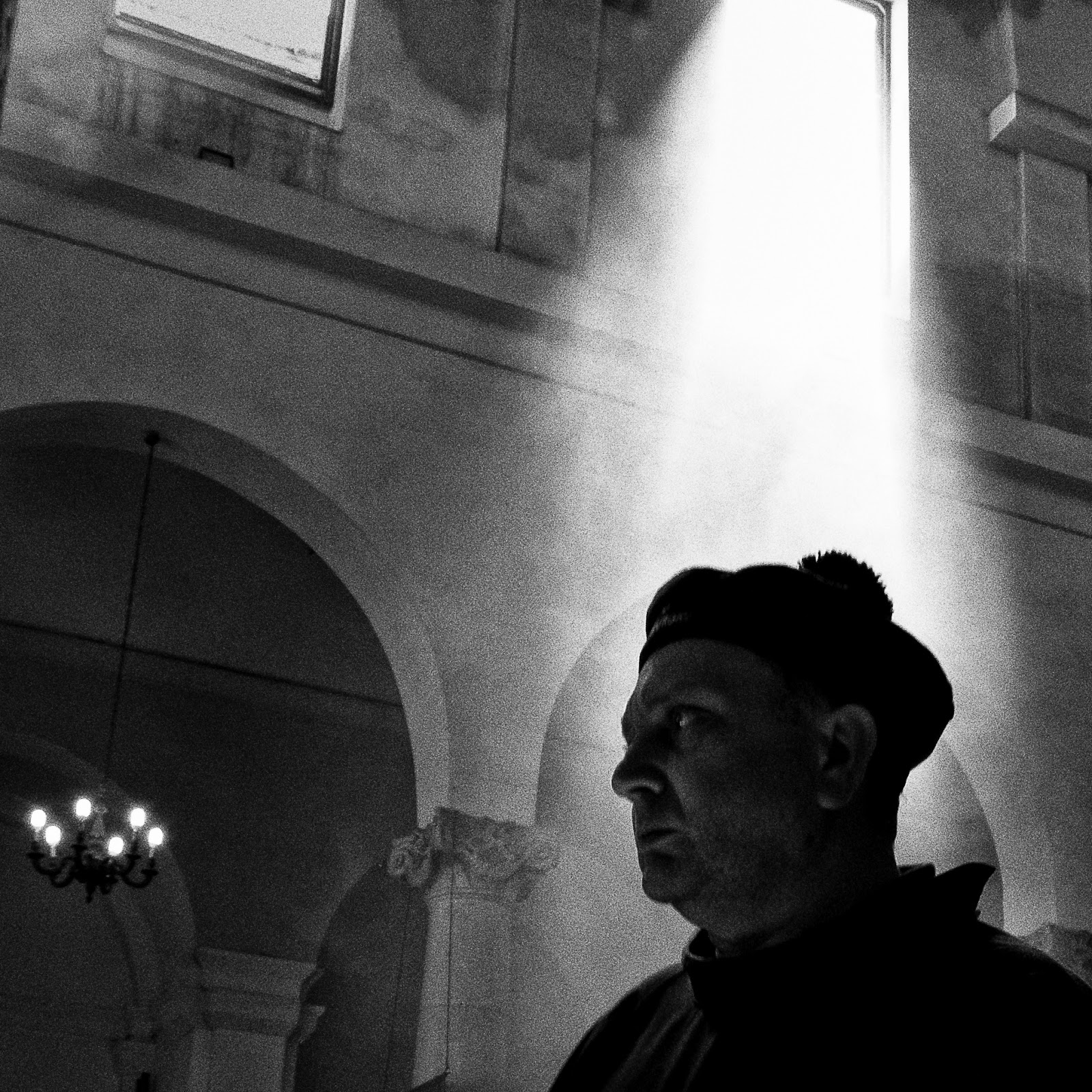
 
I am not firmly in either camp at this point - carrying lots of gear to allow flexibility, or carrying a minimum of gear to drive me to be more creative. It truly depends on where I'm going and what I plan to shoot. For example, I'm planning a one-day trip to the desert soon. For that, I imagine some wide angle and telephoto shots. I will take a full Micro 4/3 kit with me on that trip. Soon after, I'm going to Japan for a week. My current plan is to take my Leica M9, maximum of three compact lenses, and my Panasonic Lumix DMC-LX5 pocket camera. If I were going into the city for a morning of shooting, as I often do, I would probably take just the M9 and a single lens.
A Dock, by Reed A. George
Panasonic Lumix DMC-LX5
iso 80, f5.6, 0.6 sec
 
So, I suppose this compromise has no single solution. It's the balance of range of capability and level of pain in my back at the end of the day. However, don't lose sight of the fact that reduced complexity can also free up some creative flow.
 
DMC-365.blogspot.com