Showing posts with label full-frame. Show all posts

Saturday, March 7, 2015

Some Old Friends Play Purcellville

Some of my friends in bands got together for somewhat of a reunion last night in Purcellville, Virginia. I knew most of the people in the audience, as well as in the bands.
 
First, Jake and the Burtones opened the show.
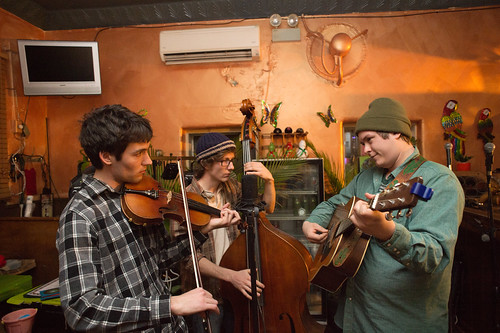
Jake and the Burtones, by Reed A. George
Nikon Df, Nikkor 24mm f2.8 AF-D Lens
iso 3200, f3.5, 1/125 sec.
with SB-600 flash and Gary Fong diffuser
 
Then, Timmy (Tmoney) Griffin and his band SpaceCanoe took over. Tmoney has moved to North Carolina for college, so we don't get to see him so often. A true creative, Timmy has been busy writing new songs.
 
TMoney, by Reed A. George
Nikon Df, Nikon Series E 100mm f2.8 Lens
iso 3200, f2.8, 1/60 sec.
with SB-600 flash and Gary Fong diffuser
In addition to his original tunes, Timmy and SpaceCanoe played some carefully-selected covers, including one of my favorite Grateful Dead tunes, "Brokedown Palace." I actually requested that song years ago, and Timmy worked it out for me! Awesome.

 
SpaceCanoe, by Reed A. George
Nikon Df, Nikkor 50mm f1.4 AF-D Lens
iso 3200, f4, 1/60 sec.
with SB-600 flash and Gary Fong diffuser
This was a very tough show to shoot, even with my shoot-in-the-dark Nikon Df and 50mm f1.4 lens. Using the Nikon SB-600 and Gary Fong light diffuser saved the day (night). I was quite pleased with the results, given that the stage lighting was so poor (non-existent).
 
I'm especially pleased with the second image, which I made with my recently purchased, inexpensive, Nikon Series E 100mm f2.8 lens. Manual focus, in the dark. That's right. I'm proud of it. This lens will be in my travel bag in Japan; it's very sharp and oh so light compared to the also amazing 105mm f2.5 AIS Nikkor.
 
DMC-365.blogspot.com
 

Wednesday, November 6, 2013

It's Here! The Nikon Df.

 
Image Source: http://www.adorama.com/ALC/BlogArticle.aspx?googleid=0014359&alias=nikon-df-is-a-small-retro-full-frame-dslr-first-look&utm_source=RSYS&utm_medium=Email&utm_campaign=Email110513NikonNPA&j=Email110513NikonNPA
 
After much fanfare and mysterious marketing, the Nikon Df has been announced. The best description I've found was on Adorama's page.
 
(Click Here) to read the description and see three videos, by Joe McNally, Bob Krist, and Lynn Goldsmith.
 
Okay - so what's important about this camera for me?
  • First, the sensor. A full-frame, roughly 16 megapixel CMOS, reportedly the same as the Nikon D4, will be a monster (a good monster) in low light. The wider spacing between pixels (as compared to 24 or 36 megapixel sensors) provides superior noise performance.
  • This camera will work with all F-mount lenses. According to Adorama's page, that includes non-AI lenses! I need to verify this point, as the Nikon site says "non-CPU" but does not specifically say "non-AI." I still have a full suite of non-AI lenses that are a blast to use. They've been incredibly cheap up until now - I just bought a gorgeous 200mm f4 non-AI lens at a camera store(!) for $75. That is likely to change with the advent of the Df.
  • While it's styled like an FM or FE classic Nikon manual focus film camera, the Df has auto focus.
  • Some people speculated that the price would be less than $2,000. Nope. It's ~$2,800 for the body only. However, I think that's reasonable for what you get.
In the videos at the Adorama link above, I picked up a few things:
 
Joe McNally - "feels like home"
Bob Krist - "more in the moment" when using the Df
Lynn Goldsmith - has always used Nikon only, for over 40 years - "limiting factors" make you work a little harder, but in a productive way
 
For me personally, the most important features of this camera, in comparison to my D700, are the ability to shoot non-AI lenses and weight. My D700 works just fine with AI and AIS lenses, but it won't shoot non-AI lenses. That would be a plus. How about weight? The D700 weighs in at 995 g., while the Df comes in at 710 g. (or 71% of the D700). That's a difference of 285 g., or about .63 pounds. Significant weight reduction to my most comparable camera. One more benchmark, the historic Nikon FM2 film camera weighed 540 g.
 
So, am I excited about this camera? Yes. Am I preordering one? Hmm. Probably not. If I didn't have the Leica M9 I would. I will likely have a Df some day.
 
DMC-365.blogspot.com


Saturday, December 15, 2012

Sony RX1 Sample Pics

 
Sony RX1
 
The new Sony RX1 is really interesting. A full-frame, 24MP Sony sensor, permanently matched to a non-interchangeable Carl Zeiss Sonnar 35mm f2 lens. Nearly $3,000 price tag. Wow.
 
Pocket Lint has posted a brief introduction, and more importantly, some sample images from this camera, including using it at iso 25,600. Not bad. Not bad at all.
 
(Click Here) to see the post on Pocket Lint.
 
What are my thoughts on this camera? Well, first off, you have to shoot it at arm's length, if you use the LCD to compose. On the positive side, since it's a fixed-lens, fixed focal length, you can use an optical finder mounted in the flash shoe. I don't know how easy it is to set hyperfocal distance on the RX1, but that could be a good solution for street photography. Otherwise, there's an accessory electronic finder. In either case, it really takes away from the nice size and shape of the camera.
 
If I were looking for a smaller back-up to my Leica M9, the RX1 would be interesting. The Leica X2 is as well. The X2 has an APS-C sized sensor, smaller than the full-frame sensor in the RX1. I'm sure the Leica can't do nearly as well at high iso.
 
Right now, my answer to this is the nice little Panasonic Lumix DMC-LX5. Not in the same league of image quality, for sure. The LX5 is okay at iso 400, can be used up to 800 or maybe 1600, if you're not going to get hung up on noise. But, that's really pushing it. Otherwise, it's an amazingly well-equipped little camera, and with zoom and focus memory, hyperfocal settings, and silent shutter, it's an awesome street shooter.
 
I think I'll always need an eye-level finder, as opposed to composing on the LCD. I highly prefer an optical finder to electronic view finder (EVF), yet have used the EVF on my Micro 4/3 cameras extensively. With an optical finder, autofocus is a real problem; you don't know what you're focusing on. With either an optical or EVF, these compact cameras become signficantly less compact and streamlined.
 
So, for me, the perfect compact companion to the M9 does not yet exist. The RX1 is close. I probably shouldn't try one. If I found that manual and hyperfocus settings were easy, I may fall in love.
 
In any case, I'm happy to see new cameras that put supreme image quality at the top of their features. Nice job, Sony (and Zeiss).


Thursday, September 13, 2012

Sony Announces A Real World-Beating Compact Camera! - DSC-RX1

8896: Sony announces the Cyber-shotâ„¢ DSC-RX1


Sony DSC-RX1 Full Frame (!) Compact
Image Source: http://dpnow.com/8896a.html


I remember my father-in-law getting me into digital photography. Living in Tokyo, he had access to the latest and greatest devices. First, he handed down a gorgeous Fujifilm camera, with a blinding 1.3MPixels. The optics on that camera were awesome. The sensor was good, but obviously not enough to make big enlargements from. That said, I did use it to shoot some artwork, which made it onto the front cover of Science. Not bad for 1.3MPixels.

The second generation gift from him was a Sony compact. At 3.2 MPixels, that little camera really had capability. In fact, it still does. It is well over ten years old. At one time, I used it in a Sony underwater case for diving. A little anecdote about Sony related to that camera. After using it for a couple of years, I was having trouble with charging the batteries. On a trip to Tokyo, I took it to Sony's service center, at their headquarters. Within two days, they had checked the camera out fully, and replaced both of my batteries, for free! That's service.

So, I have no issues whatsoever with Sony cameras.

In my work in science, which involves a lot of imaging (to put it lightly), I have developed a similarly positive relationship with Carl Zeiss. Their optics are simply wonderful. So, the combination of Sony cameras and Zeiss lenses is a natural fit for me.

I have an even closer feeling for Matsushita (Panasonic), having been accepted as a fellow and training in one of their factories in Japan for a year. Maybe that's why I got so into Lumix cameras in the beginning. Now it's because of the great equipment.

Anyway, with that introducion, let me say that I was amazed to see the announcement for the new Sony DSC-RX1 with Carl Zeiss Sonnar T* 35mm f2 lens and full-frame sensor in a compact camera body. When I read the headline, I thought it had to mean some sensor size other than 24x36mm (full-frame 35mm format). Nope. It's really there.

(Click Here) to read the announcement on dpnow.com.

With a full-frame CMOS sensor (and Sony sensors are used in a lot of other manufacturer's cameras) at 24.3 MPixels, this is awesome. It boasts iso settings from 100-25,600. You can literally shoot in near total darkness with that iso and f2!

The camera weighs in a 453 grams (1 pound)!

This is going to be interesting. Especially if Sony decides to make a similar camera with interchangeable lenses! With Zeiss lenses, it could even be an M-mount! Now I'm dreaming.

DMC-365.blogspot.com