Showing posts with label Sonnar. Show all posts

Monday, July 4, 2016

A Distinguished Couple

 
From an Asian festival in Washington, DC. Photos made with my Rolleiflex SL2000F and Sonnar 135mm f2.8 lens. That Sonnar is one of the very best telephoto lenses I've ever used.
 
DMC-365.blogspot.com


Thursday, June 16, 2016

Eyes

 
DMC-365.blogspot.com


Asia Festival, DC - Rolleiflex SL2000F

Here are a couple of images I made at a festival over the memorial day weekend. I was shooting my Rolleiflex SL2000F, with the wonderful Sonnar 135mm f2.8 lens. I think it's the best lens I have for this outfit.
 
 
Don't know what a Rolleiflex SL2000F is? (Click Here).
 
DMC-365.blogspot.com
 

Monday, January 25, 2016

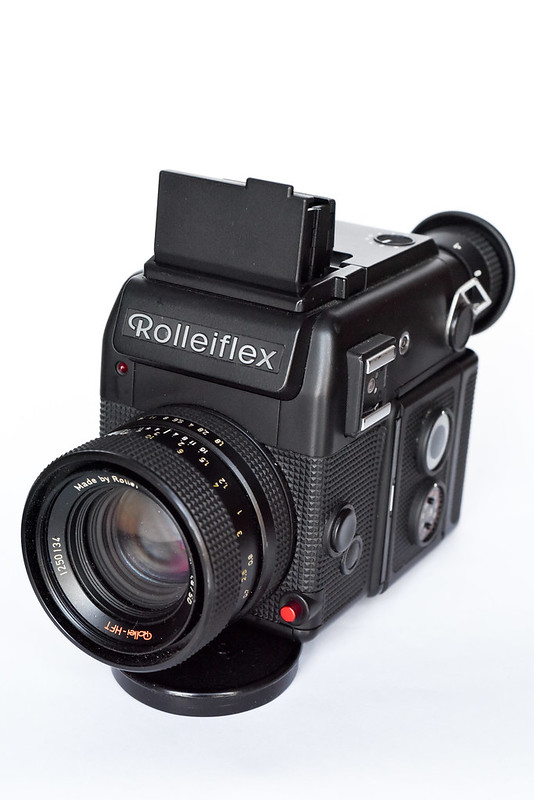
A Very Different Rolleiflex - SL2000F - My Latest Passion

So several weeks back, I went to meet my good friends Charlie and Alain for a photo outing. Charlie and I were discussing settings for his new Panasonic Lumix DMC-GX8 when Alain walked up with this beauty.
 
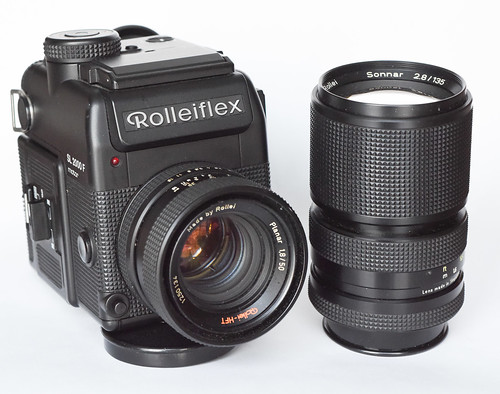
Rolleiflex SL2000F and Planar 50mm f1.8 Lens
 
Now, I admit that I'm pretty passionate about cameras. Passionate, but generally careful. When I realized that this was a 35mm Rolleiflex, with both eye-level and waist-level finders built in, interchangeable lenses (Rollei QBM mount), and interchangeable film backs, well, that was it. I had to have it. I'd never seen anything like it. No looking it up online, no research at all, had to have it. I bought it right then, in the parking lot. Alain was nice enough to part with it for the price he paid. Here it is with the matching Sonnar 135mm f2.8 lens.
 
 
Driving away after our day out shooting, I thought "What have I done?" A dead lens mount (the QBM is no longer made anywhere), electronic (not quiet) advance only (no manual override), maybe I should have been a little more cautious. But, just look at it. So, I smiled and drove on home.
 
Then, just as soon as I got home, I started looking for information on this beauty online. Oh, no! Everywhere I looked were warning signs - electronic failure, no spare parts, DO NOT BUY THIS CAMERA! Well, it gave me pause, but again, just look at it. I decided to take my chances and just plain use it.
 
This camera is a total blast to use. Something between a Rolleiflex TLR and a 35mm SLR system camera, it's just plain wonderful.
 
And then, I found out even more that I liked - a Rollei-made auto-aperture adapter to mount M42 lenses! This immediately expanded my lenses from the Planar 50 and Sonnar 135 to my wider set of Pentax M42 lenses, including a 28mm f2.8 no-namer, 35mm f3.5 Super Takumar, 50mm f1.4 Super Takumar(!), 200mm f4 Takumar, and even a Yashica 300mm f5.6 telephoto. Lots to play with.
 
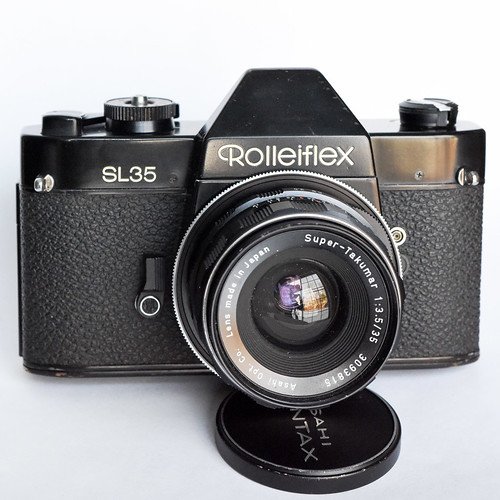
So what about all of this concern for reliability? Well, I could either try to find someone to service the SL2000F if needed, or think about spares. I determined that a spare body was the best approach. So, I picked up a Rollei SL35 (earliest model SLR) for $35 on ebay. Yes, it needed a little exercise, but now it works fine. Here it is with the Pentax 35mm mounted via adapter.
 
Rollei SL35 and Pentax Super Takumar 35mm f3.5
 
Of course, I also started a followed search on ebay for a second SL2000F body. Pretty slim pickings, as these cameras are pretty rare. But, within a couple of weeks, I found a fully-functional SL2000F listed in Germany, with another M42 adapter, Zeiss Jena Tessar 50mm f2.8 M42 lens, two film backs, the very difficult to find electronic wired remote shutter release, and, even rarer, the dedicated Metz flash and Rollei flash adapter, built specifically for the SL2000F. And at a great price. I emailed the German seller with a few questions, and went for it. The second camera is now here and appears to be fully functional.
 
So, now I'm really deep into these cameras, but loving every minute of it. And, to calibrate it a little, still have less invested than the cost of a single high quality DSLR body.
 
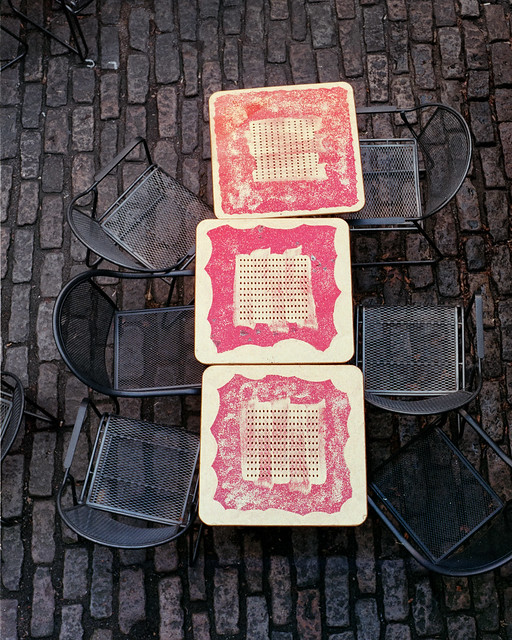
So, how does it work? Like a dream. Here are a few images from the first SL2000F body, shot on a recent road trip down to Asheville, NC.
 
 
The lenses are plenty sharp. Everything seems to work very well. No electronic problems, even though I had a few scares at first. Based on reports online of AA batteries being too high voltage for the camera (they fit), I took others' advice and ordered some rechargables and they work perfectly. I chose Panasonic Eneloop batteries, and highly recommend them.
 
More importantly, this camera just fits me perfectly. It truly feels at home in my hands. I love being able to use the waist-level finder when I want, more often the eye-level finder, without changing any parts. I love that it's 35mm. I love the lenses, both Rollei and M42. I love a lot about this camera.
 
So, I'm glad that I didn't make time to be more rational about this purchase. If I had, I would not have bought it, based on all the warning signs online. I'm glad I bought it, and feel quite fine now with a spare body, just in case.
 
DMC-365.blogspot.com
 

Friday, June 21, 2013

Brian Sweeney Writes About Using the Old Zeiss Sonnar and Leica Digital M on THEME

 
I love using classic lenses on my M9, as you will have seen by my "Whole Lotta Leica" series. I also love to learn more about these old lenses and how they are designed and perform.
 
Brian Sweeney has made a name for himself in adapting Zeiss Sonnar lenses to Leica M mount. Brian recently wrote a post for the blog THEME, describing a lot about lens design history, adapting Sonnars, and the resulting images.
 
(Click Here) to read Brian's post on THEME.
 
Here are some new things I learned from Brian's post:
 
  • Leitz (Leica) has taken the approach of minimizing aberrations in their lens designs, particularly through symmetric "double Gauss" optical arrangements. According to Brian, this is the approach used from the early days, up to and including the modern APO Summicron.
  • The concept of double configurations is that the front lens assembly's aberrations are cancelled out by the light going through a paired optical assembly at the rear.
  • Asymmetric designs allow for wider apertures.
  • Zeiss has usually pursued brighter lenses and higher contrast than Leitz. They achieve this through asymmetric design and minimizing the number of lens interfaces and gaps. For example, the classic 5.0 cm f2 Sonnar has 6 gaps, as compared to the similar era Leica Xenon, which has 10.
  • Zeiss Sonnars in original Leica mount are very rare. As a result, Brian has found ways to remount them from other mounts, like the much more prevalent Contax mount. In the post, he even shares a link to instructions to try it yourself.
In Mr. Sweeney's examples, I can see what he describes about the different rendering of the Sonnar. While very sharp, these older lenses, many uncoated, don't have the contrast of a modern lens. While lower in contrast than modern examples, they are described as being higher contrast than older uncoated Leitz lenses, like the Summar.
 
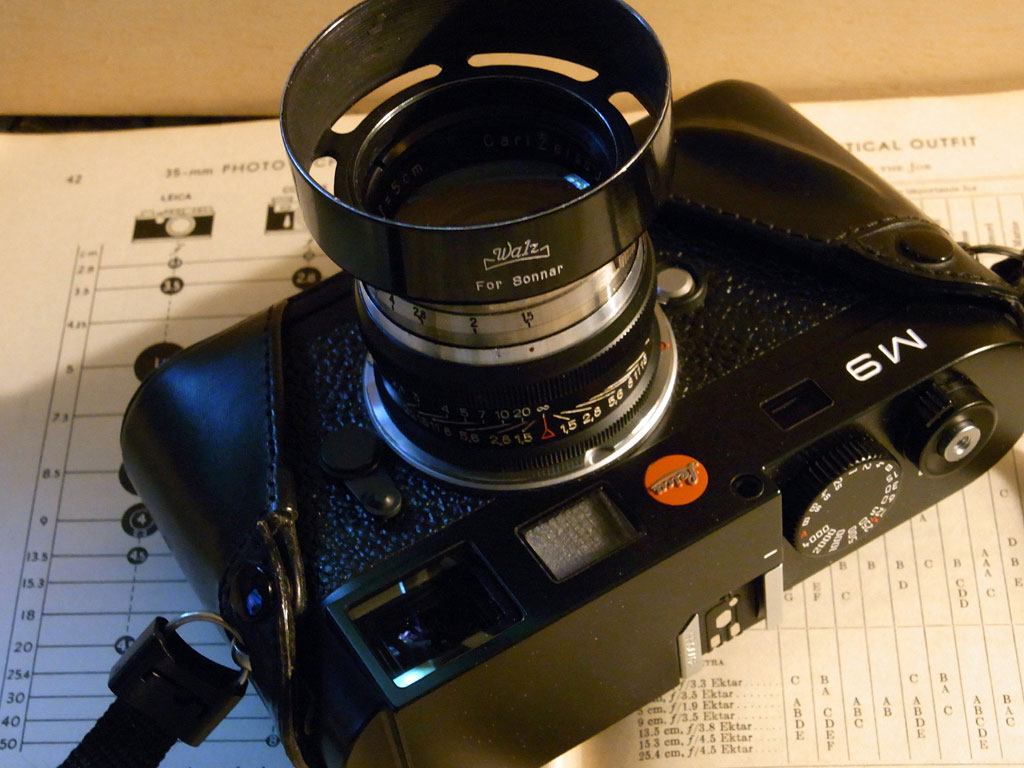
I have a couple of uncoated Leica lenses - a Summar and a Summitar. Both are favorites of mine. I don't have a classic Sonnar, but I do have the modern example of the Zeiss C-Sonnar 50mm f1.5. It's an amazing lens - both loved and hated strongly by different photographers. I love mine. In fact, I think it will be my Whole Lotta Leica lens for June.
 
Here's an example shot from my modern Sonnar on the M9.
 
Low Light Performance of Acoustic Burgoo, by Reed A. George
Leica M9, Zeiss Sonnar C 50mm f1.5 Lens
iso 1250, f2, 1/125 sec
 
If I were to pursue a classic Sonnar for my Leica, I would try to buy one from Brian. They come up every once in a while on the forums.
 
DMC-365.blogspot.com


Thursday, September 13, 2012

Sony Announces A Real World-Beating Compact Camera! - DSC-RX1

8896: Sony announces the Cyber-shotâ„¢ DSC-RX1


Sony DSC-RX1 Full Frame (!) Compact
Image Source: http://dpnow.com/8896a.html


I remember my father-in-law getting me into digital photography. Living in Tokyo, he had access to the latest and greatest devices. First, he handed down a gorgeous Fujifilm camera, with a blinding 1.3MPixels. The optics on that camera were awesome. The sensor was good, but obviously not enough to make big enlargements from. That said, I did use it to shoot some artwork, which made it onto the front cover of Science. Not bad for 1.3MPixels.

The second generation gift from him was a Sony compact. At 3.2 MPixels, that little camera really had capability. In fact, it still does. It is well over ten years old. At one time, I used it in a Sony underwater case for diving. A little anecdote about Sony related to that camera. After using it for a couple of years, I was having trouble with charging the batteries. On a trip to Tokyo, I took it to Sony's service center, at their headquarters. Within two days, they had checked the camera out fully, and replaced both of my batteries, for free! That's service.

So, I have no issues whatsoever with Sony cameras.

In my work in science, which involves a lot of imaging (to put it lightly), I have developed a similarly positive relationship with Carl Zeiss. Their optics are simply wonderful. So, the combination of Sony cameras and Zeiss lenses is a natural fit for me.

I have an even closer feeling for Matsushita (Panasonic), having been accepted as a fellow and training in one of their factories in Japan for a year. Maybe that's why I got so into Lumix cameras in the beginning. Now it's because of the great equipment.

Anyway, with that introducion, let me say that I was amazed to see the announcement for the new Sony DSC-RX1 with Carl Zeiss Sonnar T* 35mm f2 lens and full-frame sensor in a compact camera body. When I read the headline, I thought it had to mean some sensor size other than 24x36mm (full-frame 35mm format). Nope. It's really there.

(Click Here) to read the announcement on dpnow.com.

With a full-frame CMOS sensor (and Sony sensors are used in a lot of other manufacturer's cameras) at 24.3 MPixels, this is awesome. It boasts iso settings from 100-25,600. You can literally shoot in near total darkness with that iso and f2!

The camera weighs in a 453 grams (1 pound)!

This is going to be interesting. Especially if Sony decides to make a similar camera with interchangeable lenses! With Zeiss lenses, it could even be an M-mount! Now I'm dreaming.

DMC-365.blogspot.com