Showing posts with label DMC-LX5. Show all posts

Friday, August 29, 2014

Professional Traveler Dusty Blackthorn Makes Great Images with Lumix LX5

Dusty Blackthorn, guest poster on SteveHuffPhoto, is a "professional traveler." From the look of his pictures, Dusty takes some interesting modes of transportation.
Image Source: http://www.stevehuffphoto.com/2014/08/20/daily-inspiration-658-by-dusty-blackthorn/
 
Dusty has been using a Panasonic Lumix DMC-LX5, but says he feels his pushing the limits of that camera.
 
(Click Here) to read his post on Steve Huff's blog. He has a couple of other interesting shots there.
 
Dusty is looking for input on what camera to upgrade to. Personally, I think he's mastered the LX5 and should stick with it.
 
DMC-365.blogspot.com


Monday, June 23, 2014

Saul Leiter - "In No Great Hurry"

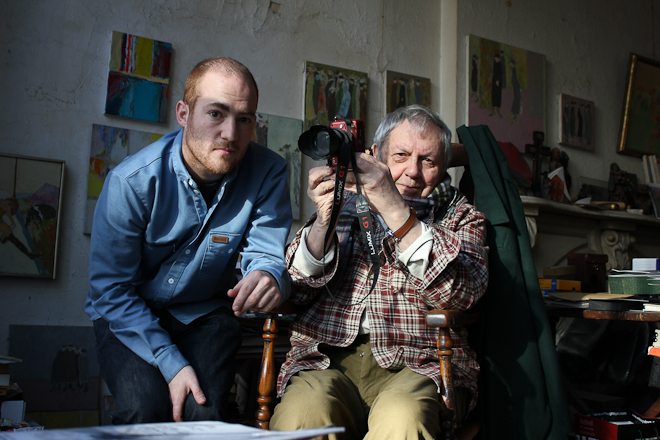
Photographer Saul Leiter (Left) and Director Tomas Leach
Image Source: http://erickimphotography.com/blog/wp-content/uploads/2013/06/INGH7-Saul-Leiter-and-Director-Tomas-Leach.jpg

Here's a movie I'm actually looking forward to seeing. Director Tomas Leach was given a book of Saul Leiter's photographs, called Early Color. He decided to approach Leiter with a proposal to make a biographical film about him, and it was accepted.
 
Based on the trailer, which you can see by
 
(Clicking Here) on http://watch.innogreathurry.com

I'm convinced this will be an interesting film for me. Leiter seems like a very down-to-earth guy. The trailer is somewhat reminiscent of the film about Bill Cunningham, which I wrote about earlier. (Click Here) to see that post.
 
While Cunningham continued to use a Nikon FM2 camera for his whole career, we see in the picture above that Leiter at least toyed with more modern digital cameras, including a Panasonic Lumix G1, and an LX series (LX5), both excellent cameras in my opinion.
 
Use google image search to look for Leiter's pictures. There's a lot for me to learn from this man.
 
I learned about Leiter on Google+ in a post by Kent Forrest. The image above came from Eric Kim's photography blog. (Click Here) to see Eric's post about the film, which opens in the US in July.
 
DMC-365.blogspot.com


Monday, March 18, 2013

My Panasonic Lumix DMC-LX7 Real World Guide is Available on the Amazon Kindle Store! $2.99 or Free for Prime Members!


Want to learn how to quickly set up and use your DMC-LX7 without wading through >200 pages of Panasonic user manual? I have finished writing my guide for how I set up and use my Lumix DMC-LX7. It's now available on Amazon.

I share exactly how I set up the camera for street photography, travel, and macro, and explain many of the less-obvious functions of the camera.
 
(Click Here) (or use the Amazon link below) to buy it for $2.99, or borrow it for free if you're an Amazon Prime member. It's currently available in Amazon's Kindle format. After 90 days I may make it available in other formats.
 
By the way, $2.99 is the lowest price that Amazon allows. I want it to be affordable, and I also want to
have the convenience of using Amazon's automatic distribution. Twenty pages of information for $2.99 seems reasonable.
 
I hope you enjoy it!
 
DMC-365.blogspot.com


Tuesday, March 5, 2013

Roger Coulam on "Travelling Light" on the Leica Camera Blog

Image Source: http://blog.leica-camera.com/photographers/guest-blog-posts/roger-coulam-travelling-light/
 
Traveling with less gear is a common subject on DMC-365. That can mean lighter gear, reduced complexity, or both. This is what initially took me into the world of Micro 4/3 gear - I could maintain a diverse set of lenses, a second body, and lots of other stuff that I may or may not end up using on a particular shoot, while reducing the strain on my back. I have to say that worked pretty well for me.
 
However, because the gear is lighter, I tend to jam more into my bag. For example, I almost never carry a second body when I'm shooting a Nikon DSLR; it is simply too much to carry. When shooting Micro 4/3, I almost always carry a second body. And yes, that allows me to shoot mostly prime lenses, which I love far more than zooms, and minimize switching lenses in the field. But, I must remember my primary goal in using Micro 4/3 - reducing overall weight. A two camera Micro 4/3 kit is still lighter than a similarly-equipped single Nikon DSLR kit, but not by all that much.
 
In addition to reducing weight, if I'm out shooting for pure enjoyment, I'd also like to reduce complexity in my kit. For example, I love to take a single camera, single lens kit on some shoots. For this to work, I must adopt the mindset that I may miss some great shots, but the ones I get should be really, really good. This doesn't work for everything. I would never go this way if I were shooting for someone else.
 
Roger Coulam has written a nice post on this subject for the Leica Camera blog.
 
(Click Here) to read Roger's post.
 
Roger has made an effort to reduce his normal equipment set to one camera - either his Leica MP or a Ricoh GR1V. But then he found himself taking both. Then adding a third camera to the mix. Then a tripod. You can see where this is going.
 
So, Roger's back to trying to simplify again. He finds that it allows him to be more expressive in his work. This sounds paradoxical, as most of us believe that more tools, lenses ranging from ultra wide to super telephoto, for example, will allow us to be more expressive. However, I see Roger's point. Sometimes, having to do the "manual zoom" (walking closer or backing away from your subject) forces you to look at it more closely, and from different perspectives.
 
I am not firmly in either camp at this point - carrying lots of gear to allow flexibility, or carrying a minimum of gear to drive me to be more creative. It truly depends on where I'm going and what I plan to shoot. For example, I'm planning a one-day trip to the desert soon. For that, I imagine some wide angle and telephoto shots. I will take a full Micro 4/3 kit with me on that trip. Soon after, I'm going to Japan for a week. My current plan is to take my Leica M9, maximum of three compact lenses, and my Panasonic Lumix DMC-LX5 pocket camera. If I were going into the city for a morning of shooting, as I often do, I would probably take just the M9 and a single lens.
A Dock, by Reed A. George
Panasonic Lumix DMC-LX5
iso 80, f5.6, 0.6 sec
 
So, I suppose this compromise has no single solution. It's the balance of range of capability and level of pain in my back at the end of the day. However, don't lose sight of the fact that reduced complexity can also free up some creative flow.
 
DMC-365.blogspot.com


Monday, February 25, 2013

Panasonic Lumix DMC-LX7 - Jpeg Settings

I have only spent a little time with the LX7 so far. I started off by shooting some Jpegs. You have lots of image options in Jpeg shooting with the LX7, under "Photo Style." I started with STD, with default settings (for contrast, sharpness, color, and noise reduction). I have to admit I was not very pleased with the look of the jpegs at these settings. So, I had an assignment - see how to optimize Jpeg settings, if indeed it's possible to get what I want.
 
Just so you know, the raw images look pretty good to me. In the past, with my DMC-LX2 and DMC-LX5, I always shot raw. I may end up in the same situation with the LX7, but let's see what contributes most to my disappointment with the default images.
 
I decided to shoot a set of images on a tripod, using iso 400, f5.6, 1/60 second (manual exposure), and manual focus. I wanted to minimize all of the other variables, so that I could focus on Jpeg processing. I also shot both STD (color) and MONO (black and white) jpegs, since I'm interesting in optimizing both.
 
Here's the scene I shot:
 
Overall Scene, by Reed A. George
Panasonic Lumix DMC-LX7
iso 400, f5.6, 1/60 sec.
 
The tight crop below shows close up what I saw with the default STD jpeg settings:
 
Crop - STD, Default Settings
 
You can see some processing artifacts, especially along the edges of the lamp shade at right, and in the shaded area of the wall, directly under the leaves.
 
Based on my experience, these artifacts could be due to one or a combination of the following variables:
  1. Jpeg compression algorithm
  2. Oversharpening
  3. Excessive noise reduction (NR)
I was hoping that it wasn't number 1; there's nothing you can do about that as a user. So, I tested Sharpness and NR, independently and in combination. First, I turned down Sharpness to the minimum (-2).
 
Crop - STD Photo Style, Sharpness -2, Default NR
 
In this, I see a distinct drop in the artifacts, and the expected reduction in sharpness. Much better. I can always sharpen in Lightroom.
 
Next, I brought sharpening back to default level, and reduced NR to the minimum (-2):
 
Crop, Default Sharpness, NR -2
 
The artifacts are back. Looks like Sharpness is the key adjustment.
 
Just for kicks, I combined minimum settings for both Sharpness and NR:
Crop, Sharpness -2, NR -2
 
 
The artifacts again disappear, but I don't think NR had much to do with it. Default Sharpness level in the LX7 creates Jpeg artifacts to a level that I find unacceptable.
 
Now let's look at the same series in black and white.
Crop - MONO, Default Settings
 
In black and white, I think the artifacts show up worse than in color. Look at the right edge of the moulding at the edge of the window.
 
The next one was shot with Sharpness set to -2:
 
Crop, Sharpness -2, Default NR
 
Much better.
 
For completeness, let's see what default Sharpness and minimized NR do:
 
Crop, Default Sharpness, NR -2
 
Artifacts back. Again, Sharpness is the setting that affects Jpeg artifacts.
 
Finally, minimizing both Sharpness and NR yields this:
 
Crop, Sharpness -2, NR -2
 
Again, the artifacts disappear, but in my opinion that's mostly due to minimizing Sharpness. NR doesn't seem to generate many artifacts.
 
So, what does this tell me? It tells me that I can drastically improve Jpeg from the default settings by reducing Sharpening. Now that I know that, I can decide whether to reduce it to -1 or -2.
 
I'm happy that I can adjust Sharpening to affect Jpeg processing. I'm also happy that it's not a combination effect, which is harder to control.
 
One more thing - I love the iAuto option on the LX series cameras. It allows you to quickly switch from any setting and let the camera make all the decisions. Let's say that you're shooting Jpeg street scenes with manual focus in black and white at iso 400. Just then, you see a person approaching with a gorgeous bouquet of red roses. Rather than trying to work through menus to get back to shooting color, you can switch the top dial to iA and shoot away. Very handy. Unfortunately, I cannot adjust sharpening in iAuto. So, that will seriously limit my use of iAuto with the LX7.
 
Lots more to come on the LX7. So far, so good.
 
DMC-365.blogspot.com

Tuesday, February 19, 2013

I Succumbed to a GAS Attack - Lumix DMC-LX7

If you don't know what GAS is, it stands for Gear Acquisition Syndrome. Most photographers suffer from it. I have it bad.
 
You probably know that I'm a Panasonic Lumix fan. I've written about my favorite ultra-compact camera, the Lumix DMC-LX5 several times. Up until now, I have refrained from upgrading to the latest model, the DMC-LX7. Yesterday, I gave in and ordered one.
Image Source: http://panasonic.net/avc/lumix/compact/lx7/index.html
 
So, if I'm content with the LX5, what made me do it? Well, first off, the LX7 comes with a Pana-Leica Summilux f1.4 lens, a full stop faster than the LX5's Summicron. With small sensors like the one in the LX5 and LX7, high iso noise is always a concern. With an extra full f-stop over the LX5, the LX7 will allow me to stay a full iso level lower, drastically reducing noise. The LX7 also has a CMOS sensor, rather than the CCD in the LX5. This may end up being a compromise, as CCD sensors can yield sharper images, while CMOS is better at high iso. We'll just have to see about that when it arrives.
 
(Click Here) for a nice review and table summarizing the other differences between the LX5 and LX7 on dpreview.com.
 
The other reason I bought on the spur of the moment? The LX7 is drastically marked down at Adorama. With a list price of $448, it is now available for $150 off at Adorama, for $298. Hard to decline.
 
Now, here's the only dilemma left for me - do I need the new DMW-LVF2 electronic viewfinder that goes with the LX7? Unfortunately, very unfortunately, the DMW-LVF1 that I have for my LX5 (and for my old Micro 4/3 DMC-GF1) won't work on the LX7. The new one, the LVF2, is supposed to be much better in resolution, but it's also larger. That matters on a compact camera like the LX7.
 
From my experience with the LX5, I do enjoy the LVF1. However, I would say that I more often use an old optical finder, a Russian model, with the zoom set to 35mm equivalent. This makes a great, bright, fast little street shooter out of the LX5; I expect to do the same with the LX7. So, for now, I'm not buying the LVF2. If I found out that the new DMC-GX2 Micro 4/3 camera (if and when it's finally announced) used the LVF2, then I'd be very tempted. It's not at all clear that will be the case. By the way, the LVF2 isn't cheap. It costs around $160.
 
There is a great set of information about the LX7 on Panasonic's website, including nice descriptions of the features, galleries of images, and a nice video of Charlie Waite using the LX7 to shoot in Holland.
 
(Click Here) to see the LX7 on Panasonic's site.
 
I have been sharing pictures from the LX5 occasionally on the getdpi forum. Some of us are making the transition to the LX7, and there's a relatively new link where others have shared some very nice LX7 images. I will be adding to this thread soon.
 
(Click Here) to see the LX7 image post on getdpi.
 
One final clincher for me? The LX7 uses the same battery as the LX5. So, I can use my existing set of batteries!
 
I anticipate writing my second e-book soon. The one I wrote on how to set up and use the Lumix DMC-G3 has been very popular, with thousands of downloads. So, I'll commit to writing one on the LX7 soon. I'll have to do it soon, as the next model in this line will undoubtedly come around soon. Stay tuned for that.
 
DMC-365.blogspot.com
 

Thursday, January 31, 2013

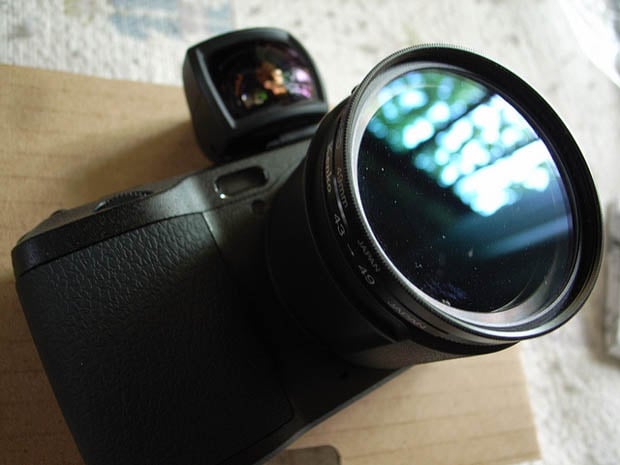
Could the Ricoh GR Digital V Be Another Runner in the Large Sensor Compact Market?

My wife has been using my Panasonic DMC-LX5 a lot recently. Given her record with damaging cameras, I'm starting to look for a replacement. Honestly, I probably should have taken advantage of the holiday deals on the DMC-LX7. It was available for $275. Now, it's back over $400.
New Ricoh Digital with APS-C Sensor Coming?
Image Source: http://www.petapixel.com/2013/01/21/ricoh-gr-digital-v-to-feature-an-aps-c-sensor/
 
 
In any case, it's a good time to look again and see what's out there. I would like a larger sensor than the LX7 offers. That brings up some excellent new cameras, all with large sensors and compact designs. Namely, I'm thinking of the new Sony RX1, Leica X2, and Fujifilm X100s. All of these are fixed-lens designs, without zooms. For my purposes, I think I want a zoom. This will be my pocket camera - the backup when needed, or sometimes the only camera I'll carry on a short trip. The Panasonic DMC-LX7 would be perfect, if it just had a little larger sensor.
 
Anyway, I read this short post about the possibility of a new Ricoh compact that may have an APS-C (larger than most other compact cameras) sensor.
 
(Click Here) to read the post on PetaPixel.
 
I think this one will likely have a fixed focal length lens as well. The GR IV does. But, I'll keep my eyes open.
 
Right now, the Fuji X20 seems like a possible good upgrade from the LX5. But, while it's sensor is bigger than the LX5 (and LX7), it's still much smaller than APS-C. Another potential is the Sony RX100, but it doesn't have a viewfinder of any type, so that's not going to work for me.
 
DMC-365.blogspot.com


Thursday, January 10, 2013

A Family Tradition - Oseichi Ryori - Japanese New Year's Breakfast

 
Japanese Oseichi Ryori, by Reed A. George
Panasonic Lumix DMC-LX5
iso 160, f2.2, 1/60 sec.
 
My wife is Japanese. Living in Northern Virginia, we don't get all that many chances to celebrate Japanese culture. One opportunity we take every year is on New Year's morning. We order out traditional Japanese food, oseichi ryori. Now I'm kind of a conservative eater, especially at breakfast. But, I thoroughly enjoy welcoming the new year in with fresh seafood and Japanese sencha (green tea) one day per year.
 
I also always grab a camera and take a shot of this year's selection. That tends to be the DMC-LX5. For these shots, I used iAuto, where the camera sets EVERYTHING for you. Obviously, I also used macro focus. Not bad for complete point and shoot automation.
Japanese Oseichi Ryori, by Reed A. George
Panasonic Lumix DMC-LX5
iso 200, f2.2, 1/60 sec.


Ohashi (chop sticks), by Reed A. George
Panasonic Lumix DMC-LX5
iso 80, f2, 1/100 sec.
 
I almost sprung for an upgrade to the LX5 over the holidays - the LX7 was obscenely cheap at less than $300. But, the additional nearly $200 to upgrade the accessory finder from the DMW-LVF1 to DMW-LVF2, necessary with the LX7, was just a little too much. I've got no complaints about the LX5, and the LX7 has a faster (f2) lens, but no advantage in sensor size. So, I held off.
 
Happy 2013!
 
DMC-365.blogspot.com


Sunday, December 30, 2012

GF1 Love


Member "red" on mu-43.com posted this awesome collage of images taken with the Panasonic Lumix DMC-GF1.
 
(Click Here) to see the comments and original post on mu-43.com
 
My friend James McKearney just purchased a used GF1 as a back-up to his Olympus OM-D. I still have a GF1, as well. I love the form factor of the GF1, even though it's imperfect in some ways. In order to keep to the clean lines and shape, you must shoot from the LCD. Adding the LVF-1 accessory finder, which I think of as required, significantly changes the outline. But, all in life is compromise.
 
The cool thing is that the LVF-1 works on both the GF1, and the more compact DMC-LX5.
 
I'm looking forward to the announcement of a DMC-GX2, which should have the same basic shape as the GF1, yet also have the latest in sensor technology.
 
In any case, the GF1 is a great little camera, and I need to drag mine out.
 
DMC-365.blogspot.com


Sunday, December 23, 2012

Beautiful Series of Street Photos from Morocco - Daniel Belenguer

Copyright Daniel Belenguer (Used by Permission From the Artist)
Leica M6
Leica M6
Image Source: www.amazon.com


I love a post that I can learn from. Photographer Daniel Belenguer gives a very nice written description of a holiday he recently took to Morocco. He went extremely light on equipment - a single Leica M6, 35mm lens, light meter (his in-camera meter is busted), and 25 rolls of film. He got some amazing images, in my opinion.
 
(Click Here) to read Daniel's post and see all of his pictures from the trip.
 
I envy those who can go so light on equipment and come back with so many successful images. For myself, if I went somewhere like Morocco, I would not be able to live without having at least one backup camera with me. Nowadays, that could be a very small camera, like the Lumix DMC-LX7. But, I'd need at least that.
 
Then I think about lenses. If I had to pick one lens for a trip like this, it may well be a 35mm, as Daniel did. However, I am really better oriented to the 50mm focal length. I've limited myself to one lens many times. If I picked the 35, I usually longed for a 50. If I chose a 50, there were moments when I wished it was a 35. Perhaps this is why the 40mm Rokkor is such a beloved lens on my Leica CL. I guess I'm saying that if I have to pick one lens, the 40mm Rokkor f2 (manufactured in a partnership between Leica and Minolta in the 70s) might be it.
 
In fact, on my recent trip to Barcelona, the only non-Lumix gear I took was the Leica CL and 40mm Rokkor. I've got my processed film back from The Darkroom (great mail-in film processing service, www.thedarkroom.com), and need to get to work on a post from those rolls. I'm quite happy with what I see in the scans. You'll see a post of those very soon.
 
When I look at Daniel's images, I see that 35mm was the appropriate focal length for him. There are a few cases where I would want to be a little tighter in composition, which the 50mm would have done perfectly. Overall, though, I would say more of his images fit the 35mm field of view. So, he made the right choice in my humble opinion.
 
Nice job, Daniel. Thanks for sharing your results with the world. And thanks for giving permission to use a photo or two.
 
 
DMC-365.blogspot.com
 
DMC-365.blogspot.com
 

Saturday, December 15, 2012

Sony RX1 Sample Pics

 
Sony RX1
 
The new Sony RX1 is really interesting. A full-frame, 24MP Sony sensor, permanently matched to a non-interchangeable Carl Zeiss Sonnar 35mm f2 lens. Nearly $3,000 price tag. Wow.
 
Pocket Lint has posted a brief introduction, and more importantly, some sample images from this camera, including using it at iso 25,600. Not bad. Not bad at all.
 
(Click Here) to see the post on Pocket Lint.
 
What are my thoughts on this camera? Well, first off, you have to shoot it at arm's length, if you use the LCD to compose. On the positive side, since it's a fixed-lens, fixed focal length, you can use an optical finder mounted in the flash shoe. I don't know how easy it is to set hyperfocal distance on the RX1, but that could be a good solution for street photography. Otherwise, there's an accessory electronic finder. In either case, it really takes away from the nice size and shape of the camera.
 
If I were looking for a smaller back-up to my Leica M9, the RX1 would be interesting. The Leica X2 is as well. The X2 has an APS-C sized sensor, smaller than the full-frame sensor in the RX1. I'm sure the Leica can't do nearly as well at high iso.
 
Right now, my answer to this is the nice little Panasonic Lumix DMC-LX5. Not in the same league of image quality, for sure. The LX5 is okay at iso 400, can be used up to 800 or maybe 1600, if you're not going to get hung up on noise. But, that's really pushing it. Otherwise, it's an amazingly well-equipped little camera, and with zoom and focus memory, hyperfocal settings, and silent shutter, it's an awesome street shooter.
 
I think I'll always need an eye-level finder, as opposed to composing on the LCD. I highly prefer an optical finder to electronic view finder (EVF), yet have used the EVF on my Micro 4/3 cameras extensively. With an optical finder, autofocus is a real problem; you don't know what you're focusing on. With either an optical or EVF, these compact cameras become signficantly less compact and streamlined.
 
So, for me, the perfect compact companion to the M9 does not yet exist. The RX1 is close. I probably shouldn't try one. If I found that manual and hyperfocus settings were easy, I may fall in love.
 
In any case, I'm happy to see new cameras that put supreme image quality at the top of their features. Nice job, Sony (and Zeiss).


Thursday, November 29, 2012

First Afternoon and Evening in Barcelona - I Think I Like It Here

 
Gelato Selection, by Reed A. George
Panasonic Lumix DMC-LX5
 
We arrived in Barcelona today, Sunday, at about noon. After a quick nap, we went out for a tasty lunch of tapas (shrimp, avocado salad, local sausage and white beans). This kept us full enough that we only needed a small snack for dinner.
 
I can already tell that the street photography is going to be great here. For our evening walk, I grabbed my Panasonic Lumix DMC-LX5 and Russian 35mm optical finder, set the zoom to 35mm equivalent, manual exposure at either iso 400, 800, or 1600 (pretty high for this small sensor), and shot away.
 
Mixed Traffic, by Reed A. George
Panasonic Lumix DMC-LX5
 
In order to minimize jet lag, I need to stay up until at least 10:00 tonight, preferably closer to midnight. It's currently only 7:30PM. I may have to go out again to succeed in staying awake...
 
I'm certainly looking forward to the rest of this trip. The images above are both jpegs directly from the camera, shot using the Dynamic Black and White option. I don't know exactly how this works, but flickr is showing the filenames as if they were raw files. That can't be, as the Black and White option only affects the jpegs. And, I can't see my EXIF information, either.
 
At any rate, I'm pretty sure that some careful post-processing at home will clean them up quite well.
 
More from Barcelona coming soon!


Friday, November 23, 2012

Amazing Deal! Lumix DMC-LX7 for $299 New!

 
Panasonic DMC-LX7
Image Source: http://www.huntsphotoandvideo.com/detail_page.cfm?ProductID=DMCLX7K&mfg=Panasonic&show=yes
 
First off, I have no connection to Hunt's Photo. However, they have an incredible deal on the Lumix DMC-LX7 today. Get it quick!
 
(Click Here) to go to Hunt's for the LX7 at $299 (regularly ~$499)!
 
This is an awesome little camera. I have the previous version, the DMC-LX5. It's an amazing street shooter, with raw file capability, a fast lens, and quick response. The LX7 has an even faster f1.4 lens.
 
I am sorely tempted by this deal, and would go for it if it didn't mean buying a new electronic viewfinder (it's different from the one on the LX5) and spare batteries. The truth is, I'm happy with the LX5, so it's not worth the upgrade for me. If I didn't have the LX5, I'd jump on this in an instant.
 
DMC-365.blogspot.com
 
If you buy one, please get your finder (LVF-2) and extra batteries through the link below:


Wednesday, November 14, 2012

This Charges Me Up For My Upcoming Trip to Barcelona!

 
Barcelona (Placa Catalunya) by jky on rangefinder forum
 
Member jky on rangefinderforum posted three excellent images from a recent trip to Barcelona.
 
(Click Here) to see them all.
 
I will be leaving for Barcelona for a family vacation, about a week from when I'm writing this post. I'm excited about street shooting there.
 
We usually end up going back to one of our favorite places on family vacations, and decided to do something really different this time. This will be a challenge trip for us, as we don't speak the language. But, we're very excited to meet nice people, eat great food, enjoy Gaudi' architecture, and anything else that comes our way.
 
I've read that theft can be a real problem, especially in the tourist areas. I'm thinking that I won't take my most expensive camera (Leica M9), even though it pains me to leave it at home. I'm also pretty sure that Barcelona is far safer than New York City, where I have used my Leica gear in the past.
 
That said, my Micro 4/3 kit of two Lumix DMC-G3 bodies will give me more flexibility anyway, and I won't commit suicide if anything goes missing. I won't like it, but I'll recover. Right now, I'm thinking that I'll take the two G3 bodies, and maybe only a couple of lenses - the Lumix 20mm f1.7 and Lumix 14-140mm f3.5-5.8 zoom. The zoom will give me awesome range in a single lens, including enough telephoto reach for external architecture shots. The 20mm is tiny and fast. Of course, I'm sure the lens list will grow before I get on the plane. Oh yeah, I'm sure I'll throw in the diminutive Lumix DMC-LX5 as well. It weighs nothing, and takes up very little space. I will also take a 35mm optical finder to use the LX5 for street shooting.
 
What do you think? Is this too minimal?
 
I'm getting psyched for this trip...
 
DMC-365.blogspot.com


Sunday, August 26, 2012

Unique Images Shot With Panasonic Lumix DMC-LX5


Image Source: http://forums.dpreview.com/forums/readflat.asp?forum=1033&message=42253729
 
TRIPLE BEAM DREAM shared some very unique images, all made with a Lumix DMC-LX5, on dpreview.com.
 
(Click Here) to see the post on dpreview
 
Here's one I took myself with the LX5:
Light and Shadow Study, by Reed A. George
Panasonic DMC-LX5
 
The LX5 is one great little camera. I'm looking forward to seeing if the recently-announced LX7 is any improvement at all. The LX7 doesn't have a larger sensor; in fact it's smaller than the LX5 sensor. But, new technology may have further improved the high iso performance. The LX5 does well in this area, but could always be improved. High iso noise is the bane of small sensor cameras. However, the overall (tiny) size of the LX5, coupled with its great image quality overall, makes it a great choice for a carry-everywhere camera.
 
DMC-365.blogspot.com


Thursday, July 19, 2012

Panasonic Announces New Top-Line Compact DMC-LX7


Panasonic Lumix DMC-LX7
Image Source: www.dpreview.com
 
Panasonic has announced the successor to the wonderful compact camera DMC-LX5, the Lumix DMC-LX7. I am a long-time LX series devotee, having owned the LX2, and now the LX5. If you haven't looked at the LX series before, you should. I've written before how well the LX5 works as a street photography camera, for me. It's tiny, flexible, has a great feature set (including the ability to lock the f-stop and zoom position when you turn the camera off), all manual controls, and raw file capability.
 
(Click Here) to see my post about the LX5 as a street photography camera.
 
As with all cameras, there are tradeoffs. The LX series cameras have small sensors. The immediate effects are: 1) decreased performance at high iso (noise), and 2) inability to produce shallow depth of field. The LX5 does pretty well up to iso 400, acceptable for small prints (and definitely for viewing on the monitor) at iso 800, after which noise becomes a real issue. The fast zoom allows you to produce a reasonable portrait at the long end of the zoom, wide open. This gives decent shallow depth of field, but nothing like your full-frame fast lenses.
 
(Click Here) to read about the new DMC-LX7 on dpreview.
 
I had heard rumors that the LX7 would have a larger sensor than the LX5, which could have improved the camera in both respects. As it turns out, the sensor on the LX7 is a little smaller. The lens is about a stop faster, so that allows you to shoot at lower iso, which will help with noise. Reportedly, the new sensor also has better inherent signal-to-noise, which should also help. The faster lens also helps with producing shallower depth of field, when it's desired.
 
So, for me this is a mixed bag. While I believe that the new sensor and faster lens will help in these areas, I would have appreciated a bigger sensor more. Also, I tend to use the LX5 for street shooting, which in my own style does not require shallow depth of field. I like to set it on f4 or f5.6, fix the zoom and focus point to give a large depth of field, and shoot what I see on the street. For that, the LX7 offers little for me personally. If the noise performance is really better, which will be challenging with a small sensor, I may change my mind.
 
Part of what I'm saying is that I'm already quite pleased with the LX5. It's really a special little camera. The LX7 is at least as good - I'm just not sure I'll be upgrading anytime soon.
 
DMC-365.blogspot.com
 
Note - apparently, Panasonic will delay preorder capability until 30 days before the camera will actually ship. I admit that I HATE waiting for a new camera that I've already ordered, and waiting, and waiting. I did this with the Pana-Leica Summilux 25mm f1.4, waiting for several months. I'm doing it again now with the Olympus 75mm f1.8 lens. But, delaying preorder only serves as a band-aid. What these companies really need to do is produce faster. If they must make the announcements to keep up with the Joneses, then they need to be ready to deliver. Thanks for letting me rant a little.
 
Here's the DMC-LX5 (not LX7) on Amazon:


DMC-365.blogspot.com
 

Monday, June 18, 2012

Shooting Rangefinder-Style With Micro 4/3

 
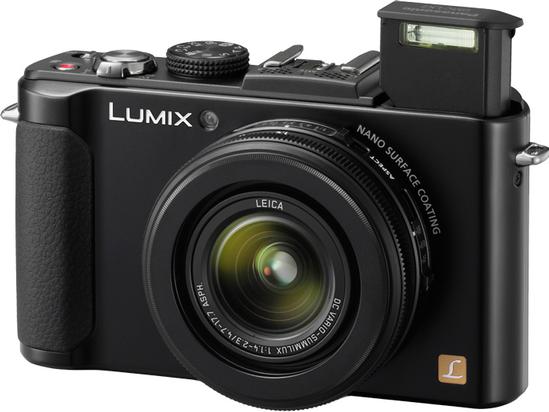
kdixey's RF Shooting Emulation
dixeyk's Emulation of Rangefinder Style Shooting on Panasonic Lumix DMC-GF2
Image Source: http://www.mu-43.com/f35/how-approximate-my-old-compact-rfs-27412/

dixeyk has written a post over on mu-43.com about recapturing the shooting style of classic rangefinder cameras with Micro 4/3 gear.

(Click Here) to read the full post.

I have referenced dixeyk's posts before. We seem to have similar interests in our photography. The goal was to set up a modern Micro 4/3 camera to allow a shooting style similar to a classic film rangefinder. Of course, the best way to get that is to have a digital Leica (or perhaps the Fuji XPro 1?), but that was not available.

The characteristics that dixeyk went for, as far as I can interpret, were a compact kit, fast (wide aperture) lenses, and fast focus (as one can achieve through manual focus on a rangefinder camera). For this, he chose to use a Panasonic Lumix DMC-GF2 and the Lumix 20mm f1.7 as his normal lens. He also used Lumix 14mm f2.5 and Olympus 45mm f1.8 lenses, approximating a 28, 40, and 90mm field of view on a classic rangefinder. So far, I would have made similar choices, using my Lumix DMC-GF1 (another Lumix body without an internal viewfinder) and Lumix 20mm f1.7 lens.

Now here's where we go different ways. In dixeyk's case, he decided to shoot with the LCD and autofocus, utilizing the camera's ability to touch focus and shoot. This allows the user to pinpoint where in the field of view they want to focus by touching the LCD screen. As soon as focus is achieved, the camera automatically releases the shutter, capturing the image. I can see how this would feel similar to the fast focus and capture capability of a classic rangefinder.

For my own approach, especially in street photography, my favorite use of a rangefinder, I go in a completely different direction. I turn off the LCD, mount a 35mm optical finder (an old Russian version in my case) in the camera's flash shoe, and use hyperfocal settings to give a lot of depth of field. For information on that,

(Click Here) to see my previous post on setting hyperfocal distance on Panasonic Micro 4/3 cameras.

I find that the 35mm finder closely approximates the field of view of the 20mm f1.7 Lumix lens.
 
I use the exact same finder on my smaller Panasonic Lumix DMC-LX5, which provides for directly setting zone focus in the manual focusing screen. In actuality, the LX5 does a better job of emulating a rangefinder than the GF1, in my opinion. It has a great scale to show the focus distance and depth of field, will allow you to lock the zoom at any focal length and the f-stop at any setting. It is a super-quick little camera for street photography.
 
(Click Here) to see my post on my LX5 street kit.
 
I will give dixeyk's approach a try. I think the main differences are in what each of us is trying to achieve. He's working toward quick response pinpoint focus and capture, while I'm working toward large depth of field, quick response street photography with a rangefinder camera.
 
Fun stuff.
 
DMC-365.blogspot.com


Saturday, May 19, 2012

Fun Little Article About Wildlife in Tokyo

 
Mandarin Ducks in Tokyo
Mandarin Ducks (Oshidori in Japanese)
Image Source:
http://www.japantimes.co.jp/text/ek20120430a1.html?utm_source=feedburner&utm_medium=feed&utm_campaign=Feed%3A+japantimes+%28The+Japan+Times%3A+All+Stories%29

The Japan Times recently ran a bilingual piece about wildlife in Tokyo. It explains the Japanese concept of an annual awakening day for wildlife (keichitsu in Japanese), which usually occurs around March 4 or 5. It is surprising how much wildlife really does exist in Tokyo, with its heavily developed land and industry-lined waterways.

(Click Here) to read the full story.

Of course, there are typical pests in the city, including the ubiquitous crows (karasu in Japanese), but the parks do still harbor many species of waterfowl, and at least three species of turtles are found within the city limits.
 
Here are a couple of wildlife shots I took on my recent trip to Tokyo:
 
 
Tokyo Turtles, by Reed A. George
Taken at Kiyosumi Garden Park
Panasonic Lumix DMC-LX5, iso80, f3.5, 1/400 sec


Waterfowl, Ueno Park, Tokyo, by Reed A. George
Panasonic Lumix DMC-G3, Pana-Leica 45mm f2.8 Macro-Elmarit
iso400, f2.8, 1/2500 sec

DMC-365.blogspot.com


Wednesday, May 9, 2012

Two Pictures From A Normal Workday

 
Neighborhood Pathway, by Reed A. George
Panasonic Lumix DMC-LX5
iso80, f4, 1/500 sec

I know this shot is a little pedestrian (sorry for that pun). Just a quick stop on my drive to work.


Box Turtle (Terrapene carolina), by Reed A. George
Panasonic Lumix DMC-LX5
iso100, f2.2, 1/80 sec

This guy (he is a male) was by another walking path, this one where I work.

The LX5 is a great little camera. I had to get very close for the turtle shot, but am pretty impressed with the macro capability. Both shots are directly from the camera, no adjustments.

Hope you enjoy these little scenes from my day.

DMC-365.blogspot.com