End of Summer Goodbyes, by Reed A. George
Panasonic Lumix DMC-GX7, 14-42mm Series II Kit Lens
iso 400, f11, 1/500 sec.
I just read an interesting article entitled "Modern Photography," about the state of photojournalism (PJ) today on the NY Times' blog, "Lens."
The piece compiles the thoughts of several photographers, curators, and editors, including Maggie Steber, who I recently had the great fortune to meet at the LHSA (International Leica Society)'s Spring Shoot in New Orleans. Maggie was our keynote speaker.
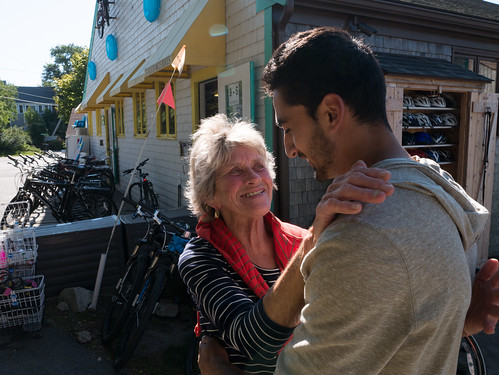
I used the photograph above for this post, as it is a piece of honest PJ that I shot, of a lady in Provincetown, Massachussetts, saying goodbye to a young man from Bulgaria who was returning home after his summer employment there. The change in P-town's population during the tourist season was a subject of interest to me.
More importantly, perhaps, I asked this young man to carry his suitcase out of his place of work for me, so that I could get a shot of him leaving. Actually, he was leaving the next day. He wasn't able to do that for me, but if he had, would that have been too much staging to qualify as PJ? Upon reflection, I think it would have been. These are tough lines to see and stay within.
Some of the interesting points in the Lens Blog post:
- In earlier times, PJ could be used simply to show or prove that something was occurring outside the direct view of some readers. But, those events - war, famine, crime, etc. are now known to everyone. We don't need proof. Now, the photographer needs to somehow go further, to tell a story, to make it more "real" for the viewer/reader.
- In fact, because the events represented are now known to everyone, a picture of the event can have the effect of trivializing the situation. Sort of "Oh, another famine," rather than engage the viewer in what it really means.
- Because of this point, at least one authority states that "photojournalism is dead."
- Many photographers engage in long term projects, where they certainly do affect the poses of their photographic subjects, move to better light, etc. This is where the lines get blurry.
- The most important thing is for the photographer to be honest about how they produced their pictures. Admit what they are and are not showing.
- When it comes to honesty, it used to be that a professional photojournalist would lose all credibility, and probably their job, if they were dishonest in representing a subject. Now, there's very little risk to most photographers, especially those who just happen to have a camera with them and capture events as they happen.
- Honesty in photography has been a problem ever since photography was invented. We now know that some famous civil war photographers staged scenes, and even used the same body twice - once as a Union soldier, another time as a confederate.
These were the things that I found most interesting about the Lens Blog piece. (Click Here) to read it for yourself.
DMC-365.blogspot.com