Showing posts with label photography. Show all posts

Tuesday, May 5, 2015

Is Photojournalism Really Dead? NY Times' Blog "Lens" Discusses Storytelling and Honesty

 
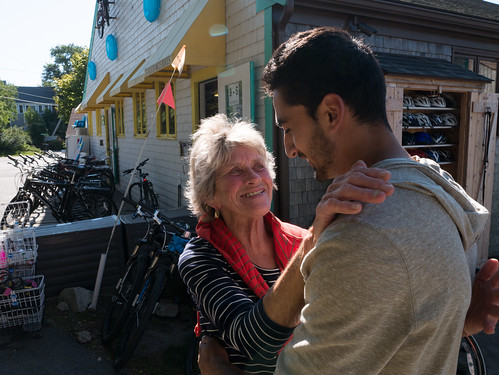
End of Summer Goodbyes, by Reed A. George
Panasonic Lumix DMC-GX7, 14-42mm Series II Kit Lens
iso 400, f11, 1/500 sec.
 
I just read an interesting article entitled "Modern Photography," about the state of photojournalism (PJ) today on the NY Times' blog, "Lens."
 
The piece compiles the thoughts of several photographers, curators, and editors, including Maggie Steber, who I recently had the great fortune to meet at the LHSA (International Leica Society)'s Spring Shoot in New Orleans. Maggie was our keynote speaker.
 
I used the photograph above for this post, as it is a piece of honest PJ that I shot, of a lady in Provincetown, Massachussetts, saying goodbye to a young man from Bulgaria who was returning home after his summer employment there. The change in P-town's population during the tourist season was a subject of interest to me.
 
More importantly, perhaps, I asked this young man to carry his suitcase out of his place of work for me, so that I could get a shot of him leaving. Actually, he was leaving the next day. He wasn't able to do that for me, but if he had, would that have been too much staging to qualify as PJ? Upon reflection, I think it would have been. These are tough lines to see and stay within.
 
Some of the interesting points in the Lens Blog post:
 
  • In earlier times, PJ could be used simply to show or prove that something was occurring outside the direct view of some readers. But, those events - war, famine, crime, etc. are now known to everyone. We don't need proof. Now, the photographer needs to somehow go further, to tell a story, to make it more "real" for the viewer/reader.
  • In fact, because the events represented are now known to everyone, a picture of the event can have the effect of trivializing the situation. Sort of "Oh, another famine," rather than engage the viewer in what it really means.
  • Because of this point, at least one authority states that "photojournalism is dead."
  • Many photographers engage in long term projects, where they certainly do affect the poses of their photographic subjects, move to better light, etc. This is where the lines get blurry.
  • The most important thing is for the photographer to be honest about how they produced their pictures. Admit what they are and are not showing.
  • When it comes to honesty, it used to be that a professional photojournalist would lose all credibility, and probably their job, if they were dishonest in representing a subject. Now, there's very little risk to most photographers, especially those who just happen to have a camera with them and capture events as they happen.
  • Honesty in photography has been a problem ever since photography was invented. We now know that some famous civil war photographers staged scenes, and even used the same body twice - once as a Union soldier, another time as a confederate.
These were the things that I found most interesting about the Lens Blog piece. (Click Here) to read it for yourself.
 
DMC-365.blogspot.com


Monday, June 9, 2014

More New Orleans Street Art

I have a thing for artists who make their living sharing creativity on the street. This gentleman was most gracious when I asked if I could take his picture at Jackson Square in New Orleans.
 
Street Artist, New Orleans, by Reed A. George
Leica M6 Titanium, Kodak 400 Color Print Film
 
I honestly can't remember if I was using my 35mm f2 Summicron or 50mm f1.4 Summilux for this shot. I must learn to record my film shooting parameters better.
 
What attracted me to this man as a subject was the combination of beautiful morning light bouncing from his sketch pad and lighting his face, and his intense concentration on his subject. In composing the shot, I got down low, hoping to use the line of the fence to align somewhat with his line of sight. I think I achieved that reasonably well. I was able to get in and out of their way very quickly, and captured exactly what I wanted with the M6.
 
Nope, I'm not ready to give up film yet.
 
DMC-365.blogspot.com


Saturday, June 7, 2014

Photography as a Passion

Point Reyes Contemplation, by Reed A. George
Nikon D70, Sigma 600mm f8 Lens
iso 400, f8, 1/640 sec.
 
I took the shot above ten years ago. I remember the thrill of getting my first DSLR, the Nikon D70. Quite a machine it was. I also remember the feeling of hiking at Point Reyes, California on that day.
 
Eric Kim has posted 35 Magnum photographers' advice to aspiring photographers. I haven't read them all yet.
 
(Click Here) to read the full post on Eric Kim's blog.
 
Here's the one that will be my thought for the day, by Alex Webb:
 
"Photograph because you love doing it, because you absolutely have to do it, because the chief reward is going to be the process of doing it. Other rewards — recognition, financial remuneration — come to so few and are so fleeting. And even if you are somewhat successful, there will almost inevitably be stretches of time when you will be ignored, have little income, or — often — both. Certainly there are many other easier ways to make a living in this society. Take photography on as a passion, not a career."
I do feel that I "absolutely have to do it." I find that part of the quote very interesting. Taken out of context, that could mean that photography is your career, thus you have to do it. I think the follow-on is important: "...the chief reward is going to be the process of doing it." Certainly true for me. The process is the thing for me.
 
DMC-365.blogspot.com
 

Sunday, August 18, 2013

Combining Two Loves - Science and Photography

I have just achieved a milestone. Combining my love for field science and photography, I have the incredible honor of being published in a first-rate Paleontology journal with a true leader in the field, Dr. Robert Weems. Our paper on amphibians and non-marine turtles from the miocene period was published in the July issue of the Journal of Paleontology.
 
(Click Here) to read the abstract.
 
My minor contributions to the work included two things - finding a humerus bone from a several million year old land turtle, and taking all of the photographs for the paper. Dr. Weems provided all of the scientific expertise, writing, and editing.
 
Here's the sample that I found:
 
Miocene Turtle Humerus, by Reed A. George
 
I met Dr. Weems through my association with Paleo Quest, a non-profit organization focused on education and scientific research, specifically in Paleontology.
 
(Click Here) to check out Paleo Quest.
 
What an exciting project! Thanks, Dr. Weems, for all of your assistance and support.
 
DMC-365.blogspot.com
 

Monday, November 26, 2012

The Psychology of Photography - Published by Theme


Occasionally, I like to back up and think about why I (we) photograph. I put an enormous amount of time and thought into my photography, and it rewards me back more than I put in. Theme recently published a thoughtful article on the subject.
 
(Click Here) to read the story on Theme. Be sure to watch the TED video. There are graphic images in the video, but they're strong, meaningful ones.
 
Sometimes the "philosophy of photography" can seem dull and overly-introspective to me. I've read some books (including some famous ones) that I forced myself to finish, and then concluded that I was no smarter at the end than the beginning. So, I like short, thoughtful pieces like the one above.
 
A couple of concepts that stuck with me are that photography is a way of "...crystallizing one's own experience..." and a way to "...to less ignore the life we live in..."
 
Another touchpoint of this article and video is that good images force us to act. I believe that all good art evokes emotion (I'm not sure who said that, but it's not my original idea). That emotion is not always positive or good. And, I also believe that emotion drives action. So, I can go along with this concept.
 
Finally, the piece makes the point that a good image is made by the photographer, the camera, the object, and most importantly by the viewer. The viewer must get the point for the communication to have been effective.
 
I found this brief piece interesting. But, enough navel gazing. Let's get out and make some pictures.
 
DMC-365.blogspot.com