DMC-365 focuses on creative photography equipment, techniques, and approaches. I believe that equipment is part of the creative process. I use Leica, Panasonic Lumix, Nikon and other cameras, both digital and film. On DMC-365, you can expect to see a lot of my own work, as well as work by others that I find interesting. I share methods, equipment developments, and creative approaches to photography.
Showing posts with label Lens. Show all posts
Saturday, March 18, 2017
Thursday, September 17, 2015
Exciting New Lenses from Zeiss - Milvus Line for DSLRs
Zeiss makes absolutely wonderful lenses. For Nikon camera bodies, the ZF lenses are all manual focus, and are unquestionably at the top of optical performance.
Not too long ago, they came out with the Otus 55mm f1.4 and 85mm f1.4 lenses for Nikon and Canon DSLRs. The Otus lenses are advertised as providing medium format image quality on the 35mm sensor size. They also cost at least $4,000. I'd love to try one.
Now, Zeiss has come out with the Milvus line. Announcing the full lineup all at once, there are Milvus models in the following focal lengths and maximum apertures: 21mm f2.8, 35mm f2, 50mm f1.4, 85mm f1.4, 50mm f2 Macro, and 100mm f2.8 Macro. Again in manual focus, the Milvus lenses are more reasonably priced, listing for less than $2,000 each on preorder at Adorama. They should be shipping in October.
So, what's special about the Milvus lenses? They're designed specifically for the new high pixel count sensors, with low light scattering, precision manual focus across the full focus range, and weather resistance.
(Click Here) to read more about the Milvus lenses on Zeiss' website.
It's great that Zeiss keeps bringing us high quality optics for various camera systems. I love the variety they're offering.
DMC-365.blogspot.com
Labels:
Carl Zeiss,
DMC-365,
DMC-365blogspotcom,
DSLR,
Lens,
manual focus,
Milvus,
new product,
optics,
zeiss
Saturday, August 8, 2015
The Old Corn Crib, Revisited
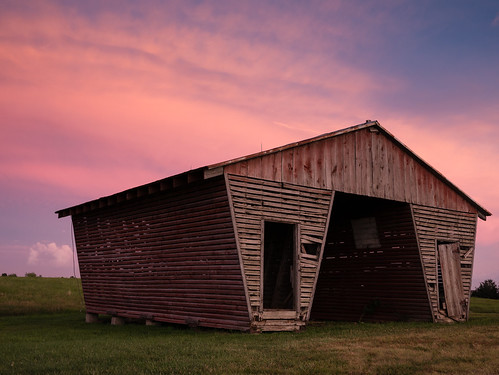
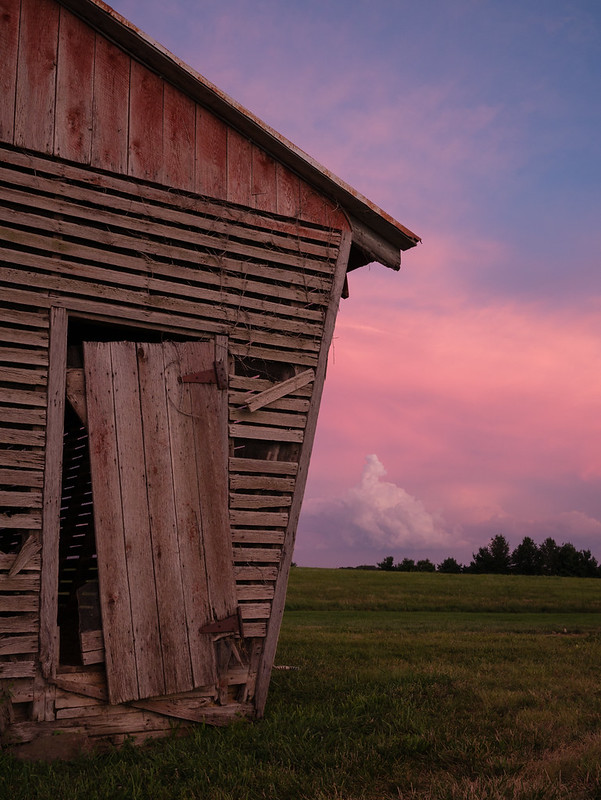
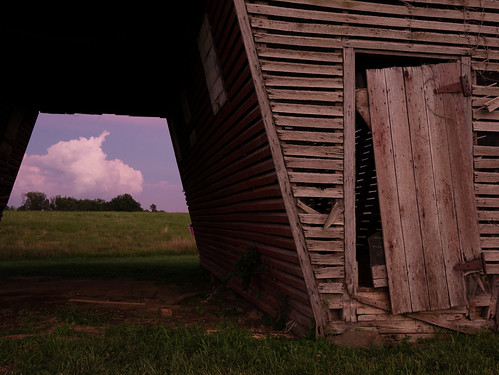
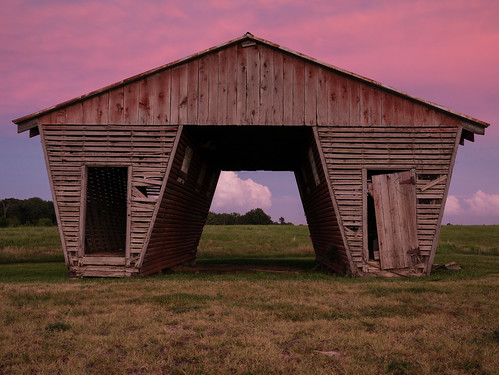
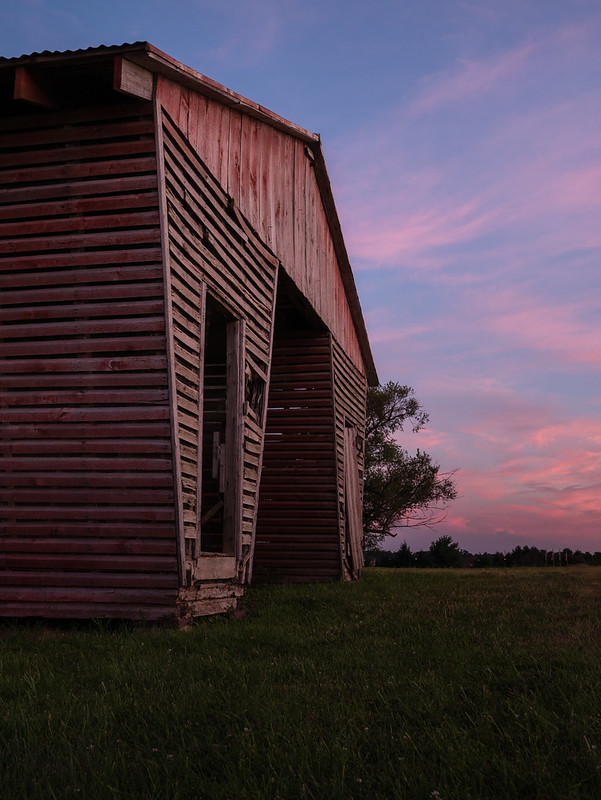
I was driving home this evening and noticed a lot of dramatic clouds in the sky, accentuated by the sunset. So, I stopped at the old corn crib that I've photographed in the past and made some images. (Click Here) to see one of my previous posts of this cool old building.
This time, I had my Panasonic Lumix DMC-GX7 and 20mm f1.7 lens with me. I'm trying to decide whether to bring this camera on vacation with me. I've drifted away from my Micro 4/3 gear recently, but this little shoot has me once again appreciating the GX7.
I actually sold some of my Micro 4/3 lenses recently, keeping only those that I hold most dear. Also, I kept the smallest lenses, as that's what shines about Micro 4/3 cameras, small size. So, I sold my 14-140mm zoom, 25mm f1.4 Summilux, and 75mm Olympus lenses. All excellent lenses, I felt that keeping my 20mm f1.7, Pana-Leica Micro-Elmarit 45mm f2.8, 14mm f2.5, Bower fisheye, and the amazing 100-300 f4-5.6 zoom was sufficient. Now I find that I'm missing the medium telephoto length of the Oly 75, especially in planning for travel. So, I'm going to try the new Sigma 60mm f2.8 Art lens, which is very cheap ($200 new), and getting great reviews. More on that to come.
DMC-365.blogspot.com
Tuesday, July 28, 2015
So, Which of My Lenses Are Best on the Nikon D810?
Image Source: http://www.nikonusa.com/en/Nikon-Products/Product/Camera-Lenses/AF-S-NIKKOR-28mm-f%252F1.8G.html#close
The advent of the D810, and its predecessors the D800 and D800E, caused many photographers to find the limits of their lenses. It used to be rare that the sensor was good enough to have the lens be the limiting factor in image quality, or acuity. Now, it's not rare at all.
So, which lenses from my (rather extensive) kit of Nikkors will work well on the D810 that's on its way to me in the mail?
I found a nice list on the DxO page, which lists the top choices for prime and zoom lenses for the D810. Testing over 100 lenses on the D810, they've compiled a list of the ones they found most suited to the new super-sensor. (Click Here) to read the full list.
As expected, my new 28mm f1.8 AF-S G lens, my most modern lens, makes the list. Importantly, so does the AF-S 200-400mm VR, though they tested the version 2 of this lens; mine is version 1. As the 200-400 is likely to be my most-used lens on this new camera, that's important to me. Another modern lens in my kit, the 70-300mm f4.5-5.6 VR zoom made it on the list. That's good.
Then there were a couple of surprise entries from my older lens selection: the 85mm f1.8 AF-D and the 50mm f1.4 AF-D (which I use all the time). Great to see those there, as well.
So, I feel that in addition to the 200-400, which will be my nature workhorse, I've got a full set of wide (28mm), normal (50mm), short telephoto (85mm), and long compact zoom (70-300) to choose from with this camera. I'll certainly use other Nikkors on the D810, but with these, I know that I can expect the very best results.
DMC-365.blogspot.com
Labels:
DMC-365,
DMC-365blogspotcom,
DSLR,
DxO,
Lens,
new product,
news,
nikkor,
Nikkor 200-400mm f4 AF-S VR G,
Nikkor 28mm f18 AF-S G,
Nikkor 50mm AF-D f14,
Nikkor 85mm f18 AF-D,
Nikon,
Nikon D810,
sensor
Wednesday, July 22, 2015
Lens Comparison: Nikon Nikkor 55mm f1.2 Non-AI Versus 50mm f1.2 AIS
Not long ago, I purchased a near-mint Nikkor 50mm f1.2 AIS lens from my friend. This super-speed manual focus lens is still made by Nikon, and is simply beautiful. I've posted a few shots from it. (Click Here) to see some photos I made with it in the darkness, during a fire.
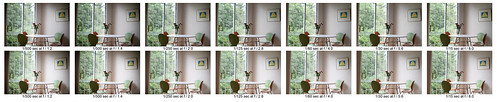
Well, for no reason other than curiosity, I just bought a much older (1970s vintage) Nikkor 55mm f1.2 Pre-AI lens. With the older lens at about half the cost of the AIS lens, I was very interested to see how the two compare. So, I mounted the 55mm lens on my Nikon Df, set the iso to 160, and began to shoot from a tripod. I shot at f1.2, 1.4, 2, 2.8, 4, 5.6, and 8. You can click on any of the following images to see them full size on flickr.
Here's what the whole scene looked like (top row: 55mm f1.2 Non-AI, bottom row: 50mm f1.2 AIS):
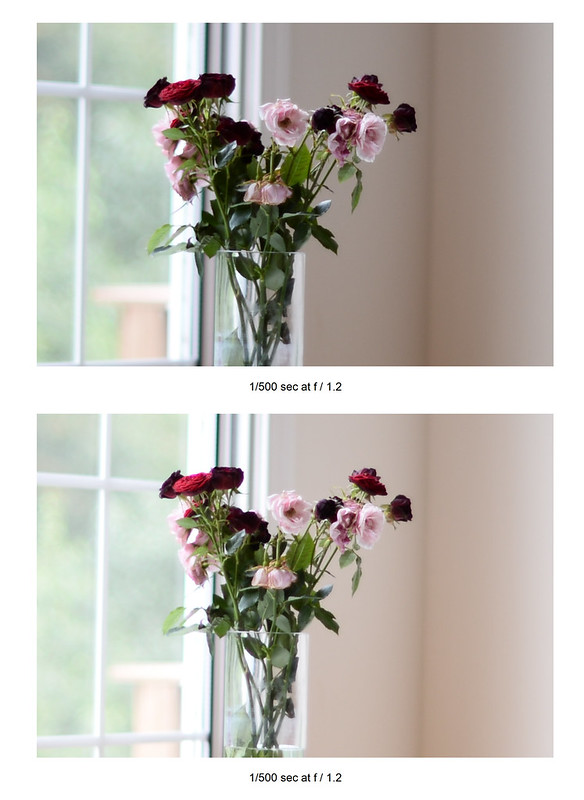
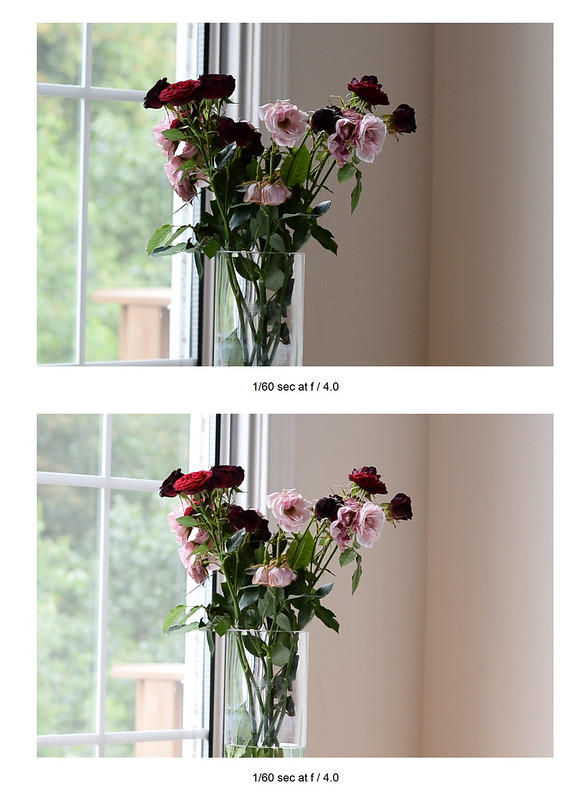
(Click Here) to go to the full flickr set, where you can get a much better idea of how these lenses compare. Be sure to look at how the vignetting decreases on both lenses as I stop down, look at the focus points (the flowers), out of focus areas (like the lemon painting on the wall at right), and how out of focus highlights are rendered. Here are a couple of selected comparisions, at f1.2 and f4:
f1.2, 55mm Non-AI on Top, 50mm AIS on Bottom
f4, 55mm Non-AI on Top, 50mm AIS on Bottom
I need to look at these more closely, but immediately conclude that the sharpness doesn't differ much at all. I also see that the 55mm lens seems to let less light in at the same f-stop as the 50mm lens. This could be do to the more modern coatings on the 50mm AIS lens.
If you're interested in these super-fast Nikkor lenses and their history, (Click Here) to read more on Nikon's website. Great information!
I plan to enjoy both of these lenses. The non-AI lens will be fun to put on a matching-age Nikon F2 and shoot some film with.
DMC-365.blogspot.com
Tuesday, May 5, 2015
Is Photojournalism Really Dead? NY Times' Blog "Lens" Discusses Storytelling and Honesty
End of Summer Goodbyes, by Reed A. George
Panasonic Lumix DMC-GX7, 14-42mm Series II Kit Lens
iso 400, f11, 1/500 sec.
I just read an interesting article entitled "Modern Photography," about the state of photojournalism (PJ) today on the NY Times' blog, "Lens."
The piece compiles the thoughts of several photographers, curators, and editors, including Maggie Steber, who I recently had the great fortune to meet at the LHSA (International Leica Society)'s Spring Shoot in New Orleans. Maggie was our keynote speaker.
I used the photograph above for this post, as it is a piece of honest PJ that I shot, of a lady in Provincetown, Massachussetts, saying goodbye to a young man from Bulgaria who was returning home after his summer employment there. The change in P-town's population during the tourist season was a subject of interest to me.
More importantly, perhaps, I asked this young man to carry his suitcase out of his place of work for me, so that I could get a shot of him leaving. Actually, he was leaving the next day. He wasn't able to do that for me, but if he had, would that have been too much staging to qualify as PJ? Upon reflection, I think it would have been. These are tough lines to see and stay within.
Some of the interesting points in the Lens Blog post:
- In earlier times, PJ could be used simply to show or prove that something was occurring outside the direct view of some readers. But, those events - war, famine, crime, etc. are now known to everyone. We don't need proof. Now, the photographer needs to somehow go further, to tell a story, to make it more "real" for the viewer/reader.
- In fact, because the events represented are now known to everyone, a picture of the event can have the effect of trivializing the situation. Sort of "Oh, another famine," rather than engage the viewer in what it really means.
- Because of this point, at least one authority states that "photojournalism is dead."
- Many photographers engage in long term projects, where they certainly do affect the poses of their photographic subjects, move to better light, etc. This is where the lines get blurry.
- The most important thing is for the photographer to be honest about how they produced their pictures. Admit what they are and are not showing.
- When it comes to honesty, it used to be that a professional photojournalist would lose all credibility, and probably their job, if they were dishonest in representing a subject. Now, there's very little risk to most photographers, especially those who just happen to have a camera with them and capture events as they happen.
- Honesty in photography has been a problem ever since photography was invented. We now know that some famous civil war photographers staged scenes, and even used the same body twice - once as a Union soldier, another time as a confederate.
These were the things that I found most interesting about the Lens Blog piece. (Click Here) to read it for yourself.
DMC-365.blogspot.com
Monday, January 5, 2015
In Photography as in Hunting, Sometimes it's Best to Stay Put
I know that there are a lot of similarities between photography and hunting. Take, for example, that both result in "shooting" your subject. I don't mean to carry that analogy further, but believe it's appropriate in this case. In working to photograph a particular subject, as in hunting, the photographer can choose to cover as much ground as possible, photographing what he/she sees along the way, or they can find a likely spot (not just any spot), and wait for the story or subject to come to them.
I've written about this picture before. (Click Here) to see my original post in the context of the project I was working on.
Goodbye My Friend, by Reed A. George
I shot this picture while attending the Magnum Days workshop in Provincetown, Massachussetts. (Click Here) to see the whole series of posts from the workshop.
I was hoping to photograph the end of summer in Ptown in a broad sense. I was struggling for how to do that more specifically. I found this summer bicycle rental shop, which was clearly wrapping up its season, and decided to stop and hang out. I met this very nice young man from Bulgaria, and just stayed around talking to him. I found out that he would leave for home the next day. Finally, after nearly moving on from there a couple of times, and getting hints from him that leaving would probably make him more comfortable as well, this nice lady from the neighborhood came over to say goodbye to him. There was my shot.
I just read an article on the NY Times' blog, Lens, about the same technique. (Click Here) to read how Fred Conrad used this technique, sitting on the roof of a building in Kosovo, to get his story.
This idea of finding a good location and waiting for a story is not new. In fact, I've read and heard it many times. But, like all good lessons for me, until I'm using it regularly and successfully, it's okay to be reminded of it. It's so easy to grab my camera and just start walking around, shooting what I see. Sometimes that's not the most productive approach.
DMC-365.blogspot.com
Labels:
blog,
DMC-365,
DMC-365blogspotcom,
Fred Conrad,
Kosovo,
Lens,
Magnum,
NY Times,
Provincetown,
Ptown,
story,
wait,
walk,
workshop
Monday, December 8, 2014
Opening at the NYC Public Library: "Public Eye: 175 Years of Sharing Photography"
From December 12, 2014 - September 4, 2015, the New York Public Library is hosting an exhibit of a selection from the library's enormous collection of photographs, collected since the 1800s. I saw the banner announcing the show on my visit to NYC last weekend, but the show had not yet opened at that time.
NYC Public Library, by Reed A. George
Leica M9, 50mm Summicron f2 v.3 Lens
iso 400, f8, 1/125 sec.
The exhibit will be arranged around contemporary themes from social media: crowdsourcing, image sharing, and street view. It will be interesting to see how these themes are interpreted and which images from such an expansive collection will be included.
The exhibit will be held at the Stephen A. Schwarzman Building, Fifth Ave at 42nd Street, NYC.
(Click Here) to read more about it on the NY Times' blog "Lens."
I really hope that I can get back up to NYC before the show ends next September.
DMC-365.blogspot.com
Labels:
blog,
DMC-365,
DMC-365blogspotcom,
exhibit,
exhibition,
history,
Lens,
library,
New Year,
New York City,
NY Times,
NYC,
show
Sunday, November 30, 2014
The Old Nikkor 50mm f1.4 Still Shines
Irish Dance, by Reed A. George
Nikomat FTN, Nikkor S 50mm f1.4, pre-AI Lens
As you may know, I'm continuing to explore shooting Nikon SLR gear that covers a range of more than fifty years. Alongside my new Nikon Df, my original F film body is ready to go, with the Nikkor S 50mm f1.4 lens attached. The lens was a gift from one of my good buddies, Dennis Gallus.
I love it when I find someone else using classic old gear. Forum member DNG on Rangefinder Forum has just shared a few images made with his old Nikkor 50.
(Click Here) to see DNG's results.
I'm not sure what the details are of DNG's statement
"I also used a K25 preset on import from Filmbot. no changes in the color, just Topaz Clarify and Topaz Detail."
but I plan to look up these programs. Always open to new tools that help me continue to enjoy my old film gear and pictures.
The coolest thing about carrying my Df and F together is that any lens I can use on the F is just fine and at home on the Df as well. The inverse is true (any lens on the Df can be used on the F), except for "G" lenses, which lack an aperture ring. I may be the only one who feels this way, but that lack of a ring is keeping me from buying some new Nikon (or Sigma with Nikon mount) lenses.
DMC-365.blogspot.com
Thursday, May 1, 2014
Sigma Steps Up Its Game - Mount Conversion Service
Image Source: http://www.sigmaphoto.com/change-your-mount
I have precious little experience with Sigma products. I have owned one or two of their zooms in the past, and have occasionally borrowed a Sigma lens from a friend while out in the field. Other than that, the only Sigma product I currently own is an 800mm mirror lens from way back. Not a high quality beast, but certainly interesting to use. In fact, it's time to dust it off and play with it again soon.
So why am I writing about Sigma now? Well, they're doing some very interesting things.
My take has always been that Sigma produces a very wide range of products, from the cheapest plastic consumer lenses to high end super telephotos. I think they're focusing on bringing their name up in the ranks by focusing more on the high end.
While hardly a competitor for more standard CMOS sensor cameras, the Sigma Foveon has many die hard adherents, and the results seem to be great. I've never tried one seriously.
More interesting to me is their new "Art" series of lenses, which now includes a 35mm f1.4 and newly-arriving 50mm f1.4, both reported to be best in class (or very near it), even as compared to the equivalent lenses from Nikon, Canon, and others. I've been eyeing both of these lenses for my Nikon kit. There's also the earlier 20mm f1.8 that sure would come in handy in low light concert shooting. My Nikkor 20mm f2.8 sees a lot of use in these shows, but I sure could do with the extra f-stops.
But, here's another example of Sigma catering to serious amateurs and professionals - a mount conversion service. How many times have you or one of your friends wished you could switch camera systems and mounts without having to start over buying lenses? Sigma will now convert any of their new lenses from the Art, Contemporary, or Sports lines between any two of these mounts:
- Nikon
- Canon
- Four-thirds
- Sigma
- Sony
- Pentax
- Sony-Emount
Compared to the cost of purchasing new lenses, the service price is quite reasonable ($80-$250 per lens).
(Click Here) to read more about this very interesting service. It would be great to know that your conversion was done by the most capable Sigma lens technicians, and verified with precision test equipment.
DMC-365.blogspot.com
Labels:
Art series,
Japan,
Lens,
mount conversion,
new product,
Nikon,
service,
Sigma
Thursday, April 3, 2014
Japan in the 1950s - Cool Picture of Nikon Lens Manufacturing
I saw a post on Rangefinder Forum with a link to The Atlantic Monthly's site, sharing images of Japan in the 1950s. The first image below really caught my attention. It's a Nikon factory worker, assembling rangefinder lenses. Very cool.
The second image is a press conference in Japan. Not a Nikon (or any other) rangefinder in sight. Instead, we see movie film cameras, and a lot fo 4x5s, mostly American, if I'm not mistaken. I'm sure I see a lot of Graflex Speed Graphics in that crowd.
Image Source: http://www.theatlantic.com/infocus/2014/03/japan-in-the-1950s/100697/#img12
(Click Here) to see the images on The Atlantic Monthly.
Thanks to Rangefinder Forum member VTHokiEE for the post (Click Here) with this link.
DMC-365.blogspot.com
Labels:
1950s,
4x5,
Japan,
Japanese,
large format,
Lens,
manufacturing,
nikkor,
Nikon,
Speed Graphic
Wednesday, March 26, 2014
New Orleans by Night - Frank Relle's Project on NYT's Lens Blog
Image Source: http://lens.blogs.nytimes.com/2014/03/19/new-orleans-by-streetlight/?_php=true&_type=blogs&_php=true&_type=blogs&_r=1/2/
The New York Times blog, Lens, has reported on a project by photographer Frank Relle, a New Orleans
native. Relle started photographing New Orleans houses (from rich to poor) while in college, as a sort of therapy for a broken heart (his girlfriend had broken up with him). Thinking that Hurricane Katrina had ruined his project, Relle actually found that it extended it, gave it new life.
(Click Here) to read the story on Lens.
Personally, I really like Relle's approach to these images. Moving over the years from long exposures with existing light (or lack thereof) to his current approach of bringing his own lighting (in the form of a lighting truck) to some of the scenes, His goal is to provoke his viewers to make up their own stories about the lives inside these structures. This is not an explicit expose' of others' lives. Just hints are given, enough to make us think on our own.
DMC-365.blogspot.com
Labels:
architecture,
blog,
Frank Relle,
Lens,
New Orleans,
New York Times,
night,
project
Monday, March 17, 2014
How Leica Killed "Leica Photography" on Leicaphilia
Now this is an interesting post, especially for me to be reading one day after I posted about taking a modern digital image from my Leica M9, removing many of the gray levels through boosting contrast, adding grain, and in my opinion, improving it.
The blog Leicaphilia provides a perspective on how Leica has killed its own style of photography by abandoning their expertise in making compact, functional, straightforward rangefinders and instead shifting their focus to exacting optical designs and products.
(Click Here) to read the post on Leicaphilia.
What do I think of all of this?
Sketching, by Reed A. George
Leica IIIC, Canon 50mm f1.4 Lens, TMax 400 Film
Well, I certainly agree that the attraction to Leica, especially old Leica cameras like the IIIC I used for the shot above, has something to do with the camera body design. Simple, effective, obviously hand-built. And, I must agree about the quality of some of Leica's competitors' lenses back in the day. The Canon 50mm f1.4 I used for the shot above is really quite nice.
I'm not sure that I agree that other brand lenses were actually better than Leica's back in the day. No, I don't judge them by micro-contrast or even necessarily sharpness, but my Leica Summar and Summaron lenses make beautiful images. They take quite a beating in the above-referenced post. There also seems to be a marked lean toward Nikkor lenses in that post. Not that I disagree; I have a nice Nikkor 3.5cm f2.5 in Leica thread mount (LTM) that does quite a nice job. Honestly, though, I prefer my Leica Summaron 3.5cm f3.5 in terms of the images it produces.
Finally, I don't agree that Leica has turned away from its design basics. The Leica M9 is about as straightforward to use as you could make a modern digital camera, while still giving the user complete control. I can easily switch back and forth between the M9 and a 1955 M3, without having to worry about differences in controls.
Now, the same cannot be said for some of Leica's other cameras. Some of them do have the same issues with complicated controls and multilayer menus that their Japanese counterparts have. Anyone notice the differences between shooting a Nikon F film camera and the wonderful, but complicated D700, for example?
So, I agree with some of the points in the article, not with others. I would say it's a call for Leica to be vigilant about future designs.
The author is correct that optical perfection does not necessarily lead to a great image. I'm learning to remove some perfection to get to the image that I really want.
DMC-365.blogspot.com
Thursday, February 27, 2014
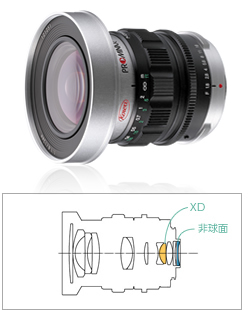
New Micro 4/3 Lenses from Kowa
Image Source: http://www.kowa-prominar.ne.jp/special/wide_lens/index.htm
It looks like Kowa, a Japanese camera maker we haven't heard from in many years in the USA, is going to produce three new lenses for Micro 4/3. The will include an 8.5mm f2.8 ultrawide angle, 12mm f1.8 wide, and 25mm f1.8 normal lens. I don't know anything about them, but they appear to be manual focus, and also appear to have aperture rings, something you can't necessarily expect these days.
You can see them on the company's Japanese site if you (Click Here).
Welcome to Micro 4/3, Kowa!
DMC-365.blogspot.com
Labels:
Kowa,
Lens,
manual,
manual focus,
Micro 43,
new product,
news
Sunday, November 3, 2013
New Kodak Lenses for Micro 4/3? This Could Be Cool.
Image Source: http://throughavintagelens.com/2009/11/selecting-a-vintage-camera-ii-kodak-cameras/
Attributed There to Duke University Collectin
No longer the case, in the past Kodak was known for lenses, and some really good ones. We may again see the name associated with good optics.
The great blog "The Phoblographer" is reporting an interesting find from the Photo Expo 2013 show. Apparently, Sakar, who has purchased at least some rights to the Kodak name, brought some pre-production lenses for Micro 4/3 to the show. It sounds like there was not much emphasis on them at the booth, which could mean it's just a fishing expedition by the company, and may not go anywhere. I hope that's not the case.
(Click Here) to read about it on The Phoblographer. They show pictures of three Kodak-branded lenses: a 25mm f0.95, 50mm f1.1, and 8mm f3 fisheye.
All manual focus lenses, these could be a lot of fun. It's difficult to tell if this will ever really materialize, but in any case, it's nice to see that the Micro 4/3 format is attracting lens designers to try new things.
Cosina Voigtlander and SLR Magic are already making nice manual focus lenses for Micro 4/3. I welcome competition in the market, as it can only help us as photographers to have more options.
DMC-365.blogspot.com
Labels:
blog,
Kodak,
Lens,
manual,
manual focus,
Micro 43,
new product,
news,
prime lenses
Friday, August 16, 2013
Old Lenses, New Bodies - I'm Not the Only One
Lotus, by Reed A. George
Leica M9, Leica 135mm f4.5 Hektor Lens
iso 200, f8, 1/125 sec.
I read an interesting post by Bill Fortney, about his experience of selling off his collection of Nikkor Ais lenses at some point in the past, in favor of more modern Nikkor lenses and digital equipment. Apparently, Bill had the good fortune of being a rep for Nikon, and therefore found the opportunities to again purchase his old favorite lenses, rebuilding his collection.
(Click Here) to read Bill's story and see some of his images.
Bill now shoots a Nikon D800 DSLR, but using his favorite manual focus lenses. Not one to avoid new technologies, Bill also shoots a modern Fuji digital body, the XE-1, with current Fuji lenses.
I think the lesson here is that a great lens or camera is timeless. Yes, newer, even better technology may come along, and if you get the chance, you should try it. However, think carefully before letting it replace an older kit that you've been happy with, made good pictures with.
DMC-365.blogspot.com
Labels:
blog,
classic,
legacy lens,
Lens,
manual focus,
nikkor,
Nikon,
old
Saturday, August 10, 2013
Gaining Trust, Even For a Short Time, Leads to Better People Pictures
Photographers are sometimes perceived negatively by those they're photographing, especially when they are anonymous, unfamiliar to the subject. I thoroughly enjoy street photography, and frequently do shoot images of people in public, without any discussion or introduction. At other times, I do choose to introduce myself, talk a little, and gain a level of trust that eases the subect just a little.
Each approach yields a different type of image. The anonymous approach shows people living their lives, without the influence of the photographer's presence. Genuine expressions and interactions are possible. Talking makes a connection, however slight, between the photographer and subject. Sometimes this connection can show through in the image.
I shot the two images below in Harlem, New York City.
Sunday Morning Game of Catch, by Reed A. George
Nikon D700, Nikkor 24-85mm f2.8-4 Zoom Lens
On this particular morning, I was on a photo walk with Marla Mossman. Marla is a master of approaching people in the street, establishing rapport, and getting their picture. I learned so much more from her than how to think about depth of field, which happens to be the most consistently-discussed topic in photo workshops, in my experience.
(Click Here) to see Marla's work. If you get the chance to meet her, take it.
There's a nice entry on the NY Times photo blog, Lens, about this subject.
(Click Here) to read about how Demetrius Freeman, a contemporary photographer, learned from looking at Gordon Parks' photos about establishing connection with his subjects. Mr. Parks' photo of Ingrid Bergman (included in the post) is stunning.
DMC-365.blogspot.com
Labels:
blog,
famous,
Gordon Parks,
Lens,
Marla Mossman,
New Year,
New York Times,
Nikon,
people,
street
Thursday, August 8, 2013
What if we put Robert Capa in Afghanistan with an iPhone?
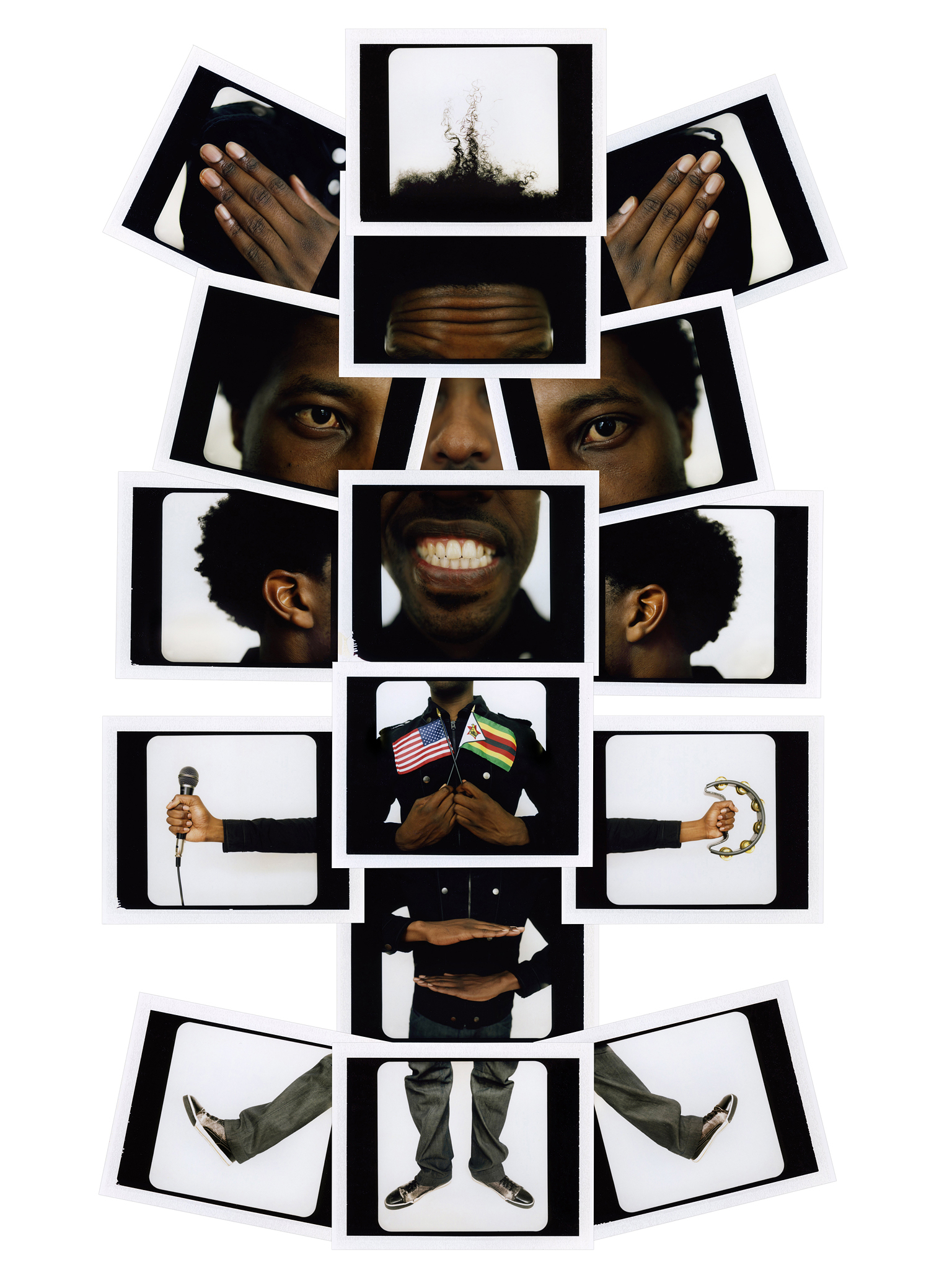
Instant Print Composite, by Joshua Yospyn
Image Source: http://yospyn.com/#/portraits/instant-film/vaki17
Two ideas came together for me this morning. The first is that I read an article about Ray Metzker on the New York Times' blog "Lens." This piece makes the point that Metzker has stuck with the development and evolution of his style over the course of decades. He was firmly in the class of modernist photographers during his relative youth, and eventually developed a completely new style in making single-image composites, sometimes from whole rolls of film. He refuses to go backwards, shoot in his previous styles, just to sell prints.
For an example of his composite photography, (Click Here) and scroll down to the third image.
Now, the Lens piece contrasts Metzker's focused concentration with today's whipping boy, the iPhone and instant gratification. I do understand the point that in many ways "serious" photography is giving way to amateurs pointing their phones at something and instantly uploading the results. For example, (Click Here) to read about the Chicago Sun-Times firing all of their photographer staff. Not cool.
The second idea came from attending a photo critique at the Washington, DC Leica Store yesterday. Our main speaker was Joshua Yospyn, who among other things, is making very interesting unique pieces of art like the one above from instant photographs (Polaroids in this case).
Joshua is a Washington, DC-based photographer. (Click Here) to go to his website.
I've been playing with an old pack film Polaroid myself. (Click Here) to see a few of my own Polaroid images.
So, maybe we're kind of missing the point. It's not the technology that's causing the problems. Instant gratification has been around a long time. It's the fact that we need photographers to step up and use the technologies to make even better photographs. This is not all about reporting on riots or demonstrations. As Joshua shows, in addition to being instant, Polaroids provide a tangible artifact, a real print. He assembles them and displays them under a sheet of acrylic. They are real works of art. You could do similar things with quick prints from iPhone images as well. I'm sure the Polaroid camera optics are much better, though.
But the real point is not prints versus electronic images. It's that if iPhones and Smartphones put instant photography at the hands of amateurs, just think what a truly skilled photographer can do with them. We can keep our Leicas, Nikons, or Canons, too. But I think we should challenge ourselves to put the benefits of our concentrated effort into new situations, including different, even instant, technologies.
DMC-365.blogspot.com
Wednesday, July 31, 2013
Panasonic Continues to Refine Micro 4/3 with Lumix 20mm f1.7 (II)
The New Lumix 20mm f1.7 (II) - Aspheric
Image Source: http://panasonic.net/avc/lumix/pressrelease/h_h020a/
I have the original Lumix 20mm f1.7 "pancake" lens. Not one of Panasonic's Leica collaborations, the 20mm is an amazing lens none the less. It is fast, sharp, and small. Mounted on my DMC-GX1, it's simply a huge amount of quality and flexibility in an impressively small package.
Panasonic has announced a second generation of this lens, this time with aspheric lens elements to further reduce any spherical aberration (of which I've noticed none in my first generation lens). Spherical aberration results from diffraction of light rays at the edge of a lens element differing from that at the center.
(Click Here) to read about the new lens.
Even though I've always been pleased with my 20mm, I'm sure the new one's even better.
Here's a shot I made with my lens:
Beginning of Virginia Autumn, by Reed A. George
Panasonic Lumix DMC-GF1, Lumix 20mm f1.7 (I)
iso 200, f8, 1/40 sec.
DMC-365.blogspot.com
Friday, June 28, 2013
Andrew Esiebo on NYT Lens Blog - West African Barber Shop Project
Image Source: http://lens.blogs.nytimes.com/2013/06/19/documenting-west-africa-one-barbershop-at-a-time/#/1/
I am always interested in new photography projects, and how to find them. Many times, they end up being concepts that sound routine, banal, but once the photos are made, an unexpected depth is discovered.
Nigerian photographer Andrew Esiebo decided to photograph barber shops across West Africa, including the countries of Ivory Coast, Senegal, Benin, Ghana, Liberia, and Mauritania. Mr. Esiebo comments on the trust that is required to allow a barber to shave you with a straight razor; it leads to a special kind of relationship.
Mr. Esiebo found similarities in the shops across West Africa - hand painted signs, posters of sports teams, religion, famous musicians. He also noted how similar hair styles are across the region, even though each may connote a different meaning in different countries. Men's hairstyles can be intended to communicate toughness, freedom from conformity, or attractiveness to females.
Mr. Esiebo notes that most foreign photographers coming to Nigeria want to focus on photographing the slums. He feels that the barber shop project provides a different view. I agree.
(Click Here) to read the entire post on the New York Times' blog "Lens."
DMC-365.blogspot.com
Labels:
Africa,
Andrew Esiebo,
barber,
blog,
Lens,
New York,
New York Times,
Nigeria,
project
Subscribe to:
Posts (Atom)