Showing posts with label point and shoot. Show all posts

Monday, December 24, 2012

Here's an Example of Something I'm Considering for DMC-365

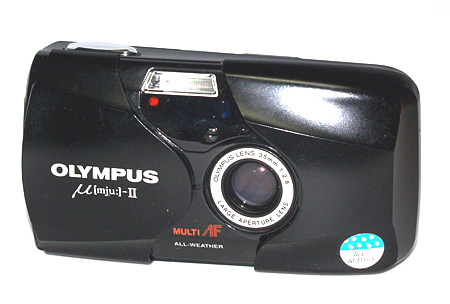
Olympus mju 2
 
Well, here's what happens when you write posts ahead of time. Two days ago, I posted a follow-up to this post, which I had meant to go up earlier. So, they're out of order.
 
If you've been reading my blog lately, you'll know that I'm exploring some changes to the format of DMC-365. One of the things I'm considering is highlighting some favorite cameras, including using them and sharing the results.
 
Steve Huff's site has hosted a very nice little post about the Olympus mju, written by Ilya Reddy.
 
(Click Here) to read Ilya's post about love for the mju on Steve Huff's site.
 
The post includes a nice description of why Ilya enjoys the mju so much, some critical review of some of the drawbacks (including the need to reset center focus and exposure, and turn off the flash, every time you turn the camera on), and several nice example images.
 
Way to go, Ilya and Steve. I hope to use a similar format to share some of my photographic favorites.
 
My wife has an old Olympus Stylus in a drawer. Maybe I'll drag it out for a weekend.
 
DMC-365.blogspot.com


Saturday, December 22, 2012

Outstanding Follow-Up to the Olympus mju Post On Steve Huff's Site

 
A few days ago, on December 18, I reposted a very nice piece from Steve Huff's site, featuring some beautiful images from the Olympus mju 2, a moderately-priced point and shoot camera. Today I share another piece from Steve's great site, a follow-up by Steve Barnes, who shoots a Yashica T5 (T4 in the US).
 
(Click Here) to see all of the pics on Steve's blog.
 
These are outstanding images, in my opinion. And made with quite modest gear. The Yashica T5 is a fully-plastic point and shoot, yet features a nice Zeiss Tessar lens. I have two of these in my camera closet, acquired as part of a package of other cameras way back when. I have not used either, as both have battery terminal corrosion problems. I'm not sure how to address those problems, without risking breakage in dismantling the outer cases. Maybe I'll give it a try with one of them.
 
These two posts on Steve Huff's site remind me of the recent fun I've had with the Holga lens on my Lumix G3. Simple photography can be really fun. As you can see above in Steve Barnes' shot with the T5, you can focus on the essential design elements of a great photo - composition, color, light. Very cool.
 
I'm not selling my M9, but there is certainly plenty to learn with inexpensive equipment.
 
DMC-365.blogspot.com


Friday, June 29, 2012

Will 3D Digital Photography Catch On?

I read about Panasonic's forays into three dimensional imaging with interest. I wonder if this will ever catch on in any big way?
Panasonic DMC-3D1 Three Dimensional Camera
Panasonic DMC-3D1
Image Source: http://www.dpreview.com/news/1111/panasonic/DMC_3D1_slant.jpg

ePhotoZine has published a review of the Panasonic Lumix DMC-3D1, a twin lens camera designed for 3D photography.

(Click Here) to read the review.

3D cameras have been around for a very long time, basically since the invention of photography.
 
Kodak Stereo Camera
Kodak Stereo Camera, ca. 1950s
Image Source: http://en.wikipedia.org/wiki/Stereo_camera
 
In the past, they always required some optical apparatus for viewing. I think this is the major limitation that kept 3D photography from taking off.
Stereo Image Viewer
Image Source: https://blogger.googleusercontent.com/img/b/R29vZ2xl/AVvXsEgq1DaSoyKKXSJG4z2POB2MIBAcYYV7cguRm4VJt8UEr_XYVbubYhqEsNeysKTXskhqmuXyCyp_mHuDkMZM9B6sC7Amd_dEeQzOLYR8rTK1tV6WZ5iTuT-38BXhcoE43oDC48JCrA2ag3rf/s1600/Graphic2.jpg
 
In the modern digital world, 3D viewing requires a special display. Panasonic builds 3D capability into many of their Viera displays. It also requires wearing glasses to get the 3D effect. Now, this seems like a serious drawback to home use, and it very well may be.
 
However, I can see a day when digital galleries gain popularity, if not overtaking prints altogether. 3D movies sure have taken off. Maybe when we all have new televisions and displays that include 3D technology basically for free, 3D photography will gain popularity. My current Viera display does not have 3D technology.
 
There is a very inexpensive 12.5mm dual lens available for Micro 4/3 cameras. It's got an aperture of f12, which will seriously limit how it can be applied. However, I'm sure that one could make some amazing 3D landscapes with it.
 
There are also techniques using two synched cameras to capture the paired images required for 3D imaging.
 
I am not ready to go into this, but will keep my eyes open. It would be neat to add a third dimension to my imaging, at least once in a while.
 
DMC-365.blogspot.com