Showing posts with label Olympus. Show all posts

Thursday, July 3, 2014

Hey, Maybe Micro 4/3 is a Sweet Spot After All?

Image Source: http://www.the.me/nikon-lost-in-hall-of-mirrors/

While I'm not happy to hear that Nikon's camera business is struggling, I found the graph above most interesting. And, while I understand that not all mirrorless cameras are Micro 4/3, the text in this post on THEME makes special mention of that format and how well it's doing.

(Click Here) to read more about how DSLRs are losing ground to mirrorless, and how Nikon and Canon, while offering what some consider to be weak options in mirrorless, are looking to new business areas for revenues.

While the post on THEME says that Nikon has no experience in Medical Imaging (the major market they've announced they'll pursue), I know firsthand that they do have expertise in imaging for medical research. Their research microscopes are excellent, and they are clearly working hard to bring new products to market that compete with the other best-in-class companies.

The theory in this article about why Nikon and Canon have offered "compromise" mirrorless cameras is that they are afraid of cannibalizing their DSLR market. That may be true. However, I've always marvelled at how Nikon will come out with a $5,000 super DSLR, then follow it up 9-12 months later with a $2,000 camera that has 95% of the features of the former. It's great for us users. But, I don't see fear of cannibalization going on there (within their own DSLR lineup), at least.

I agree that mirrorless cameras are certainly now encroaching on the specific market for DSLRs. I loved carrying two Micro 4/3 bodies and more lenses than necessary in a single bag on my most recent vacation. However, I'll be grabbing my Nikon DSLR this weekend for a music event. So, my hope, as a selfish user, is that both formats have a long future, with lots of improvements still to come. And no, I don't mean video capability that allows you to pick the perfect frame out of 10,000 captured!

DMC-365.blogspot.com

Monday, March 10, 2014

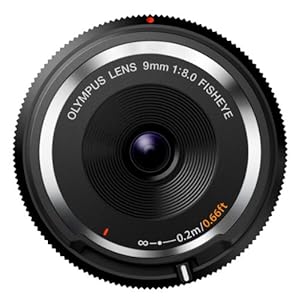
Olympus Body Cap Fisheye Lens for Micro 4/3

Image Source: http://www.amazon.com/gp/product/B00I19TVU2?ie=UTF8&camp=1789&creativeASIN=B00I19TVU2&linkCode=xm2&tag=dm36thyeofthl-20
 
I recently purchased a fisheye lens for my Micro 4/3 kit, a Bower 7.5mm model.
 
(Click Here) to see a post of images I shot with the Bower fisheye lens.
 
I haven't used the fisheye too much yet, but plan to.
 
Now it seems that Olympus has made a "body cap" lens with fisheye optics. These near-flat lenses that are so thin they double as body caps are really pretty cool. I have the older version Olympus 15mm body cap lens (not fisheye), which again, I have yet to use very much. You know the story, too many cameras, not enough days off.
 
The body cap fisheye is an ideal combination if you ask me. Since most of us will rarely use a fisheye lens, one of the challenges is that you don't tend to carry it along with you. Even the Bower lens, which is quite light and compact, takes up precious camera bag space. I think the body cap fisheye would solve that issue. And, it's pretty cheap at ~$100.
 
With a fixed aperture of f8, it's not real flexible, but again, this will be rarely-used equipment for most people. But, when you need it, you need it.
 
(Click Here) to see an example image posted by matt-pro on mu43.com
 
If I hadn't already purchased the Bower, I would certainly go for the Olympus body cap option.
 
DMC-365.blogspot.com
 

Wednesday, February 26, 2014

So What Do You Think of the Retro Styled Cameras? Canon Says No.

 
Photo of the Nikon Df and legacy non-AI NIKKOR lenses
The Nikon Df
Image Source: http://www.nikonusa.com/en/Nikon-Products/Product/Digital-SLR-Cameras/1526/Nikon-Df.html
 
Personally, I really like the styling of some of today's cameras, specifically some of those that harken back to cameras I knew or used when I was younger. No, I don't carry a pocket watch or hand-drawn maps. But I do still carry a Nikon F2 pretty often. So, the Df definitely appeals.
 
My new Lumix DMC-GX7 makes me wish it was more "retro" styled, something like the Olympus OM-D. Fuji's designs are distinctly retro and cool.
 
Apparently, Canon will not pursue this line of design, according to a post on the SLR Lounge.
 
(Click Here) to see the quote from a Canon representative.
 
Now this doesn't bother me much, as the only Canon gear I own really is retro. I have a Canon 50mm f1.4 Leica Thread Mount (LTM) lens that truly lives up to its nickname, the Japanese Summilux. I also have a Canon 135mm f3.5 LTM lens that is amazingly sharp and nice. Oh yeah, I also have a fixed lens 35mm rangefinder, the Canon QL17, with f1.7 lens. I haven't had that out in a while. Hmm. Maybe that's how I'll enjoy some retro Canon. I wouldn't be likely to buy a new Canon anyway, even if it was retro styled.
 
Now the Nikon Df is another story. Still attracted to that one.
 
DMC-365.blogspot.com


Saturday, February 1, 2014

A Little Live Music with the Panasonic Lumix DMC-GX7

I've been working a lot lately, and not getting out for enough shooting. I have roughly kept up with my posts, but it's been a stretch.
 
Last night, after a full day of science, I headed out to see Jake and the Burtones at LoCo Joe's Coffee in Purcellville, VA. Here are my favorite shots from the evening.
 
Forgive the brevity; I'm a little short on time this morning.


This final shot was made with the Panasonic Lumix DMC-GX7 and Series 2 kit lens at iso 6400. Not bad. The remaining images were made with the Pana-Leica Summilux 25mm f1.4 and Olympus 75mm f1.8 lenses at iso 1600 and 3200.
 
DMC-365.blogspot.com


Monday, December 30, 2013

The Change in Photography - Kirk Tuck Gives His Thoughts

 
It Should Be Simple to Tell a Story, by Reed A. George
 
I've been thinking a lot about where my photography is going. I've got a new project bubbling up, but it's not yet ready for prime time. I'm still absolutely all over the place with equipment, recently enjoying the use of my Nikon F2 as much or more than my digital wonders.
 
I recently read one of Kirk Tuck's posts on the Visual Science Lab, about his impressions of camera gear and photography, and what all of the changes mean. Change is certainly underway, but where is it all headed?
 
(Click Here) to read Kirk's post on Visual Science Lab. I'll summarize some of his points and give my own thoughts below.
 
First, Kirk says there are two photography communities: the old guys (I just celebrated my 49th birthday), who carry around big heavy gear and focus on "getting it right" technically, and the younger generation, who focus more on telling a story, regardless of equipment, video vs. still, or any other issues that may hold them back.
 
Another point Kirk makes is that we no longer need to worry about getting it right technically; that's easy. Unless of course you use old equipment like I do. The fact that I still sometimes wait to see if my pictures "come out" does show that I'm an anachronism. I can accept that fact.
 
Kirk also says that the difference between the very good and the very best cameras no longer matters. His example is the comparison between an Olympus OM-D (a very good camera), and a Nikon D800 (even better). His point is that you really cannot tell the difference with an online image from either camera, and that's all that matters these days. No one's going to look at prints in a gallery. At least no one but us old men.
 
Another point that I really identify with is that only those who resist the change in photography will feel any pain. I buy that. I like to use it all - old, new, difficult, simple. Hell, I had as much fun with an old Brownie 127 camera that I converted to shoot panoramic images on 35mm film as I had with my Lumix GX1 so far. Talk about different beasts. Meanwhile, I'm working through exactly how to use my new Lumix GX7.
 
Here is Kirk's prescription for what must happen with camera gear to support the change:
 
  1. Smaller, lighter, more accessible cameras
  2. Less user intervention required
  3. Cheaper camera/lens systems
  4. Connection with other technology (phones, tablets, etc.)
Personally, I believe that the camera companies are addressing some of these needs well. For example, Micro 4/3 is definitely hitting the mark with 1,3, and 4. Panasonic and Olympus are failing to meet requirement number 2 with their current Micro 4/3 cameras.
 
From my point of view, if I want simple (#2) in the digital world, it's Leica all the way. Of course, they fail at requirement #3, at least if we're talking about their system cameras.
 
And maybe I'm fooling myself about the M9 being a simple camera. After all, there's no autofocus. No video.
 
A Leica DLux 6 (Panasonic LX7) that had the manual controls and lack of menus that the M9 exhibits would be a killer camera. I don't want to accidentally hit a button that sends me into some labyrinth of menus when I'm grabbing my camera out of my jacket pocket.
 
I think the camera companies are taking different approaches, and someone will hit it just right. Nikon is appealing to us old farts with the Df (which I really like, and want). Leica is trying a little of everything, from the M240 to the C. However, I personally don't think they've developed the perfect product yet. Something along the lines of the X cameras, but with interchangeable lenses could be great. In short - small, few menus, superior interchangeable lenses, autofocus, autoexposure, video. That's what the new age is calling for.
 
As long as it also has manual controls that us old men can fiddle with, I'll be happy to give the new world order a try.
 
DMC-365.blogspot.com
 

Friday, December 27, 2013

Um, Stephanie, Your Bird is Escaping...

Here's a funny shot that caught my eye, posted by colonelpurple on mu-43.com:
Image Source: http://www.mu-43.com/showthread.php?t=57379

(Click Here) for the original post.
 
 
This was shot with the new Olympus EM-1 and spectacular Olympus 75mm f1.8 Micro 4/3 lens.
 
DMC-365.blogspot.com


Sunday, October 20, 2013

Time for a New Micro 4/3 Body

Image Source: http://shop.panasonic.com/shop/model/DMC-GX7SBODY
 
I have been focused on other camera systems for most of this year, and have left my Micro 4/3 lenses (mostly Panasonic or Pana-Leica, but also the awesome Olympus 75mm f1.8) largely unused. I think I really need the latest advance in sensor technology (beyond my DMC-G3 and DMC-GX1 bodies) to get me back into the wonderful world of Micro 4/3. Not that the G3 or GX1 are slouches; they're not.
 
I have been having a lot of fun shooting my Leica M9 this year (see Whole Lotta Leica), and will not lose focus on Leica. I've also had a blast with my film cameras (see Skeletons From The Closet), but am ready to settle in with a few of those cameras for deeper concentration in the coming year. And of course, my Nikon D700 continues to impress and serve as my only choice for extreme low light applications (think live music in small dark venues).
 
So, with all that, why get back into Micro 4/3? Shouldn't I just sell my Micro 4/3 stuff and focus on the other outfits? Well, no. While many users consider a Leica rangefinder a great travel camera, I frequently need more focal length options than that system offers. I love to travel, so the optimum travel camera is something I'm always seeking. Film cameras fall from this category simply because of the issues of traveling with film. My Nikon DSLR can be a great travel camera, but at great cost of bulk and weight. So, once again, I'm pursuing Micro 4/3 mainly for this purpose.
 
I've always been a proponent of Panasonic Lumix cameras in Micro 4/3, preferring them over Olympus. This is not a decision based on performance. I have a long history with Panasonic, including working with Matsushita Denki (Panasonic's parent company) over multiple decades in my engineering career.
 
Olympus is testing my resolve in my Panasonic dedication with the E-M1. In fact, Steve Huff, while being very complimentary about the new Panasonic Lumix DMC-GX7, says the E-M1 outperforms it in most ways. Yes, the E-M1 is $500 more than the GX7, but that would not be a deciding factor for me.
 
(Click Here) to ready Steve Huff's GX7 review.
 
I am nearing the decision point, and need to look more into the E-M1 before making it final. Subjectively, I like the form factor of the GX7 more than the SLR-like E-M1; that may be enough to keep me with Panasonic.
 
Regardless of which way I go, I'm encouraged that Micro 4/3 may now be at the performance level to really hold its own against APS-C and larger sensors. I'm hoping that my next Micro 4/3 body will give me the equivalent jump in performance that I experienced in Nikon DSLRs, when I went from the D200 (which is a solid performer) to the D700 (which is simply amazing). If I can get that sort of improvement, specifically in high iso performance, I'll be very pleased. I know Micro 4/3 will not give me the same high iso as the full-frame D700. But, a similar jump in performance relative to the earlier generation will go a long way.
 
On top of that, I will get in-body stabilization, built-in EVF, and the silent shutter - all nice features that I'll love using.
 
So, as soon as my "due diligence" in exploring the E-M1 is complete, I anticipate pulling the trigger on a new Micro 4/3 body.
 
DMC-365.blogspot.com


Tuesday, October 15, 2013

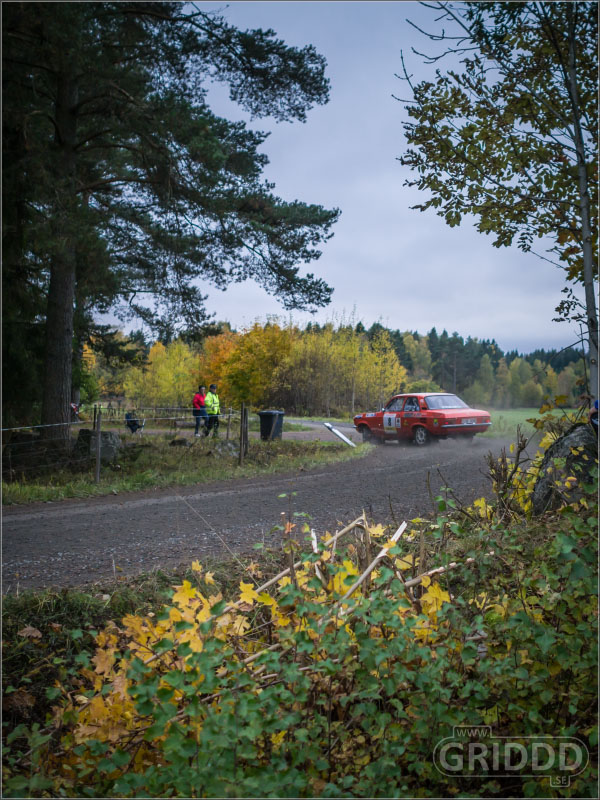
Swedish Rally Championship, Photographed on Micro 4/3 by Lars Martensson

 
Image Source: http://www.mu-43.com/showthread.php?p=535446#post535446

Swedish photographer Lars Martensson made the image above with a Panasonic Lumix DMC-GX1, Micro 4/3 camera, and Olympus 17mm lens. He didn't say whether it was the original Oly 17mm f2.8, a much-maligned but probably very capable lens, or the newer f1.8 lens (which gets great reviews).

(Click Here) to see all of the pictures Lars posted on mu-43.com.

(Click Here) to see Lars Martensson's web page.

I appreciate a photographer who can put a wide angle lens to good use in an event like this. Martensson also used a 300mm lens on an Olympus E-M5, but I think his wide angle usage adds significantly to the series. My first thought would be to grab a telephoto, and I may bring something wider to shoot the crowd, drivers up close, etc. That would be conventional. Lars shows us how to do that, and still make some unique images using the wide angle lens.

As I've mentioned, I've made the decision to add Micro 4/3 back into my active kit very soon. Just waiting on delivery of my new DMC-GX7.

DMC-365.blogspot.com


Sunday, August 25, 2013

Suryo Widjaja Shares Olympus OM-D Photos From Myanmar on Steve Huff Photo

Image Source: http://www.stevehuffphoto.com/wp-content/uploads/2013/08/Semedi.jpg
 
Photographer Suryo Widjaja has written a guest piece on Steve Huff's blog, sharing several wonderful images he took in Myanmar in January of this year.
 
(Click Here) to read Suryo's post on Steve Huff's site.
 
Myanmar is definitely on my bucket list. I know a couple of people who've been able to gain entry to the country for tourism, and they have a lot of great things to say about the place. Anywhere that measures "Gross National Happiness" sounds okay to me.
 
Suryo reports that he took two Olympus OM-D bodies on the trip - his most-used lens was an Olympus 17mm f1.8, second was the Olympus 75mm f1.8. His 12mm saw little use. I have the 75mm f1.8, and it's a keeper.
 
I am about to take a week long vacation, and I'm planning to take my Leica M9, 35mm Summicron, and a medium telephoto (likely my Canon 135mm f3.5 LTM). This post encourages me to travel light, and my choice of lenses closely matches the field of view of Suryo's lenses on his Micro 4/3 gear. Of course, I'll carry the diminuitive Lumix DMC-LX7 as well. So much capability in such a small package simply cannot be left behind. Plus, it gives me closeup capability not available in the M9, at least not easily.
 
Suryo has shown how much you can do with two lenses. I'm impressed.
 
DMC-365.blogspot.com


Wednesday, July 3, 2013

Olympus OM-D and Voigtlander Nokton 25mm f0.95 by Candlelight

 
Image Source: http://www.mu-43.com/f57/sofia-candlelight-48627/
 
Last weekend on a trip to Florida, I shot Micro 4/3 again for the first time after a long break. I've let my Leica interests, as well as my Skeletons From The Closet project, consume my photographic opportunities. In Florida, I shot my Panasonic Lumix DMC-GX1, essentially for the first time. I'll have a few shots to share, soon. Anyway, I think I will make that camera a priority at some level, too. Too many cameras, too little time.
 
Shooting the GX1 got me thinking about what others are doing with Micro 4/3 these days. I came across this post from nickthetasmaniac on mu-43:
 
(Click Here) to see other shots by nickthetasmaniac on mu-43.com
 
He made these images with the Olympus OM-D and Voigtlander 25mm f0.95 lens. I've never tried a lens faster than f1.2. It seems to me that Micro 4/3 is the right place to do that, as you don't rely on the accuracy of a rangefinder with that extremely shallow depth of field that f0.95 would provide.
 
Hope you find the images as interesting as I did.
 
DMC-365.blogspot.com


Sunday, June 23, 2013

Excellent Photo Reportage From Turkey - nickthetasmaniac on mu-43.com

 
Poster nickthetasmaniac has posted an excellent series of images from the upheaval currently going on in Turkey. Shot with the Olympus OM-D, these images really give the feel of the place and situation.
 
(Click Here) to see the whole post. Pay particular attention to the fifth image in the series, of press videographers donning gas masks. Very cool commentary on the situation
 
Nick did very nice work with the OM-D.
 
DMC-365.blogspot.com


Friday, April 26, 2013

Am I the Only One Who Wants My Fixed Lens to be 50mm?

 
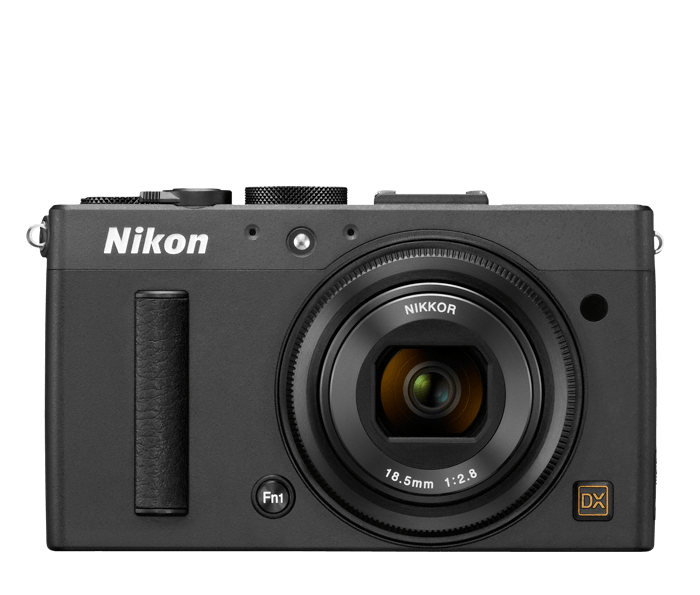
Nikon Coolpix A

Image Source:http://www.nikonusa.com/en/Nikon-Products/Product/Compact-Digital-Cameras/26423/COOLPIX-A.html

 
I like where the digital camera leaders are going - almost. I love the idea of a dedicated, fixed lens compact camera with a large sensor and great image quality. The good news is that many camera manufacturers are making them now. My favorites so far are the Leica X2 and Fujifilm X100S. Others include offerings from Sigma, Sony, and now Nikon and Ricoh.
 
When I think of these types of cameras, my thoughts go to the excellent Olympus, Canon, and Konica fixed lens rangefinders of the past. I would really love to see something equivalent to an Olympus SP, for example.
 
(Click Here) to see what the Olympus SP film rangefinder camera was like on Andrew Yue's site.
 
Now here's the rub, for me. All of the new fixed lens cameras have wide angle lenses, 35mm equivalent field of view, or wider. For me, the 42mm lens on the old Olympus SP was a bit wide, but actually a very good compromise between what I think of as a "standard" focal length of 50mm, and the admittedely popular 35mm lens. In fact, my 40mm Minolta Rokkor lens for Leica M mount cameras is one of my favorites.
 
If I'm going to buy a fixed lens camera, the lens really needs to serve most of my purposes. For me, and yes, it's personal preference, a 50mm lens would be best. I'm willing to be open-minded and take something as wide as 40mm, and actually would embrace that focal length.
 
When I saw the first announcement of the Nikon Coolpix A, I was excited. In my experience, Nikon does a great job of handling sensor noise (my Nikon D700 DSLR is the best low light camera I have), and I'm familiar with the menus. When I read that the A has an APS-C sensor and 28mm f2.8 lens, I got excited. I thought, hmm - 28mm X ~1.5 crop factor = 42mm equivalent. Great! Then I saw that it's actually an 18.5mm lens, and 28mm equivalent field of view. Really? I remember when 28mm was a rather extreme wide angle lens, one that was probably in your bag but sure didn't get the usage that a 35mm or especially 50mm lens did. This is way too wide to be a general purpose, fixed lens camera, at least for me.
 
Ricoh has also just come out with a new GR digital model - again 28mm equivalent field of view.
 
I think part of what's driving this trend is lens size. While the camera companies are trying to provide large sensors for their compacts (which is great news), they want to keep the lens size as small as is practical. I understand that. I also think this may be why some are stopping at a maximum aperture of f2.8, which I think is a little slow for a fixed lens camera. But, I still really want a litle longer lens, and fast, please.
 
I mean, let's face it, I never could really fit that Konica S1.6 with 45mm f1.6 lens (a 1970s fixed lens film rangefinder that produces incredible images) in my pocket.
 
DMC-365.blogspot.com


Thursday, March 14, 2013

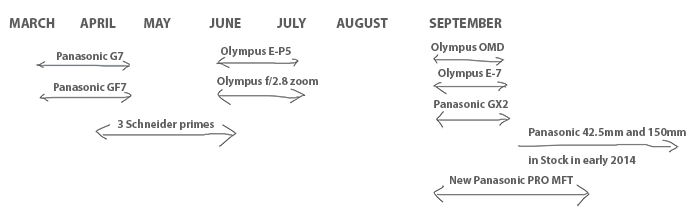
43rumors Posts Olympus and Panasonic Roadmap in Micro 4/3 for 2013


I don't usually give much thought to the sites that publish rumors about the camera industry. However, I have found 43rumors to be reasonably accurate, and they usually know when the rumor is likely to be incorrect.
 
This post is a little more fun than most on the rumor sites. The roadmap above shows what 43rumors thinks is coming in the Micro 4/3 arena from market leaders Panasonic and Olympus in this calendar year (and maybe a little later).
 
The fun thing is, you can vote on which three items on the roadmap interest you most, and see what the total voting results are so far.
 
(Click Here) to go to 43rumors.com and place your vote.
 
This tells me that the Panasonic Lumix DMC-GX2 isn't coming out anytime soon. I don't know what to think of the G7 coming out soon. The G5 was not very impressive to me. If the G7 has the GH3 sensor (or better), I may be interested, as long as the body doesn't grow too much in size from the G3. A "pro" grade Lumix may be interesting as well, but I have a feeling it'll be Nikon DSLR size, just to prove it's pro equipment. Finally, a 42.5mm f1.2 lens could be fun. Of course, characteristically, I'm focused on Panasonic more than Olympus. The OM-D is already a huge win for Olympus, and I'm sure it only gets better.
 
DMC-365.blogspot.com


Sunday, February 17, 2013

Panasonic Announcement - Is This the Next Big Technology Improvement for Camera Sensors?

 
In choosing to enter the Micro 4/3 camera format a few years back, I knew that I was making a bet - a bet on how far sensor technology would improve in the near future. I'm sure that most of you know that image quality is generally correlated with sensor size - the bigger, the better. This is why people still compare sensors to "full-frame," which means the 24x36mm size of the image produced in a standard 35mm film camera. Most sensors in cameras less than $10,000 are smaller than that.
 
So, buy the biggest sensor you can afford, right? Wrong. Some other things are correlated with sensor size - camera (and lens) size, weight, and cost.
 
So, when Micro 4/3 came along, the question for me was whether or not small sensor technology would likely improve to the point where the Micro 4/3 sensor would perform as well as the benchmark at that time - which for me was the Nikon full-frame sensor. So far, it isn't there. My Nikon D700 is still miles above any Micro 4/3 sensor in terms of image quality. That said, Micro 4/3 has made significant improvement. The latest sensors in the Panasonic Lumix DMC-GH3 and Olympus OM-D are really very good. Even the previous round of technology, like the sensor in my DMC-G3, is pretty darned good. I would say that APS-C sensors (larger than Micro 4/3) are close to the benchmark of older full-frame sensors, and Micro 4/3 is where APS-C used to be. I'm still holding out hope for the next generation of Micro 4/3 sensors to achieve my initial wish, or get much closer.
 
What does this mean for me, practically? It means that when I must have the very best image quality, especially when shooting in low light, I still grab my Nikon D700. When I'm going to be traveling a lot, and generally shooting in good light, Micro 4/3 is the right choice for me.
 
One area where companies have been challenging the standard sensor technology is in the color filters on top of the sensors, necessary for making color images. The way color images are formed on most sensors is by using a set of four pixels to capture all of the color information, which is then combined into a single pixel in the resulting image. The standard filter array is called the Bayer filter. The Sigma Foveon sensor and the XTrans sensor from Fujifilm are attempting to improve upon the Bayer filter design with at least some success. Panasonic has announced the development of another technology that could really improve the performance of their sensors by improving how color separation is done. It uses miniature light splitters to deliver specific colors to the sensor, rather than filters.
 
(Click Here) to read a post about this, and Panasonic's press release, on dpreview.com
 
The idea here is that the filters used to enable the Bayer concept are lossy - they lose approximately half of the light that hits them, transmitting only half to the sensor. Panasonic's concept uses optical splitters, which can be manufactured using semiconductor processes, to separate the light into its component colors, without so much loss of intensity. If the loss could be cut from 50% to 0% (impossible), that would mean the equivalent of one full-stop of image quality improvement. In other words, if this works extremely well, a picture taken at iso3200 with the Bayer filter could be taken at iso1600, which would give the associated improvement in noise performance.
 
What is not clear is whether this approach would allow a reduction of the number of sensors in each color pixel to be reduced from four (as used in the Bayer pattern) to three. That could potentially improve the resolution available in a given sensor size.
 
One could even imagine a futuristic version that scans the splitters during exposure, potentially limiting it to one sensor per image pixel. Now, that's simply imagination on my part - Panasonic has not hinted at any type of scanning splitter. And, it would have to happen extremely fast. But, if you could have it, it would allow image resolution like that available in the Leica Monochrom (which only shoots black and white, providing the ability to use every sensor on the chip for gathering gray level information, and yielding incredible image quality), but with the option to shoot color that the Monochrom does not have.
 
Or maybe the splitters could be switched off when shooting black and white? That would provide excellent color response when you want it, and improved resolution when you want to shoot black and white. Again, pure conjecture on my part. But wouldn't it be cool?
 
Oh, by the way. I've been neglecting my Lumix Micro 4/3 gear. So, I'm taking it to the California desert in a few weeks for a one-day workout. More to come on that subject.
 
DMC-365.blogspot.com


Friday, February 8, 2013

monchan on mu-43.com Wins a Japanese Photo Contest - Awesome Dramatic Shot


monchan, a member on mu-43.com, has won a local photo contest in Japan with this shot.
 
(Click Here) to read monchan's post on mu-43.com
 
The vertical wall of white water is amazing. It's really a great thing that the fisherman is wearing a dark color, contrasting well against the water. He has red on this hat and lower pants leg, which also help. The line of the fishing rod, essentially visually connecting him to the flying water, and the converging lines of the seawall complete the picture. And, there's a reflection even. Wow. Very nicely done.
 
By the way, this was shot with the Olympus OM-D.
 
Congratulations to monchan!
 
DMC-365.blogspot.com



Sunday, January 27, 2013

Olympus Doggy Chew - the 12mm f2 Lens

 
Lens-Eating Dog
Image Source: http://thomaslcollins.blogspot.com/2013/01/my-dog-eli-ate-my-lens.html?m=1
 
I've just come across Tom Collins, a fellow photographer and blogger. Today he told a story of his dog, Eli (pictured above), chewing up his several hundred dollar Olympus 12mm f2 lens.
 
(Click Here) to read the story on Tom's blog.
 
Well, even though Eli ruined the cosmetic condition of the lens, it is still completely functional. Lucky for Tom. I guess it's just now a "keeper." Tom took this all much better than I would have.
 
DMC-365.blogspot.com


Friday, January 25, 2013

So, Where Am I on Micro 4/3 These Days?

Travel Shot From Barcelona, Not Shot On Micro 4/3
Leica CL, Minolta Rokkor-M 40mm f2, Kodak Tmax 400 Film
 
Having started DMC-365 last year with a focus on Panasonic Lumix cameras, with specific emphasis on Micro 4/3 format, you may wonder where it fits in with my new, broader focus of the blog on the overall interface between equipment and creativity.
 
Let me be honest with you - I'm wondering the same thing. I had an enormous amount of fun with my twin Lumix DMC-G3s last year. I remember being amazed at how much progress had been made in image quality, specifically in low light, between the G1 and G3. I shot a lot of nice images with the G3 last year, if I may say so.
 
However, I also had a lot of fun with other cameras last year, and now tend to pick up either my Nikon DSLR for low light situations or nature, or my Leica M9 for street and people photography. And, in a couple of instances, shooting with film gave me pleasure and results not available to me with Micro 4/3. In fact, I've got an article soon to be published in a journal (don't want to break any confidences until it's ready), specifically about shooting film on my trip to Barcelona last fall. I shot probably 1/8 as many images on film as on digital, but actually had more "winners" by my own definition. In fact, at the moment, the G3s are not what I'd grab on the way off to another great international vacation.
 
So, I must admit, my G3s and incredible set of Micro 4/3 lenses have been idle for the last few weeks. Part of the reason is that I just don't have enough time to shoot. With more free time, I'm sure I'd still be using them. However, there's more to the story. I'm waiting on the next level of image quality in Micro 4/3 sensors.
 
What is not clear to me is whether the newest sensors in Micro 4/3 are the answer. The Lumix DMC-G5 clearly was not. It was an incremental, small step, as far as I can tell, above the G3. The Olympus OM-D looks like it really could be the next justifiable step for me, to keep using all of those wonderful compact, fast prime lenses. I honestly can't tell if the GH3 is as good an option for me. I don't like the idea of such a large form factor for a Micro 4/3 camera. And, from what I've read (you have to be careful what you read), the GH3 is perhaps as good, not better, than the OM-D. I hesitate to switch from the familiar menus of Lumix to a new set in Olympus. As I've said before, what may be convincing is a new compact GX2, with the GH3 sensor and a smaller form factor, which is a major attraction to Micro 4/3 for me.
 
So, for now, I'm thoroughly enjoying shooting other systems. I'm not ready to abandon Micro 4/3, but mainly because I have such an attraction to the size and great lenses. While I'm waiting for the next phase of sensors, I'll enjoy my other gear, and share the results with you. I hope you're enjoying the new format. I am having a great time shooting for my new regular features - Skeletons from the Closet (using old film cameras from my collection) and Whole Lotta Leica (pairing a wide range of Leica mount lenses with my M9). First results posts for both features coming soon!
 
DMC-365.blogspot.com


Tuesday, January 22, 2013

Legacy Normal Lens Makes Nice Portrait Lens on Micro 4/3

 
I love to see shots made with older lenses adapted to Micro 4/3 cameras. This one, by muzza on mu-43.com was made with a Panasonic Lumix GF3 and a Russian Helios 44, which is a 58mm f2 lens. On the smaller sensor of the Micro 4/3 Lumix, it makes a very nice, if slightly long focal length portrait lens, with a fast f2 aperture.
 
I very much like muzza's composition in this shot. The triangle of her left arm is an important element, and is just out of focus enough to be creamy in texture. The pen tip in her right hand is a nice focal point, in addition to her eye. The way her hair falls over her face also reinforces the feeling that she's intensely focused on her work.
 
With the great native Micro 4/3 portrait lenses out there now (for example the Olympus 75mm f1.8), it's easy to neglect those old classic lenses in your closet. Grab one and make a memory, like muzza has here!
 
DMC-365.blogspot.com



Tuesday, January 15, 2013

gotak from Mu-43.com Shares a Cold Toronto Winter Morning


Mu-43.com member gotak has posted some images taken in Toronto this winter, all between the hours of 5:00-9:00 am. These were shot on the Olympus OM-D.
 
(Click Here) to see them all on mu-43.com, including the iced-over docks at Toronto Harbor.
 
gotak tells us that the OM-D was a lightweight selection, and that it was good, since the icy docks come with some danger of slipping into the water.
 
These pictures make me feel cold just looking at them. Slide into that water, and it's all over, I'm afraid.
 
It's nice to see some images from so early in the morning - definitely not your average tourist shots. The OM-D seems to do quite well with long exposures.
 
DMC-365.blogspot.com


Friday, January 11, 2013

Bhupinder2002 at mu-43.com Shoots Olympus 45mm f1.8 With 10-Stop Neutral Density Filter for Motion Effect


I've posted about using neutral density filters in the past. For me, the most common uses are to:
  1. Reduce the light coming into the lens to allow me to shoot at wide apertures (for shallow depth of field) in bright light
  2. Reduce light to allow the use of longer shutter speeds, which provides the ability to blur motion.
I usually carry a 3-stop filter, which allows me to move from say f8 in daylight, as some reasonable shutter speed, to f2.8. That makes a real difference in depth of field, for instance if I want to take a portrait in bright light, and blur the background.
 
Bhupinder2002 has posted some shots using a 10-stop neutral density filter on a 45mm f1.8 lens with the Olympus OM-D. This provides for a much larger change in settings, including allowing very long shutter speeds in broad daylight. Hence the moody motion of the water in the image above. It's a cool effect.
 
(Click Here) to see all of the images Bhupinder2002 posted.
 
DMC-365.blogspot.com