Showing posts with label Bronica ETRS. Show all posts

Wednesday, October 7, 2015

Another Panorama - Bronica ETRS This Time

I really like shooting panoramic images.
 
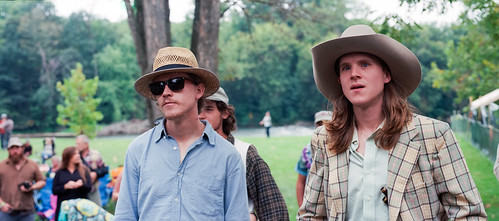
Rudy, Ben, and Will, by Reed A. George
Bronica ETRS, 135W Panoramic Back, Kodak Color 400 Film
 
I'm dragging the Bronica gear out after a few years of neglect. I'm having a problem with the film not advancing predictably with this 35mm wide back, but sure like how this image came out. More to come from this camera.
 
DMC-365.blogspot.com

Monday, May 4, 2015

Nick DeMarco (Rangefinder Chronicles) Uses His Hasselblad Xpan on the Street


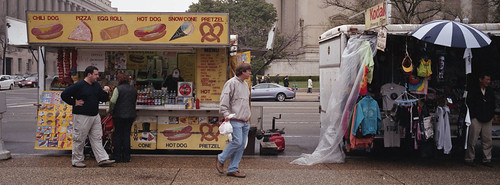
DC Street Vendors, by Reed A. George
Hasselblad Xpan
 
I used to a Hasselblad Xpan panoramic camera. Shooting 24x65mm images on regular 35mm film, it was interesting. I've always been partial to panoramic images.
 
I sold mine, for two major reasons: 1) it was worth too much money for the amount I used it, and 2) I found a panoramic back for my Bronica ETRS. I feel like I had just begun to get how to compose with the XPan when I sold it. Probably too soon. And, I have not used the Bronica pano back nearly as much as I expected.
 
What I did shoot with the Xpan was mostly landscapes.
 
I recently read a post on Nick DeMarco's Rangefinder Chronicles blog about how he uses the Xpan for street photography. (Click Here) to read about it on Nick's blog. He's got some great work there.
 

This doesn't have me back in the market for an Xpan, but it does make me motivated to get out with the Bronica. It's been sitting for far too long.


DMC-365.blogspot.com


Friday, June 13, 2014

Bronica, Panoramic Format, and a Shot That Sticks in my Mind

I made this shot a few years back (2010), with my Bronica ETRS with 35mm wide (panoramic) back. It's Antietam Creek in Maryland.
 
Antietam Creek, by Reed A. George
Bronica ETRS, 35mm Wide Film Back
 
This shot has stuck in my mind for a very long time. It makes me once again remember my Bronica kit, and how much I like it. I bought the camera on a lark, and don't use it nearly as much as I should. I have a full set of lenses, and the panoramic back really adds to the usefulness of the camera. Yes, the ETRS is big, clunky, and loud; you're not going to sneak up on anyone with this camera. At least not after you click the shutter once. But, the lenses are immense chunks of glass, and I think produce first-rate images.
 
Likewise, as many others have, I had a brief period of intense interest in shooting panoramics. Actually, I really love the long aspect ratio. I need to do more with it. One limitation is that panos don't really lend themselves to efficient use of electronic displays, as the aspect ratio is just wrong for using most of the pixels on a normal display. I have planned to order roll paper to print them, but have never done it.
 
So, next time I'm feeling bored and ready for a camera/format change, I'm going to load up the ETRS and 35mm back and get down to business.
 
DMC-365.blogspot.com
 

Friday, May 23, 2014

Film Latitude - Mike B Reports on Overexposing by Seven Stops!

"Humber Light" - Bronica ETRs - Zenzanon 75mm ƒ/2.8 @ ƒ/11 1/8s
Image Source: http://blia-yof.blogspot.com/
 
I found this image and related post on Mike B's "A Year on Film" blog. In this post, Mike writes about the incredible latitude of film, in this case Rollei IR400 IR film. While this shot above was exposed, I would say, perfectly, Mike shares an image that was overexposed by seven full stops, and still rescued. Yes, you can tell it was overexposed, but there's quite a lot of image information there.
 
(Click Here) to read Mike B's post.
 
I like a lot of things about this post. First, I'm intrigued by Mike's blog in that he is part of a "52 Rolls of Film" project, which equates to one roll per week for an entire year. I could do that. So far in 2014, I'm averaging about twice that rate. Second, Mike writes about how his digital cameras are taking the backseat to film cameras. He writes that he no longer buys film cameras, but his collection continues to grow through gifts from others. Having just returned from a trip to Ohio where I won a new Nikkormat FT3 at the Film Photography Project (FPP) Walking Workshop, and received a wonderful Konica FC-1 film SLR from my uncle, I can appreciate that. Finally, I like that Mike is using the Bronica ETRS. I have a full ETRS kit (including the 35mm panoramic back) that has not been out in ages. I must fix that.
 
Be sure to check out the FPP website if you're into film by (Clicking Here).
 
DMC-365.blogspot.com


Friday, November 16, 2012

Manassas National Battlefield Revisited - Bronica ETRS Medium Format Camera

 
Cannon, Manassas Battlefield, by Reed A. George
Bronica ETRS, Fuji Provia film, exposure unrecorded
 
I live very close to the Manassas National Battlefield, site of two of the deadliest battles of the American Civil War, exactly 150 years ago. I recently decided to take out my Bronica ETRS medium format camera, and Manassas was where I ended up. I've shot this site many times. While there's not really much there in terms of clear photographic subjects, the place has real feeling. It's a little difficult to take a shot of cannons that hasn't been taken before. I don't think I really succeeded with that here, but I do like how the barrels are aligned, with the one in the distance just a little out of focus. That was my goal.
 
Henry House, Manassas Battlefield, by Reed A. George
Bronica ETRS, Fuji Reala film, exposure unrecorded
 
 
One of the few remaining structures from the Civil War era is Henry House. You may remember that I have shot this house before, and won 2nd place in a contest, resulting in the shot being used in the Civil War Trust's 2012 calendar. That image, shot with a Panasonic Lumix DMC-G1, is shown below. The shot above is from the other side of the house.
 
Henry House, Manassas Battlefield, by Reed A. George
Panasonic Lumix DMC-G1, Leica Elmar 5.0cm f3.5 Lens
High Dynamic Range (HDR) Composite of Multiple Exposures
 
Finally, on my Bronica outing, I shot the old foundation of a house owned by a free mixed-race person during the Civil War. His name was James Robinson, and his mother was a black woman, and his father was reportedly a member of a prominent white family in the area. In any case, Mr. Robinson was very enterprising, and worked in many different ways to procure himself a piece of land and a house. As you can tell by visiting the remains of the old house, it was quite small. Judging only from memory, I would estimate the foundation to be about 400 square feet. Reportedly, it was a 1 1/2 story building, with the living quarters on the first floor.
 
Remains of James Robinson's House, Manassas Battlefield, by Reed A. George
Bronica ETRS, Fuji Reala film, exposure unrecorded
 
Mr. Robinson married an enslaved black woman, which meant by law at the time that there children were also slaves; they had eight together. While Mr. Robinson was able to arrange for some of his children to stay in the Manassas area, at least two of his sons were sold to distant plantations, including one in Louisiana.
 
For a short biography of Mr. Robinson, (Click Here).
 
During the first battle at Manassas (also known as "Bull Run") in summer 1861, after hiding under a bridge for the duration of the fight, Mr. Robinson came home to find 13 Confederate dead in his yard. His property had been in the direct path of the retreat from overwhelming Union forces. The Confederates would later push back, inspired by the arrival of Thomas Jackson's forces, routing the Union army and winning an important battle early in the war. This was the battle that earned Jackson his nickname, "Stonewall." Just 13 months later, the house served as a field hospital for the Union army in Second Manassas.
 
The house burnt down (due to arson) in 1993. While the National Park Service was dismantling the remains, they found an incredible cache of documents from the Robinson family, dating back as far as the 1830s.
 
I thoroughly enjoyed using the Bronica again. It has been a long time since I took it out. The camera and lenses are large, heavy, and noisy to use. This is no stealth camera. But, the optical performance is very nice. It certainly promotes slow, thoughtful composition. I hope you enjoyed seeing the result.
 
DMC-365.blogspot.com
 
I find Fuji Reala (iso 100) film to be very nice for scanning. It is a relatively low contrast color print film. Order yours here: