Showing posts with label creativity. Show all posts

Thursday, May 7, 2015

Worldwide Pinhole Day 2015 - Closeup with the Nikon Df and Finney Pinhole Cap

Sunday, April 26, 2015 was Worldwide Pinhole Day. (Click Here) to learn more about this fun event.
My friend, Bill, and I went out to the National Arboretum for some pinhole shooting on that day. Because I like to shoot black and white film in my Reality So Subtle 6x17 panoramic pinhole camera, I decided to also bring along my Nikon Df DSLR, fitted with an f/180, 50mm focal length pinhole bodycap.
 
My pinhole cap was made by a company called Finney; I'm not sure if they still exist. I bought it some years back, and have used it very little. On a sensor as small as even the full-frame Nikon Df, pinhole makes very soft images. Now, pinhole photography isn't about sharpness, but the large format film pinhole cameras I normally use make much sharper images. Anyway, I brought it along so that I could capture some spring color.
 
Here are some images I captured closeup with the Df and pinhole body cap:
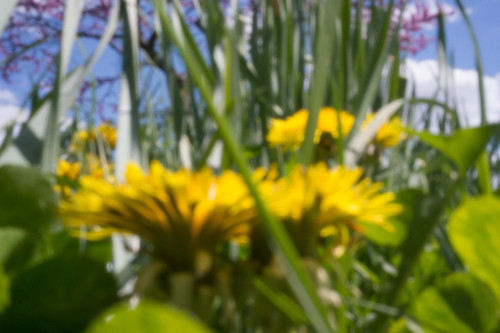
 
Dandelions, by Reed A. George
Nikon Df, Finney f/180 Pinhole Body Cap
iso 3200, 1/60 sec.
 
As you can see, I was able to shoot handheld with the Df, since I cranked the iso up to 3200. With my film pinhole cameras, I usually shoot iso 100, which requires serious stability. Exposures are in whole seconds to sometimes even hours.
 
Pinholes have extremely small apertures, which means lots of depth of field. In this case, that means that everything, no matter how far from the camera, is the same degree of blurry. But, I do kind of like the effect.
 
Here's another shot, showing another member of the dandelion micro environment, a wasp.
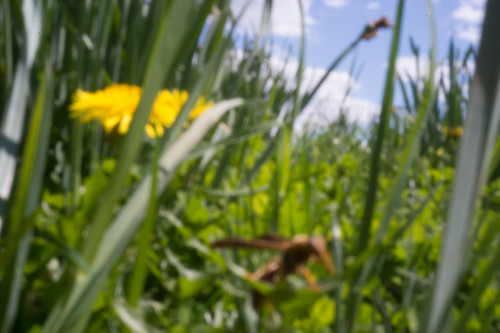
 
Dandelion and Wasp, by Reed A. George
Nikon Df, Finney f/180 Pinhole Body Cap
iso 3200, 1/60 sec.
 
Worldwide Pinhole Day only allows each entrant to post a single picture. I haven't selected my single best image yet, but will continue to share several others that I made with the Df on that day.
 
I find it very interesting that low tech can actually add interest to my images. I'm seeing it more and more, and find myself taking the technical edge off of much of my work. I know it's not for everyone, but hey, I'm doing this for my own creative development. And I'm enjoying it. If you're stuck in a photographic rut, I highly suggest that you step back, relax, and take some blurry pinhole images. It can be rewarding.
 
DMC-365.blogspot.com
 

Monday, April 20, 2015

Another Shot at Light Painting Cherry Blossoms with the Nikon Df

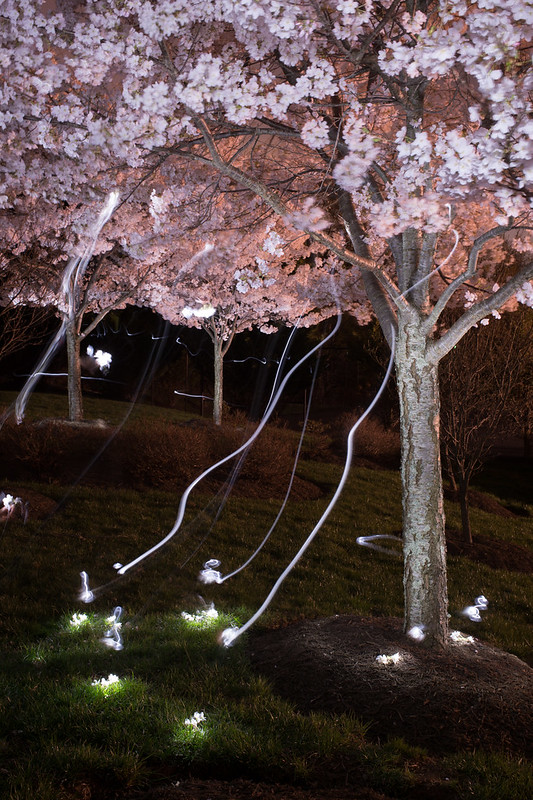
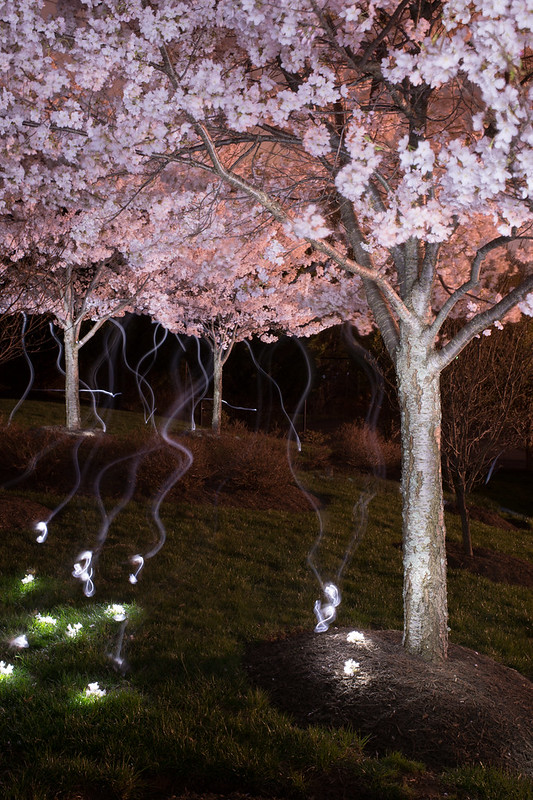
Referring to my post from two days ago, I decided to get back out with the cherry blossoms after dark one more time this year. Fighting my allergies, last remaining vestiges of jet lag from the Japan trip, and worries that my neighbors would wonder why this crazy guy was shining his flashlight up into the trees for an hour or so, I went for it. Here are my favorite light painting shots of the cherry trees this spring.
 
Falling Blossoms #1, by Reed A. George
Nikon Df, Nikkor 35mm f2 AF-D Lens
iso 100, f11, 479 seconds
Falling Blossoms #2, by Reed A. George
Nikon Df, Nikkor 35mm f2 AF-D Lens
iso 100, f11, 357 seconds
 
Yes, it took me 6-8 minutes per shot to do all of the light painting you see here. I had to paint the trunks of all three trees, then the branches. Then, I did the falling blossoms (several per tree). All with one flashlight. I think it was worth it. I feel that I succeeded in making something unique if not beautiful. At least they're not just one more series of straight shots of cherry trees. And through the process, I learned some of what not to do as well as what kind of works in this type of photography.
 
DMC-365.blogspot.com
 

Monday, October 27, 2014

From the Broad Creativity File - Using the Sun (and Magnifying Glass) to Make Art

Image Source: http://www.lostateminor.com/2014/10/10/artist-creates-landscape-artworks-using-magnifying-glass/
 
I love seeing new creative approaches to art. Usually, these come to me from the blog "Lost at E Minor," and this one is no exception.
 
This is Jordan Mang-osan. He makes the large murals by sketching them, then using a magnfying glass to burn the image into wood. Awesome, huh?
 
(Click Here) to read more.
 
I respect people who come up with different ideas like this. Once you see them, it's obvious. How many of us had wood burning kits when we were younger? For those who didn't, they were essentially electric soldering irons, which were used to burn pictures into wood. Using a magnifying glass instead isn't such a stretch. Why didn't I come up with that?
 
And regardless of who thought of it, I also respect people with the patience to put it to work on such a large scale. These pieces of art take Jordan months to complete.
 
DMC-365.blogspot.com


Tuesday, September 23, 2014

Glen Craig's Photos of The Man - Miles Davis

Image Source: http://blog.leica-camera.com/photographers/interviews/glen-craig-close-up-miles-davis-at-photokina-2014-daswesentliche/
 
As you may know, I'm into photographing musicians and creative souls. It brings balance to my life, which is also heavily involved in science and technology. Photography represents the perfect combination of the two perspectives for me.
 
In a post on the Leica Camera Blog, a full gallery of intimate images by Glen Craig shows a side of jazz master and innovator Miles Davis that I've never seen before. I suppose almost no one has.
 
(CIick Here) to read the post and see the full gallery of amazing images from 1970.
 
Craig shares that Davis generally didn't like to be photographed, but made an exception, letting him stay close and photograph him over three weeks in 1970. He also mentions that in order to gain access to the artist in the beginning, he had to pass a test of sorts, made up of questions about jazz music. Craig obviously passed the test.
 
I like that Craig shot many of the pictures of Davis working out in a boxing gym close up, with a 35mm lens. It gives the images a very intimate feel, one that would not have been accomplished with a long lens.
 
DMC-365.blogspot.com


Saturday, September 13, 2014

Evan Leavitt's Doing Instant Photography Now

Image Source: http://evanleavittphotography.wordpress.com/2014/09/04/camak/

I've posted Evan Leavitt's work several times in the past. The shot above, entitled "Camak," was made with a Polaroid camera and Fuji instant film. Right up my alley.

I think Evan's work has a very special feel to it. He shoots with vintage equipment, many times even making a paper negative. The results are always impressive to me.

(Click Here) to visit Evan's blog.

DMC-365.blogspot.com


Thursday, July 10, 2014

Whirling Disks and Rear Curtain Sync

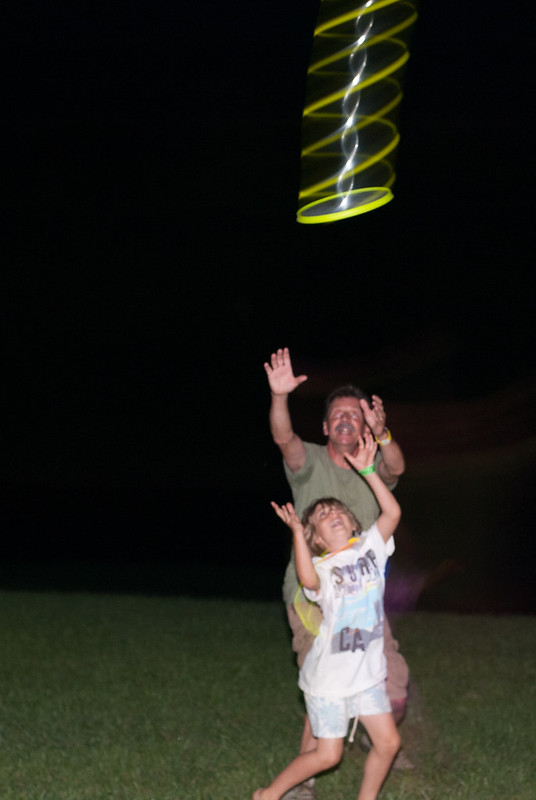
Rear curtain flash sync is a function on many cameras. The way it works is that instead of triggering your flash when your shutter opens (generally for a much longer time than the length of the flash light pulse itself), it opens the shutter, then triggers the flash right before the shutter closes.
 
Why would you want this? Well, if you're using a slow shutter speed, you'll get motion blur or light trails from anything that's moving fast. With normal (front curtain) sync, the flash goes off, the shutter stays open, and you get trails that are made after the flash. With rear curtain synch, the trails are made first, then you get flash and light the rest of the scene at the end of the exposure. The classic example is a moving car, where you get an image of a car that's already gone by you, with fantastic blur behind it. Using front curtain sync, you'd get the car before it passes by, and light streak in front of the car, not nearly as cool.
 
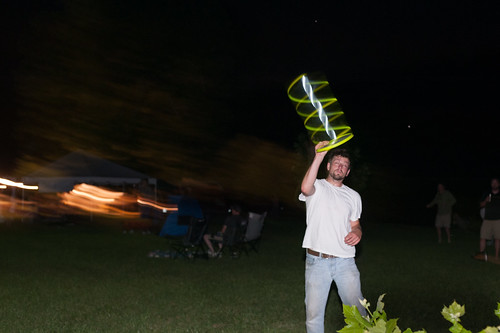
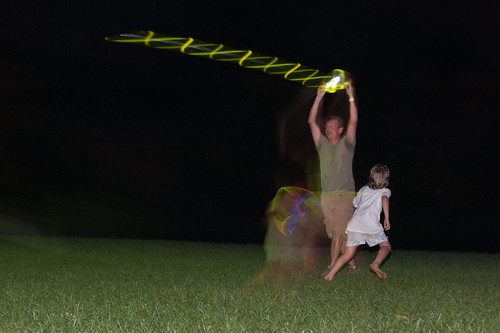
Well, I find it's pretty difficult to find applications other than moving cars for this cool technique. At the River and Roots music festival, I found one. These guys were playing what I would normally call "Frisbee," but with a disk that has its own light in it. They were playing in the dark. I thought, hmm. I bet that disk would make a great light streak. So, I tried it. Amazing! It made this really cool nested helix shape as it flew by. Next step, try rear curtain sync to see if I could capture the streaks and the player. Here's how that looks:
 
I like this shot a lot, but I wanted the streaks to be longer, and I didn't like the distracting lights in the background (at left).
First, the background lights. One of the other players was near the river, which was completely dark. Goodbye background distractions:
Getting the timing just right was tough, but I was getting the hang of it.
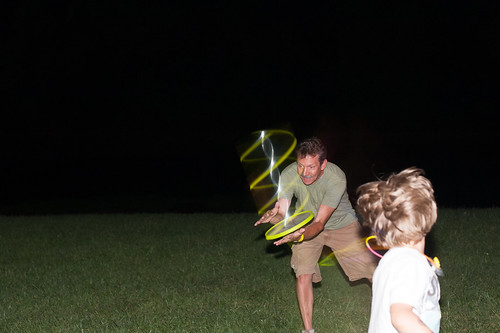
So, how to lengthen the light trails? Longer exposure, of course. So, I went to a full second exposure, with the flash at the end. Since the ambient scene was so dark, I didn't even have to change my f-stop or flash settings. This is exactly the effect I was looking for:
Whirling Disk, by Reed A. George
Nikon D700, Nikkor AF-D 50mm f1.4 Lens
iso 1600, f4, 1 second exposure, rear curtain sync flash
 
Great fun. I don't think any other photographer at the festival captured a shot just like this.
 
DMC-365.blogspot.com


Friday, July 4, 2014

Music Festival Photography

I really like shooting at music festivals. I love live music, creative people, and nature. The festivals give me all of that.


I especially like the smaller local festivals here in Northern Virginia. In fact, I'm headed out to one this weekend at Watermelon Park, in Berryville. This one's called "River and Roots," and I'll get to see many of my friends there.
 
By shooting at festivals, I've met a few of the best live music photographers there are. One of those is Milo Farineau. Another, his mentor, is Chester Simpson. Both are fabulous photographers and people.
 
Chester recently posted a link to his friend's thoughts on modern festivals, including Glastonbury in the UK.
 
(Click Here) to read Barry Wolman's thoughts, which include comparing Glastonbury to a "prison yard."
 
While the festivals I attend do focus as much on camping and spending time with friends, they also clearly celebrate the music, something that seems to be lost at some of the larger festivals. The music is what really brings us all together around here. If I felt as Wolman does, it would be time for me to stop attending festivals. As it is, I can't wait for this weekend!
 
Oh, and Happy Fourth of July!
 
DMC-365.blogspot.com


Wednesday, June 18, 2014

Cole Thompson on Vision

 
I recently read a great post on Cole Thompson's blog, about how he found his own vision. Cole started the journey with a portfolio review where the reviewer simply said that he was copying Ansel Adams. He told Cole that Ansel had already done Ansel, and he was never going to do it better than him.
 
This set Cole on a journey to find and develop his own vision, which he describes in a set of ten steps.
 
(Click Here) to read the whole post on Cole Thompson's blog.
 
A few of the elements of the post I like best are:
 
  1. He printed 100 of his most loved images, then sorted out those that he personally loved (not those that others happened to love). Then, he set his mind to pursuing more images like those.
  2. A direct quote: "I had to remind myself that this was not a race or a contest, I was not competing against others...I was competing with myself."
  3. Cole's vision didn't come to him in a flash, but in a moment of realization: "Vision was simply the sum total of my life experiences that caused me to see the world in a unique way."
I also like Cole's assertion that your vision is not necessarily associated with a particular look or style. You can bring your own vision to anything you set your mind to.
This is a very well-written piece, and one that makes me think more about why and how I pursue photography.
 
DMC-365.blogspot.com
 

Monday, June 9, 2014

More New Orleans Street Art

I have a thing for artists who make their living sharing creativity on the street. This gentleman was most gracious when I asked if I could take his picture at Jackson Square in New Orleans.
 
Street Artist, New Orleans, by Reed A. George
Leica M6 Titanium, Kodak 400 Color Print Film
 
I honestly can't remember if I was using my 35mm f2 Summicron or 50mm f1.4 Summilux for this shot. I must learn to record my film shooting parameters better.
 
What attracted me to this man as a subject was the combination of beautiful morning light bouncing from his sketch pad and lighting his face, and his intense concentration on his subject. In composing the shot, I got down low, hoping to use the line of the fence to align somewhat with his line of sight. I think I achieved that reasonably well. I was able to get in and out of their way very quickly, and captured exactly what I wanted with the M6.
 
Nope, I'm not ready to give up film yet.
 
DMC-365.blogspot.com


Tuesday, May 27, 2014

New Orleans Street Poet

Performing Poet, New Orleans, by Reed A. George
Leica M6 Titan, Summilux 50mm f1.4 Titanium Lens
Ilford Delta 3200 Film
 
I really love creative people. This poet was set up in the French Quarter, and would write about anything you asked. He was asking for donations if you liked what he wrote. I very much respect him for using his creativity and skill to make a living here.
 
I asked him to write about my daughter, Christine. I only told him a few things - her age, her interests, that we are very close. He asked me to give him 15 or 20 minutes. When I returned, here's what he had written:
 
"Christine
 
The paintball warrior
with art in her blood,
jumping into the flood of
emotions, running toward
adulthood.
 
A family well in tune,
a room, a canvas,
Christine sees with an
artist's eye, drinking in
the colors and textures,
becoming the young woman she
was meant to be.
 
A Renaissance woman in training
determined to put her mark
on the world,
one ball of paint at at time"
Perfect. Couldn't be more correct.
 
DMC-365.blogspot.com
 

Thursday, May 15, 2014

This is One Creative Dad

Sure, I took my kid out to the beach in driving rain and made a few unique pictures with her.
 
Rainstorm at the Beach, by Reed A. George
Panasonic Lumix DMC-LX5 (in waterproof bag)
iso 80, f2.8, 1/320 sec.
 
But, if you're a parent who likes kid pictures that break the normal cutesy rules, you've got to see what Japanese photographer Nagano Toyokazu has created with his four year old daughter, Kanna.
 
(Click Here) to see Nagano's images on Lost at E Minor.
 
Looking back on my own images of my daughter (now 13 years old), I see an awful lot of normal images. Of course, they're dear to me, because of the subject. But, I see now that I could have been more creative. Well, there's always tomorrow! Or today?
 
DMC-365.blogspot.com


Friday, May 9, 2014

Quirky Rituals to Spur Creativity

I read an interesting post on the Writer's Circle blog, about odd rituals that famous writers have used to keep the creative juices flowing.
My Daughter and I, a Few Years Back, by Reed A. George
Nikon D700, Nikkor AF-D 35-70mm f2.8 Lens
iso 800, f13, 1/60 sec.
 
Apparently, Joan Didion sleeps with her nearly-finished books, Truman Capote avoided many things based on superstition. My favorite, even though I don't follow it, is Hemingway's creed of "Done by noon, drunk by three." It seems he lived by it.
 
(Click Here) to read the full post on Writer's Circle.
 
I'm about to head off on a solo adventure for three days in New Orleans. No real agenda, other than meeting up with a musician friend who's migrated there. I'm hoping that the change of scenery andsome time to hang out at a leisurely pace will push me in a new creative direction. Actually, I have had lots of ideas and even some progress in images related to them lately. A little extra energy never hurts, though.
 
Now to decide on what camera gear to take...
 
DMC-365.blogspot.com


Wednesday, April 2, 2014

Art for the Sake of Art - From the Broad Creativity Files

Sand drawings. Andres Amador makes them, mostly for his own creative release. And the phrase "sand drawings" really isn't grand enough for what he produces.


Image Source: http://blog.chasejarvis.com/blog/2014/03/the-key-characteristic-shared-by-all-the-most-creative-people-i-know-andres-amador-interview/?utm_source=feedburner&utm_medium=feed&utm_campaign=Feed%3A+ChaseJarvis+%28Chase+Jarvis+Blog%29
 
I read about Andres' artistic pursuits on Chase Jarvis' blog.
 
(Click Here) to read the story and see several great examples on Chase's blog.
 
There are two things that really strike me about this work. First, as Chase emphasizes, the best art is done because the artist simply must do it, as opposed to doing it for money, prestige, etc. Second, this particular expression impresses me because of the inherent impermanence of it. The article mentions that it's somewhat like Tibetan Buddhist mandala sand paintings, where monks spend weeks making intricate paintings from colored sand, and then destroy them.
 
(Click Here) to read more about sand mandalas. I've always wanted to see one of these being made.
 
DMC-365.blogspot.com
 

Tuesday, January 28, 2014

From the Broad Creativity File - X-Ray Pictures of Nature

Image Source: http://www.lostateminor.com/2014/01/11/x-ray-shots-nature/

Dutch Physicist Arie Van't Riet makes these beautiful colored x-ray images of nature by shooting the x-ray (monochrome) and adding color in Photoshop.
 
I found this post (with several other x-ray images) at Lost at E Minor:
(Click Here) to see the original post.
 
And don't worry, most of the animals were reportedly already dead when he x-rayed them.
 
This kind of reminds me of some incredible images I've seen made with flatbed scanners, but seeing inside the animals adds another dimension.
 
DMC-365.blogspot.com


Friday, December 20, 2013

Thinking About My 2014 Plan for DMC-365

Autumn Abstract, by Reed A. George
Panasonic Lumix DMC-GX7, 14-42mm Series II Kit Zoom at 42mm
iso 200, f20, 1/2 second
 
I've mentioned a few times lately that I'm considering my strategy for this blog in the upcoming year (2014). I know that I want to stay with the core focus of the interface between photographic equipment, technique, and creativity. Beyond that, I'm largely undecided.
 
One thing is for sure - it's a tough assignment to write each and every day. For a one-person operation like DMC-365, that means I'm up every morning, drinking my coffee and thinking what to write about today. On one hand, I love the discipline and the motivation to see everything new out their in the exciting world of photography. I also know from my initial research into how to run a blog that frequent posting is a must for survival (many "pros" post multiple times daily). I have seen that there are tons of potentially interesting blogs out there that completely fail because they haven't been updated for a month.
 
This morning, I read an interesting post by David Hobby of the blog Strobist. He and fellow photography internet personality Zack Arias are both working toward what they refer to as "Low Frequency High Amplitude" posting. By this, they mean fewer posts, but more impact, more depth with the posts they do make.
 
(Click Here) to read David's post on Strobist.
 
In his post, David says he is considering going to lower frequency than two posts per week. Strobist is very well-established, so maybe it can take that. I believe one post per week would be the death of my blog, both because my readers expect news more often than that, and because I would almost surely lose interest myself.
 
I would enjoy going deeper into some subjects, and will. For example, I've really enjoyed doing my two monthly columns this year - Whole Lotta Leica and Skeletons From The Closet. I think that I'll likely select a smaller number of cameras and lenses next year and use them more often. A month seems like a long time to spend with one camera, but it's not. Especially when photography is not your occupation (my real job is reasonably demanding, so I shoot mostly on weekends). In fact, the Skeletons project for 2013 has helped me to identify a few cameras that I really want to spend more time with.
 
So, my current thinking is that I'll continue to post at fairly high frequency (perhaps not every single day) in 2014, but will try to add in more depth at some lower frequency. In the end, it's variety that's the spice of life. To take the frequency/amplitude analogy further, most of us like to hear all of the frequencies (tones) in the music we listen to. We do want the beautiful high frequency vocals and lead guitar, but we also want solid, warm bass tones to anchor it all.
 
Of course, I'm open to my readers' opinions. Drop me a line or comment!
 
DMC-365.blogspot.com


Thursday, December 12, 2013

From the Broad Creativity Files - Japanese Artists Paint Hotel Rooms

Artist Naoki Takenouchi at the Park Hotel, Shiodome, Tokyo, Japan
Image Source: http://www.japantimes.co.jp/news/2013/12/02/national/hotel-room-walls-serve-as-canvas-for-takenouchis-contemporary-art/#.UpxvkDS9KSN
 
The Park Hotel in Tokyo is having artists come and spend some time in residence, under its "Artist in Hotel" program. Artist Naoki Takenouchi is painting his interpretations of "Fujin" and "Raijin," gods of wind and thunder, respectively, in a room now entitled "Japanese Paper Garden" for the sumi ink and washi paper used in his portrayals.
 
The hotel already has two other themed art rooms, one entitled "Sumo," the other "Zen."
 
What a cool idea. I'd love to stay in one of these one-of-a-kind rooms.
 
DMC-365.blogspot.com
 

Wednesday, November 27, 2013

Look Deeper

 
Look Deeper, by Reed A. George
Leica CL, Minolta Rokkor 40mm f2 Lens
Kodak TMax 400 Film
 
 
DMC-365.blogspot.com


Saturday, November 2, 2013

Another Autumn Leaves Series, With Motion

This will mark my third small series of fall leaves in motion. As I said before, I did push myself to keep pursuing the idea, tweaking it as I went, to see how far I could push it. Of course, it could go further, but I think the following three images represent something of an accomplishment for me.
 
These shots were all made with the new Panasonic Lumix DMC-GX7 and 14-42mm f3.5-5.6 Series II kit lens. What I feel I've learned so far in this exercise is to play with the level of realism and abstraction, which I actually think I came close to in my previous mini-series (on November 1). I really like those previous images, but did push a little further.
 
This time, I paid more attention to color. The shots from the previous post are pretty bland, color-wise. I think these below pull together my intention in terms of both the level of abstraction and in fall color. I know these won't be attractive to everyone, but I am somewhat satisfied with where the exercise took me. Now you can judge them for yourself.
 
Color and Motion 1, by Reed A. George
Panasonic Lumix DMC-GX7, 14-42mm f3.5-5.6 Series II Kit Lens
iso 200, f22, 0.4 sec.
 
Color and Motion 2, by Reed A. George
Panasonic Lumix DMC-GX7, 14-42mm f3.5-5.6 Series II Kit Lens
iso 200, f22, 0.2 sec.
 
Number 2, above, is probably a little too swirled to stand on its own, in my opinion. In the context of the other two, I think it works.
 
Color and Motion 3, by Reed A. George
Panasonic Lumix DMC-GX7, 14-42mm f3.5-5.6 Series II Kit Lens
iso 200, f22, 1/8 sec.
 
If I had to pick one (I don't have to), I'd pick number 3. I love the color. I think it's right at the edge of complete abstraction, but it still says "autumn" to me. But, I think the three in this series hang together pretty well.
 
One thing I'm learning right now is to give my images time before being done with them. I've been playing with this project quite a lot, and living with the images, thinking about them. I think I'll probably print these three, and see if I'm done. At some point, the leaves will all be down, and I'll be finished by definition.
 
One thing I think is that I could crop all three of these to square images. All of them could lose some empty space on the left side. It would change the character a lot, moving the swirl center away from the center of the frame. I'll give that a try before calling it done.
 
DMC-365.blogspot.com


Thursday, October 31, 2013

"Why I Killed Street Photography" - Great Post by A.D. DeMesa on Eric Kim's Blog

 
I Guess This Is Street?, by Reed A. George
Agfa Record III, 6x9 Folding Medium Format Camera
 
 
I read a very interesting introspective post by A.G. DeMesa, a Manila-based photographer, who wrote a guest piece on Eric Kim's street photography blog.
 
Basically, A.G. is talking about breaking free of restrictions, any restrictions, imposed by trying to shoot in a particular style or genre. He has a significant body of work (10,000 images) to look back on, which helped him decide to "Kill" street photography. DeMesa refers back to historic photographers (Meyerowitz, Frank, Moriyama and others) and how they each pursued something new, different from the accepted styles of their times. Now he's doing the same.
 
I particularly like this quote:
 
"That was it. All of them had one thing in common: It was about seeing something. No dogma, no photographic gods, no one true photography. That is what I’m going to do."

 
Yes. Now if only I could decide what it is that I'm seeing, and communicate it.
 
(Click Here) to read DeMesa's post on Eric Kim's blog.
 
I've been considering taking a 1-on-1 skype or Google+ street workshop with Eric Kim. I just need to find a time when I know I'll be able to get out and shoot.
 
DMC-365.blogspot.com


Sunday, October 27, 2013

From the "Broad Creativity" File - Melting Ceramics

Image Source: http://www.lostateminor.com/2013/10/14/ceramics-melting-like-ice-cream/

Sometimes I like to look outside the confines of photography to broader creative pursuits. Usually, the things I'm interested still fall within the visual arts, as does this really cool project shown on the creative site Lost at E Minor.

Here, artist Livia Marin has converted porcelains into very diffferent works of art. I don't have a clue how she's done it, but I really like the effect. What strikes me is that the patterns are not melted or distorted. I imagine they're Marin's original designs, painted after the flowing background is produced. But, I can't be sure of that.

(Click Here) to read the original post on Lost at E Minor.

A nice diversion for a Monday morning (when I'm writing this).

DMC-365.blogspot.com