Tuesday, January 13, 2015

Not All TLRs Are Rolleiflexes

 
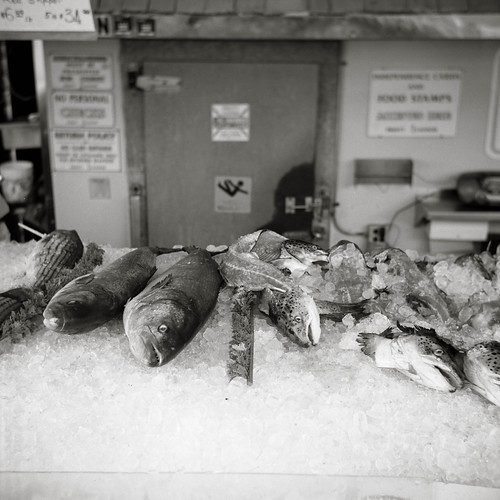
Seafood Market, Super Ricohflex TLR
 
Well, of course not all twin lens reflex (TLR) cameras are Rolleiflexes. There are also Rolleicords! But, all jokes aside, there were many, many respectable TLR cameras by makers other than Rollei. I've owned a Yashica TLR that was quite capable. I still have a Minolta Autocord, which rivals any of my f3.5 Rolleis. I also have a couple of Ricoh TLRs, including the Super Ricohflex that I used to make the picture above.
 
Most of the other brands are less expensive than Rolleis, as well. My first TLR was a Chinese camera, made by Seagull. Not as robust as the Japanese or German makes, but it worked quite well.
 
(Click Here) to check out a post by Rick Schuster on the blog "shot on film." Rick uses a Super Ricohflex himself, and shares some nice color shots. However, Rick also mentions a strange phenomenon of the area of focus being somewhat unpredictable on his camera, toward the edges of the frame. I've never experienced anything like this with my Super Ricohflex. If forced to speculate, I'd say that Rick's camera has suffered an impact that misaligned the lens axis with the film plane. That said, Rick's still making great pictures with his camera, and by all appearances enjoying the process.
 
DMC-365.blogspot.com


Sunday, January 11, 2015

Halls of Knowledge

Halls of Knowledge, by Reed A. George
Nikon F, Nikkor 45mm f2.8 Pancake Lens
 
I took this shot at the Carnegie Library in Washington, DC. Not bad for a 50 year old camera.
 
DMC-365.blogspot.com
 

Saturday, January 10, 2015

Why Are These Old Cameras So Much Fun?

I recently picked up a Brownie Reflex Synchro model camera in an antique shop. I paid $10, which is about $6 more than it originally cost.
 
It is a TLR design, but with fixed focusing only. So that really only means that it has a waist level finder. Anything >5 feet away will be in focus.
 
The camera was extremely dirty, but was easy to disassemble and clean; now it looks great. Another challenge: it shoots 127 film. Nearly extinct, 127 film can still be purchased at Frugal Photographer. (Click Here) to go to their website. It's pretty expensive, but at least it's available. You can get 127 film processed at The Darkroom.
 
I am guessing the fixed shutter speed to be about 1/50-1/100 second, and the aperture to be about f8. That means that iso 100 film should work in daylight situations. I have shot 10/12 frames of my first roll of Efke black and white 100 film. I look forward to seeing and sharing the results.
 
DMC-365.blogspot.com


Friday, January 9, 2015

Film Fear-Mongering at Pop Photo?

 
Chinese Actress, by Reed A. George
Rolleiflex T, Kodak Portra 160 Film
 
As you probably know, I love shooting film. I have so far stuck with the big names in film, with few exceptions. Kodak TMax is my choice for black and white film in iso 100 and 400. Ilford Delta 3200 is my favorite fast black and white film (I shoot it at 1600). For color, I shoot mostly Kodak and some Fuji.

While there are some other great films out there, including many to try out at the Film Photography Project's store, I have been content to stick with my favorites.


I recently started to read an article at Pop Photo entitled "12 Films Worth Shooting With Before They're Gone". I thought that maybe they had some information on films that truly are on their way out. As soon as I started the article, I noticed that the first two films listed were my favorites: Portra 400 and TMax 400! Oh, no! Did they know something I didn't? Nope, I don't believe so. Their third listed film is Tri-X, the most beloved of Kodak standards still available. I am pretty sure I would have heard if any public announcement had been made about Tri-X.

Now, I'm not saying it won't happen. We may see the sad day when these films disappear. I'm just not convinced that now is the time to get people worried about it. So, thanks for nothing useful in this case, Pop Photo.

If you feel the need to read this article (as in, if you want to worry unnecessarily), you can
(click here) to see it on Pop Photo's site.


DMC-365.blogspot.com


Thursday, January 8, 2015

The Rolleiflex and Attracting Photographic Subjects

 
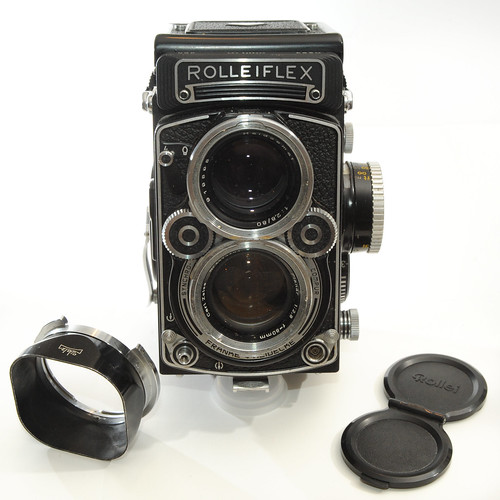
My Rolleiflex 2.8F
 
Over the holiday break, I've spent a little time with my new Rolleiflex 2.8F, which I purchased a couple of months back from my close friend Charlie. Mine is a Model K7F2 with Zeiss Planar lens, manufactured in 1966.
 
Charlie, and another good friend, Alain, have recently taken up their twin lens reflex (TLR) Rolleis and done quite a lot of shooting. One of the things that excites them both about Rolleiflex is how warmly people welcome them shooting with them. So many people ask about the cameras, or remember someone who had a camera like that, etc.
 
I have certainly experienced the same phenomenon. In fact, Charlie and I were in DC over the weekend, when a lady at the table next to ours in a cafe said "Excuse me, I see you have a Rolleiflex." She then went on to tell us that she owns one herself, which she inherited from her brother. By the way, her brother fought in World War II, including Normandy, entering the military at age 14 with a made up birth date. This nice lady asked about our little photography group, which meets once monthly. She's invited to our next meeting, and I'm hoping she'll bring her camera along and let us help her start shooting it again.
 
In my opinion, this kind of camera recognizing is both blessing and curse. While I certainly enjoy welcoming photographic subjects, sometimes I want to go unnoticed. I find that a small 35mm camera, like a Leica rangefinder, is better for that. The truth is that subject reaction to the two types of cameras is just different. Neither is good or bad; they're just different.
 
I've written about this in the past, with regard to my Mamiya Universal Press camera. Very few people recognize the MUP, but it's so big, it's not going to go unnoticed. (Click Here) to see some of the "candids" I've taken with the MUP.
 
I recently found a post on the blog "TLRgraphy" about this automatic receptivity in photographic subjects when you're using a Rolleiflex. (Click Here) to read the post on TLRgraphy.
 
Anyway, I've now got two rolls of 120 film exposed with my 2.8F, ready to go off for processing at thedarkroom.com
 
Hopefully, I'll have a few good images to share with you in a week or so.
 
DMC-365.blogspot.com

Wednesday, January 7, 2015

My New 6x17 Panoramic Camera Arrives

I wrote in the past about the "Reality So Subtle" medium format panoramic pinhole camera. (Click Here) to read about the camera.
 
I decided that it would be my 50th birthday present, and ordered one. It arrived a couple of weeks later, just before Christmas. I was pretty concerned when I saw this collapsed, wet package show up:
 
Opening the package, I did find that the enclosed user guide and exposure guideline documentation were ruined by the wetness. However, the camera was very well-wrapped in another layer of bubble wrap inside. It came through just fine.
 
I contacted James Guerin, the maker, to let him know it had arrived. James was concerned about the package, and said that he'll likely pack differently in the future. But, as I said, my camera's just fine. James will also send me the documentation again, electronically this time. If you're interested in this camera, you can check out James' website at aupremierplan.fr to learn more.
 
I've already put two rolls of 120 film through the camera. At only four images per roll, that was pretty easy to do. I will send them off to The Darkroom (thedarkroom.com) in the next few days. I can't wait to see what those enormous negatives will look like. You'll see them soon after I do!
 
DMC-365.blogspot.com