Showing posts with label Super Ricohflex. Show all posts

Tuesday, January 13, 2015

Not All TLRs Are Rolleiflexes

 
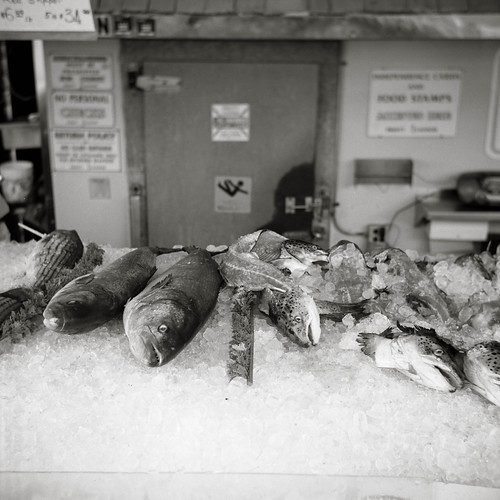
Seafood Market, Super Ricohflex TLR
 
Well, of course not all twin lens reflex (TLR) cameras are Rolleiflexes. There are also Rolleicords! But, all jokes aside, there were many, many respectable TLR cameras by makers other than Rollei. I've owned a Yashica TLR that was quite capable. I still have a Minolta Autocord, which rivals any of my f3.5 Rolleis. I also have a couple of Ricoh TLRs, including the Super Ricohflex that I used to make the picture above.
 
Most of the other brands are less expensive than Rolleis, as well. My first TLR was a Chinese camera, made by Seagull. Not as robust as the Japanese or German makes, but it worked quite well.
 
(Click Here) to check out a post by Rick Schuster on the blog "shot on film." Rick uses a Super Ricohflex himself, and shares some nice color shots. However, Rick also mentions a strange phenomenon of the area of focus being somewhat unpredictable on his camera, toward the edges of the frame. I've never experienced anything like this with my Super Ricohflex. If forced to speculate, I'd say that Rick's camera has suffered an impact that misaligned the lens axis with the film plane. That said, Rick's still making great pictures with his camera, and by all appearances enjoying the process.
 
DMC-365.blogspot.com


Sunday, March 24, 2013

Skeletons From The Closet - Final Results From the Super Ricohflex, February's Camera

 
Dwayne and Jared of The Woodshedders, by Reed A. George
Super Ricohflex TLR, Kodak Tmax 400
 
I shot a few images of The Woodshedders playing in the Lovettsville, Virginia library a couple of weeks back. It was tough focusing the Ricohflex with so little light, and I didn't get it spot on. But, I love the images anyway.
 
Jesse, Dwayne, Jared, and Dave, by Reed A. George
Super Ricohflex TLR, Kodak Tmax 400
 
I did a few test shots, and see that the Ricohflex's focus is not perfectly adjusted close up. It does fine at a little distance, and with an aperture smaller than about f5.6 or so. These were shot wide open (f3.5).
 
I enjoyed using the Super Ricohflex in February, and it's safely stored back in the closet until next time.
 
Hope you enjoyed the results!
 
DMC-365.blogspot.com


Saturday, March 9, 2013

Skeletons From The Closet - February Results - Super Ricohflex in Dramatic Light

As you may have seen, I've been exploring strong directional light here and there. I took the February SFTC camera, the Super Ricohflex, to DC for a day of wandering around the Smithsonian museums in DC. I found some wonderful light inside the lobby of the Smithsonian castle. I just sat and waited until people walked into that light. Here are some of the results.
Into the Light #1, by Reed A. George
Super Ricohflex Twin Lens Reflex, Kodak Tmax 400 Film
 
The design of the Ricohflex TLR allowed me to sit in the same position, looking down into my camera, rather than pointing it at face level at my subjects. At one point, someone came up behind me and asked if I was "filming." I assumed he meant videotaping, and replied that no, I wasn't. I suppose in fact that I was filming.
 
Into the Light #2, by Reed A. George
Super Ricohflex Twin Lens Reflex, Kodak Tmax 400 Film
 
I love the profile of the guy's face peaking out from the darkness at right.
 
Into the Light #3, by Reed A. George
Super Ricohflex Twin Lens Reflex, Kodak Tmax 400 Film
 
The Super Ricohflex has a relatively dim finder, as the viewing lens is f3.5. I had to prefocus, then just wait for someone to walk into the light.
 
Here's one from the entrance of the Natural History Museum. The dark interior contrasted nicely with the backlight coming from the bright daylight outside.
 
"That's One Big Elephant," by Reed A. George
Super Ricohflex Twin Lens Reflex, Kodak Tmax 400 Film
 
I'll finish the post up with a couple of other shots from DC.
 
Street View, DC, by Reed A. George
Super Ricohflex Twin Lens Reflex, Kodak Tmax 400 Film
 
I recently wrote about artist Ai Weiwei's exhibit at the Hirshhorn in DC. While I shot mostly with my M9 (see my recent Whole Lotta Leica post), I did make this shot with the Ricohflex:
 
Ai Weiwei's Zodiac, by Reed A. George

Super Ricohflex Twin Lens Reflex, Kodak Tmax 400 Film

 
I have one more roll of film from the Super Ricohflex to finish up and get processed. I've already moved onto shooting March's SFTC camera, the Zeiss Ikonta folder, but need to finish up the roll in the Ricohflex.
 
So, you'll be seeing a few more from the Ricohflex in the weeks to come.
 
DMC-365.blogspot.com


Sunday, March 3, 2013

Skeletons From The Closet - Some February Results With the Super Ricohflex

Back on February 4, I introduced February's SFTC selection, the Super Ricohflex twin lens reflex camera.
(Click Here) to read about the camera.
 
This has been a tough month to get out and shoot, but I didn't let that stop me. Here is my first installment of results.
 
On this particular morning, I went to the waterfront in Washington, DC, which is essentially a series of floating fish markets tucked alongside a marina full of big yachts. It seems that I end up here once in a while. Last time was with another TLR, a Rolleiflex. (Click Here) to read that post. This time, it was the Ricohflex, loaded up with Kodak Tmax 400 film.
 
Doing Business, by Reed A. George
Ricoh Super Ricohflex, Kodak Tmax 400 Film
 
Don't Slip!, by Reed A. George
Ricoh Super Ricohflex, Kodak Tmax 400 Film
 
Dramatic Shadow, by Reed A. George
Ricoh Super Ricohflex, Kodak Tmax 400 Film
 
Crab Man, by Reed A. George
Ricoh Super Ricohflex, Kodak Tmax 400 Film
I had to crop this one to remove a distracting element. I went with the "normal" 4x6 ratio.
 
I find that twin lens reflex (TLR) cameras give me a fresh perspective for a couple of reasons. First, the square format. It allows for a whole different type of composition. There's something close and intimate about it. Second, since you don't really hold the camera up to your eye, it seems less confrontational to your subjects. I tend to put my eye close to the magnifier in the TLR hood, but shooting at waist level is even less noticeable. If I have enough light to shoot with hyperfocal settings, waist level shooting is fine.
 
My Super Ricohflex is a relatively new addition to my collection. I find that for some reason it tends to produce soft images if I'm focused close to the minimum distance (close up). I am not yet sure whether this is due to my own motion blur when holding the camera, or if the focus is not adjust quite right. In any case, it does a nice job at five feet or further away from the subject.
 
Quite a lot of fun to shoot. I've got some more images from the Super Ricohflex to share, but I haven't scanned and processed them all yet. Keep looking back - more to come.
 
March's SFTC selection, the Zeiss Ikonta, also has a square format. It is not a TLR, so shooting will feel quite different, but it should share some of the compositional qualities of shooting a square picture.
 
DMC-365.blogspot.com


Monday, February 4, 2013

Skeletons From The Closet - Super Ricohflex Twin Lens Reflex - My Featured Camera for February

Well, January's over, so my Pentax K1000 will get some rest. You'll be seeing the results from that camera in multiple posts over the next couple of weeks. Simply search for "skeleton" at the top of my blog to find all of the posts from this series.
 
This month's featured camera is a relatively new addition to my collection - the Super Ricohflex Twin Lens Reflex (TLR), made around 1956.
 
February's Featured Camera, the Super Ricohflex
 
If you're not familiar with TLR cameras, they have two lenses, the top one is for framing and focusing while you look vertically downward onto a ground glass screen. The bottom lens is the taking lens, which forms the image on the film. This camera uses 120 film, and makes a 2 1/4" square (big!) negative. This is a fully manual camera - no batteries anywhere. On the Super Ricohflex, focus is achieved by rotating the taking lens.
 
The standard Super uses a red-tinted window in the rear to let you know how far to wind the film - you see an exposure number on the film backing through the window. This works fine, unless you're shooting fast (high iso) film, which can lead to fogging of the film through the window. Mine has the optional auto-stop mechanism, which adds an exposure counter and controlled spacing of the images. This is a very nice addition to the camera. You can see it at the top left of the camera body above.
 
My Super Ricohflex has a Ricoh Anastigmat f3.5 80mm lens, which is a "normal" focal length for this size of negative. It has a three-bladed leaf shutter, with speeds ranging from 1/10 to 1/100 second, plus B. This is a limited range of shutter speeds, with 1/100 not being very fast. Not exactly a sports action camera. Mine also has a flash mounting shoe on the side, and a PC electrical connection for the flash.
 
I've only shot a single roll with this camera in the past. So, I know it works, but I'm not very familiar with it yet.
 
I've got a roll of Kodak Tmax 400 black and white film loaded and ready to go! Wish me luck with the Super Ricohflex!
 
DMC-365.blogspot.com