Showing posts with label Ricoh. Show all posts

Saturday, November 11, 2017

FotoWeek 2017 Opening Party - 360 Views

Last night, I attended the opening party for DC FotoWeek, an event that is celebrating it's 10th anniversary.

(Click Here) to learn more about FotoWeek.

I took the opportunity to shoot some 360 degree panoramas with my new Ricoh Theta V, a badass little dual-sensor camera that makes these immersive images easy to produce.  Almost too easy.

Be sure to check out the final one, it's a funny little few second video of a toddler on the dance floor who takes an interest in my camera.

Here they are.  DON'T FORGET TO SCROLL AROUND AND ZOOM!

You get much better controls if you click on Theta in the bottom left of each image.
Post from RICOH THETA. #theta360 - Spherical Image - RICOH THETA

Post from RICOH THETA. #theta360 - Spherical Image - RICOH THETA

Post from RICOH THETA. #theta360 - Spherical Image - RICOH THETA

Post from RICOH THETA. #theta360 - Spherical Image - RICOH THETA

Post from RICOH THETA. #theta360 - Spherical Image - RICOH THETA

A view from the fireplace:

Post from RICOH THETA. #theta360 - Spherical Image - RICOH THETA


And finally, that video clip:


Saturday, November 4, 2017

Autumn Color

I got out in the autumn colors today, from a vantage point at Bear's Den overlooking the Shenandoah Valley, less than an hour from home.  Here's the overall scene (don't forget that it's interactive - you can zoom and scroll around in the 360 degree panorama image if you click on image):

Post from RICOH THETA. #theta360 - Spherical Image - RICOH THETA

And here are my favorite shots from the day, all shot with my Nikon D810.  The first two with the Nikkor 200-500mm, the rest with the Zeiss Milvus 50mm f1.4 (amazing lens!).


Saturday, October 7, 2017

A new way to see “the Bean”

I frequently joke that the only thing to photograph in Chicago is the damned bean.  Honestly, I have to stop saying that, as this weekend in Chicago, where I’m attending the International Leica Society (LHSA) meeting has been quite engaging.

But, it took the Ricoh Theta V to make what I think is a unique image of the bean.  This was shot standing directly underneath it.


And here’s the interactive version.  Go ahead, scroll, zoom, look around!

Click Here!


Friday, September 22, 2017

Reed in the Darkroom - 360 degree view


Check this out.  I just got a new Ricoh Theta V camera, which uses two ultrawide angle lenses and two sensors to capture 360 degree spherical pictures.

Bringing together the old with the new, I shot an image in my darkroom with it.


Post from RICOH THETA. #theta360 - Spherical Image - RICOH THETA

Be sure to scroll and zoom! Look up at the ceiling! Pretty darned cool, right?

DMC-365.blogspot.com

Tuesday, January 13, 2015

Not All TLRs Are Rolleiflexes

 
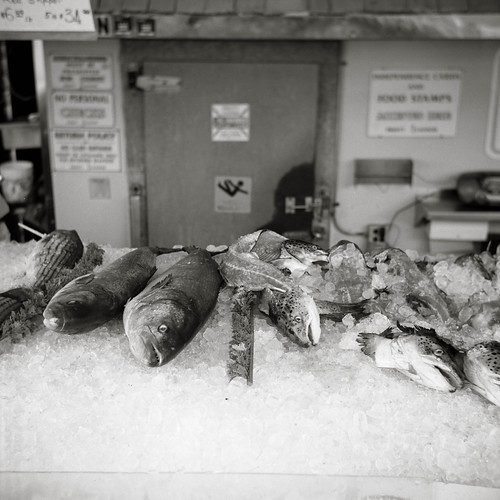
Seafood Market, Super Ricohflex TLR
 
Well, of course not all twin lens reflex (TLR) cameras are Rolleiflexes. There are also Rolleicords! But, all jokes aside, there were many, many respectable TLR cameras by makers other than Rollei. I've owned a Yashica TLR that was quite capable. I still have a Minolta Autocord, which rivals any of my f3.5 Rolleis. I also have a couple of Ricoh TLRs, including the Super Ricohflex that I used to make the picture above.
 
Most of the other brands are less expensive than Rolleis, as well. My first TLR was a Chinese camera, made by Seagull. Not as robust as the Japanese or German makes, but it worked quite well.
 
(Click Here) to check out a post by Rick Schuster on the blog "shot on film." Rick uses a Super Ricohflex himself, and shares some nice color shots. However, Rick also mentions a strange phenomenon of the area of focus being somewhat unpredictable on his camera, toward the edges of the frame. I've never experienced anything like this with my Super Ricohflex. If forced to speculate, I'd say that Rick's camera has suffered an impact that misaligned the lens axis with the film plane. That said, Rick's still making great pictures with his camera, and by all appearances enjoying the process.
 
DMC-365.blogspot.com


Thursday, December 5, 2013

Ricoh GR, Tokyo, "Daido Mode" by Colin Steel on Steve Huff's Site

This is the beauty of modern internet technology and photography blogs. This morning I got to read about a camera I've never handled, used in a place I know well but only see once a year, view photographs that a guy I've never met took and shared on another guy I don't know (but feel like I do)'s blog.
What I mean is that I got to see the awesome images that Colin Steel made in Tokyo with the Ricoh GR, and shared on Steve Huff's site.
Image Source: http://www.stevehuffphoto.com/wp-content/uploads/2013/11/colin4.jpg

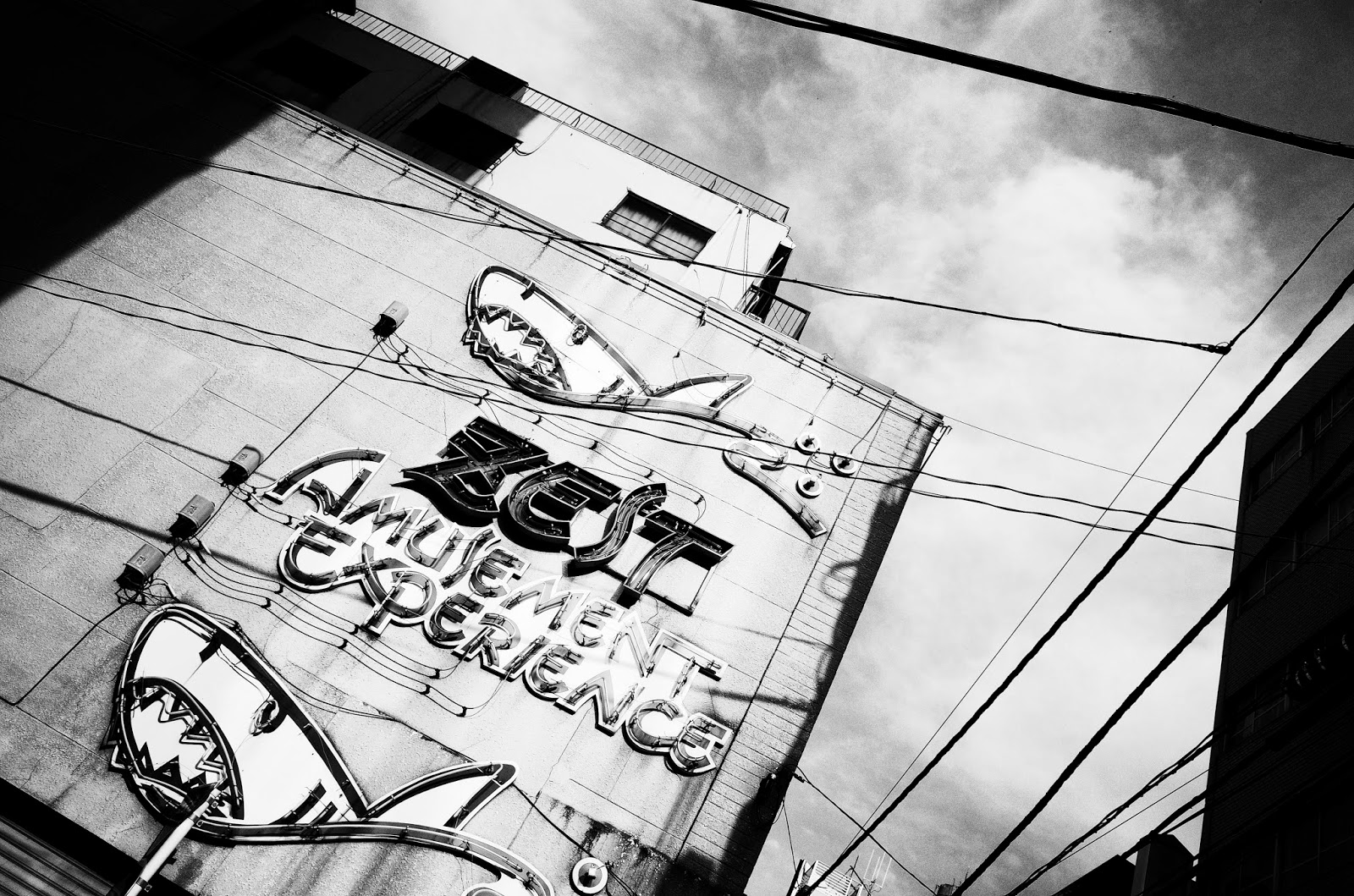
In his guest post on Steve Huff's site, Colin Steel shares a series of images he made on a quick three day trip to Tokyo. Apparently at least one day was made up of 24 hours straight wandering the streets of Tokyo, shooting with the Ricoh's high contrast monochrome setting, referred to as "Daido mode," after Daido Moriyama, famous Tokyo photographer who also happened to shoot with Ricoh cameras.

(Click Here) to read Colin's post on Steve Huff's site.

Colin writes about how he and most serious photographers usually ignore the in-camera creative presets. I used to feel the same way until one very important thing happened in the cameras I have that include presets: they started enabling most of the presets to be used in raw+jpeg shooting mode! This means that I can get a jpeg with all of the preset effects, view it on the camera display in the preset way, but have a completely unembellished raw file stored on my card to post-process in any way I see fit later on. I can see a high contrast black and white rendition while I'm shooting, then come home and use the raw file to make a low contrast color print, if I decide to. Flexibility is a great thing.

I won't go into the details of the Ricoh camera, as I honestly have not looked at them. So many cameras, so little time, you know. My two points today are: 1) it's great to be able to see wonderful photography from around the world and people I don't know through the internet, and 2) don't ignore anything on your camera. It may come to creative use if you learn how to use it, and learn about things like having the unaltered raw files available, should you change your mind later.

DMC-365.blogspot.com


Sunday, November 10, 2013

Skeletons From The Closet Camera for November - Ricoh 500G

Ricoh 500G, November's SFTC Camera
 
We are nearing the end of 2013, and I'm on my eleventh monthly SFTC camera. This month's selection is a fun choice, the Ricoh 500G, a 35mm rangefinder camera from the early 1970s.
 
I've always been partial to Ricoh cameras for some reason, probably because my first rangefinder camera was a fine Ricoh 35, which has a nearly silent leaf shutter and nice 45mm f3.5 lens.
 
The 500G sports a 40mm Rikenon f2.8 lens. 40-45mm is nearly the perfect focal length for a fixed lens rangefinder in my opinion. At f2.8, this one's certainly fast enough for most street photography. The camera is quite small, and looks old and cheap enough that people are unlikely to be concerned if they notice you pointing it at them.
 
Mine came along with the purchase of my higher-end Konica S1.6. See my SFTC posts from June to see what that camera can do. When I got the 500G, it's rear door seals were dissolved and sticky with old adhesive. I removed them and replaced them with new foam strips.
 
If you are looking for light seals, I bought mine on ebay from Jon Goodman for about $10 several years ago. I assume he's still there (seller name: interslice (J Goodman - Dallas, TX United States)). The kit had enough material to reseal several cameras.
 
Anyway, I only shot one roll with this camera, ever, before it went into the closet. So, hopefully it'll be ready to roll this month. Even though it has a built-in meter and does both fully manual and shutter priority auto exposure, I'll be using it in manual mode. It has a clean but empty battery compartment, and I'm not compelled to go find a modern battery for it. I'll just attach my Voigtlander Meter II and we're ready to go!
 
DMC-365.blogspot.com


Tuesday, September 17, 2013

Look at this Amazing Shot by Darek Meyer (With Ricoh GR Digital IV) as Posted on Steve Huff's Site

By Darek Meyer
Image Source: http://www.stevehuffphoto.com/2013/09/06/daily-inspiration-443-by-darek-meyer/
 
Steve Huff commonly publishes posts by guest authors, which I think is great. When I saw this image by Darek Meyer, a Polish photographer, I was just astounded. Darek took it in Ho Chi Minh City, Vietnam. He was using a Ricoh GRD4.
 
(Click Here) to read Darek's post on Steve Huff's site and see a couple more of his excellent images. He writes about searching for the perfect travel camera after trying a DSLR. He was interested in the Leica Monochrom, but found the Ricoh to be best suited to his needs. Clearly it works very well in his hands.
 
DMC-365.blogspot.com


Tuesday, July 2, 2013

Another Ricohflex TLR!

My New Ricohflex
 
My Mom sent me a couple of old cameras. The first is this Ricohflex (Dia L, I believe). I really have a soft spot for TLRs. This Ricoh has a light meter built in, and is more advanced than my other Ricohflex (Super). The shutter works but is a little sluggish. The lenses apperar to be in great shape.
 
I have emailed Mark Hansen (ClassicCamera@comcast.net) for an estimate on service. I've since removed the rear element from the lens of this camera, applied a very small amount of lighter fluid, and gotten the shutter back to normal. I also cleaned the lenses. It's ready to go, at no additional cost.
 
This may be a future Skeletons From The Closet camera!
 
DMC-365.blogspot.com


Friday, April 26, 2013

Am I the Only One Who Wants My Fixed Lens to be 50mm?

 
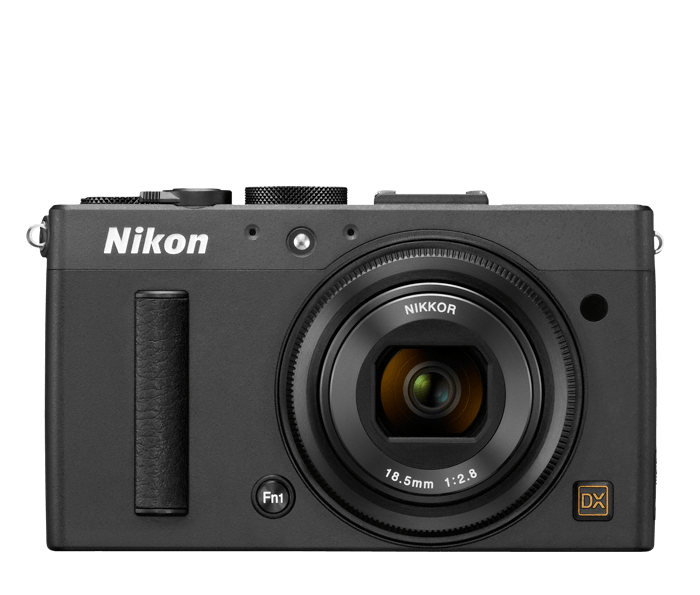
Nikon Coolpix A

Image Source:http://www.nikonusa.com/en/Nikon-Products/Product/Compact-Digital-Cameras/26423/COOLPIX-A.html

 
I like where the digital camera leaders are going - almost. I love the idea of a dedicated, fixed lens compact camera with a large sensor and great image quality. The good news is that many camera manufacturers are making them now. My favorites so far are the Leica X2 and Fujifilm X100S. Others include offerings from Sigma, Sony, and now Nikon and Ricoh.
 
When I think of these types of cameras, my thoughts go to the excellent Olympus, Canon, and Konica fixed lens rangefinders of the past. I would really love to see something equivalent to an Olympus SP, for example.
 
(Click Here) to see what the Olympus SP film rangefinder camera was like on Andrew Yue's site.
 
Now here's the rub, for me. All of the new fixed lens cameras have wide angle lenses, 35mm equivalent field of view, or wider. For me, the 42mm lens on the old Olympus SP was a bit wide, but actually a very good compromise between what I think of as a "standard" focal length of 50mm, and the admittedely popular 35mm lens. In fact, my 40mm Minolta Rokkor lens for Leica M mount cameras is one of my favorites.
 
If I'm going to buy a fixed lens camera, the lens really needs to serve most of my purposes. For me, and yes, it's personal preference, a 50mm lens would be best. I'm willing to be open-minded and take something as wide as 40mm, and actually would embrace that focal length.
 
When I saw the first announcement of the Nikon Coolpix A, I was excited. In my experience, Nikon does a great job of handling sensor noise (my Nikon D700 DSLR is the best low light camera I have), and I'm familiar with the menus. When I read that the A has an APS-C sensor and 28mm f2.8 lens, I got excited. I thought, hmm - 28mm X ~1.5 crop factor = 42mm equivalent. Great! Then I saw that it's actually an 18.5mm lens, and 28mm equivalent field of view. Really? I remember when 28mm was a rather extreme wide angle lens, one that was probably in your bag but sure didn't get the usage that a 35mm or especially 50mm lens did. This is way too wide to be a general purpose, fixed lens camera, at least for me.
 
Ricoh has also just come out with a new GR digital model - again 28mm equivalent field of view.
 
I think part of what's driving this trend is lens size. While the camera companies are trying to provide large sensors for their compacts (which is great news), they want to keep the lens size as small as is practical. I understand that. I also think this may be why some are stopping at a maximum aperture of f2.8, which I think is a little slow for a fixed lens camera. But, I still really want a litle longer lens, and fast, please.
 
I mean, let's face it, I never could really fit that Konica S1.6 with 45mm f1.6 lens (a 1970s fixed lens film rangefinder that produces incredible images) in my pocket.
 
DMC-365.blogspot.com


Sunday, March 24, 2013

Skeletons From The Closet - Final Results From the Super Ricohflex, February's Camera

 
Dwayne and Jared of The Woodshedders, by Reed A. George
Super Ricohflex TLR, Kodak Tmax 400
 
I shot a few images of The Woodshedders playing in the Lovettsville, Virginia library a couple of weeks back. It was tough focusing the Ricohflex with so little light, and I didn't get it spot on. But, I love the images anyway.
 
Jesse, Dwayne, Jared, and Dave, by Reed A. George
Super Ricohflex TLR, Kodak Tmax 400
 
I did a few test shots, and see that the Ricohflex's focus is not perfectly adjusted close up. It does fine at a little distance, and with an aperture smaller than about f5.6 or so. These were shot wide open (f3.5).
 
I enjoyed using the Super Ricohflex in February, and it's safely stored back in the closet until next time.
 
Hope you enjoyed the results!
 
DMC-365.blogspot.com


Saturday, March 9, 2013

Skeletons From The Closet - February Results - Super Ricohflex in Dramatic Light

As you may have seen, I've been exploring strong directional light here and there. I took the February SFTC camera, the Super Ricohflex, to DC for a day of wandering around the Smithsonian museums in DC. I found some wonderful light inside the lobby of the Smithsonian castle. I just sat and waited until people walked into that light. Here are some of the results.
Into the Light #1, by Reed A. George
Super Ricohflex Twin Lens Reflex, Kodak Tmax 400 Film
 
The design of the Ricohflex TLR allowed me to sit in the same position, looking down into my camera, rather than pointing it at face level at my subjects. At one point, someone came up behind me and asked if I was "filming." I assumed he meant videotaping, and replied that no, I wasn't. I suppose in fact that I was filming.
 
Into the Light #2, by Reed A. George
Super Ricohflex Twin Lens Reflex, Kodak Tmax 400 Film
 
I love the profile of the guy's face peaking out from the darkness at right.
 
Into the Light #3, by Reed A. George
Super Ricohflex Twin Lens Reflex, Kodak Tmax 400 Film
 
The Super Ricohflex has a relatively dim finder, as the viewing lens is f3.5. I had to prefocus, then just wait for someone to walk into the light.
 
Here's one from the entrance of the Natural History Museum. The dark interior contrasted nicely with the backlight coming from the bright daylight outside.
 
"That's One Big Elephant," by Reed A. George
Super Ricohflex Twin Lens Reflex, Kodak Tmax 400 Film
 
I'll finish the post up with a couple of other shots from DC.
 
Street View, DC, by Reed A. George
Super Ricohflex Twin Lens Reflex, Kodak Tmax 400 Film
 
I recently wrote about artist Ai Weiwei's exhibit at the Hirshhorn in DC. While I shot mostly with my M9 (see my recent Whole Lotta Leica post), I did make this shot with the Ricohflex:
 
Ai Weiwei's Zodiac, by Reed A. George

Super Ricohflex Twin Lens Reflex, Kodak Tmax 400 Film

 
I have one more roll of film from the Super Ricohflex to finish up and get processed. I've already moved onto shooting March's SFTC camera, the Zeiss Ikonta folder, but need to finish up the roll in the Ricohflex.
 
So, you'll be seeing a few more from the Ricohflex in the weeks to come.
 
DMC-365.blogspot.com


Sunday, March 3, 2013

Skeletons From The Closet - Some February Results With the Super Ricohflex

Back on February 4, I introduced February's SFTC selection, the Super Ricohflex twin lens reflex camera.
(Click Here) to read about the camera.
 
This has been a tough month to get out and shoot, but I didn't let that stop me. Here is my first installment of results.
 
On this particular morning, I went to the waterfront in Washington, DC, which is essentially a series of floating fish markets tucked alongside a marina full of big yachts. It seems that I end up here once in a while. Last time was with another TLR, a Rolleiflex. (Click Here) to read that post. This time, it was the Ricohflex, loaded up with Kodak Tmax 400 film.
 
Doing Business, by Reed A. George
Ricoh Super Ricohflex, Kodak Tmax 400 Film
 
Don't Slip!, by Reed A. George
Ricoh Super Ricohflex, Kodak Tmax 400 Film
 
Dramatic Shadow, by Reed A. George
Ricoh Super Ricohflex, Kodak Tmax 400 Film
 
Crab Man, by Reed A. George
Ricoh Super Ricohflex, Kodak Tmax 400 Film
I had to crop this one to remove a distracting element. I went with the "normal" 4x6 ratio.
 
I find that twin lens reflex (TLR) cameras give me a fresh perspective for a couple of reasons. First, the square format. It allows for a whole different type of composition. There's something close and intimate about it. Second, since you don't really hold the camera up to your eye, it seems less confrontational to your subjects. I tend to put my eye close to the magnifier in the TLR hood, but shooting at waist level is even less noticeable. If I have enough light to shoot with hyperfocal settings, waist level shooting is fine.
 
My Super Ricohflex is a relatively new addition to my collection. I find that for some reason it tends to produce soft images if I'm focused close to the minimum distance (close up). I am not yet sure whether this is due to my own motion blur when holding the camera, or if the focus is not adjust quite right. In any case, it does a nice job at five feet or further away from the subject.
 
Quite a lot of fun to shoot. I've got some more images from the Super Ricohflex to share, but I haven't scanned and processed them all yet. Keep looking back - more to come.
 
March's SFTC selection, the Zeiss Ikonta, also has a square format. It is not a TLR, so shooting will feel quite different, but it should share some of the compositional qualities of shooting a square picture.
 
DMC-365.blogspot.com


Tuesday, February 26, 2013

What About That Ricoh APS-C With Leica M Mount?

The Leica GXR, announced in 2011, offers a module to mount Leica M lenses on a 12 megapixel APS-C sensor. I have not seen many results from this combination, or read many user reviews.
 
(Click Here) to read dpreview's preview of the camera. It sure looks nice.
 
Why am I thinking about this? Well, I saw this picture:
 
Image Source: http://www.rangefinderforum.com/forums/showthread.php?t=129442
 
(Click Here) to read the original post on rangefinderforum.
 
This camera requires an add-on electronic viewfinder, if you don't want to shoot from the LCD.
 
I've always been a fan of Ricoh cameras. I haven't tried any of their digital offerings. Since I have the Leica M9, this isn't too attractive to me. If I wasn't lucky enough to have the M9, this may be a serious contender, in the running with one of the new Fuji X series, to which you can adapt Leica lenses. However, the Fuji has the added feature of an optical finder, a major plus in my opinion.
 
In any case, it's nice to see such a high quality image produced with the Ricoh. I really like this shot.
 
DMC-365.blogspot.com
 

Monday, February 4, 2013

Skeletons From The Closet - Super Ricohflex Twin Lens Reflex - My Featured Camera for February

Well, January's over, so my Pentax K1000 will get some rest. You'll be seeing the results from that camera in multiple posts over the next couple of weeks. Simply search for "skeleton" at the top of my blog to find all of the posts from this series.
 
This month's featured camera is a relatively new addition to my collection - the Super Ricohflex Twin Lens Reflex (TLR), made around 1956.
 
February's Featured Camera, the Super Ricohflex
 
If you're not familiar with TLR cameras, they have two lenses, the top one is for framing and focusing while you look vertically downward onto a ground glass screen. The bottom lens is the taking lens, which forms the image on the film. This camera uses 120 film, and makes a 2 1/4" square (big!) negative. This is a fully manual camera - no batteries anywhere. On the Super Ricohflex, focus is achieved by rotating the taking lens.
 
The standard Super uses a red-tinted window in the rear to let you know how far to wind the film - you see an exposure number on the film backing through the window. This works fine, unless you're shooting fast (high iso) film, which can lead to fogging of the film through the window. Mine has the optional auto-stop mechanism, which adds an exposure counter and controlled spacing of the images. This is a very nice addition to the camera. You can see it at the top left of the camera body above.
 
My Super Ricohflex has a Ricoh Anastigmat f3.5 80mm lens, which is a "normal" focal length for this size of negative. It has a three-bladed leaf shutter, with speeds ranging from 1/10 to 1/100 second, plus B. This is a limited range of shutter speeds, with 1/100 not being very fast. Not exactly a sports action camera. Mine also has a flash mounting shoe on the side, and a PC electrical connection for the flash.
 
I've only shot a single roll with this camera in the past. So, I know it works, but I'm not very familiar with it yet.
 
I've got a roll of Kodak Tmax 400 black and white film loaded and ready to go! Wish me luck with the Super Ricohflex!
 
DMC-365.blogspot.com


Thursday, January 31, 2013

Could the Ricoh GR Digital V Be Another Runner in the Large Sensor Compact Market?

My wife has been using my Panasonic DMC-LX5 a lot recently. Given her record with damaging cameras, I'm starting to look for a replacement. Honestly, I probably should have taken advantage of the holiday deals on the DMC-LX7. It was available for $275. Now, it's back over $400.
New Ricoh Digital with APS-C Sensor Coming?
Image Source: http://www.petapixel.com/2013/01/21/ricoh-gr-digital-v-to-feature-an-aps-c-sensor/
 
 
In any case, it's a good time to look again and see what's out there. I would like a larger sensor than the LX7 offers. That brings up some excellent new cameras, all with large sensors and compact designs. Namely, I'm thinking of the new Sony RX1, Leica X2, and Fujifilm X100s. All of these are fixed-lens designs, without zooms. For my purposes, I think I want a zoom. This will be my pocket camera - the backup when needed, or sometimes the only camera I'll carry on a short trip. The Panasonic DMC-LX7 would be perfect, if it just had a little larger sensor.
 
Anyway, I read this short post about the possibility of a new Ricoh compact that may have an APS-C (larger than most other compact cameras) sensor.
 
(Click Here) to read the post on PetaPixel.
 
I think this one will likely have a fixed focal length lens as well. The GR IV does. But, I'll keep my eyes open.
 
Right now, the Fuji X20 seems like a possible good upgrade from the LX5. But, while it's sensor is bigger than the LX5 (and LX7), it's still much smaller than APS-C. Another potential is the Sony RX100, but it doesn't have a viewfinder of any type, so that's not going to work for me.
 
DMC-365.blogspot.com