Showing posts with label mystery. Show all posts

Thursday, February 12, 2015

Mystery

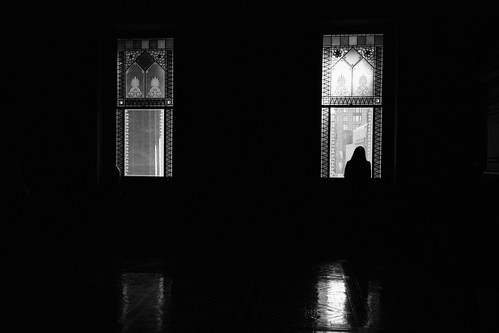
Mystery, by Reed A. George
 
Another image made with the Leica CL and Gekko 100 film. When exposing it, I knew that no film could represent the full range of light levels in the scene. So, I had to make a decision - would I expose for the interior, letting the outside light go to pure white (which may have been interesting), or expose for the highlights, letting the inside go black?
 
Obviously, I chose the latter. I love seeing the structure in the window glass and especially the buildings outside. I also like the mystery of the darkness inside.
 
DMC-365.blogspot.com
 

Tuesday, July 1, 2014

Mike Selsky - Leica Photographer, Winner of LA X-Vario Challenge

Image Source: http://blog.leica-camera.com/photographers/interviews/mike-selsky-hunting-for-the-strange-and-obscure-in-los-angeles/

I like to read the Leica camera blog, where they regularly feature interviews with other Leica photographers. I like to see what I have in common with others, as well as our differences. The latest is an interview with Mike Selsky, fine art photographer in Los Angeles. Mike recently won the Leica X-Vario City Challenge there, which earned him a free X-Vario.

(Click Here) to read about Mike's approach to photography and his interests.

Mike's regular camera choices are a Leica M6 TTL film rangefinder, and Monochrom, Leica's black and white-only digital rangefinder. His lens of choice is the 50mm Summilux Aspheric (f1.4). This is similar to my favorite rangefinders, the M6 TTL (titanium version, in my case) with matching Summilux 50mm, and the Leica M9 (which allows me to shoot both black and white and color).

Mike seems to be a wanderer, saying:

"I enjoy exploring California with a friend, planning road trips with vague photographic goals in mind."

We also have that in common.

Mike makes images that ask more questions than providing answers. Mystery is important in his style of photography. I find it a challenge to make the questions engaging enough to draw the viewer in. You don't want a response that just says "I don't know what that is." or "Why did you take a picture of that?" Sometimes, it's better to elicit "What am I looking at here?" or "How did you make X look like that?"

One final thing Mike and I have in common: we both value the effort that goes into making a great image. For me, an image is much more valuable to me personally if I know that it was a difficult one to capture. Mike says:

"My favorite images are the ones that took the most effort to make."

Mike seems to be enjoying the new X-Vario that he won in the challenge. Congratulations to Mike. I look forward to seeing more of his work.

(Click Here) to visit Mike's blog, 2WK.

One additional note. Mike mentions that with the Monochrom, he exposes for the highlights, and brings lots of detail out of the shadows in post-processing. A quick look at his blog indicates that he underexposes a lot with that camera. A little too much for my taste. I think he needs to bring up the shadows quite a bit more in many cases. Just a little critical thought on his work.

DMC-365.blogspot.com


Sunday, June 8, 2014

Under Cover of Darkness

Under Cover of Darkness, by Reed A. George
Leica M6 Titanium, Summilux 50mm f1.4 Lens
TMax 3200 Film, f1.4, 1/30 sec. (?)
 
I shot this through the window of a very dark bar on my walk home from a show on Frenchmen Street in New Orleans. I feel that it's quite mysterious, and knew at the time that it would make an interesting image if it came out. I love the blazing bar light at right in the shape of a lion (or something), and the hands with no visible attached body at left. I also love the eyes of the person on the left looking upward.
 
DMC-365.blogspot.com


Saturday, January 5, 2013

On Equipment, Resolution, Detail, and Mood

I just took this picture with my iPad camera (which is so bad, I rarely use it).
 
Through A Low Resolution Blind, by Reed A. George
iPad Camera
 
I noticed yesterday, looking through this same blind, that the weave of plastic making up the blind results in a pixelated view of what's outside, sort of like a low resolution digital sensor.
 
To me, this is a picture of a crow. In fact, the crow in the picture is literally represented by just two completely black, square "pixels." Do you see it, on top of the closest streetlight? Two pixels out of about 12,000 by my quick estimation. Completely black - no color or even gray level information.
 
I know that the crow was there. To me, it's a picture of a crow. To anyone else, it is certainly not a picture of a crow.
 
I am using the left side, the descriptive side, of my brain when I say it's a crow in the picture. I label those two pixels "crow." But, the feeling I get when looking at the image (from the right side of my brain) is definitely affected by a crow being there. This feeling would not be transmitted to other viewers with this low resolution image.
 
 
Ospreys in Flight, by Reed A. George
Nikon D700, Nikkor P 500mm f4 Lens
 
On the other hand, if I am photographing birds in flight, the shape and orientation of each feather adds to the experience of seeing it first hand. If I can't capture that, I've lost something in the process.
 
Mystery in a Street Scene, by Reed A. George
Leica CL, M-Rokkor 40mm f2 Lens
 
But, then there's mystery. Sometimes I want to obfuscate some details, specifically to allow me to share the feeling of a scene, rather than all of the details. This image makes me think "Woah. What's going on there?" even though I took the picture.
 
To me, this is why all of the technical terms associated with equipment, and the techniques that we share with each other, matter at all. But, matter they do. I hope this helps to explain why I believe that equipment and technique are important, and illustrates a little of what I mean by "Exploring the Interface Between Equipment and Creativity in Photography."
 
DMC-365.blogspot.com