Showing posts with label equipment. Show all posts

Wednesday, October 29, 2014

Jorge Torralba Suggests We Think Twice Before Upgrading to the Newest Equipment

Shot With My Nikon F2 on Kodak TMax 400 Film
 
It's so easy to get caught up in the new equipment upgrade cycle. If you know me, you know that I love my old cameras. And, I still love to shoot film. I find it very rewarding, and while the results may not be as predictable (or confirmable) as shooting with the latest digital equipment, sometimes they can be outstanding.
 
I just found Jorge Torralba's blog, where he's written about resisting the urge to constantly upgrade. Specifically, he writes about his beloved Nikon AIS 50mm f1.2 lens, and how he enjoys using it on a film body (in his case the Nikon F6), as well as his Nikon DSLRs.
 
(Click Here) to read Jorge's post and see his images made with this classic, ultra-fast Nikkor lens.
 
My problem is that I simply love cameras. Old or new, big or small. So, even though my Nikon F2 is a great example of a camera that I love and will continue to use, the new Nikon DF is calling my name. I have not yet pulled the trigger, but it's on my mind.
 
So, I fully appreciate Jorge's point about appreciating the gear you have. I simply add to that the desire to test and enjoy the latest options, as well. In truth, Jorge shows images with the 50mm f1.2 on his Nikon D3S and D4 as well, which tells me he has the same approach.
 
DMC-365.blogspot.com
 

Thursday, October 16, 2014

You Know How They Say The Camera Doesn't Matter?

Well, based on this morning's browsing of the Rolleiflex and Rolleicord group on flickr, I don't buy it.
Ada, by flickr user Traveling Darkroom
 
Okay, I know, the photographer matters more than the camera. That is true. But there's an abnormally high frequency of great images in this particular group, if you ask me.
 
(Click Here) to judge for yourself.
 
Now, it could be the square image format that I happen to like. Or, it could be the different perspective that you can get with any twin lens reflex (TLR) or other camera that has a waist level finder. But, I think there may be more to it than that.
 
I went out with my Rolleiflex yesterday, and without seeing any results yet, feel more confident than usual that I got at least one or two great images. The film ships out to The Darkroom today, so we'll know in a couple of days.
 
DMC-365.blogspot.com
 

Tuesday, September 9, 2014

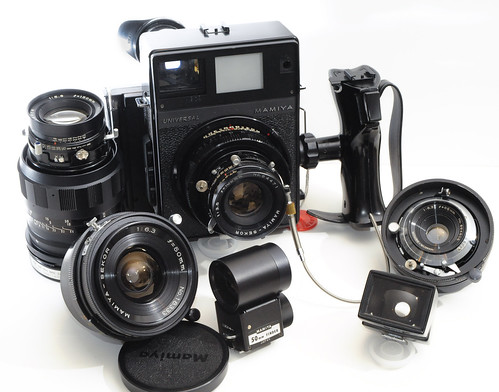
My Mamiya Universal Kit

My Mamiya Universal Press Camera Kit
 
I've been meaning to shoot some images of my new Mamiya Universal camera and lenses. Well, here it is. Pretty much a dream kit, it includes:
 
  • Mamiya Universal Body
  • Normal Lens: 100mm f3.5 with hood and caps
  • Wide Angle Lenses: 65mm f6.3 and 50mm f6.3, both with accessory finders (pictured), caps, 50mm hood
  • Telephoto Lens: 150mm f5.6 with hood and caps
  • Polaroid Film Backs: M80 (obsolete) and Pack Film Back
  • Roll Film Backs: 6x9 (2) and 6x7, all for 120 film
  • Ground glass focusing back and several cut sheet film holders
  • Assorted 55mm filters and additional cable release
I am the proud owner of all of this wonderful high quality medium format goodness because of one thing, my good friend Dennis Gallus, who thought of me first when he decided to sell it. Thank you, Dennis!
 
The more I use this camera, the more I like it. You're going to be seeing more images from it quite soon.
 
DMC-365.blogspot.com
 

Friday, March 28, 2014

Simplicity - "The Ultimate Sophistication"

My Nikon F
 
As you know, this blog is loosely focused on the interface of equipment and artistic approaches to photography. I for one don't believe that the "equipment doesn't matter." I do believe the standard adage that equipment should not get in one's way. Therefore, I tend to enjoy using simple cameras more than technologically complex ones.
 
This may seem limiting, and sometimes it can be. When I think of simple cameras that I love to use, most of them are film cameras, which is in itself a limitation. Leica's Barnack cameras, film M cameras, Nikon film SLRs (made before autofocus), folding medium format cameras, twin lens reflexes (e.g. Rolleiflexes or the lovely Minolta Autocord) all come to mind. In the digital realm, there are much fewer choices. My Leica M9 reigns supreme here. I think maybe a Nikon Df would suit me similarly.
 
Other times, I simply need to compromise and use a more complicated camera to help ensure that I get the shot, and that the results are technically superior. This is where the awesome, but awesomely complicated Nikon D700 DSLR comes in. I still use it a lot, and love the results.
 
I read a post on the blog Leicaphilia about the Leica IIIG. I think the author and I share a lot in how we think about cameras.
 
(Click Here) to read why the author chooses the IIIG more often than any other camera.
 
All that said, I'm packed for a quick trip to New Mexico for business. I've decided to carry only Micro 4/3 gear, in an effort to re-engage myself with that modern, more complicated gear. We'll see how it goes.
 
DMC-365.blogspot.com
 

Saturday, January 5, 2013

On Equipment, Resolution, Detail, and Mood

I just took this picture with my iPad camera (which is so bad, I rarely use it).
 
Through A Low Resolution Blind, by Reed A. George
iPad Camera
 
I noticed yesterday, looking through this same blind, that the weave of plastic making up the blind results in a pixelated view of what's outside, sort of like a low resolution digital sensor.
 
To me, this is a picture of a crow. In fact, the crow in the picture is literally represented by just two completely black, square "pixels." Do you see it, on top of the closest streetlight? Two pixels out of about 12,000 by my quick estimation. Completely black - no color or even gray level information.
 
I know that the crow was there. To me, it's a picture of a crow. To anyone else, it is certainly not a picture of a crow.
 
I am using the left side, the descriptive side, of my brain when I say it's a crow in the picture. I label those two pixels "crow." But, the feeling I get when looking at the image (from the right side of my brain) is definitely affected by a crow being there. This feeling would not be transmitted to other viewers with this low resolution image.
 
 
Ospreys in Flight, by Reed A. George
Nikon D700, Nikkor P 500mm f4 Lens
 
On the other hand, if I am photographing birds in flight, the shape and orientation of each feather adds to the experience of seeing it first hand. If I can't capture that, I've lost something in the process.
 
Mystery in a Street Scene, by Reed A. George
Leica CL, M-Rokkor 40mm f2 Lens
 
But, then there's mystery. Sometimes I want to obfuscate some details, specifically to allow me to share the feeling of a scene, rather than all of the details. This image makes me think "Woah. What's going on there?" even though I took the picture.
 
To me, this is why all of the technical terms associated with equipment, and the techniques that we share with each other, matter at all. But, matter they do. I hope this helps to explain why I believe that equipment and technique are important, and illustrates a little of what I mean by "Exploring the Interface Between Equipment and Creativity in Photography."
 
DMC-365.blogspot.com


Tuesday, January 1, 2013

Well! The First 365 Days Has Passed. Happy New Year - and Where DMC-365 Is Going This Year

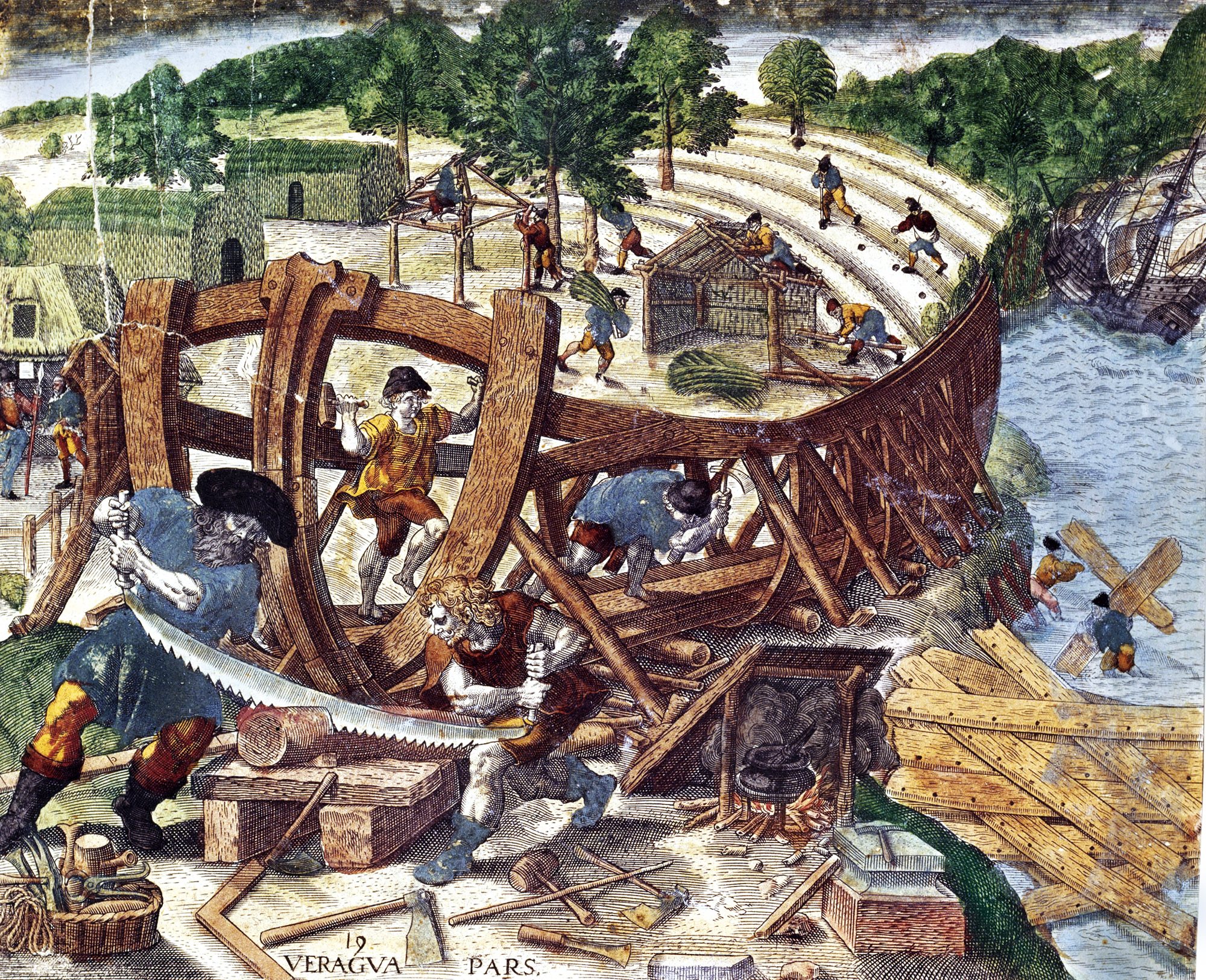
Image Source: http://en.wikipedia.org/wiki/File:Pizarroshipbuilding.jpg
 
I made a commitment to focus on Panasonic Lumix cameras in 2012. That was fun, but I found it limiting to try to focus on one camera maker, or even on Micro 4/3. At this point, I have not dropped any of my other formats (which include Nikon DSLR, Leica rangefinder, Micro 4/3, and various film cameras), have added a Leica M9 to my list of favorites, and still enjoy writing my blog every day. So, I think I'll shift gears a little, still including Micro 4/3 to a large extent, but not excluding anything. In fact, what I want to write about is the interface between equipment and creativity. I don't believe they're independent, and know for a fact that certain equipment choices work best for specific applications. I'd hate to try to shoot eagles in flight with my rangefinder camera.
 
So, I thought I'd explain my direction for 2013 with an analogy.
 
Let's say I'm working on building an enormous boat. There are lots of other people out there building their own boats, so I don't have to worry about making mine fit every usage. I will use the skills and tools that I have to make exactly the boat that I think I want to build.
 
Now here's the deal. It is not clear that this boat of mine will be a success, or that it will set sail during my lifetime. Some of that depends on how good a job I do. The job ahead is so big, possible assignments on any given day are numerous.
 
One way of determining what I'll do to build the boat on a given day is to head to a particular section that needs work. If for example, I wander over to work in the engine room, I will need a particular set of tools. If instead, I decide to finish the woodwork in the captain's quarters, I'll need another. So, I choose the right tools for the job at hand that day.
 
The Engine Room, by Reed A. George
Leica M4-2, 50mm Summicron f2 Dual Range Lens
 
There is also another way to decide. Rather than picking an area or duty, I can pick up the tools I feel like using that day and wander around until I find a section that needs work that I can do with them. Sometimes this may mean that I take my most flexible tools, in order to increase the probability of finding a productive assignment. On other days, I may pick a tool that I really want to work with and search until I find an assignment. Each appraoch is different in efficiency (how much work I complete in a given time) and effectiveness (how important and beautiful that work is).
 
One thing is for sure. I will not be finishing work on this boat for a very long time. There's plenty of work to do. I don't have to take every assignment. I do have to go do good work on any assignment I take on.
 
So. That brings me to what my second year of building DMC-365 will consist of. I will use a broader set of tools than in my first year. I have used the first year to get my feet wet, and I've made at least somewhat of a name for myself on the job. I've also bought some lovely specialist tools during the year, and plan to increase my skill in using them. Taking the approach that I don't have to do it all (no wedding photography here, most likely), and that effectiveness - making sure that what I do take on is done to the very best of my ability - is more important than efficiency, I will share the tools, processes, and results with my readers. I will certainly focus on specific tools, cameras, techniques, and types of photography. My goal will not be to get every possible good image, but to ensure that those I do get are very well-done.


Tools that I know I'll use include Leica, Lumix, other Micro 4/3 gear, film cameras of the past, and even a few toy cameras, which I believe allow me to focus on technique, rather than the quality of the equipment. I want to be like the ping pong champion who wins his matches, even if he's forced to use a heavy iron skillet instead of a paddle (I know someone who can actually do this).
 
During the first year, I began a couple of projects; the one that grew legs is photographing live music performances. I will continue that project in 2013, as well as pursuing my other photographic interests, which include wildlife, field science, travel, and street photography.
 
So, I hope you'll enjoy watching me continue to build my boat. I'm sure that I'll make some mistakes along the way, and that my goals (the boat design) will change as we move forward. Of course, I also hope to meet some of the other people out there building their own boats of their own designs. We can compare notes.
 
Happy New Year!
 
DMC-365.blogspot.com


DMC-365.blogspot.com
 

Monday, December 31, 2012

Trevor Saylor on Starting Projects

 
Door on Antietam Farm Building, by Reed A. George
Panasonic Lumix DMC-G1, Lumix 20mm f1.7 Lens
iso 100, f3.5, 1/200 sec
 
Trevor Saylor has posted a piece on Japan Camera Hunter about how to think about and start photo projects.
 
(Click Here) to read Trevor's thoughts on Japan Camera Hunter
 
Here are the major points, and my thoughts on them (in italics):
  • One approach is to prospectively define the scope of your project, then go out and shoot it. Trevor believes that this can be limiting, causing you to miss some great off-topic shots. I can understand what Trevor means here. For example, if you're out shooting about the plight of our natural places, it may be hard to feel and capture a beautiful landscape. On the other hand, if you don't get in the mood (positive or negative) about your topic, how can you capture anything great? I guess this goes to my current thinking, which is that I don't have to catch every shot; I have to make the ones I do catch great.
  • Another approach is just to shoot what you like. We've all done this. The challenge is to find a way to make something cohesive out of it.
  • Constraints are good. Trevor shares the example of a summer job project, with a limit of 100 days. I couldn't agree more. A time limit is great, as is an equipment limit, number of shots limit, or just about any other limit. I think this also applies to the first point above. A scope limit or constraint is helpful in focusing the mind.
  • Making a project end is hard. Totally. They don't all have to end. Some can go on for a lifetime. But, some of them must end, or you never get anything finished, done, completed.
  • Trevor talks a little about equipment. He makes the point that it's usually good to stick with one equipment set or approach. Otherwise, the mix of styles can be confusing to viewers. Well, I fail in this regard, epically, as my daughter would say. I know he didn't mean it as a hard and fast rule. Shooting the same project with a range of equipment sometimes brings the topic back to life for me. However, as I said above, limiting your equipment can be a good constraint for a project. So, I understand and respect the concept, but don't always put it into practice.
  • You must cull your images, keeping (or at least showing) only the very best. Agreed. And it's hard to do.
  • Don't fall in love with an image. Trevor's point here is that your favorite image may just simply not fit the scope of the project. Don't force it in. Again, I understand Trevor's point. But, if I didn't fall in love with an image here and there, I wouldn't bother to shoot. For example, the shot above was taken in the course of my Civil War project. Yes, it's from Antietam, site of a major battle in the war, and is a period-style building, but it really has little else to do with the war. But, I love it. I'll drag it out every chance I get. That's what photography is about for me. Much of the rest of life has to be cold and calculating, not my photography.
  • Get critique from others. Yes. I don't always do this. It can make that image culling much easier when another person says "eh, not so much." I find that sometimes my own experience and memories surrounding the capture of an image influence how much I like it. Viewers can't share that with you. The images have to stand on their own, unless you have the chance to supply some words with them.
 
So, Trevor's article is a good thought-provoker. As we near the end of 2012 (oh, and Merry Christmas, by the way), it's worthwhile to think again about the process of pursuing photo projects. My big one this year has been live music, and it's been great. I've made a lot of good friends this year in the course of attending and shooting shows, and hopefully made a few great images. That particular project will go on for a long time. I enjoy every part of it, and see no reason to end it. However, I should challenge myselft to take on and FINISH some smaller projects.
 
DMC-365.blogspot.com