Showing posts with label leica Monochrom. Show all posts

Saturday, December 13, 2014

Leica Makes Good on M9 Sensor Problems - Mine Is Going Back


My Leica M9 was just serviced about a year ago at Leica USA.
 
Recently, a problem with the Leica M9, M9-P, M Monochrom and M-E camera sensors surfaced, related to corrosion of a coating on the IR filter. Leica is offering a "goodwill arrangement," under which they'll replace any affected sensors free of charge. They're also offering attractive upgrade options if owners are interested in upgrading to the M240 or MP (240).

I think I'll send my camera in and see what the options are.

(Click Here) to read the official announcement of the goodwill arrangement.
 
Having a problem like this is never good for camera owners. It can only hurt the resale value of used cameras. But, given that it happened, this seems like a generous response by Leica. I'll be sure to report what happens with mine.
 
DMC-365.blogspot.com
 

Tuesday, July 1, 2014

Mike Selsky - Leica Photographer, Winner of LA X-Vario Challenge

Image Source: http://blog.leica-camera.com/photographers/interviews/mike-selsky-hunting-for-the-strange-and-obscure-in-los-angeles/

I like to read the Leica camera blog, where they regularly feature interviews with other Leica photographers. I like to see what I have in common with others, as well as our differences. The latest is an interview with Mike Selsky, fine art photographer in Los Angeles. Mike recently won the Leica X-Vario City Challenge there, which earned him a free X-Vario.

(Click Here) to read about Mike's approach to photography and his interests.

Mike's regular camera choices are a Leica M6 TTL film rangefinder, and Monochrom, Leica's black and white-only digital rangefinder. His lens of choice is the 50mm Summilux Aspheric (f1.4). This is similar to my favorite rangefinders, the M6 TTL (titanium version, in my case) with matching Summilux 50mm, and the Leica M9 (which allows me to shoot both black and white and color).

Mike seems to be a wanderer, saying:

"I enjoy exploring California with a friend, planning road trips with vague photographic goals in mind."

We also have that in common.

Mike makes images that ask more questions than providing answers. Mystery is important in his style of photography. I find it a challenge to make the questions engaging enough to draw the viewer in. You don't want a response that just says "I don't know what that is." or "Why did you take a picture of that?" Sometimes, it's better to elicit "What am I looking at here?" or "How did you make X look like that?"

One final thing Mike and I have in common: we both value the effort that goes into making a great image. For me, an image is much more valuable to me personally if I know that it was a difficult one to capture. Mike says:

"My favorite images are the ones that took the most effort to make."

Mike seems to be enjoying the new X-Vario that he won in the challenge. Congratulations to Mike. I look forward to seeing more of his work.

(Click Here) to visit Mike's blog, 2WK.

One additional note. Mike mentions that with the Monochrom, he exposes for the highlights, and brings lots of detail out of the shadows in post-processing. A quick look at his blog indicates that he underexposes a lot with that camera. A little too much for my taste. I think he needs to bring up the shadows quite a bit more in many cases. Just a little critical thought on his work.

DMC-365.blogspot.com


Sunday, April 13, 2014

Dreaming in Monochrom(e) - Buddha in Snowstorm

Here are a couple of shots I made with Ilford Delta 3200 film in my Leica M4-2, at a Buddhist temple during a snowstorm. Both were made with the Zeiss C Sonnar 50mm f1.5 lens, one of my favorite lenses.
 
Wat Yarn in Snow, by Reed A. George
 
I selected 1/125-1/250 sec. for my shutter speed, in an effort to catch the falling snowflakes.
 
Parasol, by Reed A. George
 
I like how the statue's eye shows up in this image.
 
I wouldn't normally use high speed film for images like this, but it was what I had with me. I think it worked out pretty well.
 
DMC-365.blogspot.com


Friday, February 28, 2014

Dreaming in Monochrom(e). I'm Starting to Like This Look for Live Music

I've been using my Leica M4-2 film camera with Tmax 400 film, pushing it to iso 1600 (+2 stops) for shooting live music lately. I'm really starting to like the high constrast black and white look I'm getting.
 
Here are some shots I took recently at the Bright Box, a wonderful venue in Winchester, Virginia.
 
(Click Here) to learn more about Bright Box.
 
This show happened to be opened by one of my favorites, you may recognize Melissa Wright, now in a band called Mink.
 
Mink, by Reed A. George
 
The headliner band this particular evening was River Whyless, who I can add to my list of must-see-again bands.
 
River Whyless, by Reed A. George
 
The third shot is my favorite from the evening. I love how each band member comes across quite individually, yet makes up a part of the whole. I'm pleased with it.
 
I shot three lenses with my M4-2 on this evening: Leica 35mm f1.4 pre-aspheric Summilux, Zeiss 50mm f1.5 Sonnar-C, and Leica 90mm f2.8 Elmarit. I'm really beginning to like the combination of this very light, easily maneuverable kit and the look of pushed black and white film. Of course, it wouldn't work for everything, but in already harshly-lit stage settings, I think it does just fine.
 
Continuing on the path of learning how I may like the new digital Monochrom rangefinder, I do wonder how it would be to shoot at iso 1600 or even higher and get the wonderful low contrast, high dynamic images that camera is capable of. Maybe I'll have to borrow a Monochrom and see!
 
DMC-365.blogspot.com


Tuesday, February 25, 2014

Ashwin Rao on a Year With the Real (Digital) Leica Monochrom

Image Source: http://us.leica-camera.com/photography/m_system/m_monochrom/
 
As you know, I'm playing around a lot with black and white these days, specifically in my Leica M4-2, which I'm using to emulate the modern Leica digital Monochrom rangefinder.
 
Ashwin Rao, frequent contributor to Steve Huff's excellent photography blog, has written up his thoughts after shooting a lot with the new Monochrom. He made over 15,000 exposures with it last year.
 
(Click Here) to read Ashwin's full report on Steve Huff Photo. He includes many, many excellent images.
 
Ashwin writes how constraining himself to monochrome imaging, thinking only in black and white, was at first a major challenge. He says he realized what he had given up by using a camera incapable of rendering color. But then, this challenged turned to "inspiration and motivation."
 
Ashwin prefers to use older rangefinder lenses with his Monochrom. Sound familiar? I happen to love old Leica and rangefinder lenses, so this only bring the Monochrom closer to my heart. Ashwin feels that modern lenses tend to give a surreal look, and that modern aspherical lenses suffer from loss of shadow detail. He feels that maybe the coating of older lenses, which were developed in a monochrome era, are better optimized for black and white. Clearly, color was not the main consideration fifty years ago. Or maybe, he admits, he is drawn to images made with older lenses because he learned to love the look of images he knew from the past.
 
Ashwin reports that the Monochrom is pretty much infallible at up to iso 3200, and 5000 in good light.
 
He also reports that there is so much dynamic range that images can have an overall gray look. This invites lots of post-processing, and leaves plenty of opportunity to fine tune the images to get exactly what he wants.
 
So, after a year, the Monochrom is still his favorite camera. Ashwin commits to continuing to explore this special camera, and share more results as he goes. Onward, Ashwin, and thanks!
 
DMC-365.blogspot.com
 

Sunday, January 26, 2014

Leica M4-2 (My Monochrom(e)) at the Lincoln Memorial

On the same rainy day that I shot the images of the Vietnam and Korean War memorials, I took a couple of images at the Lincoln Memorial. I like the rainy, somewhat dreary mood that I captured on that day. Both of these were shot with my Leica M4-2, Kodak TMax 400 film, and Leica Summicron 35mm f2 (version 3) lens.


DMC-365.blogspot.com


Friday, January 3, 2014

"Dreaming in Monochrom(e)," What Might I Learn?

Image Source: http://johnbuckley100.files.wordpress.com/2013/08/new-jim-crow.jpg

As I mentioned in yesterday's post, I'm interested in the Leica Monochrom. However, I want to really know more about how it would affect my photography before contemplating the purchase of one. So, I'll be working with my M4-2 film camera and black and white film in the coming months, to help answer that question.

The cost of this camera is enormous. It would probably require me to sell my belove M9, which I'm not in a hurry to do. So, I'll refer to this exercise as "Dreaming in Monochrom(e)." Look for it in coming posts.

I read a post on John Buckley's blog "Tulip frenzy," reflecting on a full year with the Leica Monochrom.

(Click Here) to read the full post on Tulip Frenzy.

In the beginning, he writes of discovering monochrome images that he never would have desaturated from color on his own. One note here - for reasons I don't know, John writes from a perspective of "we." I'll substitute "he" here. I hope no one minds.

After the discovery process, it seems that John transformed his photographic thinking when carrying the Monochrom, thinking in luminance (light level) instead of chroma (color). This led him to photograph different people than he would have with color. It also impacted his landscape images. It even drew him to classic photography books, where most of the work (or all) was black and white.

Later in the year, his confidence in choosing which images would be best in monochrome clearly increased.

My take is that if I dedicate my M4-2 (Leica film rangefinder camera) to black and white, and spend some time working with it, I should be able to experience all of the things John describes in his piece. One thing that John mentions about the Monochrom gives me even more confidence in my belief, where he refers to the sensor as:

"...precisely as limited as black and white film..."

Now, I don't think that statement is completely accurate. Apparently, you can shoot very useable images at iso 8000 with the Monochrom; I won't be achieving that with my M4-2. And, I have no illusions about my scanned black and white film rendering anything like the dynamic range of the Monochrom. No, I'm looking for qualitative aspects of dedicated black and white photography here. For example, how often will I carry only black and white film? I'm certainly not looking to add another camera to the bag I put over my shoulder.

In any case, I'm sure it will be an educational experience.

DMC-365.blogspot.com


Saturday, October 26, 2013

One Camera (Leica M Monochrom), One Lens (28mm Summicron) in Tokyo, by Dave Powell

 
Image Source: http://shoottokyo.com/controlled-arrows/

Dave Powell of the photo blog "Shoot Tokyo" has posted some images and notes on the experience of using a single lens and camera, narrowing the options so that he can focus on composition and light.

In this case, Dave chose the Leica M Monochrom and Leica Summicron 28mm f2, a lens I've written about before.

(Click Here) to read my experience of borrowing a 28mm Summicron at an LHSA event. In my case, I shot with color film and my M4-2 body. I found this lens to be quite impressive.

(Click Here) to read the original post and see more pics on Shoot Tokyo.

I don't see any amazing or once-in-a-lifetime shots in this post, but I do get the feeling of walking around in Tokyo, probably my favorite city in the whole world. That's a tough call, actually, because San Francisco and New York City have their positive points. But, overall, Tokyo really does it for me.

Dave emphasizes concepts that resonate with me - single lens excursions, shooting every day. I tried to arrange to meet up with him the last time I was in Tokyo, but he was in Boston at the time. Talk about reversals. I'll try again next time, as I'm sure we'd have plenty to talk about.

DMC-365.blogspot.com


Wednesday, October 2, 2013

Street Photography as Time Travel (Kenneth Reitz on Leica Camera Blog)

 
At the Seafood Market, NYC, 2010, by Reed A. George
Leica M8, Rokkor 40mm f2 Lens
iso 320, f4.8, 1/125 sec
 
A local (to me) photographer, Kenneth Reitz, was recently interviewed for the Leica Camera Blog. A software developer, Kenneth lives and works in Winchester, Virginia. He even mentioned the famous(?) Apple Blossom Festival held there every year. In addition to proximity, several things Reitz said gave me the feeling that we have a lot in common.
 
Like me, Reitz came back to photography after college. He has this to say about the role of photography in his life:
 
"...it makes me happy and keeps me sane."
Exactly, Kenneth. I couldn't have said it any better.
 
Reitz sees street photography as a form of time travel. The shot above takes me back to the moment, three years ago, when I shot the picture. I'm sure it will do the same 20 years from now, if I'm lucky enough to be around still.
 
Also like me, Kenneth has an interest in pieces of Leica history. He has recently purchased a 1954 M3 (which must be a double-stroke, like mine, based on the dates). When asked about shooting film, Reitz comments that everything he's ever created exists only in an electronic realm. Film breaks that pattern.
 
Here's where Reitz and I differ - he shoots only a single focal length - 35mm. Shooting a 35mm f2 Summicron aspheric on his Monochrom, and a 1979 model 35mm f2 Summicron on his M3, he comments:
 
"I plan to shoot with only my 35mm Summicron for the rest of my life."
 
Personally, I will shoot with mine, amongst many others, for the rest of my life. Committing to a single lens for a month (e.g. for my Whole Lotta Leica series) is challenge enough.
 
Kenneth even mentions meditation in passing. This is something I've become more interested in of late. Seems like I should contact Kenneth to see if we can have coffee together sometime.
 
(Click Here) to read the interview on the Leica Camera Blog.
 
(Click Here) to visit Reitz's website.
 
DMC-365.blogspot.com


Monday, July 1, 2013

LHSA's Raffle - Unbelievable Prizes!

The International Leica Society is running its annual raffle right now. This year's prizes are unprecedented. True, last year's grand prize was a Leica M9-P. I had the pleasure of meeting the lucky guy who won it. But this year, wow!
APO Summicron M Aspheric 50mm f2 Lens
Image Source: http://www.overgaard.dk/leica-50mm-APO-Summicron-M-ASPH-f-20.html
 
The current grand prize is the winner's choice of either the $7,000 Leica M (240), the newest Leica M rangefinder body, or the 50mm APO Summicron, valued at $7,300 or so. Second prize, the X2! Third? Dlux 6. All of these are excellent prizes.
 
So, how does one take part in the raffle? First, you must be an LHSA member. For $55 per year (electronic membership), you're in. Pay a little more and you get the paper version of the excellent Viewfinder magazine.
 
(Click Here) to join LHSA.
 
Once you're a member, (Click Here) to get your raffle tickets. Raffle ticket prices are $10 per ticket, $60 for a book of ten, or $100 for a book of twenty. Not bad for prizes worth several thousand dollars.
 
Hurry, as your tickets must be purchased by July 12, 2013!
 
So, what makes a $7,300 50mm lens? Well, the APO M Aspheric 50mm is probably the most well-corrected, high tech 50mm lens ever made. APO stands for apochromatic correction, which ensures that all colors in the image focus at exactly the same point. An aspheric element, which requires exotic manufacturing techniqe, corrects for other aberrations.
 
(Click Here) to read more about the lens on Thorsten Overgaard's site.
 
Personally, I'm going for the APO Summicron when I win. I'll be happy with any of the prizes, however.
 
DMC-365.blogspot.com
 

Friday, April 19, 2013

Some People Just Don't Need Color - Bo Photography Report on Leica M Monochrom and M9-P

 
After initially thinking "Boy, that's a crazy idea. A Leica rangefinder that only shoots black and white?" I'm now beginning to be a little more open-minded.
 
While I am more than pleased with my Leica M9, which can shoot color but also produces lovely black and white conversions, in my own opinion, it appears that some people just don't need color at all. Bo Photography has a new post where Bo, after using a Monochrom for quite some time, borrowed an M9-P. Concerned about how/if to use color, his results show that even when it was there, his style of photography just doesn't need color. The shot above is mesmerizing to me. I really like it.
 
I have not played with any images from a Monochrom to see if I can find enough improvement over the M9 to be intrigued. I owe it to myself to NOT do that... I have seen some gorgeous images, including some very large prints at the Washington, DC Leica store. However, I'm not convinced that the M9 couldn't have come very close.
 
In any case, (Click Here) to read Bo's post and see several more great monochrome (shot with M9-P) images.
 
DMC-365.blogspot.com


Sunday, February 17, 2013

Panasonic Announcement - Is This the Next Big Technology Improvement for Camera Sensors?

 
In choosing to enter the Micro 4/3 camera format a few years back, I knew that I was making a bet - a bet on how far sensor technology would improve in the near future. I'm sure that most of you know that image quality is generally correlated with sensor size - the bigger, the better. This is why people still compare sensors to "full-frame," which means the 24x36mm size of the image produced in a standard 35mm film camera. Most sensors in cameras less than $10,000 are smaller than that.
 
So, buy the biggest sensor you can afford, right? Wrong. Some other things are correlated with sensor size - camera (and lens) size, weight, and cost.
 
So, when Micro 4/3 came along, the question for me was whether or not small sensor technology would likely improve to the point where the Micro 4/3 sensor would perform as well as the benchmark at that time - which for me was the Nikon full-frame sensor. So far, it isn't there. My Nikon D700 is still miles above any Micro 4/3 sensor in terms of image quality. That said, Micro 4/3 has made significant improvement. The latest sensors in the Panasonic Lumix DMC-GH3 and Olympus OM-D are really very good. Even the previous round of technology, like the sensor in my DMC-G3, is pretty darned good. I would say that APS-C sensors (larger than Micro 4/3) are close to the benchmark of older full-frame sensors, and Micro 4/3 is where APS-C used to be. I'm still holding out hope for the next generation of Micro 4/3 sensors to achieve my initial wish, or get much closer.
 
What does this mean for me, practically? It means that when I must have the very best image quality, especially when shooting in low light, I still grab my Nikon D700. When I'm going to be traveling a lot, and generally shooting in good light, Micro 4/3 is the right choice for me.
 
One area where companies have been challenging the standard sensor technology is in the color filters on top of the sensors, necessary for making color images. The way color images are formed on most sensors is by using a set of four pixels to capture all of the color information, which is then combined into a single pixel in the resulting image. The standard filter array is called the Bayer filter. The Sigma Foveon sensor and the XTrans sensor from Fujifilm are attempting to improve upon the Bayer filter design with at least some success. Panasonic has announced the development of another technology that could really improve the performance of their sensors by improving how color separation is done. It uses miniature light splitters to deliver specific colors to the sensor, rather than filters.
 
(Click Here) to read a post about this, and Panasonic's press release, on dpreview.com
 
The idea here is that the filters used to enable the Bayer concept are lossy - they lose approximately half of the light that hits them, transmitting only half to the sensor. Panasonic's concept uses optical splitters, which can be manufactured using semiconductor processes, to separate the light into its component colors, without so much loss of intensity. If the loss could be cut from 50% to 0% (impossible), that would mean the equivalent of one full-stop of image quality improvement. In other words, if this works extremely well, a picture taken at iso3200 with the Bayer filter could be taken at iso1600, which would give the associated improvement in noise performance.
 
What is not clear is whether this approach would allow a reduction of the number of sensors in each color pixel to be reduced from four (as used in the Bayer pattern) to three. That could potentially improve the resolution available in a given sensor size.
 
One could even imagine a futuristic version that scans the splitters during exposure, potentially limiting it to one sensor per image pixel. Now, that's simply imagination on my part - Panasonic has not hinted at any type of scanning splitter. And, it would have to happen extremely fast. But, if you could have it, it would allow image resolution like that available in the Leica Monochrom (which only shoots black and white, providing the ability to use every sensor on the chip for gathering gray level information, and yielding incredible image quality), but with the option to shoot color that the Monochrom does not have.
 
Or maybe the splitters could be switched off when shooting black and white? That would provide excellent color response when you want it, and improved resolution when you want to shoot black and white. Again, pure conjecture on my part. But wouldn't it be cool?
 
Oh, by the way. I've been neglecting my Lumix Micro 4/3 gear. So, I'm taking it to the California desert in a few weeks for a one-day workout. More to come on that subject.
 
DMC-365.blogspot.com


Wednesday, December 26, 2012

Street Portraits by airfrogusmc on Rangefinder Forum - Leica M Monochrom, 35mm f1.4 Summilux FLE

 
Image Source: http://www.rangefinderforum.com/forums/showthread.php?t=127307
 
Rangefinder Forum member airfrogusmc has posted a very nice series of street portraits, all made with Leica's new "black and white only" M Monochrom rangefinder. The idea of this camera is that by removing the color filters used to make a color image from their sensor, they make an exquisitely sensitive black and white imaging system. For people who aren't obsessive about black and white images, an $8,000 camera that doesn't shoot color seems crazy; maybe it is. But, there you have it.
 
(Click Here) to see all of the great images posted on the Rangefinder Forum post.
 
The photographer shot all of these using a Leica Summilux 35mm f1.4 FLE (which means "floating lens element") lens. This is one of Leica's crowning achievements in lens design. The floating lens element helps to solve a classic problem in lens design, which is the fact that the focus point shifts depending on how far you are from your subject. Most lenses are optimized to focus at a certain distance. The FLE is accurate at all distances, or very nearly so.
 
I always go back and forth on which lens is best for street use. Certainly, if I were going out to do street portraits, I would choose a 50mm over a 35mm focal length. On the other hand, if portraits were not my main objective, but just street scenes, I may choose the 35mm. This post shows the flexibility of the 35mm focal length for any type of street photography.
 
Great equipment, great shots! Thanks, airfrogusmc.
 
DMC-365.blogspot.com


Saturday, November 10, 2012

APhotoContributor Author Shares His Fuji XPro-1 Experience. He's Left Leica Digital Behind.


Chris, author at the blog APhotoContributor, has posted a detailed summary of his shift from Leica digital to the Fuji XPro-1.
 
(Click Here) to read Chris' complete post.
 
Chris is a retired engineer, turned photographer and blogger. He was an initial beta-tester for the Leica M9, and took an amazing number of images (>100,000) with the M9. He always used the M9 in conjunction with either Canon or Nikon DSLRs, which he considered as more reliable. In particular, Chris had problems with the M9 hanging up while writing images to memory cards. I've never seen this with my M9, but I have maybe 1% of the M9 images under my belt that he does.
 
Chris says he's not a Leica hater, and continues to use a Leica MP (film camera) regularly. I would stretch to say that he's a "Leica-guy" hater, though. He includes a lot of disparaging comments about Leica photographers worrying more about whether their straps match their jackets than about their images, Leica photographers being those who "want to shoot in Cuba" (I admit, I'd love to shoot in Cuba), and being people who "wear a camera" instead of using it. He is also very rough on Thorsten Overgaard, a strong Leica digital proponent. To check out Thorsten's blog, (Click Here). I think Thorsten seems like a pretty good guy; Chris uses the phrase "king of dilettantes." Oh well, to each his own. Diversity makes the world more interesting.
 
On to the meaningful part of the post. Chris has been using the Fuji XPro-1, and is obviously pleased. He has had no problems with the camera writing files to cards, ever. He is a strong proponent of autofocus in digital cameras, and finds Leica's continued production of manual focus-only bodies an anachronism. Along those lines, he's not interested in adapting his Leica lenses (including the awesome 35mm Summilux) to the Fuji body. He is fond of the Fuji 18mm lens. According to Chris, the latest firmware update for the XPro was transformational, and made the autofocus on the camera "really good."
 
Chris also finds the XPro quieter than the M9.
 
Many times, critical reviews of the Leica M9 come from people who secretly wish they could have an M9, so go very far to find reasons why they'd never want one ("I'm sure those grapes were sour, anyway."). Not in this case. In fact, Chris still pairs his Fuji XPro-1 with the venerable Leica MP for street shooting.
 
Personally, I am very intrigued with where Fujifilm is going. I think the XPro-1 looks like a beginning of a great system. I'm not sure if I could get used to the hybrid finder system. Playing with it just a little made it seem a little clunky to me, but I certainly haven't given it a chance. In concept, it's a great idea. I also believe that Fuji is capable of making lenses that are every bit as good as Leica. They've made gorgeous optics for many, many years. I once had a Fuji G690 medium format rangefinder, with 100mm f/3.5 lens that was just plain incredible. Known as the "Texas Leica," the camera gave absolutely beautiful results, but was just a little too cartoonish for me to carry. It truly looked like a prop for a geeky photographer halloween outfit.
 
As you probably know, I do love my new (used) Leica M9. That said, I'm keeping my eye on Fuji. I think we're going to continue to see interesting new products from them.
 
DMC-365.blogspot.com
 
 
DMC-365.blogspot.com
 

Tuesday, September 11, 2012

Leica M9 Class - Interesting Twist With the New Leica M Monochrom

I took a nice Leica M9 user's class at the new Leica retail store in Washington, DC. It was a good chance to meet some fellow Leica photographers, and talk shop. Our instructor, Justin Stailey, Product Specialist for Leica M Products, North America, was a real source of great information.
 
I learned a few key things about setting up the M9 that I didn't know before, and also picked up some pointers on how to recognize great lighting opportunities for street photography.
 
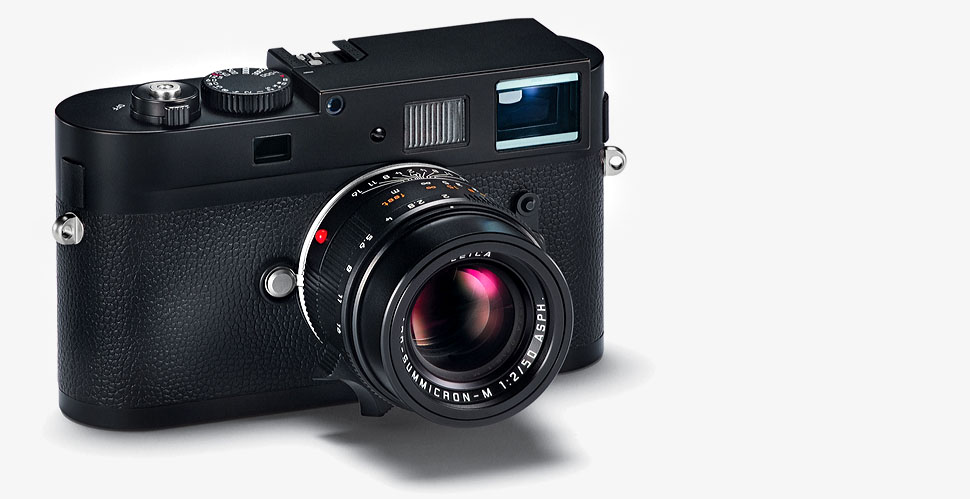
I also got clued into something that wasn't obvious to me, relating to the new Leica M Monochrom. This is an M9-like camera which is designed specifically for monochrome (black and white) imaging.
 
Leica M Monochrome
Image Source: http://us.leica-camera.com/photography/m_system/m_monochrom/
 
Normal camera sensors, designed for color photography, accomplish their job by using filters of Red, Green, and Blue over a set of four sensors, in something known as the Bayer pattern. This means that in order to get all of the color information for a location in the image, the chip must blend information from four sensors on the chip. The new Monochrom does away with the Bayer filters, and uses all of those sensor locations to gather light level information in only black and white. This results in exquisite detail in monochrome images.
 
Well, here's the twist. Until now, digital imaging has sort of rendered those old red, green, and yellow filters we used for black and white film photography obsolete. When converting an image from color to monochrome, we can use our post-processing software to balance the color channels, effectively allowing us to apply filters digitally, after the fact. Since the Monochrom doesn't even gather any color information, that's impossible. So guess what? Dig out those old filters - they're useful again. I think that's kind of cool.
 
By the way - if you're in the area, there's a spectacular exhibition of images by Magnum photographer Jacob Aue Sobol, all taken with the M Monochrom. They are awesome. They really show how this camera can make black and white images that look like the classics, but with detail and tones that are just beyond belief.
 
I can't imagine paying that kind of money for a camera that only does black and white. But, if that's your thing, this is the camera.
 
The regular Leica M digital cameras are no slouches at black and white, either.
 
All in all, an interesting day at the Leica shop.
 
DMC-365.blogspot.com
 

Friday, August 24, 2012

I Need To Do More Black and White Photography

 
Door Latch, Antietam Battlefield, by Reed A. George
Panasonic Lumix DMC-G1, Lumix 20mm f1.7
iso 100, f3.5, 1/200 sec
 
No, I'm not ready to sign up for an $8,000 camera that ONLY does black and white.
 
(Click Here) if you're interested in that.
 
But, I do want to do more monochrome photography.
 
I found an interesting video program on getting the most from your black and white imaging. It is normally $79, but currently available fore $59.
 
(Click Here) to get info on the program.
 
DISCLAIMER: I know nothing about the producer of this program, and have not tried it myself. If I decide to, I'll let you know. If you decide to, please comment here on your experience!
 
DMC-365.blogspot.com


DMC-365.blogspot.com