Showing posts with label resolution. Show all posts

Tuesday, August 4, 2015

Nikon D810 and Df - The Best Combination Available Today?

Well, I've been thoroughly enjoying my Nikon Df for some time now. The low light capabilities of this camera are spectacular.
 
I've recently purchased a Nikon D810, specifically to take advantage of the increased resolution (36 megapixels) for nature photography. Mounted on my Nikkor 200-400mm f4 AF-S VR G lens, the D810 should allow me more freedom in cropping, which is always useful in wildlife photography, especially with active species like birds.
 
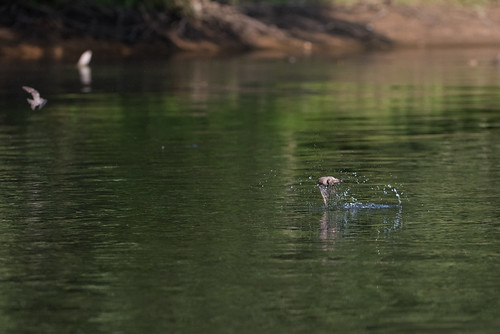
I've only had my D810 out a couple of times so far. One was this morning, shooting birds on a kayak outing. Here's a tightly-cropped shot of a swallow hitting the water surface.
And here's a 100% blow-up (cropped even more).
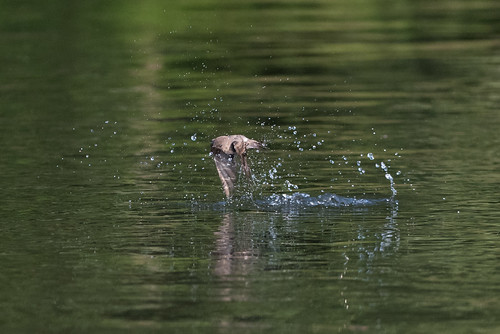
What I've found so far is that while the D810 does allow significant cropping, it doesn't handle high iso noise nearly as well as the Df. Of course, that's well-known in the Nikon crowd, and makes perfect sense, given the much higher number of pixels crammed into the same sensor real estate as the Df. The shots above were made at iso 1600, and noise is quite visible on my screen, looking at the images in Lightroom.
 
Here's a snapshot of DxO Lab's comparison of the two cameras:
 
Image Source: http://www.dxomark.com/Cameras/Compare/Side-by-side/Nikon-Df-versus-Nikon-D810___925_963
 
As you can see, the D810 wins in overall score, color depth, and dynamic range. But, it performs significantly worse in low light (high iso). Again, no new information here, but it's helping me to form my opinion of this pair of cameras and how best to use them.
 
Basically, the D810 will fill my need for high resolution and cropping ability when shooting wildlife in good light. Or anything else in good light, for that matter. The Df will remain my go-to camera for more challenging lighting situations, and when cropping is not as necessary.
 
So, I think that for me, yes, this is the best combination of Nikon bodies available today.
 
I have to get the D810 out in the field again, and shoot at lower iso settings. I'm sure that's going to really impress me.
 
DMC-365.blogspot.com


Monday, July 27, 2015

Well, I'm Going For It - Nikon D810

Nikon
 
I have long said that my Nikon D700 is the single best-performing camera I've ever owned. Not the highest fun-factor (as I love my rangefinders and old film cameras), but best at getting the shot, and in the most high quality way. So, I have not upgraded it, even after several years. I did add the Nikon Df, which is just a different beast, and brings the fun factor up considerably with its retro design, ability to take non-AI lenses, and smaller size.
 
What I did upgrade was my telephoto lens choice. Selling the spectacular 500mm f4 AiP manual focus lens, I invested in the first version AF-S 200-400mm f4 VR lens. Having fast autofocus significantly improves my chances of capturing great nature photographs. On the D700, the 200-400 really sings.
 
So why upgrade to the D810? Well, really for one reason, and one reason only - resolution. I will be able to shoot the D810 in DX crop mode and still produce 15.4 megapixel images. That is higher than the D700 at full frame, and turns my 200-400 telephoto into the equivalent of 300-600mm, without the 1.4X tele-extender! That's powerful. Or, I can shoot in full-frame (36 megapixel) mode, and crop in post-processing. That's really going to increase the number of bird-in-flight images that will be useful and printable at large sizes.
 
Resolution is the only reason that I know now. I have a feeling I'll find other reasons to love the D810.
 
I bought mine refurbished by Nikon. The cost savings was significant - I paid $2,550 at Adorama, including a third party "drops and spills" 3 year extended warranty. The camera lists for almost $3,300.
 
I don't expect the D810 to become my most-used camera; I love the Df and know the D810 won't replace it. I do expect the D810 to be my go-to nature and wildlife camera.
 
DMC-365.blogspot.com
 

Saturday, January 5, 2013

On Equipment, Resolution, Detail, and Mood

I just took this picture with my iPad camera (which is so bad, I rarely use it).
 
Through A Low Resolution Blind, by Reed A. George
iPad Camera
 
I noticed yesterday, looking through this same blind, that the weave of plastic making up the blind results in a pixelated view of what's outside, sort of like a low resolution digital sensor.
 
To me, this is a picture of a crow. In fact, the crow in the picture is literally represented by just two completely black, square "pixels." Do you see it, on top of the closest streetlight? Two pixels out of about 12,000 by my quick estimation. Completely black - no color or even gray level information.
 
I know that the crow was there. To me, it's a picture of a crow. To anyone else, it is certainly not a picture of a crow.
 
I am using the left side, the descriptive side, of my brain when I say it's a crow in the picture. I label those two pixels "crow." But, the feeling I get when looking at the image (from the right side of my brain) is definitely affected by a crow being there. This feeling would not be transmitted to other viewers with this low resolution image.
 
 
Ospreys in Flight, by Reed A. George
Nikon D700, Nikkor P 500mm f4 Lens
 
On the other hand, if I am photographing birds in flight, the shape and orientation of each feather adds to the experience of seeing it first hand. If I can't capture that, I've lost something in the process.
 
Mystery in a Street Scene, by Reed A. George
Leica CL, M-Rokkor 40mm f2 Lens
 
But, then there's mystery. Sometimes I want to obfuscate some details, specifically to allow me to share the feeling of a scene, rather than all of the details. This image makes me think "Woah. What's going on there?" even though I took the picture.
 
To me, this is why all of the technical terms associated with equipment, and the techniques that we share with each other, matter at all. But, matter they do. I hope this helps to explain why I believe that equipment and technique are important, and illustrates a little of what I mean by "Exploring the Interface Between Equipment and Creativity in Photography."
 
DMC-365.blogspot.com


Saturday, May 12, 2012

Useful Article on Printing Resolution at digitalphotopro.com

 
Table Source: http://www.digitalphotopro.com/technique/workflow/the-right-resolution.html

How do you decide what print resolution to use when printing your digital files? Do you always just set it to 300 dpi and forget it? Just use the native resolution of the image? I have known that you can get by with lower resolution printing for larger images, but didn't really know how to calibrate that. I have also learned the trick of increasing resolution to 360 dpi when I make large prints of smaller resolution images.

(Click Here) to read the whole article, which leads me to somewhat different conclusions.

First off, the table above. This table reinforces the idea that you can get by with lower print resolutions for larger prints. For example, a 3.5" x 5" print is normally viewed from 10-12" distance, meaning about 300 dpi is correct.

However, this article finds that there is benefit in printing to 360 dpi resolution with Epson printers (mine is Epson), 300 dpi for Canon, regardless of final print size. So, conclusion 1 is that you should print at 360 dpi for any print size, even if your file isn't that high in resolution. The article explains how to do this from Lightroom.

The second conclusion is that if your original file is even higher resolution than the Epson native resolution of 360 dpi at the size you want to print, you should NOT decrease the resolution. In fact, you may benefit from increasing the resolution to 720 dpi, if you have an Epson Pro printer, which has a maximum detail resolution of 720 dpi.

This article goes far in demonstrating the differences, yet results in simple conclusions. Very helpful.

DMC-365.blogspot.com