Showing posts with label technique. Show all posts

Thursday, May 21, 2015

Practicing my Telephoto Technique - Nikon 70-300mm AF-S VR and the Ducklings

I am anxiously awaiting delivery of a used Nikkor 200-400mm f4 zoom lens that a friend and I have decided to co-own. It's an expensive lens, so this made it possible for both of us to have access to it.
 
Most of my lenses, especially telephotos, are older technology. Starting with the Ai-P 500mm f4, which is my longest lens, it's manual focus. It's a true beauty, and makes wonderful photos, but clearly doesn't have the latest AF-S focusing. Then there's my 300mm f4 AF-I, which does have autofocus, but not the blazing fast AF-S.
 
In fact, the only long lens I have with AF-S is the 70-400mm f4.5-5.6 G VR zoom lens. So, I decided to take that lens out for a quick shoot before work yesterday, to practice my focusing technique. Based on the video by Steve Perry that I posted yesterday, I set up my D700 for back button focusing and gave it a try.
 
Not an action shot, but here's the best shot I made in that fifteen or twenty minutes of shooting yesterday.
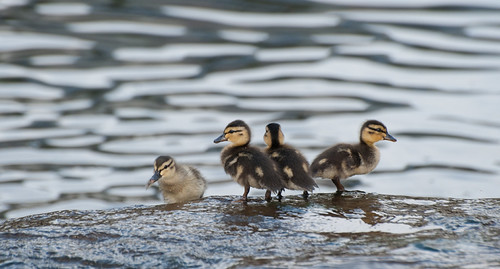
 
Spring Ducklings, by Reed A. George
Nikon D700, Nikkor 70-300mm f4.5-5.6 G AF-S Lens
iso 800, f8, 1/500 sec
 
I wanted to test out the back button method, in which you leave your camera set to continuous AF, and use the button on the rear of the camera to decide when to freeze the focus, if at all. When photographing action (e.g. birds in flight), you just keep the button pressed, and the camera will focus through the entire shooting sequence. For static objects (e.g. these ducklings), you get the focus point you want, then release the rear button, locking the focus at that point. This worked very well for me here.
 
This 70-300mm lens is very good. It's not as sharp as I expect the 200-400mm to be, which should be obvious when you compare the specs and prices. But, I think it did a pretty good job for me in this case. And, it's very light and fast.
 
I can't wait to see what the 200-400 can do!
 
DMC-365.blogspot.com

Tuesday, May 19, 2015

Use Nikon Autofocus? You MUST Watch this Video by Steve Perry

I have been shooting some wildlife recently with my Nikon cameras. With the spring weather finally here, I love to get out in my kayak and photograph birds and other wildlife.
 
My current telephoto lenses are a 300mm f4 AF-I (very old autofocus lens) and a 500mm f4 Ai-P (manual focus). Both are excellent optics, but are a bit dated. I have worked on my manual focus technique with the 500mm, and can even catch the occasional sharp image of a bird in flight.
Bald Eagle in Flight, by Reed A. George
Nikon D700, Nikkor Ai-P 500mm f4 Manual Focus Lens + 1.4X Teleconverter
iso 1600, f5.6, 1/1000 sec.
 
Of course, things get easier with autofocus, especially Nikon's modern AF-S lenses. I'm about to get my hands on a lovely 200-400mm f4 AF-S VR lens, so I'm reading up on autofocus technique.
 
Here's an outstanding 12 minute video by Steve Perry, showing some of the key concepts for successful autofocus with Nikon DSLRs:
 
If you have problem with getting to the video, (Click Here).
 
One of the techniques that Perry practices is "back button" AF. This means using only the back AF-on button to focus, and not the typical half-press of the shutter release. With the camera set to continuous AF (AF-C), you simply let your finger off of the back button when you want to lock in focus, or keep pressing to follow and focus on a moving subject. Really helpful.
 
Just to try it out, I took my D700 and 70-300mm AF-S VR lens out tonight and gave it a shot with some flying geese. It worked really well. I literally can't wait to get my hands on that 200-400!
 
DMC-365.blogspot.com
 

Tuesday, February 11, 2014

David Munchow on Spontaneity

From the Shadows, by Reed A. George
Super Ricohflex, TMax 400 Film
 
I was reading a blog post by David Munchow today, about spontaneity.
 
(Click Here) to read David's full post.
 
He talks about starting in landscape and nature photography, where he could be slow and deliberate, thinking through every element of every photo. Now he says he was "thinking too hard," and while many of the pictures were very well done, they weren't exciting.
 
Now, he shoots in a more documentary style, and challenges himself to "let go of my rational self." I can identify with that.
 
I think that you can do the same with nature photography, especially wildlife. But I do get David's point.
 
Perhaps the most interesting statement is one that David attributes to Henri Cartier-Bresson:
 
"Thinking should be done beforehand and afterwards - never while actually taking a photograph."
 
Sounds right to me.
 
DMC-365.blogspot.com


Saturday, May 18, 2013

Kirk Tuck's Blog Takes A New Turn - Mine Is Finally Hitting A Straightaway Again

 
Department Store DJ, New York City, by Reed A. George
Pentax K1000
 
Kirk Tuck's blog, the Visual Science Lab, is going in a new direction. Wildly successful at leading discussion, debate, and yes, argument about photography equipment, Kirk is now focusing on process and technique.
 
(Click Here) to read about how it's going for Kirk on his blog, Visual Science Lab.
 
If you've been reading my blog very long, you'll know that I made a similar change in January of this year. For the first year of DMC-365 (2012), I focused mainly on using Panasonic Lumix cameras. However, I found that limiting. I'm an admitted camera junkie, and other equipment - Leica, Nikon, and others - kept creeping in.
 
So, for 2013, I've decided not to abandon the equipment side, but to add to it. In fact, my interest in Panasonic continues, and I'm even expanding that area, by becoming one of Panasonic's Early Adopters and testing new equipment as the opportunity presents itself. But, I've decided to bring in more of the creative side. In fact, I'm focusing at the exact interface between the two. Let's face it, photography is a bridge art. Photography depends upon technology, even if it's that old Brownie camera from your grandma's closet. But, even the latest greatest technology doesn't make a good picture without creativity. So, I'm going to focus on where they come together.
 
I did see a drop in page views when I first made this change in January. Now, in May, I'm consistently getting more traffic day by day than I did last year. And, I'm much happier with what I'm writing about. Of course, Kirk would never be happy with my level of blog activity. I think he's had about 200 times more hits than I. But, I'm gaining experience and exposure each and every day.
 
THANKS FOR READING!
 
DMC-365.blogspot.com


Saturday, January 5, 2013

On Equipment, Resolution, Detail, and Mood

I just took this picture with my iPad camera (which is so bad, I rarely use it).
 
Through A Low Resolution Blind, by Reed A. George
iPad Camera
 
I noticed yesterday, looking through this same blind, that the weave of plastic making up the blind results in a pixelated view of what's outside, sort of like a low resolution digital sensor.
 
To me, this is a picture of a crow. In fact, the crow in the picture is literally represented by just two completely black, square "pixels." Do you see it, on top of the closest streetlight? Two pixels out of about 12,000 by my quick estimation. Completely black - no color or even gray level information.
 
I know that the crow was there. To me, it's a picture of a crow. To anyone else, it is certainly not a picture of a crow.
 
I am using the left side, the descriptive side, of my brain when I say it's a crow in the picture. I label those two pixels "crow." But, the feeling I get when looking at the image (from the right side of my brain) is definitely affected by a crow being there. This feeling would not be transmitted to other viewers with this low resolution image.
 
 
Ospreys in Flight, by Reed A. George
Nikon D700, Nikkor P 500mm f4 Lens
 
On the other hand, if I am photographing birds in flight, the shape and orientation of each feather adds to the experience of seeing it first hand. If I can't capture that, I've lost something in the process.
 
Mystery in a Street Scene, by Reed A. George
Leica CL, M-Rokkor 40mm f2 Lens
 
But, then there's mystery. Sometimes I want to obfuscate some details, specifically to allow me to share the feeling of a scene, rather than all of the details. This image makes me think "Woah. What's going on there?" even though I took the picture.
 
To me, this is why all of the technical terms associated with equipment, and the techniques that we share with each other, matter at all. But, matter they do. I hope this helps to explain why I believe that equipment and technique are important, and illustrates a little of what I mean by "Exploring the Interface Between Equipment and Creativity in Photography."
 
DMC-365.blogspot.com