Showing posts with label park. Show all posts

Sunday, June 21, 2015

Some Ultrawide (12mm) Film Shots of Parkour

I recently shared a slideshow of parkour images, made with the Nikon Df. (Click Here) to see that post.
 
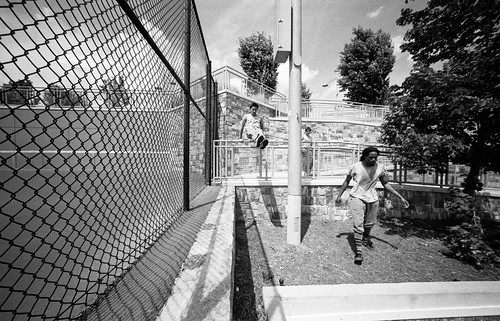
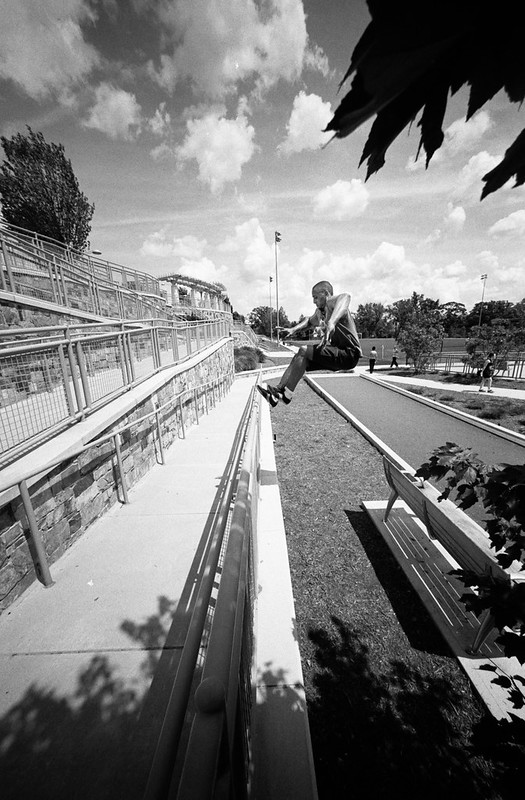
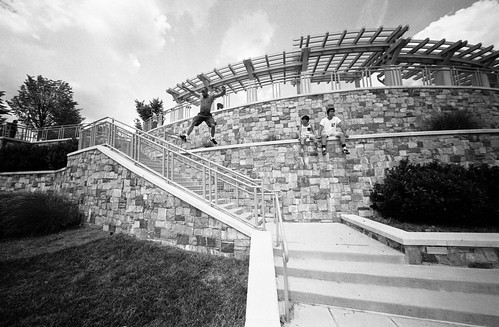
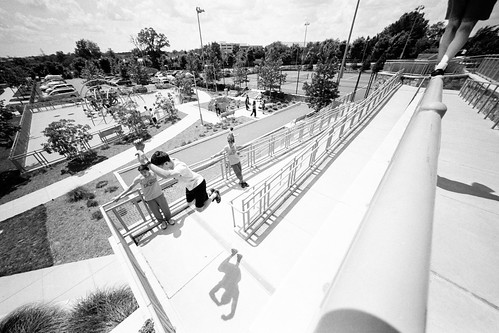
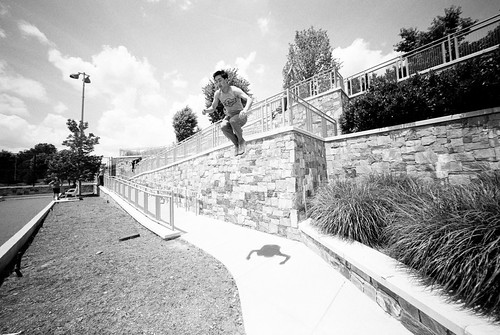
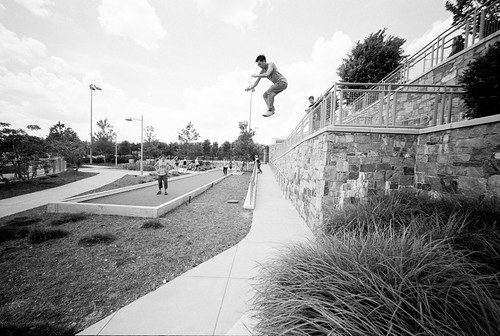
Today, I'll post some images I made at the same event, but these were all shot on the Zeiss SW film camera, with the Voigtlander 12mm f5.6 (LTM) ultra wide angle lens. These were all shot on Ilford HP5+ black and white film. I processed them myself.
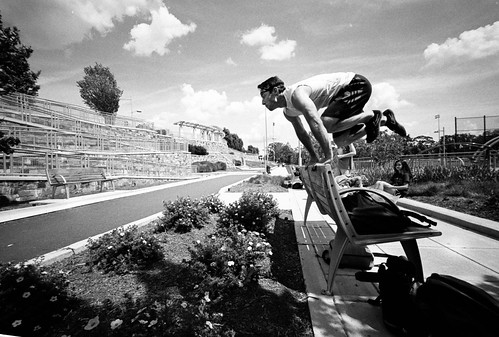
 
I loved shooting parkour with this oddball lens. I have also done some fisheye shooting with parkour. (Click Here) to see that. In both cases, the wide angle of view is great for including a lot of the context for the sport. But, it also means that I have to get very close. So close, in fact, that there's a risk of interfering with the practitioner's concentration. That did happen once; thankfully, he thought it was funny. The last thing I want to do is interfere.
 
I think what I'm learning about shooting parkour is that variety is key. These wide angle shots tell a lot about the setting, but have relatively little detail of what the person is putting into the effort.
 
Approaching this with the standard photojournalistic search for a combination of wide, normal, and close up detail shots seems to be in order. I'm about to get a great opportunity to pull together a group of parkour practitioners, specifically to photograph them. My plan will be to get that variety, and to experiment with some ideas with flash, showing motion, etc. I've got some thinking to do.
 
DMC-365.blogspot.com

Thursday, May 28, 2015

My Second Shot at Parkour Photography

Back in March, I had the opportunity to photograph some local practitioners of parkour, which is basically acrobatics in public places. (Click Here) to see that post, in which I used my Nikon F2SB and black and white film. I enjoyed it immensely, and they appreciated seeing the photos.
 
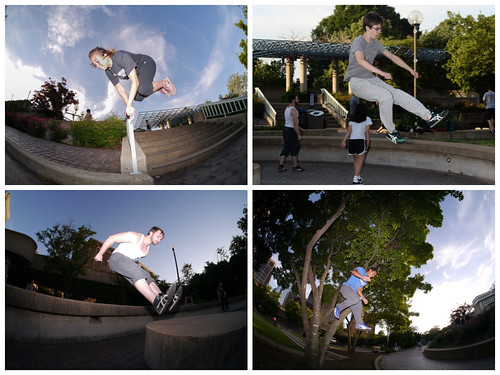
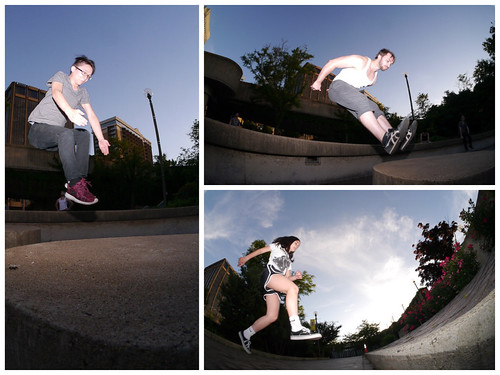
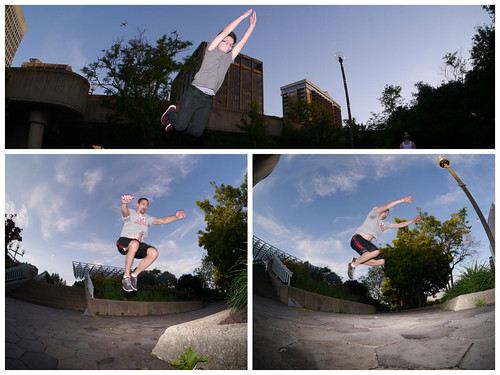
Last night, I went to one of the practice sessions for a larger group of DC Metro Parkour members. Here are some of the shots.
Parkour, by Reed A. George
 
While I shot a few of these images with my Nikon Df, most were made with my Micro 4/3 Lumix DMC-GX1 and Bower fisheye lens. All used flash to freeze the motion.
 
I recently came very close to selling off my Micro 4/3 gear, since I just have not been using it much. That, and the fact that the new Lumix LX100 (which also uses a Micro 4/3 sensor) is so capable, it replaces much of my interchangeable lens Micro 4/3 gear on travel, made me consider selling all of it. I did sell several pieces of gear, but decided to keep a smaller set of Micro 4/3 bodies and lenses. Specifically, I kept the most compact lenses, and the ones that are special in some way. The Bower fisheye is an example of that - I don't have a fisheye lens for any other camera system, so I kept it. It sure came in handy last night!
 
I'm planning to continue to work on creative techniques for photographing this exciting sport.
 
DMC-365.blogspot.com
 

Friday, September 5, 2014

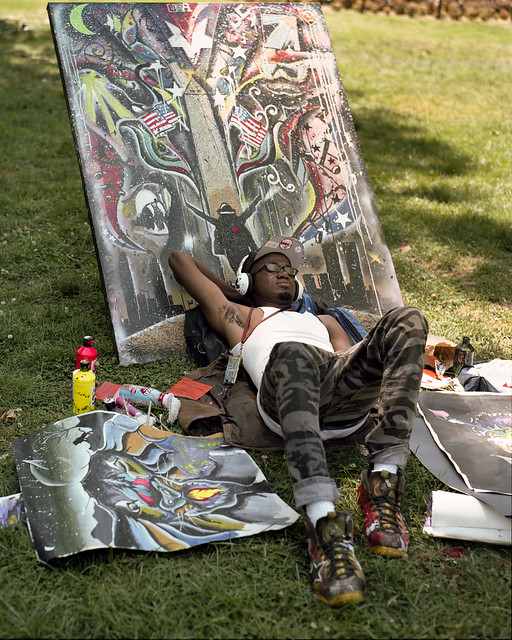
DC Artist - My Very First Shot with the Mamiya Universal

I've shared several images I've made with my new Mamiya Universal Press camera and instant film. Before I got the correct instant back for the camera, I shot a few rolls of normal 120 medium format film. This is the very first exposure I made with the camera:
 
Artist, DuPont Circle, by Reed A. George
Mamiya Universal Press, Mamiya Sekor 100mm f3.5 Lens
Kodak Portra 160 Color Negative Film
 
The Universal is becoming a favorite for me. It's not your typical street photography camera. Not what you'd call subtle. When you lift this thing to take someone's picture, they're going to notice. So, I asked this guy if it was okay. He said "Sure," and then went back to being himself, which I very much appreciated.
 
I'm very impressed with the image quality that the Mamiya is capable of producing. This first roll was shot in the 6x7 format back, which gives me ten shots per roll of 120. Can you say "slow photography?" Think of the contrast of having to change film rolls every ten shots with modern digital photography. You can shoot that many images in two seconds or less with a DSLR. But why?
 
DMC-365.blogspot.com