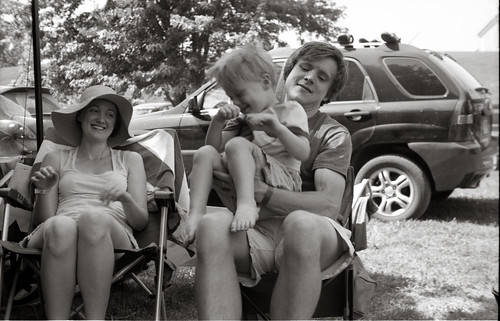
Winter Shopping With Mom, NYC, by Reed A. George
Leica M9, Leica Elmar 5cm f3.5 Lens (ca. 1938)
iso 640, f6.7, 1/250 sec
Back on January 9, I wrote about a new project I'm taking on this year, to help me explore the interface between equipment and creativity in photography. It's called "Whole Lotta Leica," and in this project I'll match up a different "normal" lens (35-50mm) with my new Leica M9 each month.
January's lens selection was a 1938 Leica Elmar 5cm (50mm) f3.5 LTM lens.
I got out for three separate shooting sessions with this lens during the month. The first was right near home, at the Udvar Hazy National Air and Space Museum. On a cold winter day, it's a pretty good place to end up.
Udvar-Hazy Air and Space Museum Building, by Reed A. George
Leica M9, Leica Elmar 5cm f3.5 Lens (ca. 1938)
iso 160, f16, 1/160 sec
Space Shuttle Discovery, by Reed A. George
Leica M9, Leica Elmar 5cm f3.5 Lens (ca. 1938)
iso 320, f4.8, 1/90 sec
You can see from these two shots that the old Elmar has some haze and scratches. Any light source directly in the field of view flares. I did not use a hood, which may have helped considerably. However, it is quite sharp, and focuses accurately on the M9.
My next outing was a little street shooting in Washington DC. I went to Chinatown, which is always good for a shot or two.
Making the Noodles, by Reed A. George
Leica M9, Leica Elmar 5cm f3.5 Lens (ca. 1938)
iso 320, f5.7, 1/180 sec
Here again, you can see the haze at work on those lightbulbs, but otherwise it's a perfectly acceptable image.
Now here's where the Elmar shines, in my opinion - gorgeous, warm reds.
Chinatown Shop Window, by Reed A. George
Leica M9, Leica Elmar 5cm f3.5 Lens (ca. 1938)
iso 320, f5.7, 1/180 sec
The detail in this shot is quite impressive. I think the color rendition is hard to beat, even with modern lenses.
While in DC, I went to the National Portrait Gallery. The building is extremely nice, and has a huge open courtyard which separates the portrait gallery from the attached Museum of American Art. The courtyard is a great place to hang out in winter - nice, bright natural light, but with the convenience heating.
View to the Courtyard, by Reed A. George
Leica M9, Leica Elmar 5cm f3.5 Lens (ca. 1938)
iso 1250, f4.8, 1/90 sec
There is a nice water feature, where the water runs over segments of the flooring in the courtyard. Even though it was sub-freezing outside, the kids loved running and playing in the water.
Playing in the Water, by Reed A. George
Leica M9, Leica Elmar 5cm f3.5 Lens (ca. 1938)
iso 1250, f5.7, 1/125 sec
I even gave the Elmar a little workout shooting from the hip, using zone focusing.
Winter Cheer by Reed A. George
Leica M9, Leica Elmar 5cm f3.5 Lens (ca. 1938)
iso 640, f6.7, 1/180 sec
My third and final outing for this month with the Elmar was in New York City.
The first shot in this post (above) was again taken with zone focus, walking up behind a mother and daughter out for a winter walk.
Hockey Practice Transit, NYC, by Reed A. George
Leica M9, Leica Elmar 5cm f3.5 Lens (ca. 1938)
iso 1250, f3.5, 1/45 sec
The image of the hockey player waiting on his train was selected for an upcoming gallery show in Alexandria, Virginia. Focused on exactly my interest, how equipment informs and shapes photography, the show at Gallery Athenaeum will be a lot of fun.
(Click Here) to read about Gallery Athenaeum. The show will be from Thursday February 28 to Sunday April 7.
I'm very excited to be part of the show.
Photo Instructor, Zim, from NYC Photo Safaris, by Reed A. George
Leica M9, Leica Elmar 5cm f3.5 Lens (ca. 1938)
iso 640, f5.7, 1/640 sec
While in New York City, I took a field seminar with NYC Photo Safaris, led by our instructor pictured above, Zim.
We met in Central Park for a four hour discussion and shooting session. I must say that Zim and I come at photography from completely different angles. A pro for over 20 years, Zim is a real authority, and I am certain that she knows how to get "the shot" better than I. Her advice for our group was to trust P mode on your DSLR, as the camera companies have spent years and millions on making exposure work for us. She also prescribes only zooms. She really did not understand why I'd be carrying two manual cameras, the M9 and my (film, really?) Pentax K1000, with prime lenses. At one point she said "Why do you people do this to yourselves?"
I ended up using my pocket camera, the Panasonic Lumix DMC-TS3, for most of the class. It has a wide angle zoom, autofocus, etc. It fit much better with the style that Zim wanted us to explore. I learned a lot from Zim in a short time. It is differing opinions that challenge us, make us better. It was a friendly, constructive tension at all times. I recommend Zim and NYC Photo Safaris - just be sure to take along an automatic camera.
The shot of Zim above feels nice to me. I think it exemplifies what the old Elmar can do. You'll notice the light source is well outside the image, avoiding any flare or haze effects.
To see more of my pictures taken this month with the Leica M9 and Elmar 5cm f3.5, please visit my set on flickr.
In terms of usage, I would say that the Elmar is challenging. Here are a few thoughts from my experience:
- First, you have to keep the flare in mind at all times when composing. Sometimes, it adds to the shot. Other times, it can ruin the shot.
- The f-stop adjustment is very fiddly. On my copy, it's also tight, so you'll literally break fingernails trying to change aperture. You'll notice that many of my shots were made at a single f-stop as a result.
- You have to be mindful not to collapse the lens on the M9, as it can hit the sensor. I cut up a 35mm film canister and made a little ring to put around my lens, to make it impossible to collapse. That would be a disaster.
- If you're out for numbers - high quantities of technically competent shots - this is probably not the best lens. If you like it's unique qualities, it's irreplaceable.
- This was a standard lens for Leica cameras for many years. Many great (understatement) images were made with the Elmar 5cm f3.5 lens.
I hope you find this useful and interesting. It's going to be a blast re-exploring all of these nice lenses!
DMC-365.blogspot.com