Showing posts with label LTM. Show all posts

Thursday, May 14, 2015

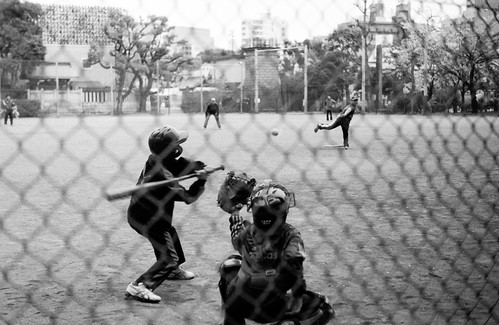
Baseball - Japanese Little League, Shot with Leica IIIG

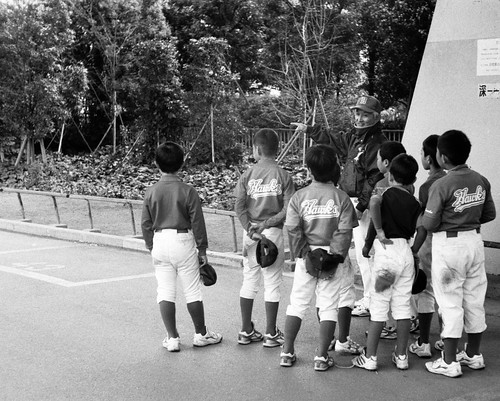
Baseball is big sport in Japan, including Little League.
 
Little League Baseball, Japan, by Reed A. George
Leica IIIG, Elmarit 5cm f3.5 Collapsible Lens
Kodak TMax 400 Film
 
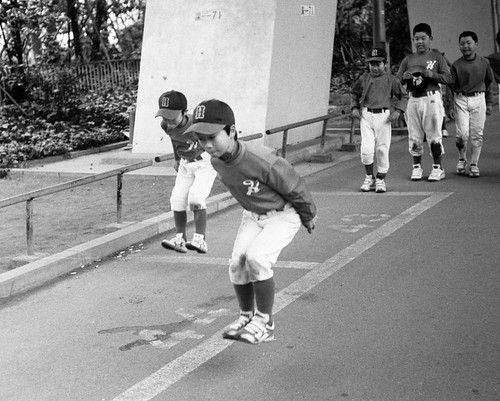
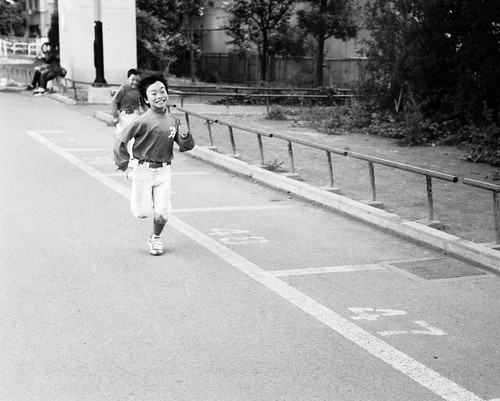
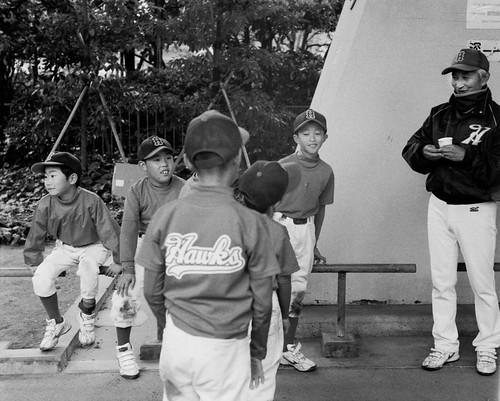
On one of my morning walks around Tokyo, I came across this team, running drills either before or after their games. I was impressed by the enthusiasm of the young players, and the attention their coach paid to them. All of the following shots were made with the Leica IIIG, this time with a Nikkor 50mm f2 LTM lens that I purchased at Map Camera in Tokyo. It's a beautiful little lens.
 
I very much appreciated capturing a little slice of the Hawks' fun together. Great fun with an old Leica rangefinder.
 
DMC-365.blogspot.com
 

Sunday, November 9, 2014

Way Back Shot - Fredericksburg, VA, Winter 2010

Just thought I'd share an old shot this morning. I took this one with my Leica IIIC and Nikon 3.5cm f2.5 LTM lens. I had recently bought the camera and lens from a friend-of-a-friend, thanks to Dennis Gallus connecting us. Dennis, James McKearney, Rob Svirskas, and I drove down to Fredericksburg for a day of shooting.
 
This shot was made at historic Chatham Manor, overlooking the Rappahannock River.
 
You can see more shots made with this classic Nikon lens if you (Click Here).
 
I have not used this lens much, mainly because it's competition in my kit is the amazing Leica Summaron 3.5cm f3.5 LTM lens. The Leica lens is a full stop slower, but is so sharp and renders color so nicely that when I have to pick one to put in my back, it's nearly always the Summaron.
 
(Click Here) to read about the Summaron, which I also used as part of my Whole Lotta Leica series.
 
To see every lens I used in the Whole Lotta Leica series, where I matched up a wide range of older lenses with my Leica M9, (Click Here).
 
DMC-365.blogspot.com


Wednesday, October 1, 2014

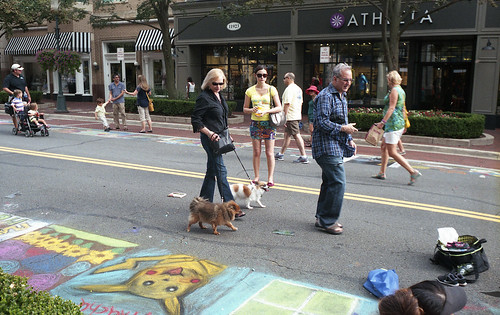
More From Chalk Fest, Leica IIIC with Summaron 3.5cm f3.5

Here are a few more pics from Chalk Fest, all shot with my Leica IIIC and Summaron, on Fuji 100 color negative film.
 
The Summaron 35 is a spectacular little lens, and I do mean little. I love the subtle color rendition that this lens produces.
 
DMC-365.blogspot.com


Tuesday, August 12, 2014

The Leica Thambar - Exclusive, Unique, Beautiful Imperfection

I've heard of the Leica Thambar lens before. That's about all I could say about it before taking a little interest in it this morning.
 
Here's what sparked my interest - a post by awslee on Rangefinder Forum.
 
Image Source: http://www.rangefinderforum.com/forums/showthread.php?t=143874

(Click Here) to see the post and more images.
 
The Thambar is a screw mount (LTM), 90mm f2.2 lens. Made in the 1930s to respond to the need for a portrait lens that wasn't too sharp, the Thambar certainly delivered. The lens relies on uncorrected optics to render interesting, soft backgrounds. It also uses a reflective spot filter to change the effect near the center of the image.
 
(Click Here) to read the best description I've found of the Thambar, on the Leica Barnack Berek blog.
 
The Thambar is one of those very special lenses, one that you probably wouldn't put in your bag very often. Couple that with the scarcity (only a few thousand were made, and now about 80 years ago), and the likelihood of my ever owning a Thambar is reduced to near zero. But boy, would it be fun to try one out.
 
Hmm. I bet someone in the LHSA (International Leica Society) has one. Any of my friends there want to lend me their Thambar for a few hours?
 
DMC-365.blogspot.com
 

Saturday, April 19, 2014

Russar (Russian 20mm Wide Angle) Remake v. 2014

The folks at Lomography have been doing some interesting things lately. For me, any company that keeps film photography alive is okay. But their latest antic is really pretty interesting.
Image Source: http://microsites.lomography.com/russar-lens/
 
Lomography is producing an updated version of the 1958 Russian "Russar" 20mm f5.6 lens with what seems the perfect combination of classic optical design and modern materials and manufacturing methods.
 
The new Russar+ will be made in Leica Thread Mount (LTM), also known as "L39," which is great for us Leica users. That makes it native on the Barnack cameras, and easily adaptable to Leica M cameras. It also makes a nice base for adapting to other mounts, like Micro 4/3.
 
It sounds like they really are making some upgrades to the lens. For example, while the original lens body was made of aluminum, the new one is brass. Reportedly, it's being manufactured by Zenit in Russia. I don't know Zenit's full history, but I know from classic camera shopping that they've been around a while.
 
Now, a maximum aperture of f5.6 is a little hard to live with, especially if you're shooting film. But, that's the classic design, and one of the tradeoffs of using them. I have a Cosina Voigtlander 12mm f5.6 lens that rarely sees use because of that small maximum aperture.
 
But, any way I look at it, this is a cool development. One of my highest-use lenses is the awesome Carl Zeiss C-Sonnar 50mm f1.5. If the Russar+ implements a classic design with modern improvements in even a slightly similar fashion, it will be worth having.
 
You can pre-order yours by (Clicking Here). The price is US$649, and they're scheduled for delivery in July 2014.
 
 
DMC-365.blogspot.com
 

Tuesday, April 15, 2014

Quick Test of an Old Leica

A couple of months back, I had the fortune of finding two Leica IIIC cameras, separate but very close together in time, both manufactured at the end of World War II. Coming from separate sellers, the cameras are extremely similar, both having the wartime "stepper" design, and having been manufactured in 1945. In both cases, according to the best source on wartime Leicas anywhere (James Lager, my colleague in the LHSA), they were most likely sold to allied soldiers in Europe at the end of the war.
 
One of the cameras came with a date-matching Elmar 5cm f3.5 collapsible lens (the standard lens of the day). I used that lens for the images below.
 
I've now had both cameras serviced by Youxin Ye, and they're working as-new. I took the second one that I purchased out for a walk and test roll recently. You see the results below.
 
I happened onto a model yachting event in Reston, Virginia. These images are straight from the camera, Walgreens iso 200 color print film, processed by The Darkroom.


In the shot above, you can see what I believe is internal reflection in the lens/camera. I was not using a lens hood.
 
This final shot is my favorite of the bunch.
 
No Pulitzers here, I'm sure. However, I did accomplish my goal, which was to test the camera and lens. I kind of like the rather low contrast result, especially as the light was quite harsh. I'm not sure how much of the low contrast comes from the lens (most, I suspect), versus the film. The cheap Walgreens film tends to have this sort of look on its own. Most of these were shot at f8 or smaller aperture, and relatively high shutter speeds.
 
The images are plenty sharp, and I think the color representation is quite nice.
 
It's amazing to me that such a piece of photographic history, made well before I was born, still works and yields results that are at least as interesting as modern cameras. Certainly the technical performance of modern cameras and lenses is better, but I'm quite happy with the look this camera and lens produce. And that's what matters to me.
 
DMC-365.blogspot.com


Monday, February 3, 2014

One Lens That Didn't Make It Into Whole Lotta Leica Last Year - Leica LTM Summarit 5cm f1.5

Autumn Color, by Reed A. George
Leica M9, Summarit 5cm f1.5 LTM Lens
iso 200, f6.7, 1/60 sec
 
One of the lenses that didn't make it into my monthly feature of Whole Lotta Leica (WLL) last year was actually the second Leica lens I ever owned. Come to think of it, my first Leica lens, the 90mm f4 Elmarit didn't make it either. Both of these lenses are in great shape, but have a little haze that needs to be dealt with.
 
Here's my Summarit:
Leica Summarit 5cm f1.5 LTM Lens (ca. 1953)
 
These lenses are notorious for coming with lots of "cleaning marks," aka scratches, on the front element. The coatings were apparently quite soft, and they are easy to scratch. Mine has essentially no marks on the elements, but does have some haze. I have hesitated to send it for cleaning, worried that it will come back with scratches. So, I live with the haze. The lens renders very interesting images, with lots of center sharpness and wonderful bokeh (out of focus areas).
 
For me, the Summarit is a special lens, not one I'd want to rely on every day. However, it can produce some very special results.
 
What got me thinking about this? A post on Rangefinder Forum, by member "tester."
(Click Here) to read tester's thoughts on the lens on Rangefinder Forum, and see some very nice example images shot with his (her) Summarit.
 
DMC-365.blogspot.com


Sunday, February 2, 2014

Quick Test of my New Wartime Leica IIIC

 
Wartime Leica IIIC
 
A few years ago, I purchased a beautiful Leica IIIC wartime model (ca. 1942) from a friend of a friend. At the same time, I got an uncoated LTM Summitar 5cm f2 lens (1939). Both the camera and lens turned out to be favorites of mine. The wartime IIICs are characterized by a little step up on the top plate, where the rewind lever sits. Therefore, these cameras are sometimes referred to as "steppers." I always have my eyes open for these models, both because the wartime IIICs are usually in better shape than postwar cameras, due to issues with chrome plating after the war, and because they really are little pieces of history. They don't come up for sale all that often.
 
Recently, I saw the camera above on one of the forums, another wartime IIIC from 1945-46, with a matching Elmar 5cm f3.5 collapsible lens from 1945. I paid a little more than I should have for it (not really bad though, as these cameras go for very little money these days). I had to have it serviced by Youxin Ye to get the slow speeds working, but that's really an investment rather than a cost. Youxin also recovered the camera and cleaned up the Elmar very nicely. It's now all fixed up and working well.
 
In order to just do a quick test of this new camera and lens, I popped in a cheap roll of Walgreens 200 speed color print film and gave it a shot. You'll see that this film is quite grainy for 200 speed, but otherwise I guess it's okay. All of these were shot with the Elmar that came with the camera.


I tried to use a variety of shutter speeds to make sure the shutter's operating properly. I don't see any problems here at all.
 
So, I've now got a second wartime Leica and matching Elmar 5cm f3.5 lens. Checking with the expert on these cameras, Jim Lager, who I met through my membership in the LHSA (International Leica Society), I learned that this camera was most likely sold to an Allied soldier at the end of World War II. The serial number indicates that it was made late in the wartime camera production era.
 
Surprisingly, I've now found an even higher serial number IIIC on the same forum, and purchased it. The seller tells me that this one fires well at all speeds, so hopefully it won't need the same level of service as the one pictured here. Again, this younger stepper IIIC was probably sold to a US or Allied soldier at the very end of the war. I'll share pics when it arrives.
 
DMC-365.blogspot.com


Sunday, January 19, 2014

Final Whole Lotta Leica Results From 2013 - December's Elmar 3.5cm f3.5 LTM

I have to admit that while the WLL series was a lot of fun in 2013, I kind of lost steam toward the end of the year. Maybe that's because I achieved what I'd hoped to with the series already, and in the last few months it was more a matter of completing a personal challenge I'd assigned myself, and finishing up the full year.
 
In December, I matched the tiny little (almost comically little) Elmar 3.5cm f3.5 LTM lens and LTM-M adapter with my Leica M9.
 
(Click Here) to see and read about the lens, manufactured in 1937.
 
I really only got out with it a little over one weekend in NYC. Here are some results, first from a very early morning walk to Grand Central Station. Keep in mind I was shooting with a maximum aperture of f3.5 in very low light, handheld.
 
Grand Central at the Holidays, by Reed A. George
Leica M9, Leica Elmar 3.5cm f3.5 LTM Lens
iso 800, f4, 1/15 sec.
 
Overnighting at Grand Central, by Reed A. George
Leica M9, Leica Elmar 3.5cm f3.5 LTM Lens
iso 800, f4, 1/15 sec.

 
Waiting on the First Morning Train, by Reed A. George
Leica M9, Leica Elmar 3.5cm f3.5 LTM Lens
iso 800, f4, 1/45 sec.

Zaro's Bakery, by Reed A. George
Leica M9, Leica Elmar 3.5cm f3.5 LTM Lens
iso 800, f4, 1/45 sec.

 
Preparing the Deliveries, by Reed A. George
Leica M9, Leica Elmar 3.5cm f3.5 LTM Lens
iso 800, f4, 1/45 sec.
Harlem Departures, by Reed A. George
Leica M9, Leica Elmar 3.5cm f3.5 LTM Lens
iso 800, f5.7, 1/25 sec.

 
Pershing Square at Daylight, by Reed A. George
Leica M9, Leica Elmar 3.5cm f3.5 LTM Lens
iso 800, f4, 1/25 sec.

 
135, by Reed A. George
Leica M9, Leica Elmar 3.5cm f3.5 LTM Lens
iso 800, f4, 1/25 sec.


The remaining images were made on our various escapades around the city.
 
'Tis the Season, by Reed A. George
Leica M9, Leica Elmar 3.5cm f3.5 LTM Lens
iso 640, f4, 1/500 sec.
Trying on Hats, by Reed A. George
Leica M9, Leica Elmar 3.5cm f3.5 LTM Lens
iso 400, f4, 1/90 sec.
Come Here Little Pigeon!, by Reed A. George
Leica M9, Leica Elmar 3.5cm f3.5 LTM Lens
iso 640, f4, 1/500 sec.
 
Elvis With His Backpack, by Reed A. George
Leica M9, Leica Elmar 3.5cm f3.5 LTM Lens
iso 640, f4.8, 1/350 sec.
Inside the NYC Public Library, by Reed A. George
Leica M9, Leica Elmar 3.5cm f3.5 LTM Lens
iso 640, f4.8, 1/30 sec.
And here's my favorite of this set:
 
The Reading Room, by Reed A. George
Leica M9, Leica Elmar 3.5cm f3.5 LTM Lens
iso 640, f4, 1/45 sec.
 
One of my observations about using this lens, and all of my Elmars, is that because the f-stop is adjusted by a tiny little tab at the front of the lens, and the f-stop numbers are printed very small there, and in this case are not even the modern standard f-stop numbers (e.g. no f5.6, you have to kind of guess between 4.5 and 6.3), I usually don't adjust my f-stop while shooting. For me, it means putting on my glasses, guessing where to set it, and that all takes too long. So, as you can see, I took a lot of images at f4. That's not really a problem, just an observation.
 
Another observation is that this lens is so small, it feels quite strange on an M style body. I would much prefer to use it on a little Barnack body, as was intended when it was designed.
 
I mentioned above that by this point in the year-long monthly WLL series, I had kind of already met my own goals with the project. What did I mean by that? Well, I'd drawn a few conclusions about using a wide range of "normal" focal length lenses, from a wide range of dates (1937-modern) on the M9 body:
 
  1. Each and every lens has a strength, somewhere.
  2. No lens has it all.
  3. I tend to use fast lenses on my M9, but need to keep in mind that some of the slower lenses, like this month's f3.5 Elmar, can make their own unique, nice images.
  4. Uncoated lenses can make very special images
  5. I have a subjective feeling that the older lenses are more pleasing to me when shooting film, and perhaps even more when shooting black and white film.
So, I didn't really end up with a list of favorites (though there were a few highlights), and I'm certainly not getting rid of any of the lenses I used in the WLL series this year. But, I am more likely to put an old Elmar on a matching Barnack body and shoot film with it than to pair it up with the digital M9.
 
In terms of highlights, the Zeiss Sonnar 50mm f1.5 definitely meets that definition. A modern lens with a classic Sonnar design, this fast lens is really amazing. Also, both of my 1970s era Summicrons (35mm and 50mm f2) did a wonderful job for me. The Canon 50mm f1.4 LTM lens is also a standout from the crowd.
 
I hope you've enjoyed seeing what each of these lovely lenses can do on the Leica M9. I had a blast exploring them.
 
DMC-365.blogspot.com


Thursday, December 26, 2013

Another Elmar 3.5cm User

Norwegian Rangefinder Forum poster Krnome has shared pics of his new Elmar 3.5cm f3.5 lens, the same lens I've picked for the final installment of Whole Lotta Leica.
 
Here's Krnome's new lens:
 
 
Image Source: http://www.rangefinderforum.com/forums/showthread.php?p=2272753#post2272753
 
Apparently, he knows more of his lens' history than I do. Reportedly, his was used in and after WWII in Germany.
 
(Click Here) to read Krnome's post on rangefinder forum.
 
I'm out to shoot mine on the M9 this weekend. Wish me luck.
 
DMC-365.blogspot.com


Saturday, November 16, 2013

November's Whole Lotta Leica (WLL) Lens - Canon LTM 50mm f1.4

Canon 50mm f1.4 Lens in Leica Thread Mount (LTM)
ca. ~1972
 
This month's lens is the Canon 50mm f1.4. Some refer to this lens as the "Japanese Summilux." I won't deliberate on whether that's deserved or not. I will say this is one sharp lens. I guess I wouldn't be surprised if it competes well with a Leica Summilux 50mm f1.4 from the same era. I don't have a 50mm Summilux, so I can't say for certain.
 
I have to use a LTM-M mount adapter to use this on my M9; that's no problem at all. They work beautifully, and I've never had a problem with focus shift or anything else when using the adapters.
 
This lens has an odd filter size of 48mm. When I used it on my Leica M8, which required a UV/IR filter, I bought a step-up ring, which allowed me to use a 49mm (much more common size) filter. I still have the adapter on there today, so that I can use a 49mm lens cap. The one I have on there now is a Pentax cap. So, I have a Canon lens mounted to my Leica M9 body, with a Pentax cap. Quite the mix.
 
My copy is a version II, and was made sometime around 1972. I bought it for around $300, and they normally go for $300-$400 on the used market.
 
The original Canon hoods for these lenses are difficult to find. I have seen them listed for $100 or more, which is simply ridiculous. Last year when I went to Japan, I went to a weekend flea market. There was not a lot of camera gear there, and what I did find was expensive. However, I did find a little leather case marked "Canon" at one of the stalls. Opening it up, I could not believe my eyes - there was the exact hood that I needed. One thousand yen (~$13 at the time) later, and it was mine. Very lucky.
 
Anyway, I'll use this lens as my standard lens in November and share the results with you. Results coming soon!
 
DMC-365.blogspot.com


Tuesday, October 1, 2013

Whole Lotta Leica Results - Minolta 45mm f2.8 Rokkor LTM

I have been very busy this month, but did get out a couple of times so far with this month's WLL lens, the Rokkor 45mm f2.8 in LTM.
 
(Click Here) to read about the lens.
 
First off, I took the lens to a meetup with some fellow Leica fans. I'm learning a lot from these guys, who have an amazing knowledge of not only the equipment but of how to use it to great advantage. Anyway, while meeting in the coffee shop, I saw this lovely lady sitting in wonderful backlight and asked if I could take her picture, to which she agreed.
Backlit 1, by Reed A. George
Leica M9, Minolta Rokkor 45mm f2.8 LTM lens
iso320 f5.6, 1/250 sec.
Backlit 2, by Reed A. George
Leica M9, Minolta Rokkor 45mm f2.8 LTM lens
iso320 f5.6, 1/250 sec.
 
I may have benefitted from opening the lens wider in the shots above, as some of the lines in the background (especially those at the top of the lady's head) are distracting.
 
The Rokkor is quite sharp, especially closed down a little as above. One thing I mentioned in the description post is that the aperture setting on my copy is a little fidgety. First, the reference point moves with the focus ring, which will be true of all copies of this particular design. Secondly, and more important, there are no click stops. So, it's very easy to bump it, especially while focusing, and change the aperture setting. I don't know if this is specific to my copy, or if this lens was designed without click stops.
 
On the same day as the meetup, I took the Rokkor to National Harbor in DC, where I was meeting some friends for dinner. It's a lively place, with plenty of people to photograph on a weekend evening.
 
The Awakening Sculpture, by Reed A. George
Leica M9, Minolta Rokkor 45mm f2.8 LTM lens
iso320 f9.5, 1/1000 sec.
"The Awakening" is a focal point of National Harbor. I didn't feel that I found a great composition of the sculpture, but did enjoy the interplay of the people and the piece.
 
Mosaic, by Reed A. George
Leica M9, Minolta Rokkor 45mm f2.8 LTM lens
iso320 f8, 1/1000 sec.
Basking in the Weekend Sun, by Reed A. George
Leica M9, Minolta Rokkor 45mm f2.8 LTM lens
iso320 f9.5, 1/1000 sec.
Another observation about the Rokkor has to do with which framelines you want to bring up on the M9. Since the focal length is closest to the 50mm Leica standard, I chose an LTM-M adapter ring that brings up the 50mm framelines. I find that the angle is much wider, and therefore produces images that go well outside the 50mm framelines. In fact, I think it's close to matching the 35mm framelines. However, I'd rather include some extra elements that may be cropped out later than miss something that was inside the framelines. For this reason, I live with the extra space in the image outside of the 50mm lines, rather than guessing how far inside the 35mm lines it will actually capture.
 
I've found a similar situation with the 40mm Rokkor f2, which came with the Leica/Minolta CL. One of my favorite lenses, the 40mm used to live on my Leica M8 when I had it. I used the 35mm framelines for that lens, which matched the Rokkor 40's actually field of view quite well.
 
Overall I'd say the Rokkor 45mm f2.8 LTM is a decent lens. Mechanically, it's not up to Leica standards, at least at its current age. Optically, it does quite well. I'll probably not use it a lot on the M9 after this month, but it's a fun little piece to have on a screwmount film camera, for example. It's quirkiness only adds to the fun in that case.
 
DMC-365.blogspot.com