Showing posts with label art. Show all posts

Monday, February 8, 2016

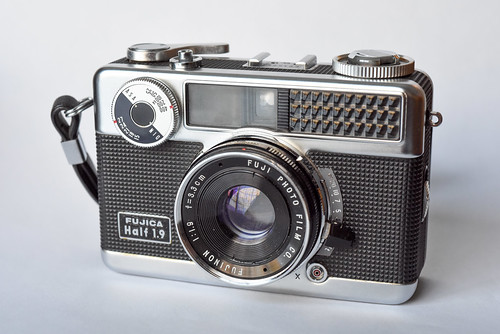
Someone I Met - and a New Camera. The Fujica Half 1.9 Half-Frame

I've been playing around with the 35mm half-frame format recently. (Click Here) and (Click Here) to see posts on my first half-frame camera, the Canon Demi EE17.
 
I recently bought a second half-frame camera, a Fujica Half 1.9. I picked it up on ebay for $22, including shipping, and it looks and works like new. It even came with the original soft leather case, strap and lens cap. Very cool.
 
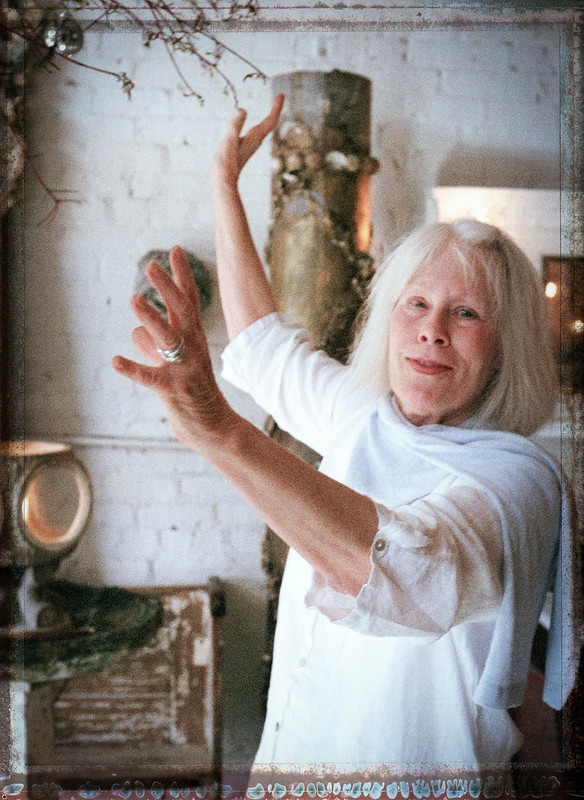
Here's the important part - a picture I made with it on a recent trip down to Greenville, South Carolina. My friend, Craig, and I took a run over to Asheville, North Carolina for the day. We met this fine lady in an art studio there.
 
 
I scanned the film, then edited it in Analog Efex 2 (Nik Software/Google) and Lightroom. Analog Efex has a wealth of film and camera emulations, and frames.
 
DMC-365.blogspot.com


Sunday, May 10, 2015

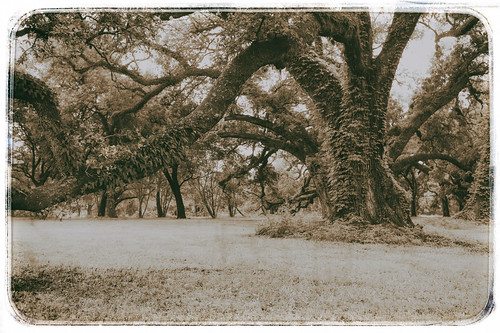
Live Oak Trees - Belle Haven Plantation - Nature Shot with Leica M9

During my trip to New Orleans for the LHSA (International Leica Society)'s Spring Shoot, we got to visit Belle Haven, a plantation that has been closed to the public for many years.
 
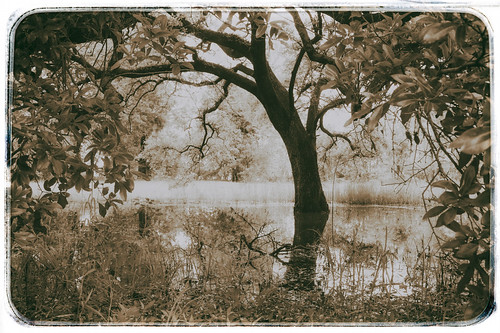
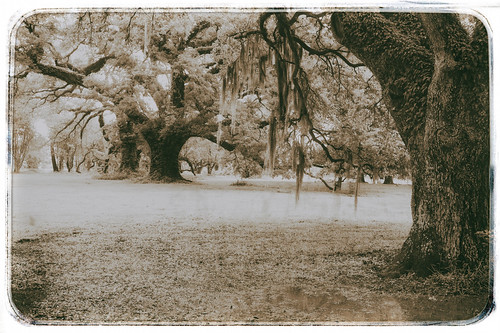
Our visit was wonderful, and I got to spend a lot of time out wading in the wet grass photographing the amazing old live oak trees on the property. Shooting with my M9, I manipulated the images in NIK Software to get the look I wanted. Here they are.
 
Live Oaks, by Reed A. George
 
All of these were shot with the M9 and either the 35mm v.3 Summicron or 50mm f1.4 Summilux (titanium).
 
One thing I don't like (or haven't figured out) in the NIK software is that if I want the same frame effect on a series of pictures, the frames come out looking exactly the same, including the dark and light smudges around the edges, which are supposed to represent the individual results of chemical darkroom techniques. Each one should be slightly different.
 
Overall, I'm pretty happy with the result. Not everyone agrees with manipulation, but I got the feel from the images that I was looking for.
 
(Click Here) to learn more about LHSA (International Leica Society). The national meetings like the Spring Shoot are great, but there are also many other reasons to join, including a great publication (Viewfinder), newsletter, and local groups and activities.
 
DMC-365.blogspot.com
 

Tuesday, March 31, 2015

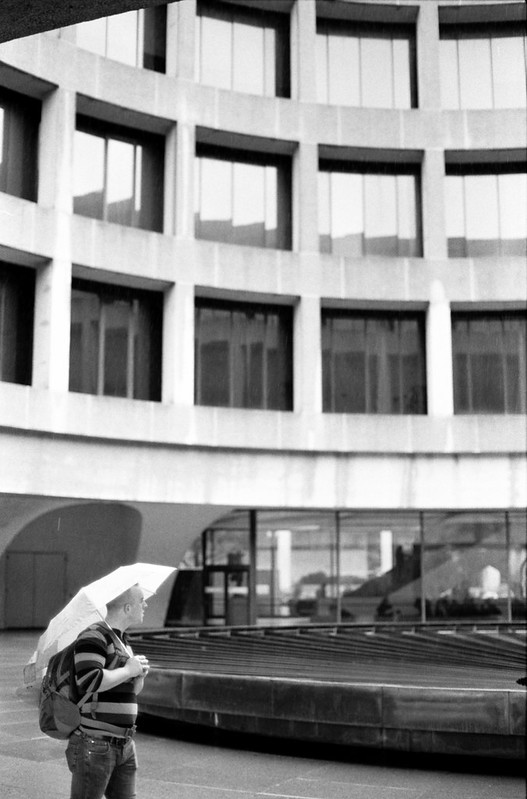
Trip to the Hirshhorn Museum in Washington, DC

I took my Nikon F2SB with me to the Hirshhorn Museum of Art in Washington, DC.
 
It was a cold, rainy afternoon.
 
Museums are Good for Rainy Days, by Reed A. George
Nikon F2SB, 50mm f1.4 AI Lens
Ilford HP5 Film
 
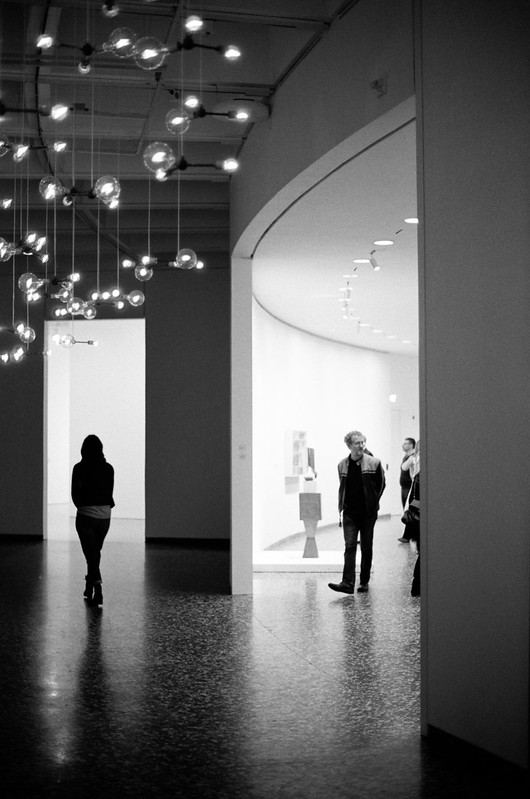
While photographing the displays or pieces of art in a museum is tantamount to stealing someone else's creativity, I always enjoy photographing people in the interesting environment created by a museum.
 
Separate Worlds, by Reed A. George
Nikon F2SB, 50mm f1.4 AI Lens
Ilford HP5 Film
 
I like how the left and right of the frame above could have come from completely different photographs.
 
The more I use the F2SB (which is a normal Nikon F2 SLR with the photomic finder that uses a very sensitive silicon sensor for light metering), the more I like it. Mine's in very nice user condition - not so nice that I'm afraid to take it out, but certainly well-preserved for its age. I enjoy shooting film with older manual Nikkor lenses, as well.
 
DMC-365.blogspot.com
 

Sunday, March 29, 2015

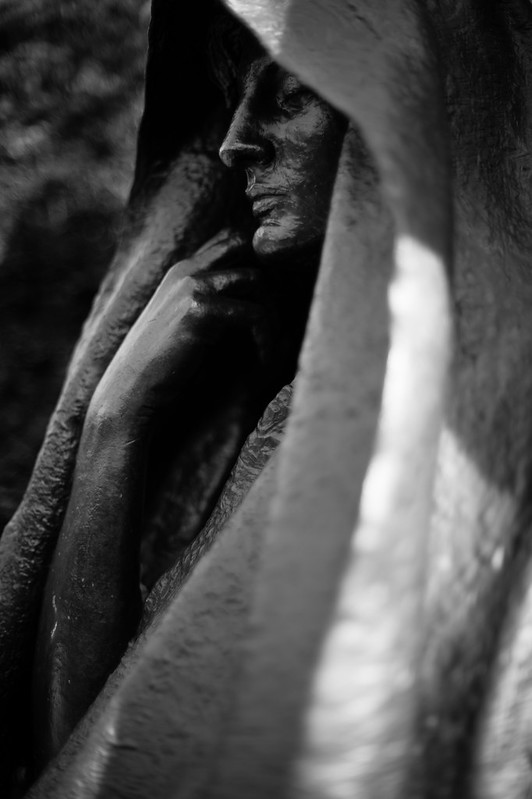
Adams Memorial Statue by Saint-Gaudens - And Connections

Adams Memorial Statue, by Reed A. George
Nikon Df, Nikkor 50mm f1.2 AIS Lens
iso 100, f1.2, 1/2000 sec.
 
My friends Charlie and Bill introduced me to this beautiful piece of art in the Rock Creek Cemetery in Washington, DC. It was made by Saint-Gaudens in memory of the wife of Henry Adams, Marian "Clover" Hooper Adams.
 
The first connection with photography is the fact that Mrs. Adams perished after drinking potassium cyanide, which she normally used to process photographs. Another photographic connection is that the statue was inspired by the Buddhist Bodhisattva of Compassion, Kannon. Kannon (Kwannon) was the namesake of the Japanese camera company Canon.
 
Adams felt very strongly that this statue should never be named. In fact, he cursed anyone who names it. (Click Here) to read his wishes, and the full history of the memorial.
 
I am pleased with the way my new 50mm f1.2 AIS lens rendered the statue. I used out of focus regions resulting from the very thin depth of field the lens produces wide open to bring attention to the shrouded face. The hand also serves as a compositional element that leads to the face.
 
DMC-365.blogspot.com

Monday, February 9, 2015

Contrasting Styles at the Japanese Ambassador's Residence

And one final shot from the new year event at the Japanese Ambassador's residence. I really like the feeling of this one.
Contrasting Styles, by Reed A. George
Nikon Df, Nikkor 35-70mm f2.8 AF-D Lens
iso 220, f4, 1/250 sec.
 
I could write a good fiction story based on this image. I love the reflected man in a business suit, with a female character, likely his wife, directly behind him, while two women in traditional kimono walk the corridor from the teahouse. There's some mystery in this image.
 
DMC-365.blogspot.com
 

Sunday, December 7, 2014

Leica Camera Blog Interviews Robert Mertens - Discussing Abstract and Surreal Images

Robert Mertens is an author, instructor of Master Classes at Leica Wetzlar, and a graphic artist.
 
 
The Leica Camera Blog interviewed Mertens to discuss his creative abstract and surreal imaging approach. Mertens says that his work "keeps revealing new elements through intense observation and interaction."
 
About his workflow, Mertens remarks:
"Think of the data from my Leica as modelling clay, from which my images are created in Photoshop."


His works take hours to sometimes days to complete in Photoshop.
 
Personally, even for my abstract work, I prefer to do as much in the camera as possible, including any composite construction of multiple images (multiple exposures). I certainly do post-process them, but prefer for that to take minutes, not hours or days.
 
Mertens uses a Leica M240 and 50mm Summilux for much of his work, and a Leica D-Lux for closeup images.
 
(Click Here) to read the full interview and see more images on the Leica Blog.
 
DMC-365.blogspot.com

Monday, October 27, 2014

From the Broad Creativity File - Using the Sun (and Magnifying Glass) to Make Art

Image Source: http://www.lostateminor.com/2014/10/10/artist-creates-landscape-artworks-using-magnifying-glass/
 
I love seeing new creative approaches to art. Usually, these come to me from the blog "Lost at E Minor," and this one is no exception.
 
This is Jordan Mang-osan. He makes the large murals by sketching them, then using a magnfying glass to burn the image into wood. Awesome, huh?
 
(Click Here) to read more.
 
I respect people who come up with different ideas like this. Once you see them, it's obvious. How many of us had wood burning kits when we were younger? For those who didn't, they were essentially electric soldering irons, which were used to burn pictures into wood. Using a magnifying glass instead isn't such a stretch. Why didn't I come up with that?
 
And regardless of who thought of it, I also respect people with the patience to put it to work on such a large scale. These pieces of art take Jordan months to complete.
 
DMC-365.blogspot.com


Wednesday, June 18, 2014

Cole Thompson on Vision

 
I recently read a great post on Cole Thompson's blog, about how he found his own vision. Cole started the journey with a portfolio review where the reviewer simply said that he was copying Ansel Adams. He told Cole that Ansel had already done Ansel, and he was never going to do it better than him.
 
This set Cole on a journey to find and develop his own vision, which he describes in a set of ten steps.
 
(Click Here) to read the whole post on Cole Thompson's blog.
 
A few of the elements of the post I like best are:
 
  1. He printed 100 of his most loved images, then sorted out those that he personally loved (not those that others happened to love). Then, he set his mind to pursuing more images like those.
  2. A direct quote: "I had to remind myself that this was not a race or a contest, I was not competing against others...I was competing with myself."
  3. Cole's vision didn't come to him in a flash, but in a moment of realization: "Vision was simply the sum total of my life experiences that caused me to see the world in a unique way."
I also like Cole's assertion that your vision is not necessarily associated with a particular look or style. You can bring your own vision to anything you set your mind to.
This is a very well-written piece, and one that makes me think more about why and how I pursue photography.
 
DMC-365.blogspot.com
 

Friday, May 2, 2014

Diane Varner's Daily Walks Blog

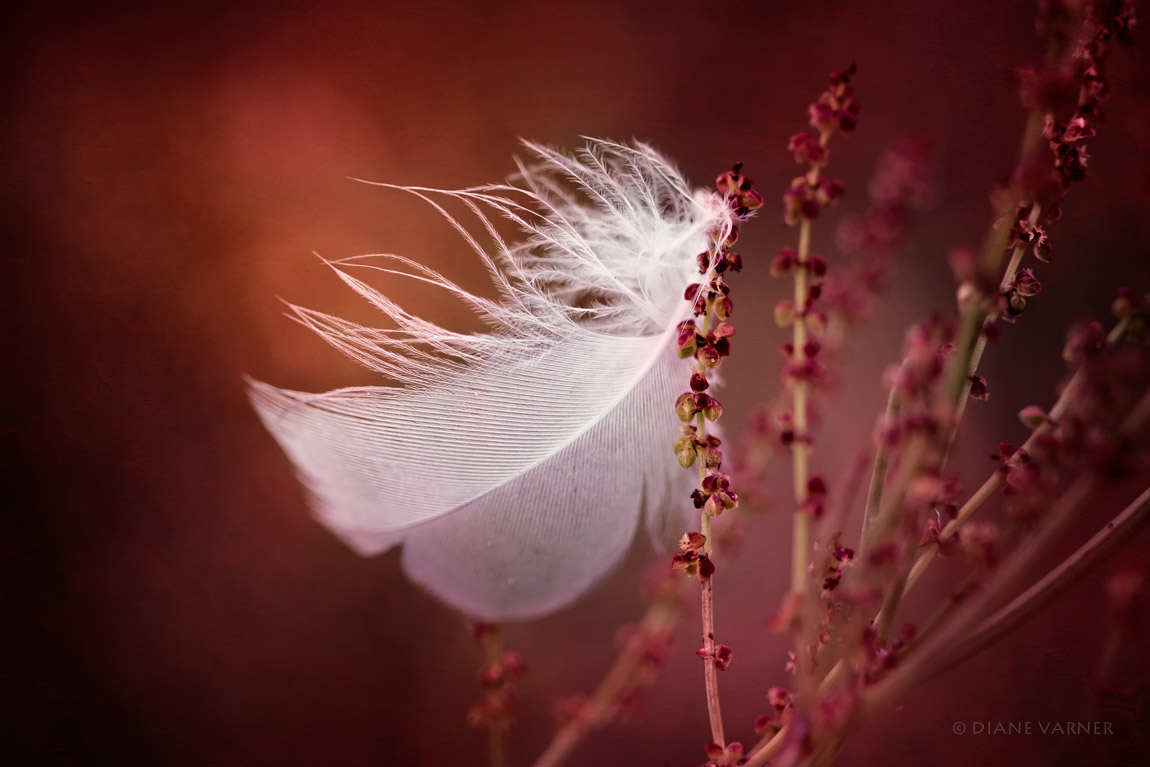
Soft Breeze, by Diane Varner
Image Source: http://dailywalks.com/dailywalks/2013/12/31/soft-breeze
 
Every once in a while, I find a simple image that just speaks to me. This one, from Art Photographer Diane Varner is one of them.
 
(Click Here) to go to Diane's blog.
 
To me, this image says "early spring." Not yet a sea of green, yet with nice color in the plants. Birds are out, doing there thing. I have no idea when this was taken, but that's my interpretation.
 
Sorry to be taking the easy way out, cross-posting some incredible work I've been finding in other blogs. But, I'm still recovering from jet lag and allergies, while doing my best to keep regular hours and make progress at work. Priorities, you know.
 
Hope you enjoy this image as much as I do. Back to more in-depth posts very soon.
 
DMC-365.blogspot.com
 

Monday, April 28, 2014

Petroglyph National Monument, New Mexico

One final post of images from my recent trip to Albuquerque, New Mexico. Very close to my hotel, Petroglyph National Monument offered a unique early morning walk before my business meetings started.
 
Petroglyphs are images by native people of the area, made by chipping away at the surface of the basalt rock in the area. The basalt stones were created about 200,000 years ago, when lava flowed 5-50 feet thick over a series of six separate eruptions. These boulders have a thin dark patina layer on their surface, caused by water, sun, temperature extremes, and microbes. It was by chipping away at the outer layer and exposing the lighter stone color underneath that native Americans made the petroglyph images.
 
Petroglyph on the Mesa Top, by Reed A. George
Panasonic Lumix DMC-GX7, Bower 7.5mm f3.5 Fisheye Lens
iso 400, f-stop unrecorded, 1/250 sec.
 
Most of these petroglyphs were made 400-700 years ago. Those from that period ("Rio Grande" style) include human figures, masks, hands, feet, as well as animal shapes and tracks, and geometric designs. Others date back as far as 3,000 years.
 
Various Petroglyphs, by Reed A. George
Panasonic Lumix DMC-G1, Pana-Leica Macro-Elmarit 45mm f2.8 Lens
 
As I've written in other posts, I found the Bower fisheye lens to be very useful on this trip. This was a bit of a surprise for me, as I've always thought of fisheye lenses as gimmicks, for special effects only. On this walk, I carried the GX7 with the fisheye attached, and my backup Micro 4/3 body, the GX1, with the Macro-Elmarit. This made for a very good combination in this particular setting.
 
DMC-365.blogspot.com
 

Saturday, April 12, 2014

New Mexican Art, Shot With Lumix DMC-GX7 Micro 4/3 Camera

I've been posting a few images from New Mexico, including a couple of fisheye images. Well, here are a few more, probably the last I'll post from this particular trip.
 
Old and New, by Reed A. George
Panasonic Lumix DMC-GX7, Lumix 14-42mm f3.5-5.6 Series II Kit Lens at 31mm
iso 200, f22, 1/200 sec.
 
This was shot outside an art museum. I very much like the contrast of the modern art right up front, and the more traditional looking sculpture in the background. After capturing this, I decided to get up close and personal with the stature, taking advantage of the fisheye lens' capability of simultaneously showing detail of the sculpture and the distinctly Southwestern architecture and courtyard surrounding it.
 
Native, by Reed A. George
Panasonic Lumix DMC-GX7, Bower 7.5mm f3.5 Fisheye Lens
iso 200, f-stop unrecorded (f8?), 1/1000 sec.
 
I really like how the fisheye captured this scene. I don't consider this to be only a special effect lens, as I had anticipated. Yes, there is quite a lot of distortion of the lines in the building, but I don't think it takes much away from the composition. I would like to compare this image to what I would get with the Voigtlander 12mm f5.6 (rectilinear, not fisheye) lens on a Leica M body. Less distortion, and even a little wider angle would be expected, but I don't know if I'd like the image as much or more. Sounds like a good test for the future.
 
Finally, a purely tourist-targeted scene:
 
Southwestern Kitsch, by Reed A. George
Panasonic Lumix DMC-GX7, Lumix 14-42mm f3.5-5.6 Series II Kit Lens at 34mm
iso 200, f11, 1/640 sec.
I don't mind that this is a stereotypical tourist trap scene, including some fake, painted peppers (the multicolor ones; the red ones are real). It's part of the environment in New Mexico now. So, why not show it?
 
One of my goals on this short trip was to see if I can rely on the GX7 for good travel photography. Carrying the GX7 and the even smaller GX1 as a backup body worked very well for me. I'm thoroughly impressed with the image quality of the GX7, if not the handling. I still don't feel that it quite fits my hands. But, it's pretty darned good.
 
DMC-365.blogspot.com
 

Wednesday, April 2, 2014

Art for the Sake of Art - From the Broad Creativity Files

Sand drawings. Andres Amador makes them, mostly for his own creative release. And the phrase "sand drawings" really isn't grand enough for what he produces.


Image Source: http://blog.chasejarvis.com/blog/2014/03/the-key-characteristic-shared-by-all-the-most-creative-people-i-know-andres-amador-interview/?utm_source=feedburner&utm_medium=feed&utm_campaign=Feed%3A+ChaseJarvis+%28Chase+Jarvis+Blog%29
 
I read about Andres' artistic pursuits on Chase Jarvis' blog.
 
(Click Here) to read the story and see several great examples on Chase's blog.
 
There are two things that really strike me about this work. First, as Chase emphasizes, the best art is done because the artist simply must do it, as opposed to doing it for money, prestige, etc. Second, this particular expression impresses me because of the inherent impermanence of it. The article mentions that it's somewhat like Tibetan Buddhist mandala sand paintings, where monks spend weeks making intricate paintings from colored sand, and then destroy them.
 
(Click Here) to read more about sand mandalas. I've always wanted to see one of these being made.
 
DMC-365.blogspot.com
 

Thursday, December 12, 2013

From the Broad Creativity Files - Japanese Artists Paint Hotel Rooms

Artist Naoki Takenouchi at the Park Hotel, Shiodome, Tokyo, Japan
Image Source: http://www.japantimes.co.jp/news/2013/12/02/national/hotel-room-walls-serve-as-canvas-for-takenouchis-contemporary-art/#.UpxvkDS9KSN
 
The Park Hotel in Tokyo is having artists come and spend some time in residence, under its "Artist in Hotel" program. Artist Naoki Takenouchi is painting his interpretations of "Fujin" and "Raijin," gods of wind and thunder, respectively, in a room now entitled "Japanese Paper Garden" for the sumi ink and washi paper used in his portrayals.
 
The hotel already has two other themed art rooms, one entitled "Sumo," the other "Zen."
 
What a cool idea. I'd love to stay in one of these one-of-a-kind rooms.
 
DMC-365.blogspot.com
 

Sunday, October 27, 2013

From the "Broad Creativity" File - Melting Ceramics

Image Source: http://www.lostateminor.com/2013/10/14/ceramics-melting-like-ice-cream/

Sometimes I like to look outside the confines of photography to broader creative pursuits. Usually, the things I'm interested still fall within the visual arts, as does this really cool project shown on the creative site Lost at E Minor.

Here, artist Livia Marin has converted porcelains into very diffferent works of art. I don't have a clue how she's done it, but I really like the effect. What strikes me is that the patterns are not melted or distorted. I imagine they're Marin's original designs, painted after the flowing background is produced. But, I can't be sure of that.

(Click Here) to read the original post on Lost at E Minor.

A nice diversion for a Monday morning (when I'm writing this).

DMC-365.blogspot.com


Monday, October 14, 2013

Accidental Degas (Impressionism) on THEME blog

Image Source: http://www.the.me/the-accidental-degas/?utm_source=feedburner

I love this. On the photography daily blog THEME, the author describes how they got the image above by accident - using an iPhone to photograph in low light at a gala dinner party.

It appears to me that noise reduction software in the iPhone provided the impressionist smearing. The colors are just magnificent.

(Click Here) to read about it, and see the image compared to a real Edgar Degas painting on THEME.

It is so easy to get hung up in technical perfection. Sometimes the impression is more important than the details. It was shown by the impressionists, who really weren't accepted at the time by more realistic painters. This picture proves that it translates to photography as well.

DMC-365.blogspot.com


Thursday, August 29, 2013

Mixed Media - Printing on Brushed-On Emulsion by Andrew Kaineder

 
Image Source:
http://www.lostateminor.com/2013/08/19/andrew-kaineder-professional-doer/?utm_source=feedburner&utm_medium=feed&utm_campaign=Feed%3A+LostAtEMinor+%28Lost+At+E+Minor%29
 
Not so excited with any equipment news recently, I'm once again widening the net in my search for interesting photographic subjects. I found this one on "Lost at E Minor," a broad creativity site.
 
(Click Here) to check out Lost at E Minor.
 
Andrew Kaineder and colleagues paint a liquid emulsion onto a surface, and then expose it, presumably from a negative. In the case above, the emulsion is painted onto paper, yielding one-of-a-kind character to each piece, and plenty of imperfection.
 
I'm not sure how I feel about the concept of making a photographic piece "one-of-a-kind." In some ways, I understand that increasing the value of a print, because no one else can have exactly the same print. However, is it merely a grasping at making photography more like painting, for example? One of the primary characteristics of photography is that it can be reproduced. Digital technology makes this even more true. I remember when digital audio came about and how it affected my friends who were into recording live performances (in their case mostly the Grateful Dead). It was an amazing piece of fortune to be able to duplicate a recording an unlimited number of times without ever losing a drop of sound quality. So, is that a bug or a feature?
 
I can also imagine the texture of Andrew's print. That is a little easier to appreciate for me.
 
I like to challenge and be challenged by new creative ideas like this.
 
DMC-365.blogspot.com
 
 
https://affiliate-program.amazon.com/gp/associates/network/build-links/individual/get-html.html?ie=UTF8&asin=B00023JE3E&marketplace=amazon


Monday, May 27, 2013

Film Photography Project Report on Shooting B&W Film


Photo by Lance King
Image Source: http://filmphotographyproject.com/content/features/2013/05/exploring-engaging-enlarging-black-and-white
 
I fell in love with the picture above when I saw it. It was taken on a recent walking workshop, put on by the Film Photography Project (FPP).
 
(Click Here) to check out FPP. These guys are great. They have a regular podcast that's pretty fun, and their store sells Kodak film for prices equivalent to the big NYC stores. I like to support FPP.
 
In a recent article on the FPP site, Jim Austin writes about black and white photography's important characteristics of austerity, authenticity, and abstraction.
 
By austere, I take Jim to mean that black and white photos offer none of the warmth or comfort of rich colors. It makes me think of the expression "It's right there, in black and white."
 
His point on authenticity is that monochrome images give the impression of being made before the days of photo manipulation. This is not true, of course, as manipulation has been around since the beginning of photography. But, I see his point. Most photos that are manipulated with modern software tools are likely to be color images.
 
The abstraction point is also good, in my opinion. Lack of color immediately takes us away from ust trying to replicate and show exactly what we saw, and hopefully leaves us with what we felt.
The Libyan Sibyl, by Reed A. George
Leica M4-2
 
So, go buy your film at FPP. Let's support the guys (and gals) who are keeping film photography alive!
 
DMC-365.blogspot.com


Saturday, March 16, 2013

Documentation of an Artist's Day - Yoshirou Shinkawa, Hill of Carnation Blog


Yoshirou's blog, hillofcarnation.blogspot.com, is in Japanese language. Therefore, I can't tell you much about this entry. I can refer you to this post:
 
(Click Here) to experience a day in the life of an artist, presumably in Japan.
 
The picture above really catches my eye. It is beautifully done - the colors are understated and real. The focus is in exactly the right place, and the background blurred, so as not to draw too much attention, yet retaining enough detail to make it interesting. A great environmental portrait.
 
I love to photograph people who are into their art. Here's one such person, who I found painting at an outdoor music festival:
 
Artist, by Reed A. George
Panasonic Lumix DMC-G3, Lumix 12-35 f2.8 Lens at 19mm
iso 400, f4, 1/500 sec
 
Artistic people are usually interesting.
 
DMC-365.blogspot.com
 

Saturday, March 9, 2013

Skeletons From The Closet - February Results - Super Ricohflex in Dramatic Light

As you may have seen, I've been exploring strong directional light here and there. I took the February SFTC camera, the Super Ricohflex, to DC for a day of wandering around the Smithsonian museums in DC. I found some wonderful light inside the lobby of the Smithsonian castle. I just sat and waited until people walked into that light. Here are some of the results.
Into the Light #1, by Reed A. George
Super Ricohflex Twin Lens Reflex, Kodak Tmax 400 Film
 
The design of the Ricohflex TLR allowed me to sit in the same position, looking down into my camera, rather than pointing it at face level at my subjects. At one point, someone came up behind me and asked if I was "filming." I assumed he meant videotaping, and replied that no, I wasn't. I suppose in fact that I was filming.
 
Into the Light #2, by Reed A. George
Super Ricohflex Twin Lens Reflex, Kodak Tmax 400 Film
 
I love the profile of the guy's face peaking out from the darkness at right.
 
Into the Light #3, by Reed A. George
Super Ricohflex Twin Lens Reflex, Kodak Tmax 400 Film
 
The Super Ricohflex has a relatively dim finder, as the viewing lens is f3.5. I had to prefocus, then just wait for someone to walk into the light.
 
Here's one from the entrance of the Natural History Museum. The dark interior contrasted nicely with the backlight coming from the bright daylight outside.
 
"That's One Big Elephant," by Reed A. George
Super Ricohflex Twin Lens Reflex, Kodak Tmax 400 Film
 
I'll finish the post up with a couple of other shots from DC.
 
Street View, DC, by Reed A. George
Super Ricohflex Twin Lens Reflex, Kodak Tmax 400 Film
 
I recently wrote about artist Ai Weiwei's exhibit at the Hirshhorn in DC. While I shot mostly with my M9 (see my recent Whole Lotta Leica post), I did make this shot with the Ricohflex:
 
Ai Weiwei's Zodiac, by Reed A. George

Super Ricohflex Twin Lens Reflex, Kodak Tmax 400 Film

 
I have one more roll of film from the Super Ricohflex to finish up and get processed. I've already moved onto shooting March's SFTC camera, the Zeiss Ikonta folder, but need to finish up the roll in the Ricohflex.
 
So, you'll be seeing a few more from the Ricohflex in the weeks to come.
 
DMC-365.blogspot.com


Thursday, March 7, 2013

Whole Lotta Leica - February Results - Ai Weiwei's Exhibit at the Hirshhorn With the W-Nikkor 3.5cm f2.5 Lens

I visited the Hirshhorn Museum in Washington, DC in February, where I saw a wonderful exhibit by Chinese artist Ai Weiwei. Weiwei is a multi-talented artist, working in an extremely wide range of media including photography and video, woodwork, pottery, architecture, social media, and sculpture. He has been the target of suppression by the Chinese government. He exposes social commentary in his art, for example in a series of pieces centered around the 2008 earthquake in Sichuan, China, where he decries the death of so many school children due to cheap construction of public school buildings.
 
(Click Here) to read about Ai Weiwei's exhibit at the Hirshhorn. It's certainly worth a visit.
 
I took the opportunity to shoot some images with my February Whole Lotta Leica lens - the W-Nikkor 3.5cm f2.5 LTM.
 
Ai Weiwei's Zodiac, by Reed A. George
Leica M9, W-Nikkor 3.5cm f2.5 Lens
iso 640, f4.8, 1/60 sec.
 
I like the radiating lines of the zodiac in the picture above. I waited until the lady walking around the exhibit came fully into a beam of light to release the shutter. The light on her face provides a small but powerful focal point.
 
Captivating Video, by Reed A. George
Leica M9, W-Nikkor 3.5cm f2.5 Lens
iso 640, f2.5, 1/30 sec.
 
Dragon's Gaze, by Reed A. George
Leica M9, W-Nikkor 3.5cm f2.5 Lens
iso 400, f4.8, 1/125 sec.
 
I find the W-Nikkor to be very sharp in the center, with a pretty nice range of contrast, if a little on the low contrast side. I think it's a little soft further from center, which can impart a particular look that's not good for every subject, but can be special in the right cases. Not exactly soft, but the peak sharpness is clearly in the center.
 
I elected to keep some of the images in color. Let's take a look at those. First off, this room of the exhibit is wallpapered with shots of the Olympic Stadium in Beijing, in which Ai collaborated on the architectural design. He makes wooden pieces, such as these geometric shapes (which, by the way, are constructed without a single nail, using traditional Chinese woodworking techniques), frequently using wood from ancient temples that have been disassembled or destroyed in the name of progress.
 
Ai Weiwei Exhibit, by Reed A. George
Leica M9, W-Nikkor 3.5cm f2.5 Lens
iso 640, f4.8, 1/15 sec.
 
Ai Weiwei Exhibit, by Reed A. George
Leica M9, W-Nikkor 3.5cm f2.5 Lens
iso 640, f4.8, 1/15 sec.
 
Ai Weiwei's "Snake Ceiling," by Reed A. George
Leica M9, W-Nikkor 3.5cm f2.5 Lens
iso 640, f5.6, 1/15 sec.
 
The snake in the picture above is constructed of children's backpacks. It is a statement about the Sichuan earthquake. Apparently, backpacks were an ever-present reminder of the many children lost in the disaster.
 
I enjoy shooting with the little Nikkor. I am very pleased with the way it renders subtle colors. It's a tiny lens, and is faster than my similarly-designed Leica 3.5cm f3.5 Summaron. However, I must admit that I prefer the Summaron's overall image quality.
 
I'm happy to have the Nikkor, but certainly would not want it to be my only or main 35mm lens for the M9. I have always wondered about the Nikon rangefinders, and wonder if the LTM lens performs similarly to the Nikon rangefinder mount lenses. I imagine that the performance is very similar.
 
DMC-365.blogspot.com