Showing posts with label museum. Show all posts

Wednesday, May 25, 2016

Tuesday, March 31, 2015

Trip to the Hirshhorn Museum in Washington, DC

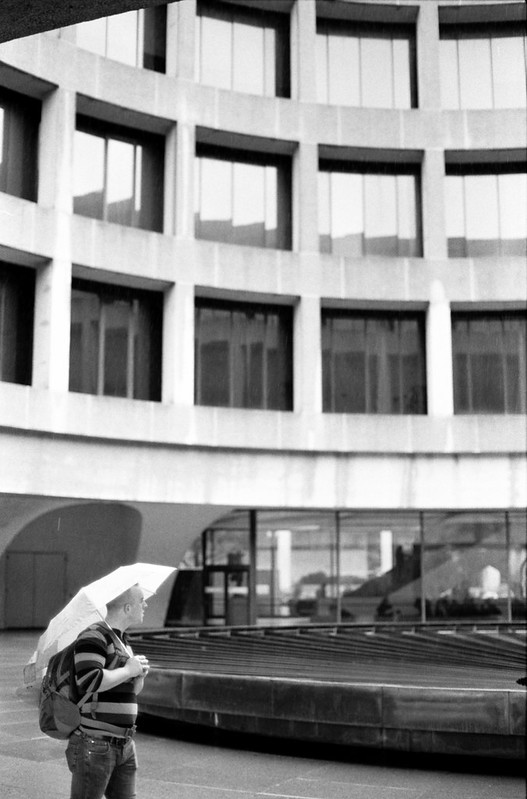
I took my Nikon F2SB with me to the Hirshhorn Museum of Art in Washington, DC.
 
It was a cold, rainy afternoon.
 
Museums are Good for Rainy Days, by Reed A. George
Nikon F2SB, 50mm f1.4 AI Lens
Ilford HP5 Film
 
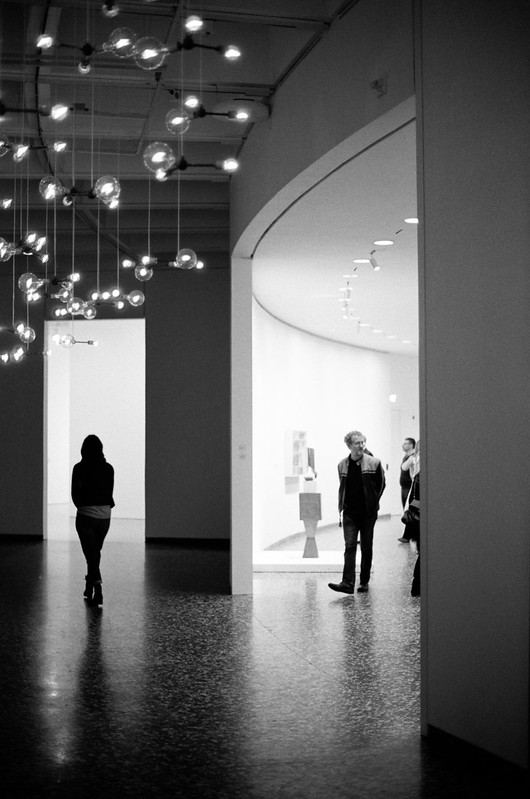
While photographing the displays or pieces of art in a museum is tantamount to stealing someone else's creativity, I always enjoy photographing people in the interesting environment created by a museum.
 
Separate Worlds, by Reed A. George
Nikon F2SB, 50mm f1.4 AI Lens
Ilford HP5 Film
 
I like how the left and right of the frame above could have come from completely different photographs.
 
The more I use the F2SB (which is a normal Nikon F2 SLR with the photomic finder that uses a very sensitive silicon sensor for light metering), the more I like it. Mine's in very nice user condition - not so nice that I'm afraid to take it out, but certainly well-preserved for its age. I enjoy shooting film with older manual Nikkor lenses, as well.
 
DMC-365.blogspot.com
 

Tuesday, July 22, 2014

Caught in the Maze

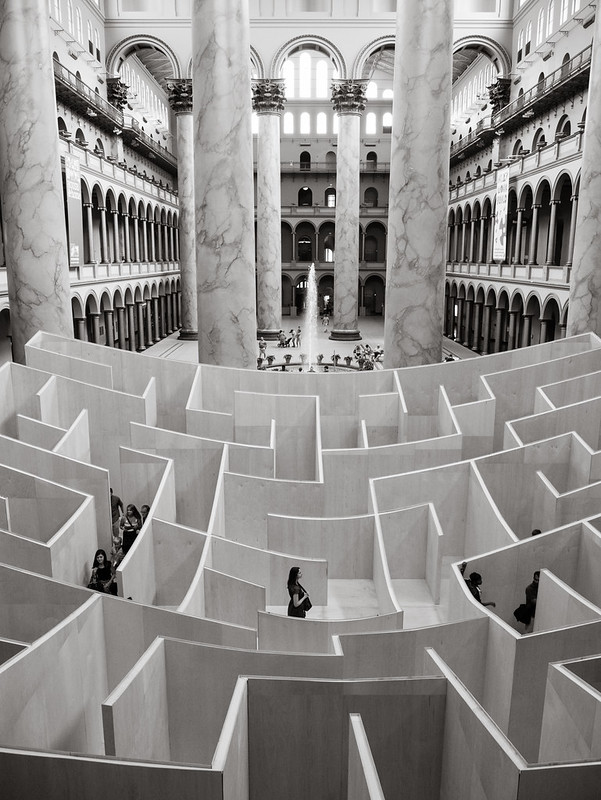
The National Building Museum in Washington, DC is currently hosting an exhibit called the BIG Maze.
 
(Click Here) to read about the museum and the maze.
 
The BIG Maze, by Reed A. George
Panasonic Lumix DMC-GX7, 14-42mm f3.5-5.6 Series 2 Kit Lens
iso 800, f5.5, 1/80 sec.
 
I like the context of the enormous museum interior to help show where the maze is in the larger space. I also like the single person in the very middle of the maze in this picture. She adds a lonesome element. People tended to gather in the center of the maze; I'm not sure why.
 
If you decide to attend this exhibit, be sure to get your maze entry tickets early. We came late and were not able to get it. But, that gave me the opportunity to photograph it from above as we watched others go through.
 
DMC-365.blogspot.com


Tuesday, May 6, 2014

The I.C.P. is Moving, Physically and Conceptually

The International Center for Photography (I.C.P.) in NYC, started by Robert Cornell Capa, is moving.
Museum Queue (not I.C.P.), by Reed A. George
Panasonic Lumix DMC-LX2
iso 400, f2.8, 1/8 sec.
 
The I.C.P. is one of those places I love to visit when I'm in NYC. Admittedly, I have not been there in a couple of years, but it strongly holds my interest. Started by Cornell Capa, brother of photographer Robert Capa*, the I.C.P. is a home for photographers, and hosts multiple simultaneous exhibits, typically focused on some aspect of photojournalism and reportage. I saw the fabled "Mexican Suitcase" exhibit there.
 
(Click Here) to read about the Mexican Suitcase and the work by Chim, Capa, and Taro that comprises it. A real look into the lives of these three masters, see it if you get the chance.
 
The I.C.P. also has a great store filled with all kinds of fun photographic paraphernalia and books.
 
Well, the I.C.P. is moving. A post in the New York Times' blog Lens describes what this means to Mark Lubell, Executive Director, and where he sees the I.C.P. going in the future.
 
(Click Here) to read the full article on Lens.
 
There are a couple of obvious conclusions that I can draw from the article. First, the I.C.P. plans to continue operations. Second, in the longer term, it plans to consolidate all activities, including the exhibition center and education program into a single location. Third, they plan to stay in Manhattan.
 
Beyond that, it's a little hard for me to really get where they're going conceptually. The interview focuses a lot on recent technological aspects of photojournalism, the use of smart phone cameras and immediate upload to communicate what's going on the world. I can almost detect the hint of virtual displays, with less focus on the physical output and display of prints. On the other hand, Mr. Lubell says that photography should be somewhat independent of technology, and that the Center should be a place for discourse on photography itself. I suppose these ideas can go together.
 
I was interested to find that Mr. Lubell thinks that Robert Capa would have been an enthusiastic user of Instagram. I'm sure the speed to market of photographic information would have impressed him.
 
DMC-365.blogspot.com
 
*Thanks to James McKearney for correcting my mistaken assertion that Robert Capa started ICP.
 

Sunday, August 18, 2013

Combining Two Loves - Science and Photography

I have just achieved a milestone. Combining my love for field science and photography, I have the incredible honor of being published in a first-rate Paleontology journal with a true leader in the field, Dr. Robert Weems. Our paper on amphibians and non-marine turtles from the miocene period was published in the July issue of the Journal of Paleontology.
 
(Click Here) to read the abstract.
 
My minor contributions to the work included two things - finding a humerus bone from a several million year old land turtle, and taking all of the photographs for the paper. Dr. Weems provided all of the scientific expertise, writing, and editing.
 
Here's the sample that I found:
 
Miocene Turtle Humerus, by Reed A. George
 
I met Dr. Weems through my association with Paleo Quest, a non-profit organization focused on education and scientific research, specifically in Paleontology.
 
(Click Here) to check out Paleo Quest.
 
What an exciting project! Thanks, Dr. Weems, for all of your assistance and support.
 
DMC-365.blogspot.com
 

Thursday, June 20, 2013

I'm Hosting the First International Leica Society (LHSA) Regional Meetup in DC This Saturday!

 
Daguere Statue, by Reed A. George
Leica M8, iso 320, f9.5, 1/180 sec
 
This coming Saturday, June 22, 2013 at 1:00PM, I'll be hosting the first regional meetup of the International Leica Society (LHSA) in the atrium at the National Portrait Gallery in Washington, DC.
 
If you're not familiar with LHSA, (Click Here) to check it out. Originally known as the Leica Historical Society of America, the LHSA has broadened and updated its scope, renaming itself to the International Leica Society. It is a great society to be a part of, offering an excellent journal, "The Viewfinder," national meetings, a raffle (ongoing at the moment, where members can win a new Leica M or APO Summicron lens, a Leica X2, or a Leica Dlux-6), a lively community on Google+, and now, regional meetups.
 
We will plan to meet at 1:00PM, get to know each other a little, maybe see an exhibit at the gallery. Then we'll head out and do some shooting around DC, ending up with a visit to the Leica Store DC.
 
Right now it looks like 6-8 of us will be there. So, get your membership up to date, grab your gear, and come on over!
 
DMC-365.blogspot.com
 

Saturday, March 9, 2013

Skeletons From The Closet - February Results - Super Ricohflex in Dramatic Light

As you may have seen, I've been exploring strong directional light here and there. I took the February SFTC camera, the Super Ricohflex, to DC for a day of wandering around the Smithsonian museums in DC. I found some wonderful light inside the lobby of the Smithsonian castle. I just sat and waited until people walked into that light. Here are some of the results.
Into the Light #1, by Reed A. George
Super Ricohflex Twin Lens Reflex, Kodak Tmax 400 Film
 
The design of the Ricohflex TLR allowed me to sit in the same position, looking down into my camera, rather than pointing it at face level at my subjects. At one point, someone came up behind me and asked if I was "filming." I assumed he meant videotaping, and replied that no, I wasn't. I suppose in fact that I was filming.
 
Into the Light #2, by Reed A. George
Super Ricohflex Twin Lens Reflex, Kodak Tmax 400 Film
 
I love the profile of the guy's face peaking out from the darkness at right.
 
Into the Light #3, by Reed A. George
Super Ricohflex Twin Lens Reflex, Kodak Tmax 400 Film
 
The Super Ricohflex has a relatively dim finder, as the viewing lens is f3.5. I had to prefocus, then just wait for someone to walk into the light.
 
Here's one from the entrance of the Natural History Museum. The dark interior contrasted nicely with the backlight coming from the bright daylight outside.
 
"That's One Big Elephant," by Reed A. George
Super Ricohflex Twin Lens Reflex, Kodak Tmax 400 Film
 
I'll finish the post up with a couple of other shots from DC.
 
Street View, DC, by Reed A. George
Super Ricohflex Twin Lens Reflex, Kodak Tmax 400 Film
 
I recently wrote about artist Ai Weiwei's exhibit at the Hirshhorn in DC. While I shot mostly with my M9 (see my recent Whole Lotta Leica post), I did make this shot with the Ricohflex:
 
Ai Weiwei's Zodiac, by Reed A. George

Super Ricohflex Twin Lens Reflex, Kodak Tmax 400 Film

 
I have one more roll of film from the Super Ricohflex to finish up and get processed. I've already moved onto shooting March's SFTC camera, the Zeiss Ikonta folder, but need to finish up the roll in the Ricohflex.
 
So, you'll be seeing a few more from the Ricohflex in the weeks to come.
 
DMC-365.blogspot.com


Sunday, February 3, 2013

Skeletons From The Closet - January Results Post #1 - Pentax K1000

I managed to get out a few different times with the my SFTC camera for January - the Pentax K1000. This is the first of a few posts to share the results with you.
 
My first outing was to the Udvar-Hazy Air and Space Museum. I'll start with a couple of shots made there.
Studying the Rockets, by Reed A. George
Asahi Pentax K1000, SMC Pentax 50mm f1.7 Lens
Kodak Tmax 400 Film
 
The fast f1.7 lens did a nice job here in the Udvar-Hazy museum, where I find photography to be quite challenging. First, there is an incredible number of historic aircraft and spacecraft jammed into a single giant hangar. I mean everything from the Enola Gay (yes, the actual B-29 that dropped an atomic bomb on Hiroshima, Japan) to a space shuttle. That makes it very difficult to shoot any particular aircraft without showing parts of neighboring ones, likely from different eras or locations. Second, the lighting is rough there. So, I decided to focus on people interacting with the museum. People are always a safe bet.
 
Gazing Up at the Space Shuttle's Thrusters, by Reed A. George
Asahi Pentax K1000, SMC Pentax 50mm f1.7 Lens
Kodak Tmax 400 Film
 
For my next outing, I took the K1000 to the National Portrait Gallery in Washington, DC. I've posted a picture or two from there recently, as part of my Whole Lotta Leica series.
 
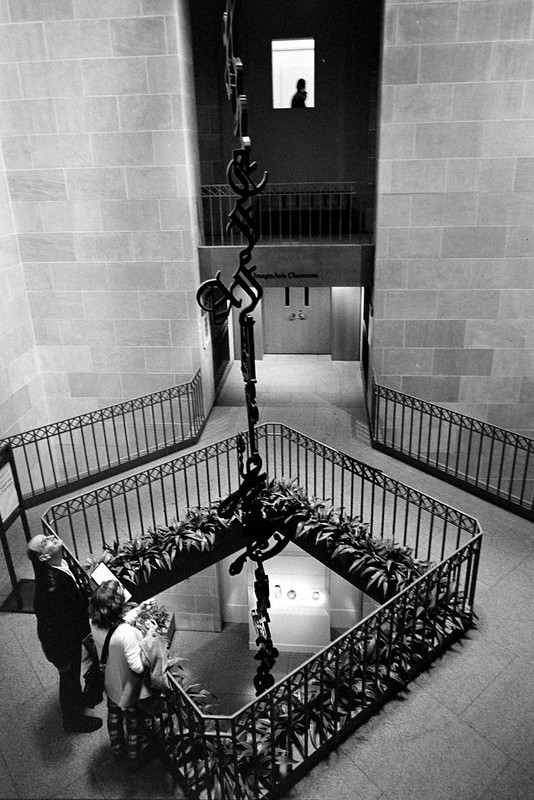
This is a stairway in the gallery:
 
National Portrait Gallery, by Reed A. George
Asahi Pentax K1000, SMC Pentax 50mm f1.7 Lens
Kodak Tmax 400 Film
 
A main attraction for me at the gallery is the indoor courtyard. Naturally lit, it is also warm in winter. Warm enough that kids can play in the water, as long as their parents are willing to stay long enough for them to dry off before again braving the winter weather.
Playing in the Courtyard, by Reed A. George
Asahi Pentax K1000, SMC Pentax 50mm f1.7 Lens
Kodak Tmax 400 Film
 
Playing in the Courtyard, by Reed A. George
Asahi Pentax K1000, Pentax 135mm f2.5 Lens
Kodak Tmax 400 Film
 
I switched lenses, using the Pentax 135mm f2.5 lens for a little more reach. I'm pretty impressed with this lens, which I picked up for a song. I got the 135, a Ricoh 50mm f2 (untested so far, but reportedly a great lens), and a Pentax 50mm f2 for $30. The 135 does not get any love on the forums. But, I'm quite pleased with the results I've gotten so far.
Playing in the Courtyard, by Reed A. George
Asahi Pentax K1000, Pentax 135mm f2.5 Lens
Kodak Tmax 400 Film
 
Of course, manually focusing it fast enough to keep up with playing children is a challenge, as it is will all manual focus lenses.
 
Here is my favorite image from this series:
 
Be Careful, Sister! by Reed A. George
Asahi Pentax K1000, Pentax 135mm f2.5 Lens
Kodak Tmax 400 Film
 
I love how the little girl looks so worried about her sister, judging from her hand gesture. Not sharply focused, but I don't think that takes away from this image.
 
So, how was the experience of shooting the K1000 for a month? Well, you must remember that I grew up with this camera in my hands. So, it felt like going home. I was so comfortable using it, I think that affected how I used it. In the case of the kids at the Gallery, my K1000 got a conversation going with the parents. I sent them some of the pictures, which they assure me are going into their family album. That is rewarding to me.
 
The 50mm f1.7 was always my normal lens. Again, I felt very comfortable using it. The 135mm f2.5 is relatively new to me. It is a challenge to focus well, but when you do, you get nice sharp images.
 
Just carrying around a film SLR draws a lot of looks, and some comments. All positive, like "Hey, a K1000! I had one of those! Maybe I still have it, even."
 
The battery (required for metering but not for shooting in this manual camera) lasted the whole month with no issues. It will still be fine the next time I pick the camera up, too.
 
So, I had a great time with the K1000. In fact, I hesitate to put it down and move on to another camera. But, that's the plan - a different camera from my collection each month of this year. Tomorrow, you'll see the camera I've selected for February - quite a departure from the K1000...
 
I have a couple more posts of results from January to write up, so more to come!
 
DMC-365.blogspot.com


Saturday, September 8, 2012

No, Really, What Do You Mean, Kodak? Are You In or Out of the Film Business?

 
Watching the Dinosaur Come Back To Life?, by Reed A. George
Leica M4-P, Summicron 50mm f2, film
 
Okay, now I see a new post from Kimberly Snyder, President and General Manager, Entertainment and Commercial Films Group, Vice President of Eastman Kodak Company, written in moderately more clear language than the previous post (see my post from Wednesday). Kimberly's post indicates:
 
"As a matter of fact, all film manufacturing will actually stay with Kodak, including that of consumer and professional still film."
 
Well, I certainly welcome this news, and hope it's true.
 
(Click Here) to read the Kodak message.
 
At this point, I'm sure that Kodak continuing in the business is best for us photographers. At the very least, the transition of so many years of manufacturing process, expertise, and equipment would take some time. So, here's to Kodak. I'll buy some film today just to support your efforts.
 
DMC-365.blogspot.com


Sunday, May 13, 2012

Jetpack Photography - Kirk Tuck's Take on Film and Digital

Personal Jetpack
Image Source:
http://io9.com/5029930/five-reasons-you-dont-have-a-personal-jet-pack-yet
 
Kirk Tuck has written a thought provoking piece about the controversy regarding how digital has affected photography. This is no nostalgic piece about how he longs for the good old days. It uses the analogy of competitive swimmers with jetpacks, and how, once they're allowed in the sport, no one can swim without one any more.
 
(Click Here) to read Kirk's piece on visualsciencelab.
 
I like many of the points that Kirk makes. I can admit two things in regard to this piece. First, I have a very hard time making myself slow down and think with a whiz-bang camera in my hands. I'm getting better. The Leica M8 is probably the best thing to happen to help me in that area. With that (wonderful) camera, I have to take my time, because it takes so long to write an image to the card that you better not miss the moment. But, seriously, the manual controls, manual focus probably being the most important, make me feel that I have invested something (if not money for film and processing) into each image.
 
Second, I do find it hard to wade through the piles of crap images that are posted on the web. I can click on through if I don't see something interesting, so no harm done. But, I find that I have to do that a lot.
 
One point that Kirk makes is that most of the famous images and successful collections were shot with film. Personally, I don't think that's a fair statement to make. How many years, how many decades of experience, went into making those film images? Sure, there are more images made every day now than then, so we can't compare the absolute numbers of images easily. But, definitely, the bulk of photographic history did not have digital equipment available to it.
 
I agree with Kirk's point that the equipment affects the photographer. I sure feel different when I'm holding a Lumix G3 than when I'm holding a 4x5 film camera. And, I shoot differently. I also judge other photographers (probably mostly incorrectly) by what they shoot with. Just last night, I met a lady who shoots the same Pentax film SLR that she has used her entire adult life. In my mind, she's a better photographer than her neighbor with an iPhone camera. Again, I'm probably wrong.
 
I prefer to focus my attention on what I like about each technology. Personally, I love the anticipation of getting film processed, when the images are just for my own enjoyment. It's even better when I have to wait to open an envelope filled with big 2 1/4" color transparencies, which have just returned from mail-in processing at Dwayne's.
 
(Click Here) for Dwayne's website. They do great work.
 
With that said, I sure appreciate the ability to experiment with new techniques with digital, see if they're working immediately, and resort to more proven approaches to make sure I get the shot, if not. I love being able to print (either scanned film or digital images) at home. I love having a 32" display, so I can see what a big print would look like, without having to invest in printing it.
 
And, personally, I'd love to have a jetpack.
 
Thanks, Kirk, for some stimulating words.
 
DMC-365.blogspot.com


Friday, March 23, 2012

Dual Exhibit at Tokyo Metropolitan Museum of Photography

 
Exploring Steel Bridge, by Masao Horino
Image Source: http://www.japantimes.co.jp/text/fa20120322a1.html?utm_source=feedburner&utm_medium=feed&utm_campaign
=Feed%3A+japantimes+%28The+Japan+Times%3A+All+Stories%29
 
As I have mentioned, I will be traveling to Japan in a little over a week from now. I love Tokyo, and am never without something new to explore, a new neighborhood to walk, or someone new to meet. I usually make it to the excellent gallery at Fujifilm's modern facility in Midtown. But, I have yet to make it to the Tokyo Metropolitan Museum of Photography. The last time I was there, I made the mistake of planning to go on a Monday, the only day of the week the museum is closed.
 
This time, while I'm there, there are two concurrent exhibits, one showing the work of Felice Beato (1832-1909), the other Masao Horino (1907-1998).
 
Beato was an early war photographer, active as Brady and his cohort were busy photographing the American Civil War. Beato photographed British military activities throughout Asia, but ended up spending 20 years in Japan. In addition to military subjects, he photographed local culture, and introduced hand coloring of photographs to the region. He also manually produced enormous panoramic images, ten of which are included in the exhibit. About 140 of his photographs in total are included.
 
Masao Horino was most active in the 1930s, and was very interested in advancing modern photography. He put his efforts into improving low, available light. He also showed female subjects in a new, casual way, unconventional in Japanese society. Horino stopped photographing, and showing his work, after World War 2, claiming his photographs had been lost in the war. This exhibit, including about 200 of his works, is his first show in 75 years.
 
(Click Here) for more information on the show, at Japan Times online.
 
I am planning to view both shows on my upcoming trip. Hopefully I'll have a good story to tell, or at least some of my own impressions to share.
 
DMC-365.blogspot.com