Showing posts with label comparison. Show all posts

Tuesday, August 4, 2015

Nikon D810 and Df - The Best Combination Available Today?

Well, I've been thoroughly enjoying my Nikon Df for some time now. The low light capabilities of this camera are spectacular.
 
I've recently purchased a Nikon D810, specifically to take advantage of the increased resolution (36 megapixels) for nature photography. Mounted on my Nikkor 200-400mm f4 AF-S VR G lens, the D810 should allow me more freedom in cropping, which is always useful in wildlife photography, especially with active species like birds.
 
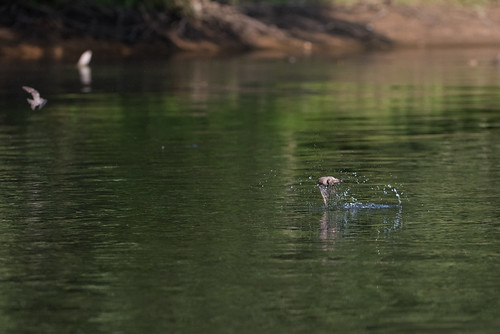
I've only had my D810 out a couple of times so far. One was this morning, shooting birds on a kayak outing. Here's a tightly-cropped shot of a swallow hitting the water surface.
And here's a 100% blow-up (cropped even more).
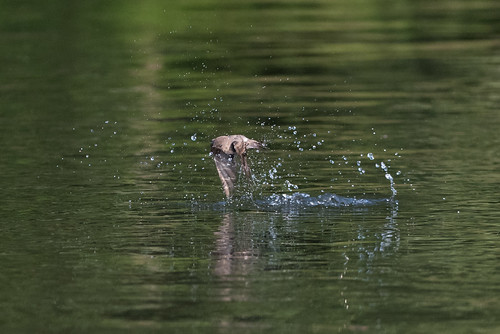
What I've found so far is that while the D810 does allow significant cropping, it doesn't handle high iso noise nearly as well as the Df. Of course, that's well-known in the Nikon crowd, and makes perfect sense, given the much higher number of pixels crammed into the same sensor real estate as the Df. The shots above were made at iso 1600, and noise is quite visible on my screen, looking at the images in Lightroom.
 
Here's a snapshot of DxO Lab's comparison of the two cameras:
 
Image Source: http://www.dxomark.com/Cameras/Compare/Side-by-side/Nikon-Df-versus-Nikon-D810___925_963
 
As you can see, the D810 wins in overall score, color depth, and dynamic range. But, it performs significantly worse in low light (high iso). Again, no new information here, but it's helping me to form my opinion of this pair of cameras and how best to use them.
 
Basically, the D810 will fill my need for high resolution and cropping ability when shooting wildlife in good light. Or anything else in good light, for that matter. The Df will remain my go-to camera for more challenging lighting situations, and when cropping is not as necessary.
 
So, I think that for me, yes, this is the best combination of Nikon bodies available today.
 
I have to get the D810 out in the field again, and shoot at lower iso settings. I'm sure that's going to really impress me.
 
DMC-365.blogspot.com


Wednesday, July 22, 2015

Lens Comparison: Nikon Nikkor 55mm f1.2 Non-AI Versus 50mm f1.2 AIS

Not long ago, I purchased a near-mint Nikkor 50mm f1.2 AIS lens from my friend. This super-speed manual focus lens is still made by Nikon, and is simply beautiful. I've posted a few shots from it. (Click Here) to see some photos I made with it in the darkness, during a fire.
 
Well, for no reason other than curiosity, I just bought a much older (1970s vintage) Nikkor 55mm f1.2 Pre-AI lens. With the older lens at about half the cost of the AIS lens, I was very interested to see how the two compare. So, I mounted the 55mm lens on my Nikon Df, set the iso to 160, and began to shoot from a tripod. I shot at f1.2, 1.4, 2, 2.8, 4, 5.6, and 8. You can click on any of the following images to see them full size on flickr.
 
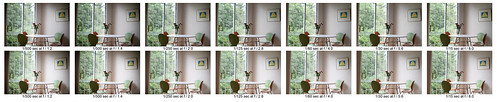
Here's what the whole scene looked like (top row: 55mm f1.2 Non-AI, bottom row: 50mm f1.2 AIS):
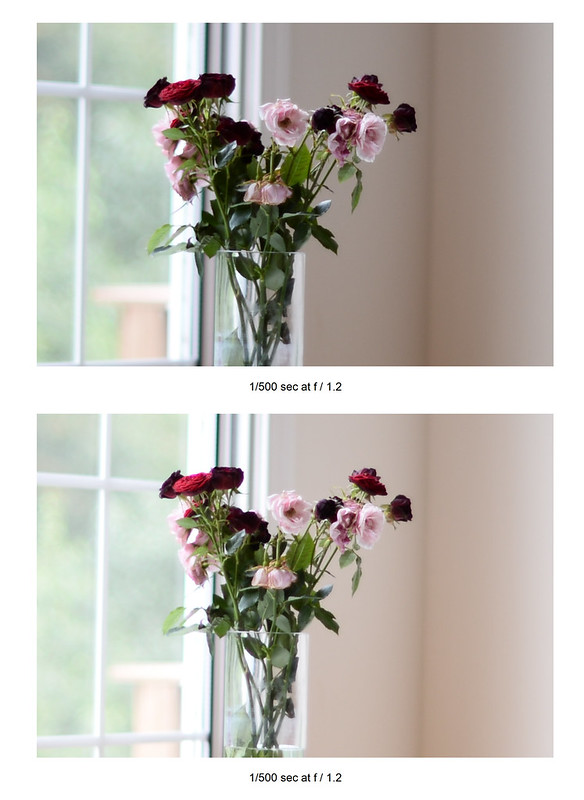
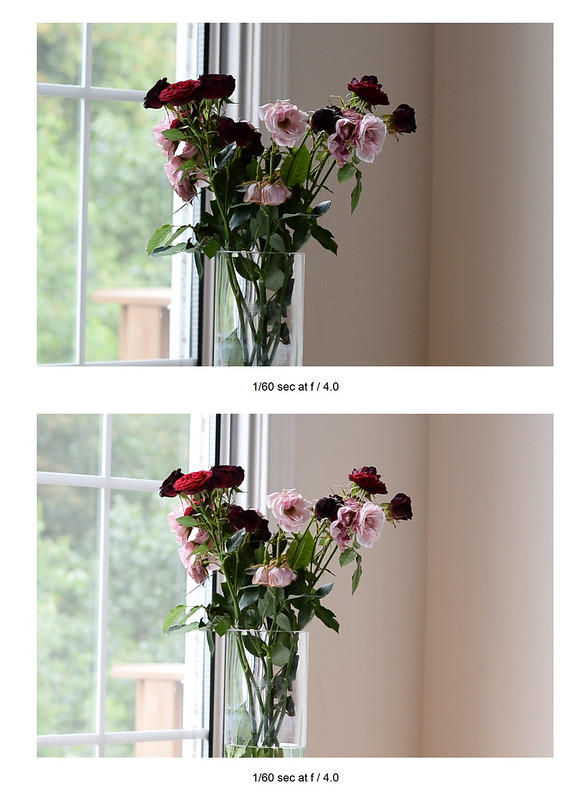
(Click Here) to go to the full flickr set, where you can get a much better idea of how these lenses compare. Be sure to look at how the vignetting decreases on both lenses as I stop down, look at the focus points (the flowers), out of focus areas (like the lemon painting on the wall at right), and how out of focus highlights are rendered. Here are a couple of selected comparisions, at f1.2 and f4:
f1.2, 55mm Non-AI on Top, 50mm AIS on Bottom
f4, 55mm Non-AI on Top, 50mm AIS on Bottom
 
I need to look at these more closely, but immediately conclude that the sharpness doesn't differ much at all. I also see that the 55mm lens seems to let less light in at the same f-stop as the 50mm lens. This could be do to the more modern coatings on the 50mm AIS lens.
 
If you're interested in these super-fast Nikkor lenses and their history, (Click Here) to read more on Nikon's website. Great information!
 
I plan to enjoy both of these lenses. The non-AI lens will be fun to put on a matching-age Nikon F2 and shoot some film with.
 
DMC-365.blogspot.com

Wednesday, April 24, 2013

I Guess I'm Just A Camera Romantic - How Does Lumix DMC-LX7 Compare to Medium Format?

Side by Side - Panasonic Lumix DMC-LX7 on Left, Zeiss Ikonta Medium Format on Right
 
Camera comparisons are always dangerous. So, I'll start out by saying that I did this only for my own edification. I tried to take the same picture of the scene above using two cameras - the Panasonic Lumix DMC-LX7 (which I was using as an exposure meter) and my March Skeletons From The Closet camera, the Zeiss Ikonta 521/16.
 
(Click Here) to read about the Ikonta.
 
I've written several posts about the LX7 already, so you can just search my blog for the list of posts.
 
What I'm trying to figure out here is what it is that I like about my old cameras. I also find myself thinking about how capable the LX7 is, and where its limitations are.
 
I shot both images with the respective camera mounted on a tripod. I shot the LX7 shot at iso100, versus the Portra 160 film in the Ikonta.
 
I uploaded the LX7 raw file to Lightroom and edited it as you see above - converted to black and white, minor cropping of the already square format image from the LX7, sharpening, and a little noise reduction.
 
With the Ikonta shot, I mailed the film off to The Darkroom (thedarkroom.com), waited a week (which is very fast for excellent processing service), scanned it at an outrageous high resolution, down-rezzed to a reasonable size, and edited in similar fashion to the LX7 raw image.
 
Then, when I was happy with each image, I compared them directly side-by-side in Lightroom (as you can see above).
 
What was the result? First, the LX7 image is much sharper. I was surprised by this. The prime Tessar on the Ikonta should outresolve a zoom on the LX7, right? Well, maybe it was just a focusing issue on my part; the Ikonta is a guess-focus camera. Or, it could be loss of sharpness in the scanning process.
 
In tonality, the images are very similar. The Ikonta image does show the wood grain a little better. I didn't notice this until seeing them next to each other. Subjectively, I can't really say that there's much difference. I would not pick one over the other. Unless I zoomed in and saw the better sharpness in the LX7 picture, I probably couldn't identify which image came from which camera at approximately 8x8" on my display screen.
 
Would the medium format image hold up better to big enlargements? Given that it's not as sharp to begin with, I doubt it. I don't see much noise in either image at reasonable sizes.
 
Again, this is not to say that the LX7 is as good as a medium format camera. Not at all. But, I find it educational that the results look so close for my normal application, which is sharing images online, and making enlargements up to 13x19" on my Epson R2400 printer.
 
So, I wonder why I go through all of the hurdles of using a completely manual film camera, the extra security at the airport when I ask for film to be hand-checked, waiting for film to be processed, scanning, and all the rest? Because I love it, that's why.
 
This exercise did two things for me. First, it reaffirmed to me that I really do photography out of love more than reason (that's what love is, right? Doing irrational things for the love of it?). Second, it made me more confident in using the LX7, even for pictures that I really care about.
 
How would it have done if we were comparing at iso 400? Hmm. I don't know. Maybe I'll try that next.
 
DMC-365.blogspot.com