Showing posts with label Tessar. Show all posts

Tuesday, August 5, 2014

Walter Ulreich Shares His Experience Going Back to a Zeiss Folder

 
Old Style, Kyoto, by Reed A. George
Zeiss 521/16 Medium Format Folding Camera
 
I love shooting old cameras. I have a few favorites, one of which is the Zeiss 521/16 folder, with Tessar 75mm f3.5 lens, which I used for the shot above.
 
(Click Here) to read more about this particular camera. This is the one that happened to have an old roll of film still in it, with pictures from JFK's Fourth of July speech in Philadelphia. (Click Here) to read about that roll of found film.
 
So, what made me think about this today? Well, as the post title mentions, Walter Ulreich has made a blog post that shares his experience in going back to a Tessar-equipped Zeiss folder after many years. His test images are quite impressive, certainly worth a look.
 
(Click Here) to go to Walter's post.
 
Amazing what a well-preserved old (very old, near 80 years old) camera can do!
 
DMC-365.blogspot.com
 

Wednesday, April 24, 2013

I Guess I'm Just A Camera Romantic - How Does Lumix DMC-LX7 Compare to Medium Format?

Side by Side - Panasonic Lumix DMC-LX7 on Left, Zeiss Ikonta Medium Format on Right
 
Camera comparisons are always dangerous. So, I'll start out by saying that I did this only for my own edification. I tried to take the same picture of the scene above using two cameras - the Panasonic Lumix DMC-LX7 (which I was using as an exposure meter) and my March Skeletons From The Closet camera, the Zeiss Ikonta 521/16.
 
(Click Here) to read about the Ikonta.
 
I've written several posts about the LX7 already, so you can just search my blog for the list of posts.
 
What I'm trying to figure out here is what it is that I like about my old cameras. I also find myself thinking about how capable the LX7 is, and where its limitations are.
 
I shot both images with the respective camera mounted on a tripod. I shot the LX7 shot at iso100, versus the Portra 160 film in the Ikonta.
 
I uploaded the LX7 raw file to Lightroom and edited it as you see above - converted to black and white, minor cropping of the already square format image from the LX7, sharpening, and a little noise reduction.
 
With the Ikonta shot, I mailed the film off to The Darkroom (thedarkroom.com), waited a week (which is very fast for excellent processing service), scanned it at an outrageous high resolution, down-rezzed to a reasonable size, and edited in similar fashion to the LX7 raw image.
 
Then, when I was happy with each image, I compared them directly side-by-side in Lightroom (as you can see above).
 
What was the result? First, the LX7 image is much sharper. I was surprised by this. The prime Tessar on the Ikonta should outresolve a zoom on the LX7, right? Well, maybe it was just a focusing issue on my part; the Ikonta is a guess-focus camera. Or, it could be loss of sharpness in the scanning process.
 
In tonality, the images are very similar. The Ikonta image does show the wood grain a little better. I didn't notice this until seeing them next to each other. Subjectively, I can't really say that there's much difference. I would not pick one over the other. Unless I zoomed in and saw the better sharpness in the LX7 picture, I probably couldn't identify which image came from which camera at approximately 8x8" on my display screen.
 
Would the medium format image hold up better to big enlargements? Given that it's not as sharp to begin with, I doubt it. I don't see much noise in either image at reasonable sizes.
 
Again, this is not to say that the LX7 is as good as a medium format camera. Not at all. But, I find it educational that the results look so close for my normal application, which is sharing images online, and making enlargements up to 13x19" on my Epson R2400 printer.
 
So, I wonder why I go through all of the hurdles of using a completely manual film camera, the extra security at the airport when I ask for film to be hand-checked, waiting for film to be processed, scanning, and all the rest? Because I love it, that's why.
 
This exercise did two things for me. First, it reaffirmed to me that I really do photography out of love more than reason (that's what love is, right? Doing irrational things for the love of it?). Second, it made me more confident in using the LX7, even for pictures that I really care about.
 
How would it have done if we were comparing at iso 400? Hmm. I don't know. Maybe I'll try that next.
 
DMC-365.blogspot.com


Monday, April 22, 2013

Skeletons From The Closet - A Few More Shots From Japan With March's Camera - Zeiss Ikonta 521/16

I want to share a few more pictures and experiences from shooting my Zeiss Ikonta 521/16 medium format folder in Japan. There is always a certain amount of risk of failure in shooting cameras thirty or more years old. In this case, it's more nearly sixty years old. The Tessar lens on my Ikonta is in great shape, and really performs well. In general, the rest of the camera is in nice shape as well, but using it wasn't completely without issues.
I noticed on my second roll that the film wasn't being tightly spooled onto the take-up spool. When I removed it from the camera, I could see the edge of the film where it extended past the spool - not good. I did have several frames ruined by light getting in through this edge exposure. The shot below is a fairly mild example of that, with the streak of light at the bottom, right of center.
Light Leakage From Loosely Wound Film, by Reed A. George
Zeiss Ikonta 521/16
 
Kyu-Yasuda Garden, Ryogoku, Tokyo, Japan, by Reed A. George
Zeiss Ikonta 521/16
 
The shot above, of the Kyu-Yasuda Garden in Ryogoku, has the same problem. That's why it's cropped to a rectangle here. You can see a hint of the light leak at the bottom right. While I like it with this crop, the composition was better in square format, with larger walking stones closer in the foreground.
 
Sakura Reflection, by Reed A. George
Zeiss Ikonta 521/16
 
I don't know what causes the film to be loosely wound onto the take-up spool, but it did happen on about half of my rolls. There are two spring steel tabs that apply pressure to the source and take-up spool, but that's about all I can see inside this simple camera that may affect tightness on the spool.
 
Luckily, it didn't affect all of my images, just those that were on the outside (later shots in the roll). But, until I figure out how to fix it, it requires unloading the camera in complete darkness, and re-rolling the film tightly onto the spool by hand in the dark. Not exactly convenient.
 
It was a blast shooting the old Ikonta in March. I'm still very impressed by the optical quality of the Tessar.
 
DMC-365.blogspot.com


Saturday, April 20, 2013

Skeletons From The Closet - March Results - Rokkaku-Do Temple in Kyoto Shot With Zeiss Ikonta 521/16

Every year when I visit Japan, I make it a goal to get out early in the mornings for some solitude, thought, and photography. This year, I achieved that on our last day in Kyoto, by visiting Rokkaku-Do, a Buddhist temple from the early Heian period. That means it was like constructed before the year 1000 (otherwise known as Y1K to the computer scientists of the time). Rokkaku-Do is in an urban part of Kyoto, and is immediately adjacent to the headquarters of Ikenobo, the association for Ikebana, Japanese flower arrangement. Apparently, Ikebana was started at Rokkaku-Do temple.
 
(Click Here) to read more about Rokkaku-Do temple.
 
I shot in an interesting way on this morning. I carried my Panasonic Lumix DMC-LX7, a tripod, and my Skeletons From The Closet camera for March, the Zeiss Ikonta 521/16.
 
(Click Here) to read more about my Zeiss Ikonta 521/16.
 
I used the LX7 as my exposure meter and scene test camera. Setting it to the same iso as the film in the Zeiss Ikonta, and selecting square image format, I found the LX7 extremely useful in this way. I also have a nice set of LX7 images to compare to the film shots. I plan to do a post about that in the future.
 
I used my DIY paper card rangefinder to just distance for focusing. (Click Here) to read about that. Scroll down to the bottom of the post for a description and link to a very helpful website for making your own rangefinder card.
 
Here are some of the quiet scenes I experienced that morning, scanned and cropped, but otherwise unedited.
 
Dragon Fountain, by Reed A. George
Zeiss Ikonta 521/16 with Tessar f3.5 Lens
 
 
Swan Pond, by Reed A. George
Zeiss Ikonta 521/16 with Tessar f3.5 Lens

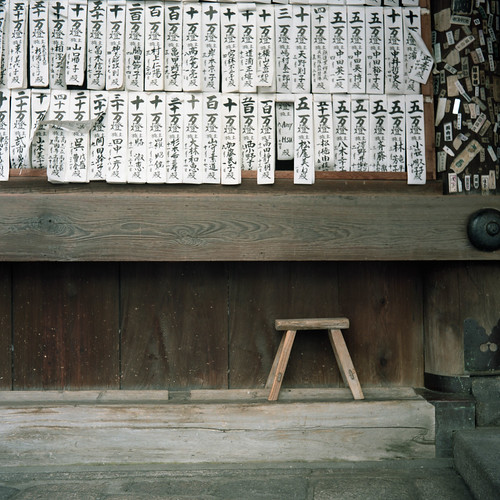
Wooden Stool, by Reed A. George

Zeiss Ikonta 521/16 with Tessar f3.5 Lens

I knew that I liked the shot above as soon as I took it.

Symmetry, by Reed A. George

Zeiss Ikonta 521/16 with Tessar f3.5 Lens

That is the hexagonal main hall roof reflected in the water above. Rokkaku means hexagon in Japanese, and is the source of the temple's popular name.
Traveling Monks and Fallen Blossoms, by Reed A. George
Zeiss Ikonta 521/16 with Tessar f3.5 Lens
 
The best part of my morning was when an elderly Japanese lady came by and said good morning to me. Surprised that I could answer in Japanese, she then began my education about Rokkaku-Do.
 
Kami-Sama, by Reed A. George

Zeiss Ikonta 521/16 with Tessar f3.5 Lens (cropped)

 
She spoke only Japanese, so I must admit that I missed a significant part of the lesson. However, I did understand that the stone gods (kami-sama) above were collected from an important path in the area, I believe a path that led between multiple temples. She also told me that old ladies like her knit the hats and aprons for the kami-sama, because they want to make sure they don't get cold out here.
 
If you notice the little white sculptures lined up in front, they are ceramic doves. When I asked her what they were for, she literally took me by the arm, and walked me up to them, telling me how young couples who are in love come here for a specific purpose. She walked with a spring in her step, like a young girl with her boyfriend. She explained to me that a prospective bride can write down the things she likes about her fiance' on a piece of paper, and also list the things she's not so crazy about, putting an X next to those. The paper is then rolled up and put into a special groove in the bottom of the pigeon statue. The gods will work to make the X'd features of her lover go away. I loved that I was able to understand this part, through a combination of halting language on my part, rapid-fire Japanese on hers, and some hand gestures.
 
She also took me inside one of the buildings to explain that Rokkaku-Do was one of 36 stops on the Kansai Kannon pilgramage, where people visit 36 different spots to worship the god Kannon.
 
(Click Here) to read more about the Kansai Kannon pilgrimage.
 
My only regret was that she was too shy to let me take her picture. She politely gave me a wave of the hand, shook her head "no," and quickly moved off. I have said that my goal is not to catch every possible good photograph, but to make sure the ones I do get are the best I can make them. She'll have to be one of the ones I missed.
 
DMC-365.blogspot.com


Friday, March 1, 2013

Skeletons From The Closet - March's Camera - The Zeiss Ikonta 521/16 With "Eagle Eye" Tessar

 
Zeiss Ikonta 521/16 With Tessar 75mm f3.5 Lens, by Reed A. George
 
My original plan for March's Skeletons From The Closet (SFTC) pick was a 35mm folding camera. Since I'm taking probably my most exciting trip of the year (to Japan) in March this year, instead of April when I normally go, I decided that I really wanted to carry a medium format camera this month. So, I decided to take my Zeiss 521/16.
 
This is a beautiful old camera, produced between 1948 and 1953. It uses 120 film, and produces 6x6 (2 2 1/4" square) images.
 
You may have seen my post back on November 19 of last year, sharing some found film images from this camera. It was used to shoot a presidential speech by John F. Kennedy in the early 1960s.
 
(Click Here) to see that post of old images from this camera.
 
I also wrote a tongue-in-cheek nod to Edgar Allan Poe's Telltale Heart about this camera. You can read that on JPG Magazine's site if you (Click Here).
 
I want to shoot some color images with this camera while I'm in Japan, so I've already purchased a five roll box of Portra 400. With a maximum shutter speed of 1/200 sec., that may be a little fast if the weather is nice. I'll also take along a roll or two of Fuji Reala that is waiting in my refrigerator.
 
Oh, and don't worry, that 35mm folder will be out in a later month as the SFTC pick.
 
DMC-365.blogspot.com


Monday, November 19, 2012

Found Film - How Cool It Can Be


A couple of years back, I took a chance and bought a largely-undescribed Zeiss medium format folding camera from a seller on ebay. The seller did not normally deal in camera equipment (I checked), so I thought

"Who knows, maybe I'll get lucky."

Well, I did. Not only did the camera turn out to be equipped with a downright gorgeous Tessar f2.8 f3.5 lens (YES!), it had a roll of film still in it. I could hardly breathe as I processed that roll. Here are a couple of the results:
Found Film, Recovered by Reed A. George
Zeiss 521/16 Folder, 120 Film
Man, I Wish I Knew the Exposure (and other) Details!

I quickly posted the results to my favorite online neighborhood of friendly photographers.
(Click Here) to see what people had to say, and the rest of the pictures from this camera. Consensus says it's likely from a JFK speech in Philadelphia, Pennsylvania in the early 1960s, probably right before I was born.

(Click Here) to read a tongue-in-cheek story I wrote about it for JPG Magazine.

And here's what the camera can still do:
Waterford News, by Reed A. George
Not Bad for Guess Focus and f2.8 3.5, Huh?
Zeiss 521/16, f2.8 3.5

What got me thinking about this? A very cool post by New Zealand blogger Jason about purchasing some Leica equipment from a deceased photographer's family and discovering a treasure trove of slides.

(Click Here) to see the post on aperturepriority.co.nz

I have to get that old Zeiss folder out soon. It's been a while. You just can't beat using an old camera that gives these kind of results.

DMC-365.blogspot.com