Showing posts with label temple. Show all posts

Saturday, May 16, 2015

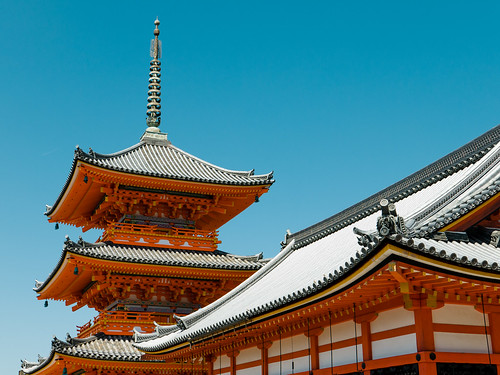
Kiyomizu-dera Temple in Kyoto, with Lumix DMC-LX100

Here's another shot showing the capability of the Panasonic Lumix DMC-LX100 for travel.
 
Kiyomizu-dera, by Reed A. George
Panasonic Lumix DMC-LX100
iso 200, f5.6, 1/640 sec.
 
Now this is a situation where most cameras would do just fine - bright sunny day, outdoors, wonderful subject. But, the detail, sharpness, and color representation of the LX100 really come through here in my opinion. None of my (much) heavier, more complicated cameras would have done significantly better with this scene.
 
I'm quite pleased with the LX100 as a travel camera.
 
DMC-365.blogspot.com
 

Friday, April 10, 2015

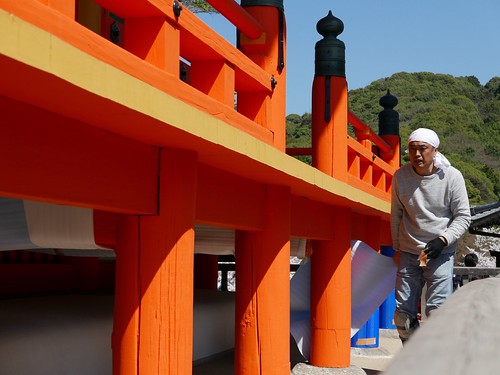
Today's Image From Japan - Someone Has to Keep This Place Up!

Shrine Painter, by Reed A. George
Panasonic Lumix DMC-LX100
iso 200, f5.6, 1/1000 sec.
 
I always like to photograph people at work. This gentleman was painting the shrine; you can see his handiwork right there. He was completely surrounded by tourists, but that didn't affect his concentration on his job.
 
DMC-365.blogspot.com
 

Thursday, April 9, 2015

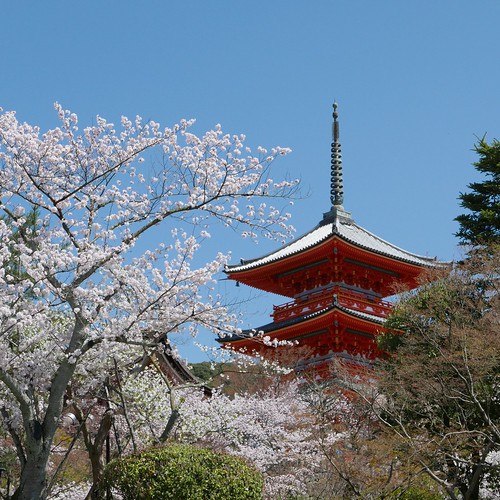
Image of the Day From Japan

 
Kiyomizu-Dera, by Reed A. George
Panasonic Lumix DMC-LX100
iso 200, f8, 1/400 sec.
 
Yes, it is a little postcard-like, but I loved the view.
 
DMC-365.blogspot.com


Wednesday, April 8, 2015

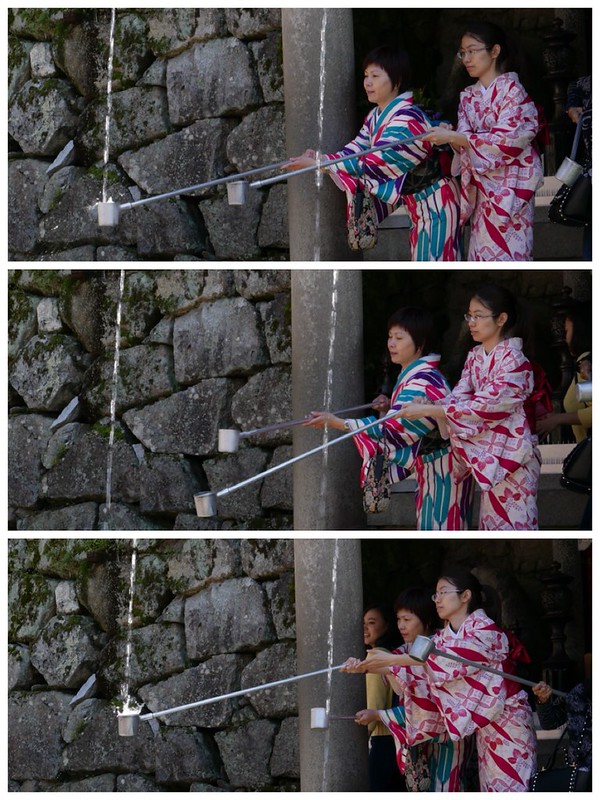
Kiyomizu-dera Temple in Kyoto, Japan - Wish-granting Waterfall

My family and I just got back from a visit to Kyoto. We visited Kiyomizu-dera temple, founded in the year 798. (Click Here) to read more about the temple.
 
One of the features of Kiyomizu-dera is the Otawa waterfall, whose water is said to grant wishes to those who catch and drink it.
 
Here's a triptych that I made there with the Panasonic Lumic DMC-LX100.
Otawa Waterfall Triptych, by Reed A. George
Panasonic Lumix DMC-LX100
 
For this day of our trip, since I knew we would be on the move all day, I left the Nikon Df and lenses at the hotel, taking only the LX-100. To be honest, it's almost embarrassing just how good the LX100 is. I didn't miss the Df at all, and really enjoyed my freedom from the heavy camera bag.
 
These images are direct from the camera, just cropped and put together on my iPad.
 
DMC-365.blogspot.com


Tuesday, March 17, 2015

Visit to a Buddhist Temple - With My Rolleiflex 2.8F

Wat Lao Buddhavong, by Reed A. George
Rolleiflex 2.8F, Kodak TMax 400 Film
 
I made a visit to a local Buddhist temple that I'd never been to before - Wat Lao Buddhavong in Catlett, Virginia. Anticipating a festival that never materialized (I guess my information was wrong), I took the opportunity to walk around the grounds. These are a few of the things I saw there.
 
Shooting with TMax 400 in the bright sunlight and with snow still on the ground meant very fast shutter speeds (1/250-1/500) and small apertures. I did use a yellow filter, which reduced the sensitivity by about 1 - 1 1/2 stops, so really, I was shooting at an equivalent of about iso 150.
 
The square composition worked well for me here. The detail that the 2.8F's Carl Zeiss Planar bring out are just amazing.
 
DMC-365.blogspot.com


Sunday, March 15, 2015

Some Panoramic Pinhole Images - Buddhist Temple

Here are three 6x17 shots I recently made at my meditation class:
 
These were made with the "Reality So Subtle" panoramic pinhole camera that my wife bought for my on my 50th birthday. It shoots four exposures on a roll of 120 film (TMax 400 in this case, which I developed in Kodak D-76 diluted 1:1 for 13 1/2 minutes). The top and bottom images were made with about ten seconds of exposure; the middle one took one hour.
 
(Click Here) to read more about the camera.
 
(Click Here) to see the images above at full size on my flickr page.
 
DMC-365.blogspot.com


Saturday, September 14, 2013

Skeletons From The Closet - August's Agfa Record III - Buddhist Temple

My SFTC camera for August made a huge impression on me. The Agfa Record III with Solinar is a super capable camera.
 
(Click Here) to read about the camera.
 
Producing big ol' 6x9 negatives, the image quality is spectacular, in my opinion. Here are some shots from a recent trip to my local Buddhist temple, all on Kodak Portra 400 color negative film.
 
Altar Flowers, by Reed A. George
Agfa Record III with 105mm f4.5 Solinar Lens
 
Tree Deck and Altar, by Reed A. George
Agfa Record III with 105mm f4.5 Solinar Lens
 
I wish I had lined up Buddha's face in the reflection on the rail. That would have been difficult but interesting.
 
Bell, by Reed A. George
Agfa Record III with 105mm f4.5 Solinar Lens
 
Smile!, by Reed A. George
Agfa Record III with 105mm f4.5 Solinar Lens
 
This old camera is amazing. I recently found myself looking long and hard at the modern Fujifilm GF670, a folding 6x7 medium format camera. While I was looking, the Record III showed up in my life, thanks to a package from my Mom. With its uncoupled rangefinder built-in, and accessory shoe to hold my Voigtlander CV Meter II, the Record III is very convenient to use; I don't have to carry around a separate meter and/or rangefinder in my pocket. And, unlike the GF670, the Record III doesn't need a battery to operate.
 
So, the Record III is a perfect high quality medium format camera for carrying on travel. In fact, it went with me to Maui recently. The film is off for processing at The Darkroom now, so you'll see those pics soon as well.
 
DMC-365.blogspot.com


Saturday, April 20, 2013

Skeletons From The Closet - March Results - Rokkaku-Do Temple in Kyoto Shot With Zeiss Ikonta 521/16

Every year when I visit Japan, I make it a goal to get out early in the mornings for some solitude, thought, and photography. This year, I achieved that on our last day in Kyoto, by visiting Rokkaku-Do, a Buddhist temple from the early Heian period. That means it was like constructed before the year 1000 (otherwise known as Y1K to the computer scientists of the time). Rokkaku-Do is in an urban part of Kyoto, and is immediately adjacent to the headquarters of Ikenobo, the association for Ikebana, Japanese flower arrangement. Apparently, Ikebana was started at Rokkaku-Do temple.
 
(Click Here) to read more about Rokkaku-Do temple.
 
I shot in an interesting way on this morning. I carried my Panasonic Lumix DMC-LX7, a tripod, and my Skeletons From The Closet camera for March, the Zeiss Ikonta 521/16.
 
(Click Here) to read more about my Zeiss Ikonta 521/16.
 
I used the LX7 as my exposure meter and scene test camera. Setting it to the same iso as the film in the Zeiss Ikonta, and selecting square image format, I found the LX7 extremely useful in this way. I also have a nice set of LX7 images to compare to the film shots. I plan to do a post about that in the future.
 
I used my DIY paper card rangefinder to just distance for focusing. (Click Here) to read about that. Scroll down to the bottom of the post for a description and link to a very helpful website for making your own rangefinder card.
 
Here are some of the quiet scenes I experienced that morning, scanned and cropped, but otherwise unedited.
 
Dragon Fountain, by Reed A. George
Zeiss Ikonta 521/16 with Tessar f3.5 Lens
 
 
Swan Pond, by Reed A. George
Zeiss Ikonta 521/16 with Tessar f3.5 Lens

Wooden Stool, by Reed A. George

Zeiss Ikonta 521/16 with Tessar f3.5 Lens

I knew that I liked the shot above as soon as I took it.

Symmetry, by Reed A. George

Zeiss Ikonta 521/16 with Tessar f3.5 Lens

That is the hexagonal main hall roof reflected in the water above. Rokkaku means hexagon in Japanese, and is the source of the temple's popular name.
Traveling Monks and Fallen Blossoms, by Reed A. George
Zeiss Ikonta 521/16 with Tessar f3.5 Lens
 
The best part of my morning was when an elderly Japanese lady came by and said good morning to me. Surprised that I could answer in Japanese, she then began my education about Rokkaku-Do.
 
Kami-Sama, by Reed A. George

Zeiss Ikonta 521/16 with Tessar f3.5 Lens (cropped)

 
She spoke only Japanese, so I must admit that I missed a significant part of the lesson. However, I did understand that the stone gods (kami-sama) above were collected from an important path in the area, I believe a path that led between multiple temples. She also told me that old ladies like her knit the hats and aprons for the kami-sama, because they want to make sure they don't get cold out here.
 
If you notice the little white sculptures lined up in front, they are ceramic doves. When I asked her what they were for, she literally took me by the arm, and walked me up to them, telling me how young couples who are in love come here for a specific purpose. She walked with a spring in her step, like a young girl with her boyfriend. She explained to me that a prospective bride can write down the things she likes about her fiance' on a piece of paper, and also list the things she's not so crazy about, putting an X next to those. The paper is then rolled up and put into a special groove in the bottom of the pigeon statue. The gods will work to make the X'd features of her lover go away. I loved that I was able to understand this part, through a combination of halting language on my part, rapid-fire Japanese on hers, and some hand gestures.
 
She also took me inside one of the buildings to explain that Rokkaku-Do was one of 36 stops on the Kansai Kannon pilgramage, where people visit 36 different spots to worship the god Kannon.
 
(Click Here) to read more about the Kansai Kannon pilgrimage.
 
My only regret was that she was too shy to let me take her picture. She politely gave me a wave of the hand, shook her head "no," and quickly moved off. I have said that my goal is not to catch every possible good photograph, but to make sure the ones I do get are the best I can make them. She'll have to be one of the ones I missed.
 
DMC-365.blogspot.com