Showing posts with label statue. Show all posts

Wednesday, June 3, 2015

Ribbon High in the Branches

 
White ribbon high in the branches above,
But how?
A balloon held too loosely in the spring breeze?
No evidence to say so,
But normal silk doesn't often fly to such heights.
What luck, to have been caught at the apex of its path,
We should all be so fortunate.
 
Before me, the gladiator, the eagle, the mounted warrior victorious,
all too captured at their peak.
But do they know?
Is it not just as well to know you've attained it,
and always have the memory,
as imperfect or even embellished?


DMC-365.blogspot.com
 

Saturday, April 4, 2015

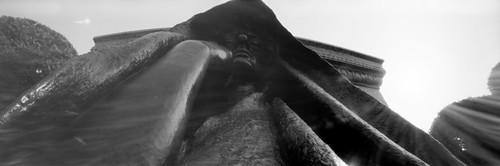
Another Example of How Technology Affects Vision

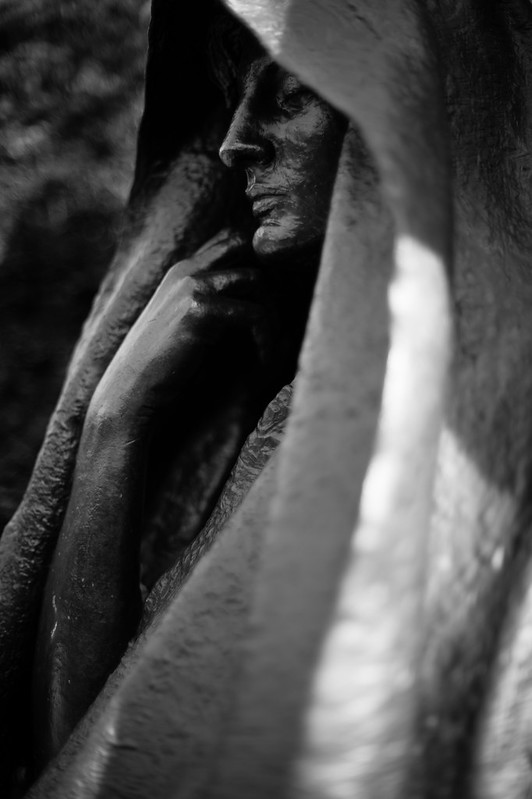
I've posted this picture before, taken with the Nikon Df and Nikkor 50mm f1.2 AIS lens.
 
Here's the same statue, shot with the Reality So Subtle 6x17 panoramic pinhole camera.
 
 
I love figuring out how to use different tools to make images that appeal to me.
 
DMC-365.blogspot.com

Sunday, March 29, 2015

Adams Memorial Statue by Saint-Gaudens - And Connections

Adams Memorial Statue, by Reed A. George
Nikon Df, Nikkor 50mm f1.2 AIS Lens
iso 100, f1.2, 1/2000 sec.
 
My friends Charlie and Bill introduced me to this beautiful piece of art in the Rock Creek Cemetery in Washington, DC. It was made by Saint-Gaudens in memory of the wife of Henry Adams, Marian "Clover" Hooper Adams.
 
The first connection with photography is the fact that Mrs. Adams perished after drinking potassium cyanide, which she normally used to process photographs. Another photographic connection is that the statue was inspired by the Buddhist Bodhisattva of Compassion, Kannon. Kannon (Kwannon) was the namesake of the Japanese camera company Canon.
 
Adams felt very strongly that this statue should never be named. In fact, he cursed anyone who names it. (Click Here) to read his wishes, and the full history of the memorial.
 
I am pleased with the way my new 50mm f1.2 AIS lens rendered the statue. I used out of focus regions resulting from the very thin depth of field the lens produces wide open to bring attention to the shrouded face. The hand also serves as a compositional element that leads to the face.
 
DMC-365.blogspot.com

Monday, June 16, 2014

New Orleans, Latrobe Park at Sunrise

Latrobe park is dedicated to architect Benjamin Latrobe. Located in the French Market, it's on the former site of a waterworks designed by Latrobe. Now, it's a cool place to relax in the shade of a hot day, just a few steps from the Mississippi River, and on the edge of the French Quarter.
 
I was walking through on my morning exploration when the light through this statue caught my eye.
 
Latrobe Park Statue, by Reed A. George
Leica M6 Titan, Leica Summicron 35mm f2 v.3 Lens
Kodak TMax 400 Film
 
Man, I could sure spend more time in New Orleans. Friends who visited a week after me told me of the torrential rains during their trip; not a drop of rain while I was there. In fact, I'd love to shoot the city in fog and rain. Maybe my next trip to New Orleans will be selected for moodier weather.
 
DMC-365.blogspot.com
 

Wednesday, June 4, 2014

Visual Poetry - Audubon Park, New Orleans

Visual Poetry, by Reed A. George
Leica M9, Leica Summicron 35mm f2 v.3 lens
iso 200, f3.4, 1/1000 sec.
 
Knowing that it was important to get out of the French Quarter, at least for a little while on my recent trip to New Orleans, I hopped a streetcar to Audubon Park one morning. After my own SNAFU, whereby I rode past the station where I needed to change lines, walked several blocks to recover, then discovered that the streetcar line was under construction and being supported by bus, I was quite a bit later arriving than I had planned. The bright Louisiana sun was well up in the sky when I got to the park. That did not stop me.
 
This is one of my favorite couple of images from that morning. I saw this composition as soon as I walked into the park; an hour later and the lighting would have been all wrong. There are several things I love about this shot. The light is at nearly exactly the right position to put the statue's face in a nice combination of light and shadow, and light the body of the statue perfectly to stand out against the dark backround of the live oak branches behind it. I love how the statues interact, including the third and fourth, slightly out of focus in the background above the child statue at bottom right. They're barely even elements in the composition, which is how I wanted it. The palm tree in silhouette way back there is another important element to me. The similarity of the main statue's pose and arm position to that of the lovely live oak tree behind is probably what attracted me to this composition in the first place.
 
Of course, the next time I go to New Orleans, I will be at the park at sunrise; that would just be spectacular. Not having made it at the perfect time on this morning, I'm quite pleased with this result.
 
The Leica M9 and 35mm Summicron pulled it off nicely for me. I think this one warrants a print.
 
DMC-365.blogspot.com
 

Tuesday, March 12, 2013

Exploring A Subject Thoroughly With the Lumix DMC-LX7 - "Forever Marilyn" -

I have been starting to explore my new Panasonic Lumix DMC-LX7. I've been playing with some of the
built-in scene modes, including the "toy camera" mode. It adds a vignette effect, and some pretty interesting color effects as well.
 
On a recent trip to Palm Springs, California, I noticed something new in town. There's an enormous statue of Marilyn Monroe, 26 feet tall. I decided to give the LX7 a shot at capturing Marilyn.
 
Here's my first, quite pedestrian shot:
 
Marilyn #1, by Reed A. George
Panasonic Lumix DMC-LX7, Toy Camera Scene Mode
iso 125, f3.2, 1/1600 sec.
 
I liked how the Palm Springs sign painted on the wall behind makes it clear where this is. I didn't like much else about it. Then I decided to change position to get this:
Marilyn #2, by Reed A. George
Panasonic Lumix DMC-LX7, Toy Camera Scene Mode
iso 125, f2.8, 1/2000 sec.
 
Then, I thought, how about closer?
 
 
Marilyn #3, by Reed A. George
Panasonic Lumix DMC-LX7, Toy Camera Scene Mode
iso 125, f3.2, 1/1600 sec.
 
I liked having the sign oriented to be between her legs.
 
Then, I wondered how important it was to have Marilyn's face in the picture. So, I got even closer.
 
Marilyn #4, by Reed A. George
Panasonic Lumix DMC-LX7, Toy Camera Scene Mode
iso 125, f2.8, 1/1600 sec.
 
I used a wider aspect ratio on the shot above, because I wanted to include her skirt. I suppose if you know the famous shot of Marilyn's skirt being blown up, you may be able to recognize that this is her.
 
Then, I moved in real close. At this point, in the shot below, I doubt if many people would make the connection to Marilyn Monroe.
 
Marilyn #5, by Reed A. George
Panasonic Lumix DMC-LX7, Toy Camera Scene Mode
iso 125, f2.8, 1/1600 sec.
 
 
Then, I went for the money shot. I think most people would at least wonder, for a brief moment (pardon the pun) what Marilyn was wearing under her skirt. I know I was curious. Well, here's the answer:
 
Marilyn #6, by Reed A. George
Panasonic Lumix DMC-LX7, Toy Camera Scene Mode
iso 125, f2.8, 1/1600 sec.
 
The shot above no longer includes the Palm Springs sign. But, I think it is my favorite. It answers one question, yet leaves others unanswered. This picture on its own would certainly lead to some questions.
 
Finally, on my way down the street after shooting these, I saw this in a shop window:
 
Reflections of Marilyn, by Reed A. George
Panasonic Lumix DMC-LX7, Toy Camera Scene Mode
iso 125, f2.5, 1/100 sec.
 
You can see the statue of Marilyn reflected in the shop window, at the left. This was a hard shot to compose, and was only partially successful in my opinion. I had to align the poster in the window with the dark reflection of the palm tree trunk, so that you can see Marilyn's face in the poster. Of course, I wanted the statue reflected in a nice way as well.
 
So, as you can see, my composition and approach changed as I thought more about it, and tried new things. I feel like I explored the subject pretty well, and enjoyed the process.
 
By the way, the statue, "Forever Marilyn" was made by Seward Johnson. It weighs 34,300 pounds, and is constructed of steel and aluminum.
 
DMC-365.blogspot.com