Showing posts with label Canon. Show all posts

Tuesday, December 15, 2015

I've Got Half a Mind to....

I was at the weekend Georgetown flea market a week or so ago with my friend Charlie. We were visiting with an acquaintance there, who always brings a nice selection of old cameras, when I spotted one of interest - a Canon Demi EE17 half-frame camera. Here's what the camera looks like.
Image Source: http://www.canon.com/c-museum/en/product/film64.html
 
What's a half-frame camera, you ask? Well, it shoots normal 35mm film, but in 24x18mm frames, allowing you to get 72 exposures from a normally 36 exposure roll. This fact also makes the frame orientation to shift from the normal landscape arrangement to portrait, when the camera is held normally.
 
Needless to say, the Demi went home with me. I have not even tried to put a battery in it, happy to use an external light meter and set shutter speed and f-stop manually. The lens is a Canon 30mm f1.7 (fast!) model. Focus is accomplished through a manual distance scale on the outside of the camera, or selecting one of three distances (portrait, group of people, or mountain). At 30mm depth of field is pretty big, so that works.
 
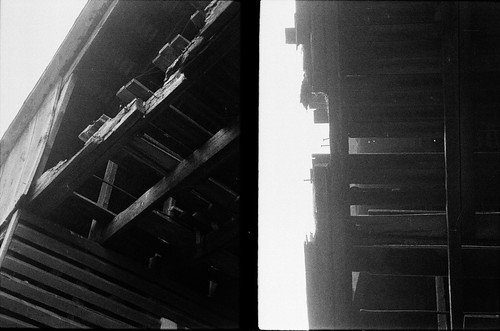
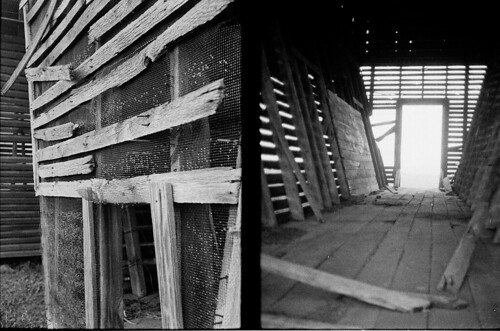
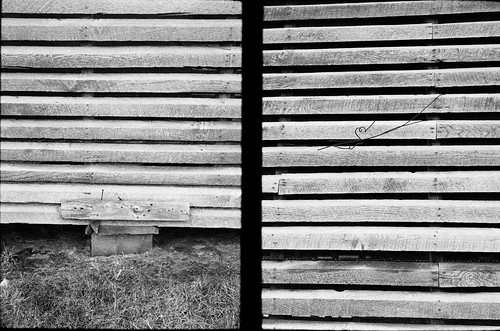
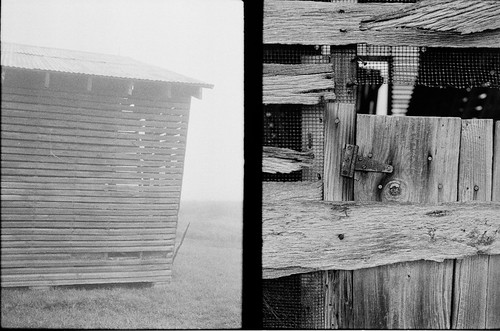
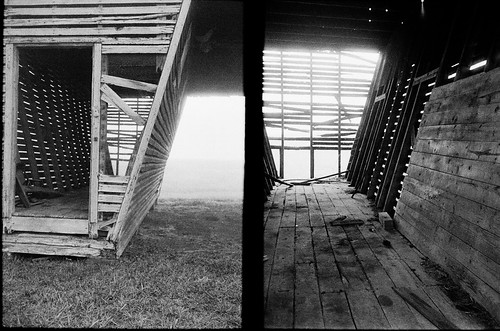
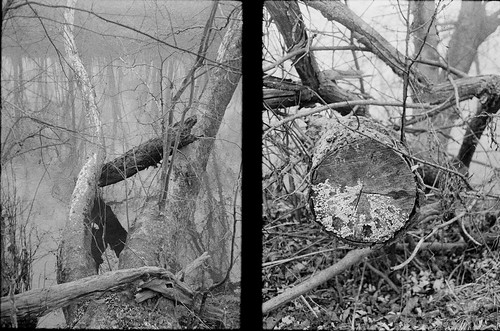
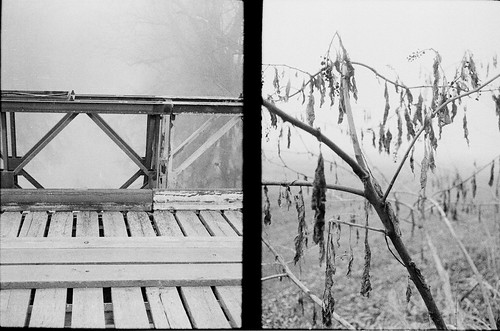
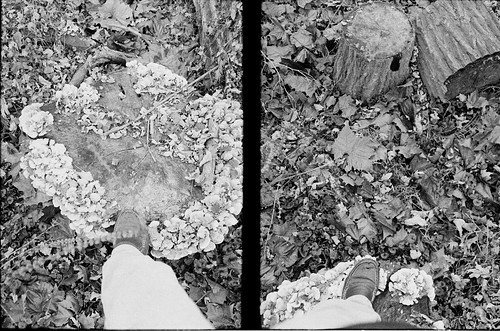
Here are some shots from my first test roll through the camera, an expired roll of Agfa APX400 from my friend Dennis, exposed at 200 speed, and developed in straight D76 for 7.5 minutes. I scanned all of them in pairs, as they appear here. I'm definitely planning to shoot a lot of diptychs (picture pairs) with this little jewel.
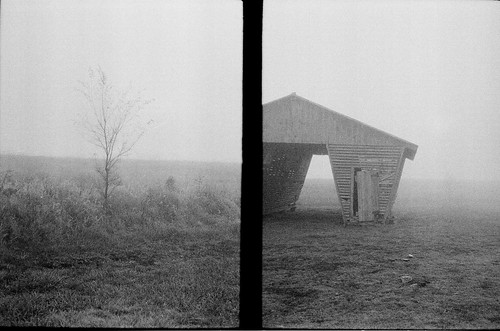
 
 
Many people think that 35mm (full frame) is small, and pushes the limits of negative size to give decent image quality. I agree, to an extent, but as long as I'm not trying to make big prints, the half-frame works fine. The Canon optics seem to be quite sharp, and the little camera is a blast to shoot.
 
And, getting 72 exposures on one roll is pretty cool, too.
 
DMC-365.blogspot.com
 

Sunday, March 29, 2015

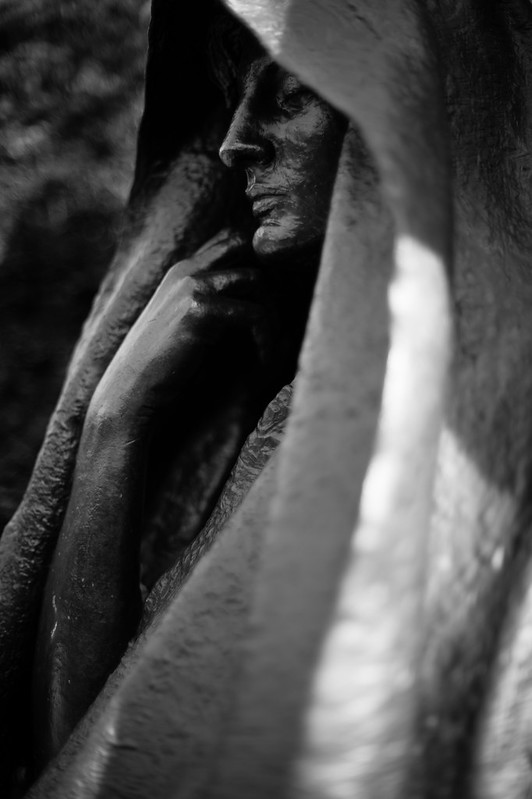
Adams Memorial Statue by Saint-Gaudens - And Connections

Adams Memorial Statue, by Reed A. George
Nikon Df, Nikkor 50mm f1.2 AIS Lens
iso 100, f1.2, 1/2000 sec.
 
My friends Charlie and Bill introduced me to this beautiful piece of art in the Rock Creek Cemetery in Washington, DC. It was made by Saint-Gaudens in memory of the wife of Henry Adams, Marian "Clover" Hooper Adams.
 
The first connection with photography is the fact that Mrs. Adams perished after drinking potassium cyanide, which she normally used to process photographs. Another photographic connection is that the statue was inspired by the Buddhist Bodhisattva of Compassion, Kannon. Kannon (Kwannon) was the namesake of the Japanese camera company Canon.
 
Adams felt very strongly that this statue should never be named. In fact, he cursed anyone who names it. (Click Here) to read his wishes, and the full history of the memorial.
 
I am pleased with the way my new 50mm f1.2 AIS lens rendered the statue. I used out of focus regions resulting from the very thin depth of field the lens produces wide open to bring attention to the shrouded face. The hand also serves as a compositional element that leads to the face.
 
DMC-365.blogspot.com

Thursday, July 3, 2014

Hey, Maybe Micro 4/3 is a Sweet Spot After All?

Image Source: http://www.the.me/nikon-lost-in-hall-of-mirrors/

While I'm not happy to hear that Nikon's camera business is struggling, I found the graph above most interesting. And, while I understand that not all mirrorless cameras are Micro 4/3, the text in this post on THEME makes special mention of that format and how well it's doing.

(Click Here) to read more about how DSLRs are losing ground to mirrorless, and how Nikon and Canon, while offering what some consider to be weak options in mirrorless, are looking to new business areas for revenues.

While the post on THEME says that Nikon has no experience in Medical Imaging (the major market they've announced they'll pursue), I know firsthand that they do have expertise in imaging for medical research. Their research microscopes are excellent, and they are clearly working hard to bring new products to market that compete with the other best-in-class companies.

The theory in this article about why Nikon and Canon have offered "compromise" mirrorless cameras is that they are afraid of cannibalizing their DSLR market. That may be true. However, I've always marvelled at how Nikon will come out with a $5,000 super DSLR, then follow it up 9-12 months later with a $2,000 camera that has 95% of the features of the former. It's great for us users. But, I don't see fear of cannibalization going on there (within their own DSLR lineup), at least.

I agree that mirrorless cameras are certainly now encroaching on the specific market for DSLRs. I loved carrying two Micro 4/3 bodies and more lenses than necessary in a single bag on my most recent vacation. However, I'll be grabbing my Nikon DSLR this weekend for a music event. So, my hope, as a selfish user, is that both formats have a long future, with lots of improvements still to come. And no, I don't mean video capability that allows you to pick the perfect frame out of 10,000 captured!

DMC-365.blogspot.com

Monday, March 17, 2014

How Leica Killed "Leica Photography" on Leicaphilia

Now this is an interesting post, especially for me to be reading one day after I posted about taking a modern digital image from my Leica M9, removing many of the gray levels through boosting contrast, adding grain, and in my opinion, improving it.
 
The blog Leicaphilia provides a perspective on how Leica has killed its own style of photography by abandoning their expertise in making compact, functional, straightforward rangefinders and instead shifting their focus to exacting optical designs and products.
 
(Click Here) to read the post on Leicaphilia.
 
What do I think of all of this?
 
Sketching, by Reed A. George
Leica IIIC, Canon 50mm f1.4 Lens, TMax 400 Film
 
Well, I certainly agree that the attraction to Leica, especially old Leica cameras like the IIIC I used for the shot above, has something to do with the camera body design. Simple, effective, obviously hand-built. And, I must agree about the quality of some of Leica's competitors' lenses back in the day. The Canon 50mm f1.4 I used for the shot above is really quite nice.
 
I'm not sure that I agree that other brand lenses were actually better than Leica's back in the day. No, I don't judge them by micro-contrast or even necessarily sharpness, but my Leica Summar and Summaron lenses make beautiful images. They take quite a beating in the above-referenced post. There also seems to be a marked lean toward Nikkor lenses in that post. Not that I disagree; I have a nice Nikkor 3.5cm f2.5 in Leica thread mount (LTM) that does quite a nice job. Honestly, though, I prefer my Leica Summaron 3.5cm f3.5 in terms of the images it produces.
 
Finally, I don't agree that Leica has turned away from its design basics. The Leica M9 is about as straightforward to use as you could make a modern digital camera, while still giving the user complete control. I can easily switch back and forth between the M9 and a 1955 M3, without having to worry about differences in controls.
 
Now, the same cannot be said for some of Leica's other cameras. Some of them do have the same issues with complicated controls and multilayer menus that their Japanese counterparts have. Anyone notice the differences between shooting a Nikon F film camera and the wonderful, but complicated D700, for example?
 
So, I agree with some of the points in the article, not with others. I would say it's a call for Leica to be vigilant about future designs.
 
The author is correct that optical perfection does not necessarily lead to a great image. I'm learning to remove some perfection to get to the image that I really want.
 
DMC-365.blogspot.com
 

Wednesday, February 26, 2014

So What Do You Think of the Retro Styled Cameras? Canon Says No.

 
Photo of the Nikon Df and legacy non-AI NIKKOR lenses
The Nikon Df
Image Source: http://www.nikonusa.com/en/Nikon-Products/Product/Digital-SLR-Cameras/1526/Nikon-Df.html
 
Personally, I really like the styling of some of today's cameras, specifically some of those that harken back to cameras I knew or used when I was younger. No, I don't carry a pocket watch or hand-drawn maps. But I do still carry a Nikon F2 pretty often. So, the Df definitely appeals.
 
My new Lumix DMC-GX7 makes me wish it was more "retro" styled, something like the Olympus OM-D. Fuji's designs are distinctly retro and cool.
 
Apparently, Canon will not pursue this line of design, according to a post on the SLR Lounge.
 
(Click Here) to see the quote from a Canon representative.
 
Now this doesn't bother me much, as the only Canon gear I own really is retro. I have a Canon 50mm f1.4 Leica Thread Mount (LTM) lens that truly lives up to its nickname, the Japanese Summilux. I also have a Canon 135mm f3.5 LTM lens that is amazingly sharp and nice. Oh yeah, I also have a fixed lens 35mm rangefinder, the Canon QL17, with f1.7 lens. I haven't had that out in a while. Hmm. Maybe that's how I'll enjoy some retro Canon. I wouldn't be likely to buy a new Canon anyway, even if it was retro styled.
 
Now the Nikon Df is another story. Still attracted to that one.
 
DMC-365.blogspot.com


Monday, November 18, 2013

Whole Lotta Leica - Canon LTM 50mm f1.4 - Kevin the Kiteman!

UPDATE: I don't know what I was thinking. These images were shot with November's WLL lens, the Canon 50mm f1.4, not October's WLL lens, the Summicron 50mm f2 v3. I've updated the information below.
 
Starting out my day of walking around NYC, after meeting Adam Garelick (see yesterday's post), I saw this interesting character riding by:
The Kiteman, by Reed A. George
Leica M9, Leica Summicron 50mm f2 v.3 Lens
Canon LTM 50mm f1.4 Lens
iso 400, f6.7, 1/250 sec.
 
Camera set and ready, I struggled to get it out of my jacket and nearly missed him. But I did manage to grab this shot.
 
He smiled and stopped, and called me over to chat. He asked me if I'd ever flown kites as a kid, and what kinds of feelings those memories brought me. He explained that by selling kites in the city, he not only gets to introduce kids to them, he gets to re-introduce adults to flying kites. In fact, sometimes the kids can't get the string out of their parent's hands. He told me that he's had a customer 80 years old just smile from ear to ear from flying a kite again.
 
Frankly admitting that he "hustles" for his money, he said that he tries to do things that spread a little happiness to people, because he realizes we're all in this world together. He told me that instead of being in a jail cell somewhere, he's doing something positive. I told him that I believe he'd be doing something positive even if he was in jail.
 
Our conversation turned to the specific kite that he was flying as he rode by. He said
 
"Do you know what this is?"
 
Phoenix Kite, by Reed A. George
Leica M9, Leica Summicron 50mm f2 v.3 Lens
Canon LTM 50mm f1.4
iso 400, f5.7, 1/250 sec.
 
I said I knew it was a phoenix, a bird rising from the ashes. He was surprised, and said I wouldn't believe how many people said it was just a chicken! The phoenix is an important symbol for him, and shows the ability to rise above anything.
 
I didn't want to carry a kite around the city all day, so I didn't buy one. I did give him a little cash just to help out; he really would have preferred to give me a kite in exchange.
 
His name is Kevin. "Kevin the Kiteman."
 
I love the City. I love being able to meet interesting people. Kevin's doing what he can to help people be happy.
 
DMC-365.blogspot.com


Saturday, November 16, 2013

November's Whole Lotta Leica (WLL) Lens - Canon LTM 50mm f1.4

Canon 50mm f1.4 Lens in Leica Thread Mount (LTM)
ca. ~1972
 
This month's lens is the Canon 50mm f1.4. Some refer to this lens as the "Japanese Summilux." I won't deliberate on whether that's deserved or not. I will say this is one sharp lens. I guess I wouldn't be surprised if it competes well with a Leica Summilux 50mm f1.4 from the same era. I don't have a 50mm Summilux, so I can't say for certain.
 
I have to use a LTM-M mount adapter to use this on my M9; that's no problem at all. They work beautifully, and I've never had a problem with focus shift or anything else when using the adapters.
 
This lens has an odd filter size of 48mm. When I used it on my Leica M8, which required a UV/IR filter, I bought a step-up ring, which allowed me to use a 49mm (much more common size) filter. I still have the adapter on there today, so that I can use a 49mm lens cap. The one I have on there now is a Pentax cap. So, I have a Canon lens mounted to my Leica M9 body, with a Pentax cap. Quite the mix.
 
My copy is a version II, and was made sometime around 1972. I bought it for around $300, and they normally go for $300-$400 on the used market.
 
The original Canon hoods for these lenses are difficult to find. I have seen them listed for $100 or more, which is simply ridiculous. Last year when I went to Japan, I went to a weekend flea market. There was not a lot of camera gear there, and what I did find was expensive. However, I did find a little leather case marked "Canon" at one of the stalls. Opening it up, I could not believe my eyes - there was the exact hood that I needed. One thousand yen (~$13 at the time) later, and it was mine. Very lucky.
 
Anyway, I'll use this lens as my standard lens in November and share the results with you. Results coming soon!
 
DMC-365.blogspot.com


Friday, August 23, 2013

A Walk In The Woods, With Leica M9 - Composing Differently

Yesterday, I posted an image I made at Manassas National Battlefield, on my way to a hike at the Shenandoah National Park. Here are some shots from the hike itself.
 
I have been in the situation of shooting nature with my M9 recently. Not exactly what most nature photographers grab on their way out, the rangefinder presents challenges. It doesn't play well with long telephoto lenses or macro. This is part of the fun for me. In fact, it forces me to compose differently, maybe even better in some cases.
 
This little white mushroom was sticking out of a bank of green along the trail. If I were carrying my Nikon DSLR, I would have been motivated to grab a macro lens, and show as much detail of the mushroom as possible. It did have an interesting texture; this would not have been a bad idea. But, it would have missed some of the context, the contrast between this little fungus and everything else around it. This month's Whole Lotta Leica Lens, the Summicron 35mm f2, showed that quite well.
 
Shroom, by Reed A. George
Leica M9, Leica Summicron 35mm f2 Version 3
iso 400, f8, 1/25 sec.
 
Perhaps a little more in the normal Leica realm, I really liked the abstract shapes made by the flowing water, wood, and stone in the creek below. I would have liked to use a neutral density filter and get a longer exposure, to let the water flow even more. I don't carry filters for my Leica lenses.
Creek, by Reed A. George
Leica M9, Leica Summicron 35mm f2 Version 3
iso 160, f16, 1/3 sec.

I shot the leaf below from several angles before getting what I wanted. What really attracted me was the reflection of the green leaves and dark tree trunks above the water. This green patch was actually quite small, so my shots with the 35mm wide angle lens included too much. I switched to my lovely little Canon LTM 135mm f3.5 lens. This is an amazingly sharp lens. I was able to get it up on a tripod pretty high, and isolate the reflections from the rest of the scene. The leaf in the water provides an anchor point for the eye.
Summer Reflection, by Reed A. George
Leica M9, Canon LTM 135mm f3.5 Lens
iso 400, f5.6, 1/60 sec.

I spied this Northern Water Snake (Nerodia sipedon), sunning himself by the creek. My nature photographer instincts kicked in, and I started shooting from afar, to make sure I got a shot of him. Again using the 135mm, a rather modest telephoto length, I kept easing closer and closer. Here's the closest shot I got.
Northern Water Snake, by Reed A. George
Leica M9, Canon LTM 135mm f3.5 Lens
iso 320, f6.7, 1/1000 sec.

Upon looking at all of the shots I took when I got home, I discovered the one below. Including the full body of the snake, and more of his surroundings, I actually prefer this one:
Northern Water Snake With Context, by Reed A. George
Leica M9, Canon LTM 135mm f3.5 Lens
iso 320, f6.7, 1/1000 sec.
 
I most definitely would not have made the shot above with a DSLR and long telephoto. Just to be clear, this is not a weakness of the DSLR per se. It is my own way of thinking when I'm using that equipment. I'm really glad that I forced myself to work with what I had.
 
I continue to learn about this interface of equipment and creativity.
 
DMC-365.blogspot.com


Friday, July 26, 2013

Leica at the Sunday Afternoon Jam Session - Including Whole Lotta Leica Lens for July - Summitar 5cm f2 Collapsible

I went to a jam session at Jammin' Java, a great music venue and coffee house here in Vienna, Virginia.
 
(Click Here) to check out Jammin' Java.
Margot MacDonald, by Reed A. George
Leica M9, Canon 50mm f1.4 LTM
iso 800, f2, 1/125 sec.
 
I took along my WLL lens for this month, the Summitar 50mm f2 collapsible. Here's a shot from that lens.
 
 
Jam Session, by Reed A. George
Leica M9, Summitar 5cm f2 Collapsible LTM Lens (Coated)
iso 640, f2, 1/160 sec.
 
It was pretty dark in there, with bright afternoon light coming from the front windows, but very little additional light inside. It made for some dramatic lighting for those standing in that window light, just plain darkness for the others.
 
I was glad that I had thrown my Canon 50mm f1.4 LTM lens in my bag on the way out. I used it a lot more than the Summitar. Here are a couple of examples.
 
 
Nina, by Reed A. George
Leica M9, Canon 50mm f1.4 LTM
iso 40, f1.4, 1/90 sec.

 
Margot MacDonald and Tony Moreno, by Reed A. George
Leica M9, Canon 50mm f1.4 LTM
iso 1250, f2, 1/90 sec.
 
 
Bass, by Reed A. George
Leica M9, Canon 50mm f1.4 LTM
iso 800, f1,7, 1/125 sec.

 
Margot MacDonald, by Reed A. George
Leica M9, Canon 50mm f1.4 LTM
iso 800, f1.4, 1/125 sec.
I thoroughly enjoyed the session, and met a few new people.
 
For more images from the session, (Click Here).
 
I have always really liked my Summitar. However, the Canon f1.4 really came through for me. I think the Summitar is a street photography lens, not so much a low light, wide open shooter. I have shot it in dark spaces a couple of times recently, and am not really that happy with it wide open. At f5.6 or smaller, it excels. That wasn't going to happen at the jam session.
 
Guess I've got to get the Summitar out on the street this month!
 
DMC-365.blogspot.com


Tuesday, July 23, 2013

Key West Cemetery - Shot With Panasonic Lumix DMC-GX1

When in Key West, I always like to look for hints of the local culture, which all too often get covered over with the trappings of tourism. The historic Key West cemetery is always worth a quick visit. This time, I grabbed my Lumix DMC-GX1, 20mm f1.7 lens, and Canon LTM 135mm f3.5 lens and headed there for an early morning walk.
 
Rather than try to paraphrase, I'll quote directly from the historic marker at the cemetery to provide some background:
 
"Key West Cemetery was founded in 1847 following a hurricane the previous year that destroyed the earlier cemetery located near present day Higgs Beach. To protect from future flooding the 10-acre cemetery was located here on Solares Hill, the highest natural elevation in Key West. An estimated 75,000 people are interred here, divided among parcels that reflect the cultural diversity that continues to characterize the city of Key West today. The cemetery contains a historic Catholic section, Jewish section, the USS Maine plot dedicated in 1900, and the Los Martires de Cuba, a memorial for those who fought in the 1868 Cuban revolution. In addition to these defined areas, African Americans, Cubans and Americans, rich and poor, are interred throughout. In-ground and crypt style graves range from simple concrete copings filled with soil to elaborate monnuments. Plot enclosures of wrought iron, wood, or concrete were often used to mark family plots.
A Florida Heritage Site Sponsored by the Historic Florida Keys Foundation, The City of Key West, and the Florida Department of State"
 
Let's take a look at the place.
Key West Cemetery, by Reed A. George
Panasonic Lumix DMC-GX1, Lumix 20mm f1.7 Lens
iso 160, f2.8, 1/400 sec


Fallen, by Reed A. George
Panasonic Lumix DMC-GX1, Lumix 20mm f1.7 Lens
iso 160, f2.8, 1/40 sec


Gravestones and Chickens, by Reed A. George
Panasonic Lumix DMC-GX1, Lumix 20mm f1.7 Lens
iso 160, f2.8, 1/320 sec


Family Plots, by Reed A. George
Panasonic Lumix DMC-GX1, Lumix 20mm f1.7 Lens
iso 160, f2, 1/1000 sec
 
Occupying a relatively small area of land, completely surrounded by residential neighborhood, this is a place of visual details. For example, the flowers really stand out from the dull gray stone.
Pink Flowers, by Reed A. George
Panasonic Lumix DMC-GX1, Lumix 20mm f1.7 Lens
iso 160, f1.7, 1/640 sec
 

Sleeping Angel, by Reed A. George
Panasonic Lumix DMC-GX1, Lumix 20mm f1.7 Lens
iso 160, f1.7, 1/1250 sec


This next shot was made with the adapted Canon 135mm f3.5 LTM lens. I'm amazed by the sharpness of this old lens. I also really like the out of focus areas in the background.

Isolated, by Reed A. George
Panasonic Lumix DMC-GX1, Canon LTM 135mm f3.5 Lens
iso 160, f4, 1/200 sec
 
Thoughtful, by Reed A. George
Panasonic Lumix DMC-GX1, Lumix 20mm f1.7 Lens
iso 160, f5.6, 1/40 sec
Cross, by Reed A. George
Panasonic Lumix DMC-GX1, Lumix 20mm f1.7 Lens
iso 160, f1.7, 1/640 sec
 
Peaceful, by Reed A. George
Panasonic Lumix DMC-GX1, Lumix 20mm f1.7 Lens
iso 160, f1.7, 1/800 sec
 
Key West is such a funky place. It's somehow comforting to know that even in death, you can retain a little uniqueness. The cemetery here is another thing about Key West that reminds me of another unique place, New Orleans.
DMC-365.blogspot.com


Tuesday, April 16, 2013

Night Photography in Frederick Maryland - I Need to Get Up There Again.

I live pretty close to Frederick, Maryland. I went there a while back to hear some live music, and was impressed with the nightlife - lots of people on the street, etc.
 
I just read a nice post by "Slothead" on mu-43.com, who did some night photography of his own there with an Olympus OM-D.
 
(Click Here) to read Slothead's post and see his images.
 
Here are a couple of mine, shot with the Leica M8 and Canon 50mm f1.4 LTM lens.
 
 
Frederick at Night, by Reed A. George
Leica M8, Canon LTM 50mm f1.4
 
 
DMC-365.blogspot.com


Tuesday, February 12, 2013

Now This Blows My Mind

You may have seen this picture before. I posted it on October 14, 2012. In that posting, I described how resisting the urge to take a telephoto, and shooting with a 50mm normal lens on the Leica M9 allowed me to get a very different shot than what I usually get at the circus.
Big Apple Circus, Horses, by Reed A. George
Leica M9, Canon LTM 50mm f1.4
iso 640, f2, 1/90 sec
 
I am reposting it for a reason. I was recently reading about a set of photographs by Cornell Capa, taken in 1947 in Hugo, Oklahoma. Apparently, Hugo was and is the place where circus performers go for downtime and training when they're not performing. Imagine my surprise when I saw this:
 
 
Circus Horses, Hugo, Oklahoma, 1947
Image Source: http://quitecontinental.net/2011/04/25/life-archives-circus-city-usa-1947-hugo-oklahoma/
 
I think the similarity is quite striking. It's even the same number of horses. Cool.
 
DMC-365.blogspot.com


Sunday, October 14, 2012

Leica M9 Goes to the Circus

 
Big Apple Circus, by Reed A. George
Leica M9, Canon LTM 50mm f1.4
iso 640, f2, 1/90 sec
 
My family, a friend, and I went to the Big Apple Circus. I always enjoy photographing there because the lighting is dramatic, the action and subject matter always interesting. Usually, I bring a fast(ish) telephoto, like my Nikon 300mm f4. This time, I decided to bring only my Leica M9 and a single lens, the Canon 50mm f1.4 (a Leica thread mount lens, also known as the "Japanese Summilux").
 
I found that I was able to shoot at wide apertures at iso 640 or 1250, with reasonably fast shutter speeds (1/90 or faster).
 
 
Enter the Contortionist, by Reed A. George
Leica M9, Canon LTM 50mm f1.4
iso1250, f2.8, 1/350 sec
The pictures I brought home are very different from what I usually get. Wider angle, of course. But also, a little wider in sharing the context of the event. I even took the opportunity to walk a little during the intermission, which yielded the following shot:
 
Glowing, by Reed A. George
Leica M9, Canon LTM 50mm f1.4
iso 1250, f1.4, 1/60 sec

This shot was taken in deep darkness. Amazing what f1.4 can do.

I was a little concerned about how the noise would creep in at iso 1250 on the M9. I must say I'm very pleased. Even in a shot like the one above, with lots of black space around the subjects, I don't find the noise objectionable. Lightroom's exposure adjustments (namely, making the blacks even blacker) and noise reduction work beautifully with the M9's files.

And here is my favorite shot from the event:
The Moment, by Reed A. George
Leica M9, Canon LTM 50mm f1.4
iso 1250, f2, 1/125 sec

This one's worth looking at full-size, to see the details.

With my normal gear, I may have captured one or two of the horses in great detail. This image shows how the performer is conducting the full coordinated motion of the magnificent animals. That would have been missed. I also felt it when I captured the exact moment that shows their strength, concentration, and timing. This is why I love shooting rangefinders. The constraints force me to make better images than complete flexibility in focal lengths allows. I know, that sounds strange. But, I would certainly have elected to go for details in this scene if I'd had a telephoto lens with me.

DMC-365.blogspot.com


Monday, August 6, 2012

Another Convert - Canon-to-Micro 4/3 - tconelly Shoots Barcelona With OM-D

 
Madrid, by tconelly on mu-43.com
Image Source: http://www.mu-43.com/f56/e-m5-travel-performance-barcelona-29520/
 
One of the main reasons I like Micro 4/3 is for compactness. That especially comes into play in travel.
 
tconelly on mu-43.com has converted from a Canon DSLR kit to an Olympus OM-D and large selection of lenses, including the Panasonic Lumix 20mm f1.7.
 
(Click Here) to read the post on mu-43.com, where tconelly describes the difference in size and weight of what he was able to carry on trips with Canon vs. Olympus.
 
On his Madrid trip, he shot a lot of images, and provides links to them. I would suggest at least going to his condensed set of the whole trip.
 
(Click Here) to see that photo set on pbase.
 
It's hard to imagine that he would have been more pleased with the results if he'd carried a larger camera.
 
Now I want to go to Madrid, as well. :)
 
DMC-365.blogspot.com


Saturday, July 14, 2012

I Finished the July 7 Day Film Challenge - and LOVED IT!

 
Sunrise Watering, Hinton, Oklahoma, by Reed A. George
Leica M4-2, Leica Summicron 50mm f2, exposure unrecorded
 
I finished up the "one roll per day for seven day" challenge this week. The challenge was posted on the rangefinder forum.
 
(Click Here) to read more about it.
 
I was able to complete it between July 3 and 7, but it was not easy. First, it was challenging to find enough interesting things to shoot on regular workdays. Then, I got very ill on the trip to Oklahoma where the image above was shot. On two consecutive evenings, I got up at 11:30PM in a fevered haze and shot pictures around my Mom's house, just to make sure I stayed in the challenge. As it turned out, those pictures are very meaningful to me, and really remind me of exactly how badly I felt. Not exactly pretty pictures, but full of feeling for me.
 
I shot Leica film bodies the entire time. I shot a 3.5cm Elmar f3.5, 50mm f2 Summicron, 90mm Elmarit f2.8, and Canon 50mm f1.4.
 
So, now I'm considering becoming the "Panalog Photographer," mainly focusing my digital work on Lumix as before, but including a lot more analog (film) photography. Just for fun, I've posted a poll at the top of the blog page. Let me know what you think of that idea.

None of this is exclusive, and you'll still see my work with Nikon and Leica digital from time to time. The main change is that you'll see film work much more often.

So, I hope that sits well with my readers. I'm very excited about the idea.
 
I'll post my selected three images once I submit them to the challenge forum page.
 
DMC-365.blogspot.com
 
 
DMC-365.blogspot.com
 

Friday, July 13, 2012

Photographers Appreciate Local Musicians

Musicians by Steven
 
Musicians, by Steven on mu-43.com
Image Source: http://anotherguywithacamera.zenfolio.com/img/s9/v14/p127639138-6.jpg
 
Poster Steven on mu-43.com shared a couple of nice environmental portraits of musicians at the park.
 
(Click Here) to see Steven's post on mu-43.com.
 
For the image above, he used a Panasonic Lumix DMC-GX1 and Lumix 20mm f1.7 lens.
 
I think this shot has a very nice color balance, sharpness, and composition. It does make you wonder what they're looking at...
 
Here's a street musician shot of my own, from downtown Frederick, Maryland. His name is Willie Barry, and he plays a mean guitar.
 
Willie Barry, by Reed A. George
Leica M8, Canon 50mm f1.4 Leica Thread Mount Lens
 
Here's to the local musicians that add their music to our experiences.
 
DMC-365.blogspot.com