Showing posts with label depth of field. Show all posts

Sunday, April 5, 2015

Stained Glass, Mausoleums in Rock Creek Cemetery

A final post of images I made during my recent visit to Rock Creek Cemetery.
 
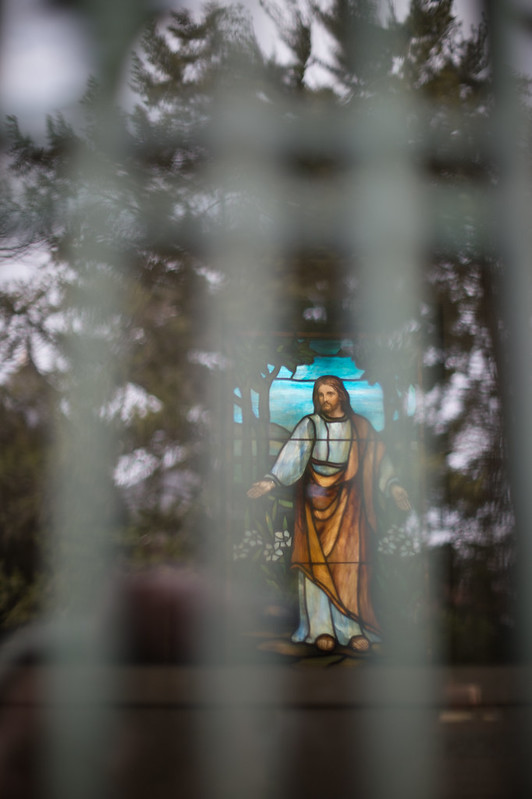
There are a lot of mausoleums at this cemetery, and some of them have lovely stained glass windows, usually in the rear of the building. I decided to shoot some of them using my new Nikkor 50mm f1.2 AIS lens. This lens allowed me to get sharp images of the stained glass, but blur the distracting front glass and iron gates of the mausoleums. I like how the shallow depth of field isolates the images from the rest of the scene.
Mausoleum Stained Glass, by Reed A. George
Nikon Df, Nikkor 50mm f1.2 AIS Lens at f1.2
 
I also like the reflections of the trees in the front glass.
 
This lens provides the opportunity to do some very unique things with my images.
 
DMC-365.blogspot.com
 

Sunday, March 29, 2015

Adams Memorial Statue by Saint-Gaudens - And Connections

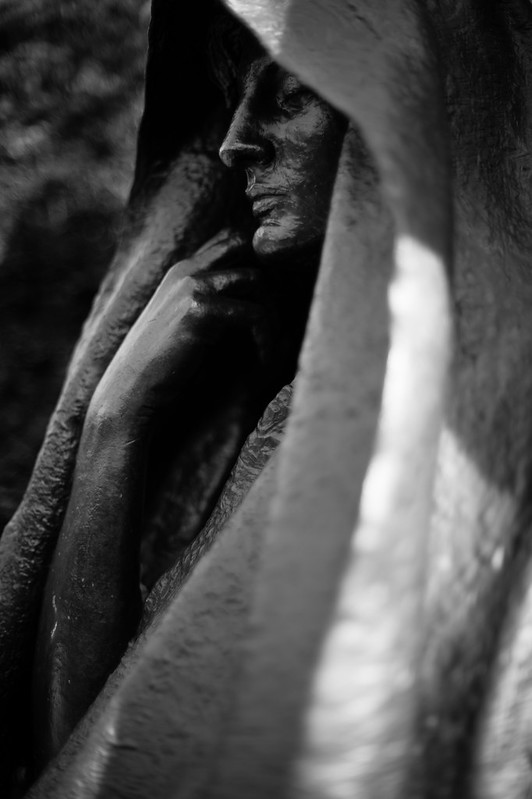
Adams Memorial Statue, by Reed A. George
Nikon Df, Nikkor 50mm f1.2 AIS Lens
iso 100, f1.2, 1/2000 sec.
 
My friends Charlie and Bill introduced me to this beautiful piece of art in the Rock Creek Cemetery in Washington, DC. It was made by Saint-Gaudens in memory of the wife of Henry Adams, Marian "Clover" Hooper Adams.
 
The first connection with photography is the fact that Mrs. Adams perished after drinking potassium cyanide, which she normally used to process photographs. Another photographic connection is that the statue was inspired by the Buddhist Bodhisattva of Compassion, Kannon. Kannon (Kwannon) was the namesake of the Japanese camera company Canon.
 
Adams felt very strongly that this statue should never be named. In fact, he cursed anyone who names it. (Click Here) to read his wishes, and the full history of the memorial.
 
I am pleased with the way my new 50mm f1.2 AIS lens rendered the statue. I used out of focus regions resulting from the very thin depth of field the lens produces wide open to bring attention to the shrouded face. The hand also serves as a compositional element that leads to the face.
 
DMC-365.blogspot.com

Wednesday, August 27, 2014

More UC Berkeley Trees

A couple of days back, I posted about the tree sit-in protest at Berkeley from 2006-2008. You may or may not think the protesters crazy for living in the trees for so long, but you have to admit that the landscape on the campus is beautiful and is worth protecting. Here's a shot I took on my walk around UC Berkeley.
 
Berkeley Trees, by Reed A. George
Panasonic Lumix DMC-GX1, Lumix 20mm f1.7 Lens
iso 400, f1.7, 1/640 sec.
 
This is an unedited image straight from the camera. I shot it wide open to render the leaves in the foreground sharp, and slightly blur the trees in the background.
 
DMC-365.blogspot.com
 

Saturday, April 26, 2014

Remind Me Again Why I Need Multiple Cameras? The Lumix DMC-LX7 Does So Much.

Japanese Garden Scene, by Reed A. George
Panasonic Lumix DMC-LX7, 70mm (equivalent full-frame focal length)
iso 200, f2.1, 1/400 sec.
 
This is another jpeg direct from the Lumix DMC-LX7. As you can see, you can achieve relatively shallow depth of field with this camera, despite the small sensor size. That's because it has a very large maximum aperture in the Leica Vario Summilux lens, f1.4 at the widest angle zoom setting (24mm full-frame equivalent). I believe f2.1 is the maximum aperture at the focal length I needed for this shot. I think the bokeh (out of focus rendering) is very nice with this lens.
 
This camera really does sometimes make me wonder why I need any other gear, especially for travel photography. If you know me, and the fact that I have a large and broad collection of cameras, this statement doesn't come lightly from me. The LX7 is just plain impressive.
 
DMC-365.blogspot.com


Thursday, April 10, 2014

More Fisheye Images - Panasonic Lumix DMC-GX7

I've always thought of a fisheye lens as a novelty. I never really owned one, other than a toy fisheye film camera, and I only used that once or twice. Over the holidays, I found the Bower 7.5mm f3.5 fisheye lens for Micro 4/3 for an amazing low price, and bought it.
 
I decided to take it with me on my trip to New Mexico. Another place where Micro 4/3 compactness shines. I don't think I'd ever carry a lens like this with a full-sized DSLR kit. The probability of use : weight ratio would be too low.
 
Anyway, I used it. The shot below is the only interesting one I could make at sunset over the city. Instead of a beautiful desert sunset, on this evening the clouds were rolling in, and the color just wasn't there. So, I pointed the fishey upward, got right to the base of the tree, and shot this.
Upward Reach, by Reed A. George
Panasonic Lumix DMC-GX7, Bower 7.5mm f3.5 Fisheye Lens
iso 200, 1/125 sec., f-stop unrecorded
 
The Bower lens is also marketed under other names. I believe it's identical to one sold under the Samyang and Rokinon name. It's a manual focus lens, but with the depth of field you get with a 7.5mm lens on Micro 4/3 sensors, that really isn't a drawback at all. At far less than half the cost of a Panasonic fisheye lens, I think it's a reasonable compromise.
 
Here's a shot I made outside a church in New Mexico:
 
Sacred Tree, by Reed A. George
Panasonic Lumix DMC-GX7, Bower 7.5mm f3.5 Fisheye Lens
iso 200, 1/800 sec., f-stop unrecorded
Here again, the fisheye perspective allowed me to make a somewhat interesting image, even in midday sun. The distortion of the lens works with the tree branch arching overhead, with its crucifixes hanging down. Mother Mary makes a nice off-center focal point.
 
So, this lens has my vote. I enjoyed using it on the GX7 quite a lot.
 
Click on my Amazon link below to buy yours, and support this blog!
 
DMC-365.blogspot.com


Monday, March 24, 2014

The Joy of a Film Leica Rangefinder

Yoko Ono's Tree, by Reed A. George
Leica M4-2, Summicron 50mm f2 Lens
 
If you know me, you know that I love to shoot Leica rangefinders. And, I love to shoot film.
 
Having read a post by Rikard Landberg on Steve Huff's site, I just felt the need to find an old film Leica image and share it. Mr. Landberg writes of his experience of selling off all of his digital (Canon) gear and shooting film only for a year.
 
(Click Here) to read Mr. Landberg's post on Steve Huff Photo.
 
While I don't find it necessary to be exclusive of digital (or exclusive of anything in particular) in my photography, I do appreciate the narrowing of variables and focus on attention and concentration that Rikard discusses in his post.
 
He shoots Kodak TMax 400 film, usually at iso 1600, which leads to the high contrast you'll see in his shots there. I like the look. However, I also notice that all of his images have extremely large depth of field. This is likely due to the need to shoot at small apertures while shooting at iso 1600 outdoors. Not really a problem, but as you can see in my image above, I like to take advantage of very shallow depth of field in some cases. For me, if I had to pick a single iso to shoot at (thank goodness I don't), it would probably be 400.
 
 
If you're wondering, the note just left of center in the image of Yoko Ono's tree, above, says:
 
"I wish I was happy and no one I love feels sad."
That's a pretty noble wish.
 
DMC-365.blogspot.com


Friday, November 29, 2013

Whole Lotta Leica - October Results - That Summicron Bokeh

Not All That Matters Is Sharp, by Reed A. George
Leica M9, Leica Summicron 50mm f2 v.3 Lens
iso 400, f2.8, 1/3000 sec.
 
Lens geeks, especially Leica lens geeks, frequently discuss "bokeh." Apparently, bokeh is a Japanese word for "out of focus" areas in an image. The lens design, including the number and shape of the aperture blades, has a lot to do with how "pleasing" a given lens' bokeh will be. In general, more aperture blades, and rounded edges, yield smoother bokeh.
 
The Summicron is known for beautiful bokeh. In fact, I believe it was Mike Johnston who decided that the 35mm Summicron version 4 lens is the "king of bokeh." At any rate, you should expect a lot from any Summicron in this area.
 
In the shot above, I exposed the tree at f2.8, making for very shallow depth of field, on purpose. The combination of a wide aperture and close focus makes for lots of bokeh. To me, the structure in the back is as important as the tree leaves. It gives a strong sense of the context of the image. The red maple leaves go along with the Asian style structure. Neither element would be as strong without the other.
 
People argue about bokeh - what is pleasing, which lenses have the best. I've noticed that the bokeh from some of my cheaper lenses is as nice as higher end lenses. In fact, I've seen quite nice bokeh from very cheap lenses, with few (four) aperture blades. So, I'm not saying you need a Summicron to get beautiful bokeh. I am saying that bokeh can be important to conveying what you want with an image.
 
DMC-365.blogspot.com


Friday, January 11, 2013

Bhupinder2002 at mu-43.com Shoots Olympus 45mm f1.8 With 10-Stop Neutral Density Filter for Motion Effect


I've posted about using neutral density filters in the past. For me, the most common uses are to:
  1. Reduce the light coming into the lens to allow me to shoot at wide apertures (for shallow depth of field) in bright light
  2. Reduce light to allow the use of longer shutter speeds, which provides the ability to blur motion.
I usually carry a 3-stop filter, which allows me to move from say f8 in daylight, as some reasonable shutter speed, to f2.8. That makes a real difference in depth of field, for instance if I want to take a portrait in bright light, and blur the background.
 
Bhupinder2002 has posted some shots using a 10-stop neutral density filter on a 45mm f1.8 lens with the Olympus OM-D. This provides for a much larger change in settings, including allowing very long shutter speeds in broad daylight. Hence the moody motion of the water in the image above. It's a cool effect.
 
(Click Here) to see all of the images Bhupinder2002 posted.
 
DMC-365.blogspot.com


Monday, December 10, 2012

A Deeper Look at the New Olympus 17mm f1.8 Micro 4/3 Lens

Ming Thein (blog.mingthein.com) has done a very nice write-up on the new Olympus 17mm f1.8 lens. I covered the announcement of this exciting new lens a few days ago.
 
Unfortunately, Ming copyright protects all of his images, so rather than using one of his excellent images, I grabbed this one (also nice) from photoxels.com:
 
Shot With Olympus 17mm f1.8 Lens
Image Source: http://www.photoxels.com/photography/wp-content/uploads/2012/11/olympus-m-zuiko-17mm-f1.8-low-light-photo-pa170026_Art.jpg
 
Ming compares the new lens to two existing ones: the Olympus 17mm f2.8 and the Panasonic Lumix 20mm f1.7. I have the 20mm f1.7, and it's an amazing little lens. However, Ming's article brings out one very important feature of the new Olympus lens that really has me interested - a real depth of field scale! More on that later.
 
Ming says that the Olympus 17mm f1.8 is built similarly to the new Olympus 75mm f1.8, that is, it's one of their premium lenses, with no plastic construction. I can say that the 75mm is built very nicely, and feels great in the hand. Ming also says the expensive Olympus accessory hood is poorly designed, and makes it hard to remove the lens cap.
 
Focus is reportedly "very, very fast," even when compared to the Lumix 20mm lens. I have never felt that the 20mm is slow to focus, but I have read it in other places. Focus speed is not enough to interest me in the new lens
 
The new Olympus lens focuses to a minimum of 25 cm.
 
Ming reports that the field of view difference between the Lumix 20mm and Olympus 17mm f1.8 is nearly negligible; from that standpoint it makes me think that it's not worth adding the Olympus lens to my kit.
 
However, as I mentioned above, the fact that the 17mm has a depth of field scale may change all that. You see, none of my Micro 4/3 lenses have any type of focus scale or depth of field indicator on the lens body. Importantly, you also cannot trust the scale on lenses adapted to Micro 4/3 from other mounts; they are usually not correct. This means that doing zone focus manually (where I use a set f-stop and manual focus to allow for very quick shooting on the street) is impossible, other than a trick for setting hyperfocal distance. This is a major drawback, as I love to use a small aperture (usually f8), and manually focus to get a very large range of distances in focus. I also like to use the depth of field scale to tell me how far away the minimum point of clear focus will be. With my Leica, for example, I can look down and tell myself mentally "anything beyond 8 feet is mine." This new Olympus lens will make that possible on a Micro 4/3 body. Therefore, I've got to give this lens a try.
 
The new lens is reportedly going to be priced at around $500, and should be available in the US in December.
 
(Click Here) to read Ming's full review.
 
DMC-365.blogspot.com
 
The new Oly lens is not yet on Amazon. Here's a link to the very nice Lumix 20mm f1.7:


Monday, July 30, 2012

Is the Lumix 12-35mm f2.8 a Portrait Lens?

 
Festival-goer, by Reed A. George
Panasonic Lumix DMC-G3, Lumix G Vario 12-35mm Aspheric f2.8 Zoom at 35mm
iso 160, f3.2, 1/800 sec
 
This is a pretty good example of a picture that I want to be able to take at music festivals. It's not a head shot style portrait. Perhaps it's wide enough to be called an "environmental portrait." It gives some context to the subject. However, I really want to be able to separate the subject from background with shallow depth of field.
 
It is a matter of physics that Micro 4/3 lenses will have more depth of field at a given field of view, because of the crop factor and sensor size. That is, in the shot above, which was shot at 35mm focal length on Micro 4/3, has the same field of view as a 75mm lens on a full frame 35mm sensor. The Micro 4/3 lens has more depth of field in this shot than if I had shot it with a 75mm on full frame at the same f-stop (f3.2 in this case). All this adds up to less ability to separate your subject from the background with the Micro 4/3 format at a given field of view and aperture.
 
While I like this shot very much, I would prefer to have the background blurred more. Yes, I should have shot it at f2.8, which would have narrowed the field of view a little more, but that's only a half-stop wider, and would not have made much difference.
 
So, my preliminary conclusion is that no, this is not the perfect lens for these types of shots. I could have done better with one of my prime lenses - either getting closer with the Summilux 25mm f1.4 or using the Pana-Leica 45mm f2.8 Macro-Elmarit. Actually, the 45mm f2.8 may have been about the same, since I would have had to move away from the subject, which increases depth of field. The true best would be an Olympus lens - either the 45mm f1.8 (which would have been perfect for this shot), or the 75mm f1.8, which would have required me to be further away. I don't own either of the Olympus lenses, yet. The 75mm is on order.
 
I must say that I've enjoyed using the new Lumix 12-35mm f2.8 lens this weekend. However, I am close to concluding that I prefer to shoot primes. I've been very careful with this lens over the past couple of days. I have in my mind that it may go back for a refund. I haven't decided yet, and need to look at more results.
 
Don't get me wrong. It's a very capable lens. I just think I prefer primes.
 
DMC-365.blogspot.com


Wednesday, July 25, 2012

Oh, Man, I Can't Wait For That Olympus 75mm f1.8 to Arrive!

 
Image Source: http://www.mu-43.com/f38/olympus-75mm-f1-8-first-thoughts-29556/
 
Member 938mm on mu-43.com has posted their initial thoughts and some results, shooting the new Olympus 75mm f1.8 lens for Micro 4/3 on the new Olympus OM-D.
 
(Click Here) to read the original post on mu-43.com.
 
938mm seems quite pleased with the handling of the lens, and the results speak for themselves.
 
Mine is on order from Amazon, but is not yet shipping in the US.
 
938mm mentions that one challenge with such a fast lens is that to use a wide aperture in bright sunlight, you may need to use a neutral density (ND) filter. This is probably something I will want to do. The filter diameter is 58mm, so I'll have to add another filter to my kit.
 
On the subject of NDs, many people are now purchasing extremely expensive variable ND filters. These allow you to adjust the density and resulting effect of the filter across a wide range of exposures with a twist of the wrist. So far, I have decided to go the less expensive route, sticking with a 3-stop filter for my Lumix lenses. In my opinion, that has not been a difficult compromise. I find that if I need an ND, 3-stops is usually sufficient.
 
Some photographers have complained that 75mm (equivalent to 150mm field of view on full frame) is too long for portraits. I wholeheartedly disagree, especially when you consider that you have to go a little longer on the Micro 4/3 sensor to achieve shallow depth of field. I have always leaned telephoto, so 75mm is going to work great for me.
 
Looking forward to sharing some results with this lens on the Panasonic Lumix DMC-G3, just as soon as it arrives!
 
DMC-365.blogspot.com


Thursday, July 19, 2012

Panasonic Announces New Top-Line Compact DMC-LX7


Panasonic Lumix DMC-LX7
Image Source: www.dpreview.com
 
Panasonic has announced the successor to the wonderful compact camera DMC-LX5, the Lumix DMC-LX7. I am a long-time LX series devotee, having owned the LX2, and now the LX5. If you haven't looked at the LX series before, you should. I've written before how well the LX5 works as a street photography camera, for me. It's tiny, flexible, has a great feature set (including the ability to lock the f-stop and zoom position when you turn the camera off), all manual controls, and raw file capability.
 
(Click Here) to see my post about the LX5 as a street photography camera.
 
As with all cameras, there are tradeoffs. The LX series cameras have small sensors. The immediate effects are: 1) decreased performance at high iso (noise), and 2) inability to produce shallow depth of field. The LX5 does pretty well up to iso 400, acceptable for small prints (and definitely for viewing on the monitor) at iso 800, after which noise becomes a real issue. The fast zoom allows you to produce a reasonable portrait at the long end of the zoom, wide open. This gives decent shallow depth of field, but nothing like your full-frame fast lenses.
 
(Click Here) to read about the new DMC-LX7 on dpreview.
 
I had heard rumors that the LX7 would have a larger sensor than the LX5, which could have improved the camera in both respects. As it turns out, the sensor on the LX7 is a little smaller. The lens is about a stop faster, so that allows you to shoot at lower iso, which will help with noise. Reportedly, the new sensor also has better inherent signal-to-noise, which should also help. The faster lens also helps with producing shallower depth of field, when it's desired.
 
So, for me this is a mixed bag. While I believe that the new sensor and faster lens will help in these areas, I would have appreciated a bigger sensor more. Also, I tend to use the LX5 for street shooting, which in my own style does not require shallow depth of field. I like to set it on f4 or f5.6, fix the zoom and focus point to give a large depth of field, and shoot what I see on the street. For that, the LX7 offers little for me personally. If the noise performance is really better, which will be challenging with a small sensor, I may change my mind.
 
Part of what I'm saying is that I'm already quite pleased with the LX5. It's really a special little camera. The LX7 is at least as good - I'm just not sure I'll be upgrading anytime soon.
 
DMC-365.blogspot.com
 
Note - apparently, Panasonic will delay preorder capability until 30 days before the camera will actually ship. I admit that I HATE waiting for a new camera that I've already ordered, and waiting, and waiting. I did this with the Pana-Leica Summilux 25mm f1.4, waiting for several months. I'm doing it again now with the Olympus 75mm f1.8 lens. But, delaying preorder only serves as a band-aid. What these companies really need to do is produce faster. If they must make the announcements to keep up with the Joneses, then they need to be ready to deliver. Thanks for letting me rant a little.
 
Here's the DMC-LX5 (not LX7) on Amazon:


DMC-365.blogspot.com

 

Saturday, July 7, 2012

ePhotoZine Posts Sample Shots From Olympus 75mm f1.8 on OM-D

 
ePhotoZine's Oly 75mm f1.8 sample
Olympus 75mm f1.8 on Olympus OM-D, iso 320, f1.8, 1/160 sec
Image Source: http://www.ephotozine.com/article/olympus-75mm-m-zuiko-digital-f-1-8-lens-sample-photos-19553?utm_source=feedburner&utm_medium=feed&utm_campaign=Feed%3A+Ephotozine+%28ePHOTOzine%29
 
 
I am thinking very hard about reasons for and against buying the new Olympus 75mm f1.8 lens for Micro 4/3 cameras (like my Panasonic Lumix DMC-G3). Having shot with my Voigtlander 75mm f2.5 lens in Leica Thread Mount on the G3 recently, I'm pretty convinced the focal length is what I need for music photography.
 
(Click Here) to see my concert pics with the G3 and Voigtlander 75mm f2.5 Color-Heliar.
 
Because the new Olympus lens is so fast (in light gathering, f1.8), I wondered if the depth of field at that f-stop would be so shallow as to not be useful for portraits and people pictures. Depth of field is reasonable on my Voigtlander lens at f2.5, but what about f1.8? Well, ePhotoZine's picture above answers that question. It seems to have just the right amount of depth of field at f1.8.
 
It doesn't look good for me talking myself out of the new Olympus lens. :)
 
DMC-365.blogspot.com


Tuesday, June 26, 2012

Jordan Steele's Thoughts On The Panasonic Lumix 12-35mm f2.8 and Olympus 75mm f1.8 Lenses

 
Panasonic Lumix 12-35mm f2.8
Panasonic Lumix 12-35mm f2.8 Zoom
Image Source: http://admiringlight.com/blog/thoughts-panasonic-12-35-olympus-75-18/
 
Jordan Steele, who runs the blog Admiring Light, has posted his initial thoughts on the two new lenses on my mind - the Lumix 12-35mm f2.8 zoom and the Olympus 75mm f1.8 telephoto.
 
(Click Here) to read Jordan's piece on Admiring Light.
 
First, on the Lumix zoom, Jordan remarks on the common complaints from prospective users: price and lack of shallow depth of field. Keep in mind, none (or nearly none) of these people has had the opportuntiyt to try or even see the lens. Price is what it is. I think $1300 is a lot for a normal range zoom, even at f2.8. However, it's lower than the equivalent from Nikon. Of course, the Nikon lens is designed to cover a full 35mm frame, so there's more glass in the Nikon. Anyway, most people don't get into photography to save money. Second, depth of field. The issue is that with the smaller sensor (compared to 35mm) used in the Micro 4/3 cameras, shallow depth of field requires a wider aperture at any given focal length. In layman's terms, it's harder to get out of focus backgrounds, which is desirable for portraits and other images where you want to focus attention to the foreground subject. Yes, it's true. The Physics don't lie. You can't get the same shallow depth of field at f2.8 that you get on a full-frame lens. However, with the zoom at 35mm focal length (the longest setting), which is what you'll use for portraits much of the time, the depth of field will be plenty shallow in my opinion. In fact, I see an awful lot of portraits where the photographers take shallow depth of field too far - the subject's eyes are in focus, but their nose is not. Too far. Anyway, I understand that it's always good to be able to get shallower depth of field. I'll make that trade for the smaller form factor of Micro 4/3 cameras.
 
Next, the Olympus 75mm f1.8. There will be no problem with shallow depth of field here. At f1.8, it should be very shallow. This is one lens I can't wait to try. I sure wish I could have one this weekend for the music festival I'm planning to attend.
 
These reviews, including mine, from people who have yet to touch the lens, are of very limited value. We can discuss what we can surmise from the specifications (which is actually quite a lot), but we cannot see the more subjective features that are part of loving or hating any lens or camera.
 
I'm still on the fence about the 12-35mm, but fully expect to be able to give a hands-on review and samples from the 75mm f1.8 very soon. As soon as it's available for purchase, that is.
 
DMC-365.blogspot.com


Thursday, June 21, 2012

Landscape Photographer Hans Strand Shares His Story On Zeiss Lens Blog

 
Hans Strand on Zeiss Lenses
Hans Strand - Master Landscape Photographer and Zeiss Enthusiast
Image Source: http://blogs.zeiss.com/photo/en/?p=1785

Hans Strand, Swedish landscape photographer, and I have at least a couple of things in common. First off, Hans is a trained Mechanical Engineer with a passion for photography. Second, he appreciates fine photographic equipment, from the point of view of an engineer.

(Click Here) to read Hans' complete story on the Zeiss lens blog, outlining how he transitioned from Engineering to Photography as his vocation, how he composes his images, and why he enjoys Carl Zeiss lenses.

We also have some differences. Hans is a master of the wide angle, which is somewhat elusive to me (I'm working on it). He maximizes depth of field and ultra-sharp focus in his landscape work. Another difference - he loves cold places. If I were to pick an ideal location to photograph, it would likely be a tropical island (Kauai comes to mind), or the Sierra Nevada Mountains, at the cold end. Hans prefers Iceland. To each his own.

Finally, one more point we share - even though he does a completely different style of photography, Hans appreciates the precision and timing of Henri Cartier Bresson's (HCB's) compositions. In my opinion, no other famous photographer has gotten it as right as HCB. Every time I pick up a rangefinder and head out to shoot a street scene, I wish for some insight from that guy.

I also enjoy Zeiss lenses - especially old ones, like the old Zeiss Tessar f2.8 on my 521/16 medium format folding camera that I used for these two shots:
Snow Dance, by Reed A. George
Zeiss 521/16 Medium Format Folding Camera, Zeiss Tessar f2.8

Waterford News, by Reed A. George
Zeiss 521/16 Medium Format Folding Camera, Zeiss Tessar f2.8

To tie it in a little, of course I enjoy my modern Zeiss Biogon 25mm f2.8, which makes a wonderful normal lens on the Lumix G3, great for street photography.

(Click Here) to see my recent post of a triptych shot with that combination.

DMC-365.blogspot.com


Monday, June 18, 2012

Shooting Rangefinder-Style With Micro 4/3

 
kdixey's RF Shooting Emulation
dixeyk's Emulation of Rangefinder Style Shooting on Panasonic Lumix DMC-GF2
Image Source: http://www.mu-43.com/f35/how-approximate-my-old-compact-rfs-27412/

dixeyk has written a post over on mu-43.com about recapturing the shooting style of classic rangefinder cameras with Micro 4/3 gear.

(Click Here) to read the full post.

I have referenced dixeyk's posts before. We seem to have similar interests in our photography. The goal was to set up a modern Micro 4/3 camera to allow a shooting style similar to a classic film rangefinder. Of course, the best way to get that is to have a digital Leica (or perhaps the Fuji XPro 1?), but that was not available.

The characteristics that dixeyk went for, as far as I can interpret, were a compact kit, fast (wide aperture) lenses, and fast focus (as one can achieve through manual focus on a rangefinder camera). For this, he chose to use a Panasonic Lumix DMC-GF2 and the Lumix 20mm f1.7 as his normal lens. He also used Lumix 14mm f2.5 and Olympus 45mm f1.8 lenses, approximating a 28, 40, and 90mm field of view on a classic rangefinder. So far, I would have made similar choices, using my Lumix DMC-GF1 (another Lumix body without an internal viewfinder) and Lumix 20mm f1.7 lens.

Now here's where we go different ways. In dixeyk's case, he decided to shoot with the LCD and autofocus, utilizing the camera's ability to touch focus and shoot. This allows the user to pinpoint where in the field of view they want to focus by touching the LCD screen. As soon as focus is achieved, the camera automatically releases the shutter, capturing the image. I can see how this would feel similar to the fast focus and capture capability of a classic rangefinder.

For my own approach, especially in street photography, my favorite use of a rangefinder, I go in a completely different direction. I turn off the LCD, mount a 35mm optical finder (an old Russian version in my case) in the camera's flash shoe, and use hyperfocal settings to give a lot of depth of field. For information on that,

(Click Here) to see my previous post on setting hyperfocal distance on Panasonic Micro 4/3 cameras.

I find that the 35mm finder closely approximates the field of view of the 20mm f1.7 Lumix lens.
 
I use the exact same finder on my smaller Panasonic Lumix DMC-LX5, which provides for directly setting zone focus in the manual focusing screen. In actuality, the LX5 does a better job of emulating a rangefinder than the GF1, in my opinion. It has a great scale to show the focus distance and depth of field, will allow you to lock the zoom at any focal length and the f-stop at any setting. It is a super-quick little camera for street photography.
 
(Click Here) to see my post on my LX5 street kit.
 
I will give dixeyk's approach a try. I think the main differences are in what each of us is trying to achieve. He's working toward quick response pinpoint focus and capture, while I'm working toward large depth of field, quick response street photography with a rangefinder camera.
 
Fun stuff.
 
DMC-365.blogspot.com