Showing posts with label technology. Show all posts

Saturday, April 4, 2015

Another Example of How Technology Affects Vision

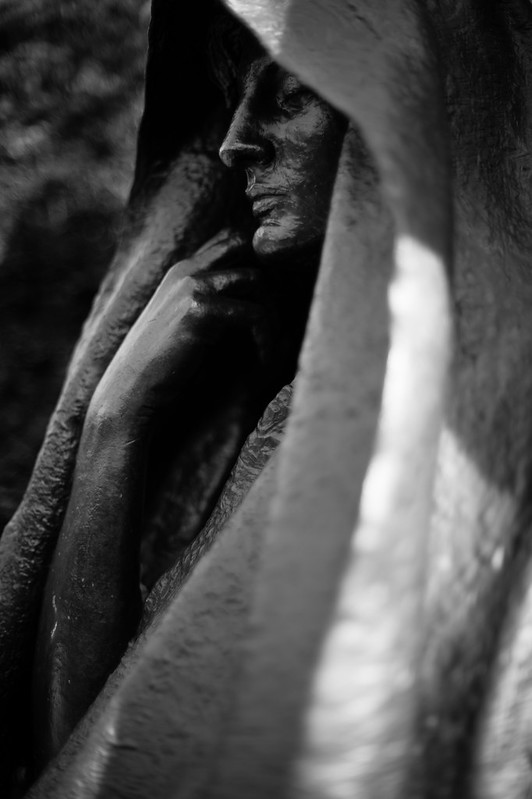
I've posted this picture before, taken with the Nikon Df and Nikkor 50mm f1.2 AIS lens.
 
Here's the same statue, shot with the Reality So Subtle 6x17 panoramic pinhole camera.
 
 
I love figuring out how to use different tools to make images that appeal to me.
 
DMC-365.blogspot.com

Wednesday, December 17, 2014

Nat Geo's Camera Wizard - Kenji Yamaguchi


Here's a rare look inside the genius behind some of the National Geographic images that make you think
 
"How in the world did they do that? How do you rig a camera to capture a bat flying over the water surface in complete darkness and achieve perfect focus?"
 
Sometimes it's purely a result of technique. Let's face it, those Nat Geo photographers know what they're doing. Other times, it's a matter of physically tweaking or even designing and building new equipment.
 
Kenji Yamaguchi was sent from Nikon Japan over 30 years ago to help Nat Geo customize and fabricate photographic tools to enable the amazing pictures the publication is famous for.
 
(Click Here) to read more about this camera wiz on Nat Geo's site, and watch the 3 minute video.
 
For a camera geek and photographer like me, this is right up my alley. Add in the fact that he's a Nikon guy, born and trained in Japan, and now I'm really interested. I'd love to meet Kenji and see his workshop in DC. Hmm. I wonder how I might pull that off?
 
DMC-365.blogspot.com
 

Monday, June 30, 2014

Making Street Photography Automatic? Oh, Boy, I Don't Like This

Library, NYC, by Reed A. George
Leica M9, 50mm Lens
iso 400, f8, 1/125 sec.
 
I just read a post by member katrak on Rangefinder Forum, about how you can use the new Panasonic Lumix DMC-GH4 camera to record video at 24 frames per second with each frame having 8 megapixels of resolution. The title of the post is "Taking away luck in street photography?"
 
(Click Here) to read the post on Rangefinder Forum.
 
Technology may have finally come too far for an old traditionalist like me. One of the things I really love about photography, and street photography in particular, is the game. The game includes finding the scene, getting close enough to the subjects (who you don't know), and most importantly, capturing just the right moment. I would hate for this to be lost. It's like hunting with a machine gun or a bomb.
 
As you probably know, I'm a fan of Panasonic. The GH4 looks like a wonderful camera. So, it's not the camera that is the problem; they're simply pushing video technology to its limits.
 
However, I think this post could be renamed in multiple ways: "Taking away skill in street photography?" or perhaps "Taking away fun in street photography?"
 
I suppose since photography is a hobby for me, and because very few people make money on street photography, I can continue to shoot my old one-at-a-time cameras as long as I live. I'm only competing with myself to capture the moment. There are plenty of those moments to go around, including to people just recording every 1/24 of a second and selecting their favorite from tens of thousands of images later on.
 
DMC-365.blogspot.com

Thursday, February 6, 2014

Dante Stella on the Transition from Film to Digital

 
A Different Spin, by Reed A. George
Leica M9, Zeiss Sonnar 50mm f1.5 Lens
iso 640, f4, 1/180 sec
 
Dante Stella recently wrote an interesting piece about the world's transition from film to digital photography.
 
(Click Here) to read it on The Machine Planet.
 
In the post, Dante refers to the loss of the analog world's science and research - volumes of data on the specifics of light interacting with various components and chemicals, instructions to allow the home enthusiast to develop their own film (with potential for poisoning themselves with color developing). One of his strongest points is that while there is some maintenance level production of film going on, we've lost any hint of further development, of creation, that companies like Kodak were so good at back in the day.
 
Dante also mentions how even those of us who still shoot film mostly use a hybrid analog/digital process. I certainly do. My negatives are never printed in an enlarger any more (and if they were, most processors now use laser printing anyway). I scan them, and from there it's completely digital.
 
I found the piece very insightful, and successful at not covering the same old ground and arguments about film versus digital.
 
Dante's piece ends with a quote:
"Se vogliamo che tutto rimanga com’รจ, bisogna che tutto cambi."
 
Using the best digital technology at hand (Google Translate), I found that this means:
"If we want to keep it this way, everything must change."
 
I find that pretty appropriate. I would not have stood a chance at translating it without digital technology.
 
DMC-365.blogspot.com


Monday, December 30, 2013

The Change in Photography - Kirk Tuck Gives His Thoughts

 
It Should Be Simple to Tell a Story, by Reed A. George
 
I've been thinking a lot about where my photography is going. I've got a new project bubbling up, but it's not yet ready for prime time. I'm still absolutely all over the place with equipment, recently enjoying the use of my Nikon F2 as much or more than my digital wonders.
 
I recently read one of Kirk Tuck's posts on the Visual Science Lab, about his impressions of camera gear and photography, and what all of the changes mean. Change is certainly underway, but where is it all headed?
 
(Click Here) to read Kirk's post on Visual Science Lab. I'll summarize some of his points and give my own thoughts below.
 
First, Kirk says there are two photography communities: the old guys (I just celebrated my 49th birthday), who carry around big heavy gear and focus on "getting it right" technically, and the younger generation, who focus more on telling a story, regardless of equipment, video vs. still, or any other issues that may hold them back.
 
Another point Kirk makes is that we no longer need to worry about getting it right technically; that's easy. Unless of course you use old equipment like I do. The fact that I still sometimes wait to see if my pictures "come out" does show that I'm an anachronism. I can accept that fact.
 
Kirk also says that the difference between the very good and the very best cameras no longer matters. His example is the comparison between an Olympus OM-D (a very good camera), and a Nikon D800 (even better). His point is that you really cannot tell the difference with an online image from either camera, and that's all that matters these days. No one's going to look at prints in a gallery. At least no one but us old men.
 
Another point that I really identify with is that only those who resist the change in photography will feel any pain. I buy that. I like to use it all - old, new, difficult, simple. Hell, I had as much fun with an old Brownie 127 camera that I converted to shoot panoramic images on 35mm film as I had with my Lumix GX1 so far. Talk about different beasts. Meanwhile, I'm working through exactly how to use my new Lumix GX7.
 
Here is Kirk's prescription for what must happen with camera gear to support the change:
 
  1. Smaller, lighter, more accessible cameras
  2. Less user intervention required
  3. Cheaper camera/lens systems
  4. Connection with other technology (phones, tablets, etc.)
Personally, I believe that the camera companies are addressing some of these needs well. For example, Micro 4/3 is definitely hitting the mark with 1,3, and 4. Panasonic and Olympus are failing to meet requirement number 2 with their current Micro 4/3 cameras.
 
From my point of view, if I want simple (#2) in the digital world, it's Leica all the way. Of course, they fail at requirement #3, at least if we're talking about their system cameras.
 
And maybe I'm fooling myself about the M9 being a simple camera. After all, there's no autofocus. No video.
 
A Leica DLux 6 (Panasonic LX7) that had the manual controls and lack of menus that the M9 exhibits would be a killer camera. I don't want to accidentally hit a button that sends me into some labyrinth of menus when I'm grabbing my camera out of my jacket pocket.
 
I think the camera companies are taking different approaches, and someone will hit it just right. Nikon is appealing to us old farts with the Df (which I really like, and want). Leica is trying a little of everything, from the M240 to the C. However, I personally don't think they've developed the perfect product yet. Something along the lines of the X cameras, but with interchangeable lenses could be great. In short - small, few menus, superior interchangeable lenses, autofocus, autoexposure, video. That's what the new age is calling for.
 
As long as it also has manual controls that us old men can fiddle with, I'll be happy to give the new world order a try.
 
DMC-365.blogspot.com
 

Saturday, May 18, 2013

Kirk Tuck's Blog Takes A New Turn - Mine Is Finally Hitting A Straightaway Again

 
Department Store DJ, New York City, by Reed A. George
Pentax K1000
 
Kirk Tuck's blog, the Visual Science Lab, is going in a new direction. Wildly successful at leading discussion, debate, and yes, argument about photography equipment, Kirk is now focusing on process and technique.
 
(Click Here) to read about how it's going for Kirk on his blog, Visual Science Lab.
 
If you've been reading my blog very long, you'll know that I made a similar change in January of this year. For the first year of DMC-365 (2012), I focused mainly on using Panasonic Lumix cameras. However, I found that limiting. I'm an admitted camera junkie, and other equipment - Leica, Nikon, and others - kept creeping in.
 
So, for 2013, I've decided not to abandon the equipment side, but to add to it. In fact, my interest in Panasonic continues, and I'm even expanding that area, by becoming one of Panasonic's Early Adopters and testing new equipment as the opportunity presents itself. But, I've decided to bring in more of the creative side. In fact, I'm focusing at the exact interface between the two. Let's face it, photography is a bridge art. Photography depends upon technology, even if it's that old Brownie camera from your grandma's closet. But, even the latest greatest technology doesn't make a good picture without creativity. So, I'm going to focus on where they come together.
 
I did see a drop in page views when I first made this change in January. Now, in May, I'm consistently getting more traffic day by day than I did last year. And, I'm much happier with what I'm writing about. Of course, Kirk would never be happy with my level of blog activity. I think he's had about 200 times more hits than I. But, I'm gaining experience and exposure each and every day.
 
THANKS FOR READING!
 
DMC-365.blogspot.com