Tuesday, October 14, 2014

Thoughts on the Panasonic Lumix DMC-LX100

 
Size Comparison - DMC-GX7 (Left) v. DMC-LX100 (Right)
Image Source: http://www.dpreview.com/articles/0540594623/opinion-why-buy-a-panasonic-lx100-when-you-could-buy-a-gx7
 
I am a huge fan of the Panasonic Lumix DMC-LX7. I have owned LX-series cameras since the LX2 came out. They are absolutely amazing in terms of features, lens speed and quality (Pana-Leica lenses, including the DC Vario-Summilux f1.4-2.3 lens on the LX7), and compact design. Up until now, the only downside to the LX cameras has been small sensor size. Of course, that small sensor enabled some of the very positive features already mentioned, most clearly the overall compact design of both body and lens (not interchangeable). From the LX3 on, there has been an available accessory electronic viewfinder (EVF).
 
The newest LX-series camera is the DMC-LX100, which was announced a few weeks back. The LX100 addresses that small sensor question by putting a full-size Micro 4/3 sensor into a compact camera body. Not as small as the LX7, but still pocketable, the LX100 sports a 24-75mm equivalent f1.7-2.8 lens. And, the LX100 has a built in EVF. Very nice.
 
Knowing that the LX100 is a little larger than the LX7, I began to wonder if the GX1 Micro 4/3 camera I already have doesn't fill the space of the LX100. Both have the Micro 4/3 sensor, though the LX100 reported uses slightly less than the full sensor area. The GX1 is truly tiny, especially without the accessory EVF attached. Even with, it's quite small. But, I have nothing like a 24-75mm equivalent zoom with fast f1.7-2.8 aperture for the GX1. There's the 14-42 Series II kit lens, which is nothing short of great in my opinion, but it's a slow f3.5-5.6 aperture lens and makes the camera too big to fit in a pocket. The Lumix 12-35mm f2.8 zoom lens for Micro 4/3, slower than that on the LX100, quite expensive, and a lot larger, just doesn't compare.
 
If it weren't for the compact and fast lens on the LX100, I think the GX1 would make it completely redundant. As it is, that differentiates the LX100 as a very capable pocket camera from the GX1 or GX7 for that matter, which have the benefits of many great interchangeable lenses, but at the cost of size.
 
I still wonder how they can make this lens on a Micro 4/3 sensor as small as it is. Maybe I need to hold an LX100 to see just how compact it has remained (or not)
 
I decided to see if others had the same question about the overlap of the larger LX camera and the smallest Micro 4/3 cameras. Of course they did.
 
(Click Here) to read a comparison of the LX100 and GX7 on dpreview.com.
 
Author Damien Demolder comes to essentially the same conclusion as I did - the LX100 is indeed distinct from both the previous LX-series cameras, and the interchangeable lens G cameras.
 
At about $900, the LX100 is more expensive than the LX7 was. But, I'm pretty convinced that it's going to be worth every penny.
 
DMC-365.blogspot.com


Monday, October 13, 2014

Pro Photographer Shoots Fuji Instax for Fun!

fotolucid_it_web_instax_scan_006
 
Image Source: http://snapitseeit.com/cindys-island-time/
 
I've recently gotten back into instant film photography, because I like it. No other reason. I have a Fuji Instax Neo, which really is pretty darned good. But, for amazing quality instant pictures, my Mamiya Universal Press (MUP) with pack film back is unbeatable.
 
This picture is by professional photographer Cindy Leon.
 
(Click Here) to read about her thoughts on the Fuji Instax Wide (larger format than my Neo), and see several more nice instant images she made.
 
I'm down to only a few more packs of Fuji FP3000B to shoot in my MUP, and am dreading the end of it, as the film has been discontinued. The much slower (iso 100 vs. 3000) color film is still available from Fuji, but who knows for how long.
 
So, the Fuji Instax film, which is relatively new, may one day become our only instant film option. But, rather than focus on narrowing options, I should be focusing on enjoying making every shot with instant film!
 
DMC-365.blogspot.com


Sunday, October 12, 2014

Another Watermelon Park Festival Highlight - The Knicely Family Band

I'm working through my Watermelon Park images, in between traveling for work (I'm in Albany, NY at the moment), and several other projects. Here's a shot of the Knicely Family Band.
 
Knicely Family Band, by Reed A. George
Nikon D700, Nikkor 20mm f2.8 AF-D Lens
iso 3200, f5.6, 1/125 sec.
 
As you probably already know from my posts, the Knicely family is kind of a core of musical talent here in Virginia. Danny Knicely (second from right) is a musical powerhouse, playing in multiple bands as well as producing his own music, including his latest CD, "Waltz for Aimee." Those are his brothers on the ends, and Mom and Dad next to him.
 
(Click Here) to go to Danny's website and purchase the new CD.
 
I knew that I wanted to get all of their faces in this shot, to the extent possible. The wide angle 20mm f2.8 lens allowed me to do that from right at the front of the stage.
 
Along those lines, Nikon has a new 20mm f1.8 lens out. I'd love to have that extra speed in my 20mm lens. I've been using the 20 more lately for live music, in dark spaces. The extra 1.4 or so f-stops would really help. See the link below to see the new lens on Amazon.
 
DMC-365.blogspot.com


Saturday, October 11, 2014

Magnum Workshop Day 7/7 - Honoring Bruce Davidson

Bruce Davidson
Image Source: http://onlinebrowsing.blogspot.com/2011/05/bruce-davidson.html
 
Saturday, the workshop is officially over. I slept in, rolling in to the work center sometime in the late morning.
 
The big event was a presentation by Bruce Davidson, who arrived the night before. Bruce has been in Magnum for 56 years.
 
Davidson met Henri Cartier-Bresson while stationed in France with the US military. This clearly had a positive effect on Davidson's direction and focus in photography.
 
One of Bruce's most famous projects was "East 100th Street," where he documented life in an almost-exclusively black neighborhood in NYC. Davidson shot 4,000 negatives, most of them 4x5, in this project. In order to gain access to the neighborhood, he presented the residents with his work and his goal in photographing them. They held a neighborhood meeting and voted to let him in. That said, he still required a "helper" for the first year of the project.
 
Another famous project set in NYC, Davidson documented the subways and people who rode them. In this project, Davidson was mugged, and witnessed a lot of crime against others. One picture that stuck with me was an armed mugging.
 
(Click Here) to see that picture on the Magnum website.
 
Once color film became widely available and useful, Davidson could normally be seen carrying two Leicas - one loaded with color, one with black and white - and only one lens (a 35mm).
 
When asked for advice for photographers trying to improve their work, Davidson repeated what I'd heard multiple times during the workshop, and multiple times from David Alan Harvey: "Stick Around." By this, he meant don't be in a hurry, find the scene and let it develop. This is probably the most important lesson I learned during the weeklong workshop.
 
It is apparent that Davidson also has an interest in nature, as he's photographed it in urban settings including Central Park in NYC, Los Angeles, and Paris. He has a current work in progress where he's photographing people interacting with displays at the Museum of Natural History with a digital Leica and Voigtlander wide angle lens.
 
So, this is the last post about the Magnum Days workshop in Provincetown. What are my conclusions?
 
  1. Definitely a worthwhile experience for me.
  2. I learned, firsthand, many of the things I've read and only partially practiced over the years.
  3. Each and every Magnum photographer is different, and their personalities are wide-ranging.
  4. Telling a story with pictures in a relatively short time is difficult.
  5. Magnum is very exclusive; the workshop assistants are great examples of first-rate photographers who are not in Magnum.
  6. There are a lot of amazing photographers developing out there. The students in this workshop are not just digital "point and clickers." I'm encouraged about the future of people making quality images.
I really feel that I was exposed to both the history and future of photojournalism for a week, and loved the experience. Thanks to everyone at Magnum, in Ptown, and a the FAWC who made it happen.
 
DMC-365.blogspot.com
 

Friday, October 10, 2014

Magnum Workshop Day 6/7 - Showing Our Work

Friday rolled around very quickly. I was now in a position of knowing that I had at least 5 or 6 acceptable images that loosely fit into a theme. It was the hardest I've ever worked for such a small number of decent images. But, with this group the bar was pretty high. There were many, many images that I decided were not even good enough to put in front of a Magnum photographer.
 
In the morning, we met with DAH and the group, reviewed images one more time, and started supplying them along with title slide information and our selected music for a combined digital slideshow. First thing, DAH asked me what I'd added to my set during the last evening after dinner. I said nothing. My project was mostly a daytime thing. He told me that I really needed to add at least one more good shot, one that could wrap up the series. In other words, he said "get your ass back out there and shoot." So, I did.
 
I decided to go to the wharf and catch people saying goodbye at the ferry dock. The ferry runs from Ptown to Boston a couple of times per day. I walked up to the front of the line, near the ticket booth, and asked the attendant if I could set up and shoot from there. He agreed. This should be the right place to catch people saying their final goodbyes for the season. The line was a little small, but there were a few groups around. It was also hard to tell if they were all passengers, or if some were well-wishers, who may give a final hug or kiss as their friends moved onto the boat. Anyway, all set up in a good location, I waited and watched.
 
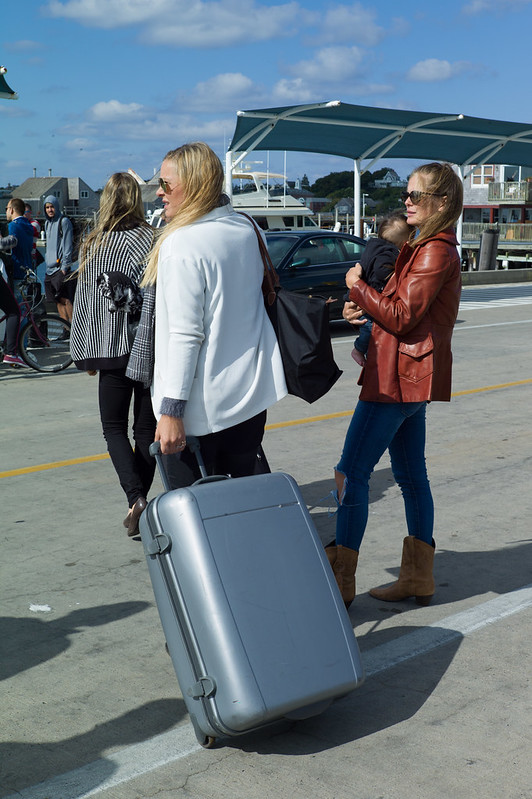
Pretty near the last minute before boarding, I saw a car pull up and park right at the end of the wharf. The security guy went over to talk to them, I imagined to tell them they couldn't park there. It obviously wasn't the normal parking place. Then he sort of nodded and walked away as three beautiful ladies and a young boy emerged from the car. Well, I had to abandon my spot and see if they may be my subjects.
 
Last Minute Arrivals
 
Turns out that they were three sisters, from Sweden. The lady in the leather jacket is a Ptown native, which helped to explain why the guard made an exception. The little boy is her son. Her two sisters were leaving to return to Sweden that day. Wonderful, gorgeous subjects, obviously. And, once I explained what I was doing, they agreed to let me photograph their goodbyes.
 
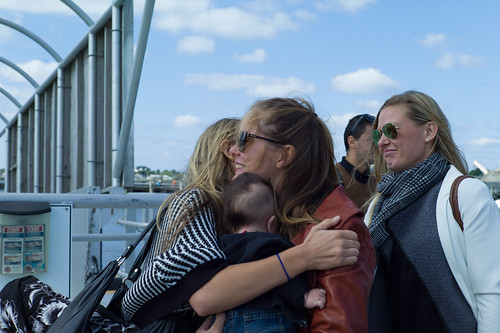
Here's one from their final hug at the wharf. Good, but not great.
 
Goodbye!
 
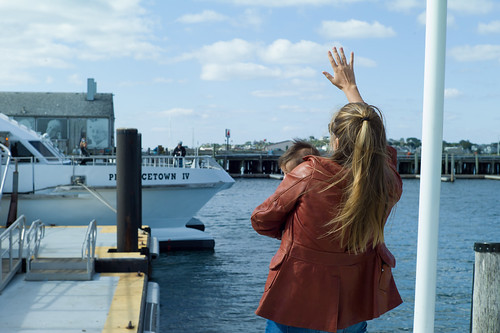
I just had to have something better. Once the two sisters were onboard, I asked the Ptown sister if she wasn't going to walk over and wave to them. She said "Oh yes, I should do that." This was what I was waiting for.
 
The Wave
 
This was going to be the final shot in my slideshow. When you see it large enough, you can see her sister on the deck of the ferry, waving back. I thanked her and headed back to the Fine Arts Work Center.
 
As I went to drop my gear in my room, I noticed David Kaplan (who I'd never met) standing outside his home speaking on his phone. Asking if I could shoot a picture of him there, he obliged, but said that I must come back because I "had no idea" what I was photographing. I did, and that led to the portraits I shot of him, a true highlight of the workshop experience. It was that ten minutes of access that I'd been searching for the whole week.
 
(Click Here) to see my portraits of David Kaplan, author and Curator of the Provincetown Tennessee Williams Festival. In fact, this resulted in my being invited to stay another week in Ptown to photograph behind the scenes at the festival. Boy, I wish I could've done that, but it wasn't in the cards.
 
On this evening, the public presentation was a slideshow of results from all of the different workshop sessions of the week. I found it quite impressive what others were able to come up with in such a short time in Ptown. I'll post the link to the slideshow as soon as it's up on the Magnum education blog.
 
DMC-365.blogspot.com
 

Thursday, October 9, 2014

Magnum Workshop Day 5/7 - Focus Pays Off, With One Usable Shot

Okay, at the end of Day 4 I felt pretty confident. I had a few images from the beach and the ladder shot, which reasonably tied in to my "end of the season" in Ptown theme. DAH selected a couple of the images, didn't like the beach exit picture I posted yesterday, and told me frankly that I had more work to do. He did suggest that I head back to the beach to see what else I could make of that.
 
I had in the back of my mind that I may once again find the surf fishermen, but that didn't happen.
 
I threw my Lumix GX7 over my shoulder, grabbed lunch to go in a bag, and biked back out to the shore. I went to the places I'd been the day before, met and talked with a few different people on the beach, and even got a young couple to let me shoot their relaxing day in the sand. None of these made it past my own filter.
 
Making a long loop ride around the seashore as shown below, I ended up at a bike shop near the west end of town.
 
Original Map Source: http://www.visit-provincetown.com/wp-content/uploads/2013/03/parkingPtown.png
 
Sort of out of options after leaving the beach with no real good additions to show for my efforts, I decided to act on DAH's advice to find a spot and let the image develop. The bike shop had lots of "Sale" signs up, indicating the end of the season. The deli inside the store was already closed for the season, and I photographed that, but not to much effect.
 
Going back outside, I noticed one of the shop employees working there. I struck up a conversation, and found that he himself was a sign of the change of seasons in town. Having come to Ptown for the summer from Bulgaria, this young man was preparing to return home in a couple of days. While he had enjoyed Ptown very much, working very long hours (90 hours per week!), he was looking forward to getting home to see his family. I asked where he had lived during the summer, and he told me he'd shared a space with two other people on the property. Asking if I could photograph his room, he told me that he was not allowed to bring guests in. And, he was working at the moment, anyway.
 
Having to pursue it further, I asked him if he could grab his suitcase, and let me photograph him walking out the door of the shop. Not exactly what I wanted, and staged for sure, it would have at least been something. He politely told me that he'd already been on break that afternoon, and wasn't allowed to take another. I asked him if I could request that his boss make an exception. He replied that his boss himself was on break, and not available. He would not be back for about 30 minutes. I said I'd wait.
 
Now at this point, it was clear that I was pushing hard, and quite possibly had outstayed my welcome. This guy was extremely nice, but was getting a little uncomfortable about my persistence. Anyway, I decided to wait it out.
 
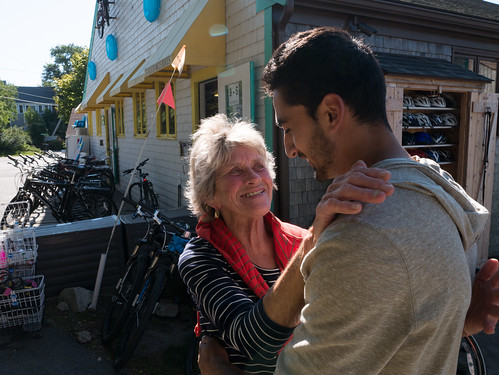
Sitting on a picnic table in front of the store, waiting, I shot a couple of pictures of people coming and going, but nothing with a story. And then it happened. A lady from the neighborhood who'd befriended this young gentleman over the summer came to say goodbye before he left to return to Bulgaria. She hugged him, and told him how much she enjoyed knowing him. Real emotion, finally! I asked her permission to photograph them together, and she happily obliged. Here's the one shot I got from a few hours of pursuit:
 
Goodbye My Friend
 
This one shot made it all worthwhile. In fact, it was the only useful image I got the entire day.
 
That evening back at the Fine Arts Work Center (FAWC), Costa Manos was our featured speaker. Like Bruno Barbey, Costa has been with Magnum for 50 years. Costa was the main motivator for the Magnum Days in Provincetown program. Costa walked us through his amazing career in photography, beginning with his early coverage of a South Carolina island known as Daufuskie. This was where Costa made his first "serious" image, in 1952.
 
(Click Here) to see that image on the Magnum website.
 
It is an amazing image. In fact, it haunted me. Haunted me to the point that I purchased a limited edition print of it. I am not an art collector, but I really wanted to have this image to put on my wall as a reminder of the workshop, meeting Costa, and all of the other great people involved in the workshop.
 
DMC-365.blogspot.com


Wednesday, October 8, 2014

Magnum Workshop Day 4/7 - Starting to Find My Way

Day 4. Wednesday. David Alan Harvey (DAH) had arrived on Tuesday night, and I knew that I'd be working with him for the rest of the week.
 
My final meeting with Bruno Barbey in the morning allowed me to share my images from Rego Automotive, two or three of which Bruno actually liked. I also showed him my shots from meeting the NYC surf fishermen. Bruno suggested that I try to find them again.
I joined DAH at around 10:30AM, and each of us students shared what we had so far. David was clear in telling us that we didn't have much for being on the third day of the workshop, and I agreed. He shared some of his own work, including a series from a strip bar in NYC, and showed us every exposure. This helped us to understand how he built up to the final few amazing images by working the scene. DAH doesn't believe in walking around looking for images. He finds a spot and sticks with it until a photograph emerges. This was an important lesson for me, and one that would pay off in the end.
 
After lunch, I grabbed my bike and headed back toward the beach, hopeful of finding the surf fisherman again.
 
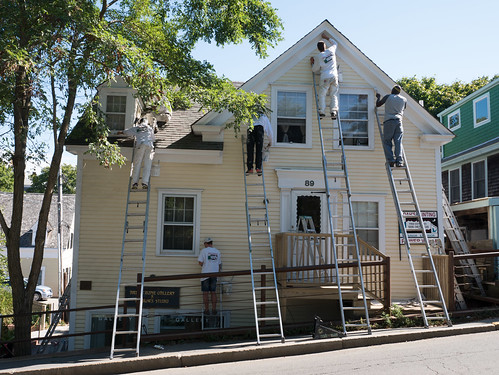
On the way, I noticed this scene, which has some relation to the changing of seasons in Ptown. Trying to follow directions and work the scene, I shot this one, which I thought was just an ice breaker. Then I proceeded to get close, and shoot images of individuals working. Technically fine, they just showed one or two guys painting. DAH picked this shot below because the real visual draw was having all of these ladders in place on one house. It gives the impression of working to get the painting done quickly. So, this was the only one that made the cut.
 
 
Winter Preparations
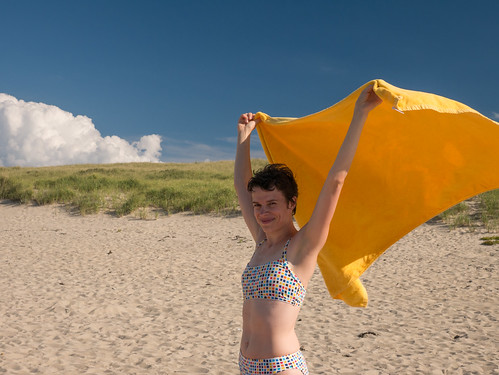
I never did find the surf fishing group again. However, on this day, I did finally start to find my groove. It was Wednesday, DAH was in town, and the pressure was on. Walking the beach, I caught a flash of brilliant color out of the corner of my eye. It was this young lady, letting her beach towel blow in the breeze. Walking over to her, I explained that I simply had to have that image for my workshop series. She happily obliged. I knew at this point that things were starting to go somewhere, at least a little.
Golden Towel
 
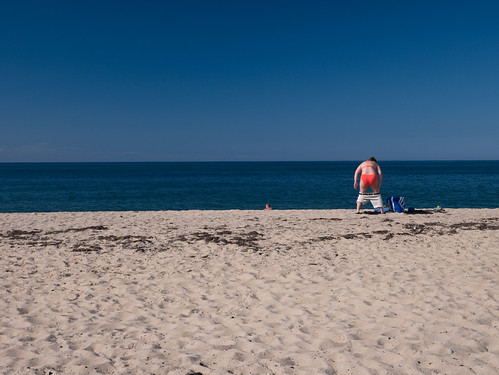
Then, I happened to catch this amusing little moment. Having my Lumix DMC-GX7 and kit zoom allowed me to quickly capture this image without anyone noticing. One second later and it was gone.
 
Caught in the Moment
 
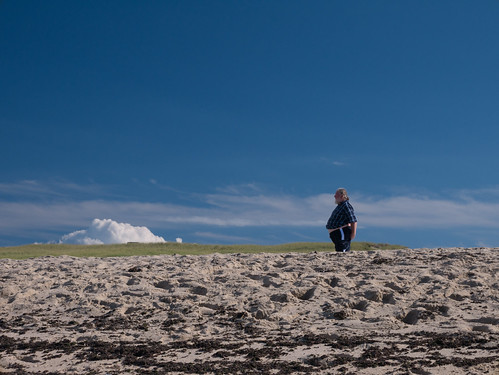
Not five minutes later, I found this somewhat similar scene:
 
 
A Theme, Perhaps?
 
Deciding that a final day or two at the beach did fit my story line of Ptown shutting down for the season, I was happy to bring these into my image collection. I knew that I would need some pictures of people departing, and grabbed the shot below to try to capture that feeling.
 
Leaving the Beach
 
That shot didn't make the cut. DAH liked the concept, but not the execution. Getting a couple of closing shots would prove to be no simple feat. At least I had a start, however. I went into Wednesday evening feeling much more confident. Maybe too much so.
 
The public talk was by DAH on this evening. Knowing that he'd just arrived after days of trying to fly in from Europe, and had worked the full day that day, I was impressed with his energy and clear thought in presenting his work. There are many great examples of DAH's work to look at. Having been a National Geographic photographer for many years, of course he had stories. One of his latest projects, "Based on a True Story," demonstrates an edgy, energy-filled depiction of Rio de Janeiro. I was very pleased to get a copy of the book, complete with signature, as part of being in David's workshop.
 
So, I had a start. Far from really having a full story, I knew I had to find more good images in the coming two days, but at least I had a start.
 
DMC-365.blogspot.com