Showing posts with label dmc-gx7. Show all posts

Tuesday, August 18, 2015

Spider's Web, Waihe'e Ridge, Maui

 
Spider's Web, by Reed A. George
Panasonic Lumix DMC-GX7, Sigma 60mm f2.8 Art Lens
 
From my sunrise hike up Waihe'e Ridge in Maui. Sometimes jet lag can be a good thing. Today, it made it awfully easy to be up before dawn for the drive to the trailhead.
 
DMC-365.blogspot.com
 

Monday, August 17, 2015

Long Shadows - Waikiki Beach

 
Long Morning Shadows, Waikiki, by Reed A. George
Panasonic Lumix DMC-GX7, Sigma 60mm f2.8 Art Lens
 
In this scene, I was struck by the extremely long shadow projecting from the person on the beach, and an even longer one from a palm tree not visible from this viewpoint. This highly directional strip of light was coming through between two large hotel towers. I took this from the 19th floor of the hotel.
 
DMC-365.blogspot.com
 

Sunday, August 16, 2015

Haleakala Crater

Haleakala Crater, by Reed A. George
Panasonic DMC-GX7, Lumix 20mm f1.7 Lens
Graduated ND Filter
 
What an amazing, nearly-alien landscape this is...
 
DMC-365.blogspot.com
 

Sunday, August 9, 2015

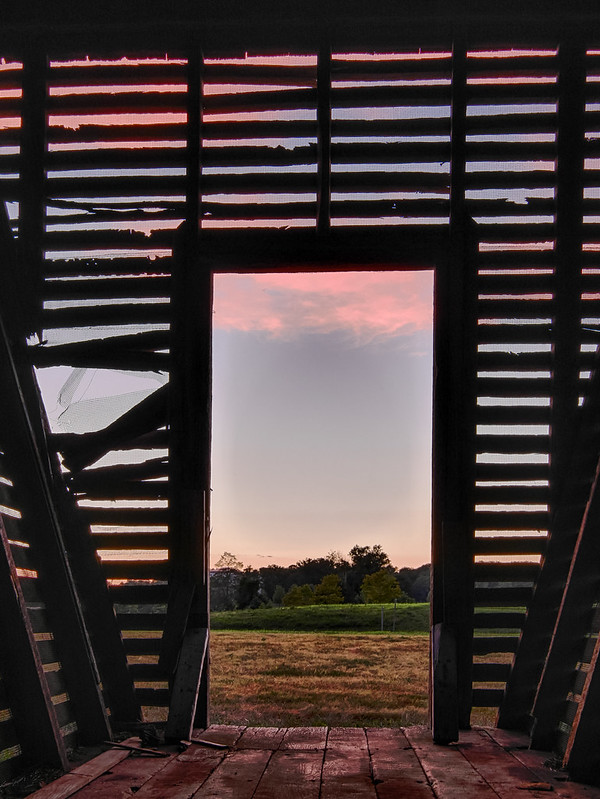
Another Corn Crib Shot - HDR

I added one more shot to the corn crib set, this one a high dynamic range (HDR) image from inside the corn crib.
 
Inside Looking Out, by Reed A. George
Panasonic Lumix DMC-GX7, Lumix 20mm f1.7 Lens
HDR from three separate exposures
 
I'm looking forward to getting refamiliarized with the GX7 on my upcoming vacation.
 
DMC-365.blogspot.com

Saturday, August 8, 2015

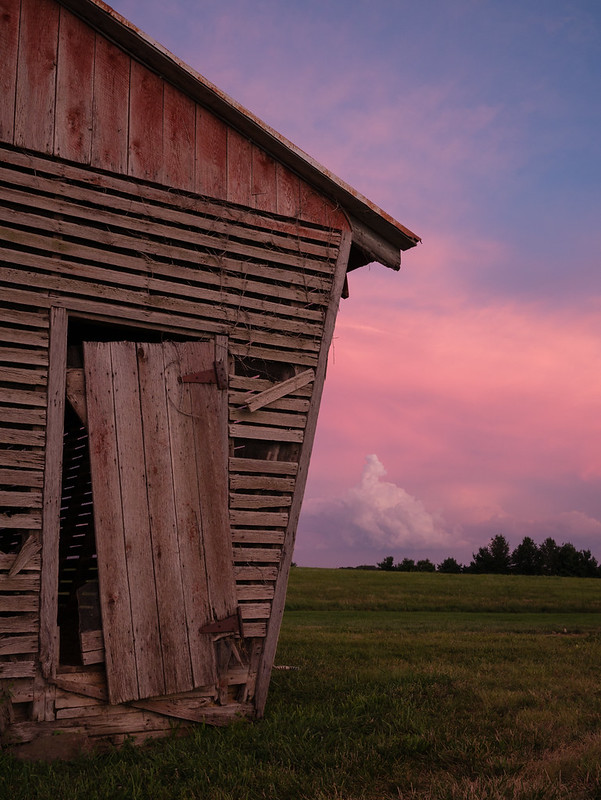
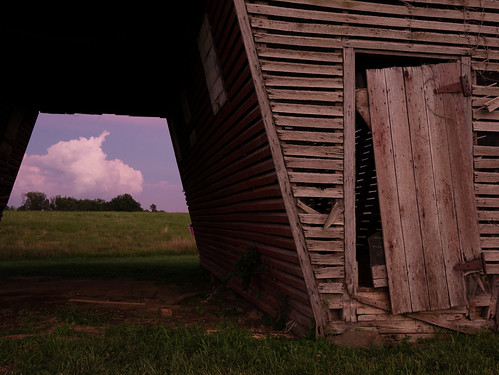
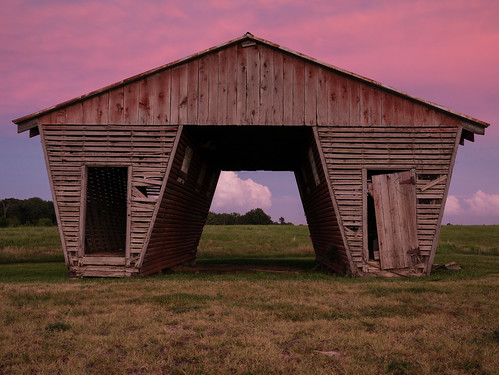
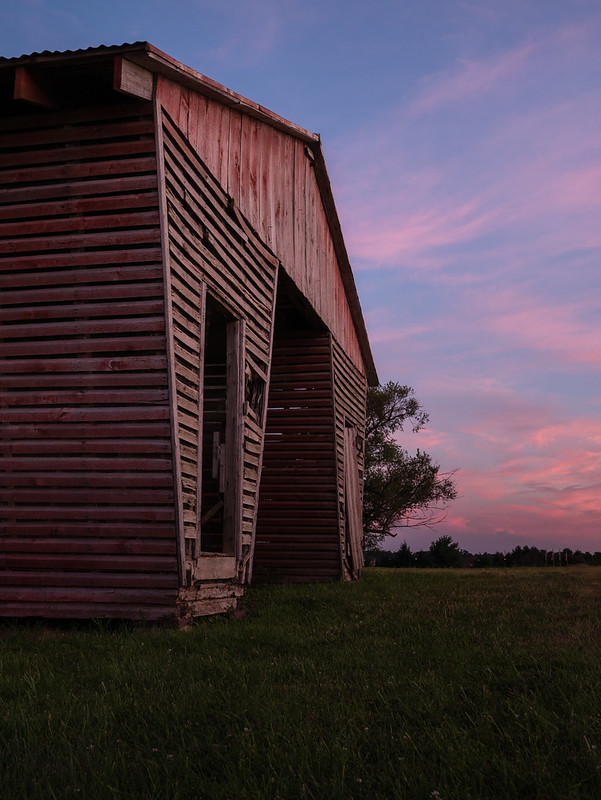
The Old Corn Crib, Revisited

I was driving home this evening and noticed a lot of dramatic clouds in the sky, accentuated by the sunset. So, I stopped at the old corn crib that I've photographed in the past and made some images. (Click Here) to see one of my previous posts of this cool old building.
 
This time, I had my Panasonic Lumix DMC-GX7 and 20mm f1.7 lens with me. I'm trying to decide whether to bring this camera on vacation with me. I've drifted away from my Micro 4/3 gear recently, but this little shoot has me once again appreciating the GX7.
 
I actually sold some of my Micro 4/3 lenses recently, keeping only those that I hold most dear. Also, I kept the smallest lenses, as that's what shines about Micro 4/3 cameras, small size. So, I sold my 14-140mm zoom, 25mm f1.4 Summilux, and 75mm Olympus lenses. All excellent lenses, I felt that keeping my 20mm f1.7, Pana-Leica Micro-Elmarit 45mm f2.8, 14mm f2.5, Bower fisheye, and the amazing 100-300 f4-5.6 zoom was sufficient. Now I find that I'm missing the medium telephoto length of the Oly 75, especially in planning for travel. So, I'm going to try the new Sigma 60mm f2.8 Art lens, which is very cheap ($200 new), and getting great reviews. More on that to come.
 
DMC-365.blogspot.com
 

Monday, August 3, 2015

More Parkour - Fisheye Shots

Here are some fisheye images I made with the Panasonic Lumix DMC-GX7 and Bower fisheye lens. These were taken at the same parkour workout that I wrote about yesterday.
 
 
I shot these at the end of the workout, choosing to use high iso and no flash. I really need to try some fisheye images with rear curtain, slow shutter flash. That will be cool.
 
DMC-365.blogspot.com
 

Saturday, March 21, 2015

Another One From a Year Ago

Santa Fe Diner, by Reed A. George
Panasonic Lumix DMC-GX7
 
I guess I was smart enough to travel to Santa Fe last winter. I took this shot with my GX7 sitting on the restaurant table. I like that you can see each of the couple's heads three times (the heads themselves, reflections in the mirror beside them, and reflections on the table surface). Pretty cool.
 
DMC-365.blogspot.com

 

Saturday, November 22, 2014

Lumix DMC-GX7 for Live Music

I've been focused on other cameras lately. So many great cameras out there, so little time to shoot them.
 
I read an interesting piece on Steve Huff's blog about using the Lumix GX7 for live music.
(Click Here) to read it, and see some nice GX7 images from bars in Amsterdam.
 
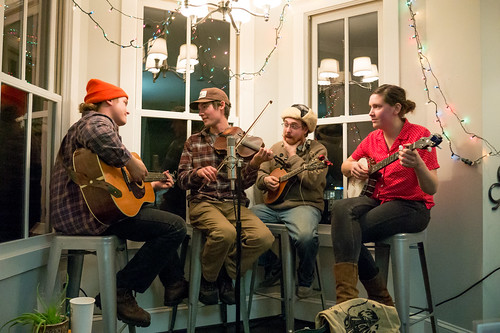
Here are a couple of shots of my friends Jake and the Burtones, shot with my GX7.
 
Jake and the Burtones, Plus Melissa, by Reed A. George
Panasonic Lumix DMC-GX7, Bower 7.5mm Fisheye Lens
iso 3200, f4 (or so), 1/50 sec.
 
 
Burtones, by Reed A. George
Panasonic Lumix DMC-GX7, Lumix 14-42mm f3.5-5.6 Aspheric Series II Zoom
iso 6400, f3.5, 1/100 sec.
 
The GX7 does pretty well in low light, even at iso6400. Not like a full frame Nikon, of course, but respectable. And so much easier to lug around.
 
DMC-365.blogspot.com


Monday, November 17, 2014

A Morning Out Birding as Winter Approaches

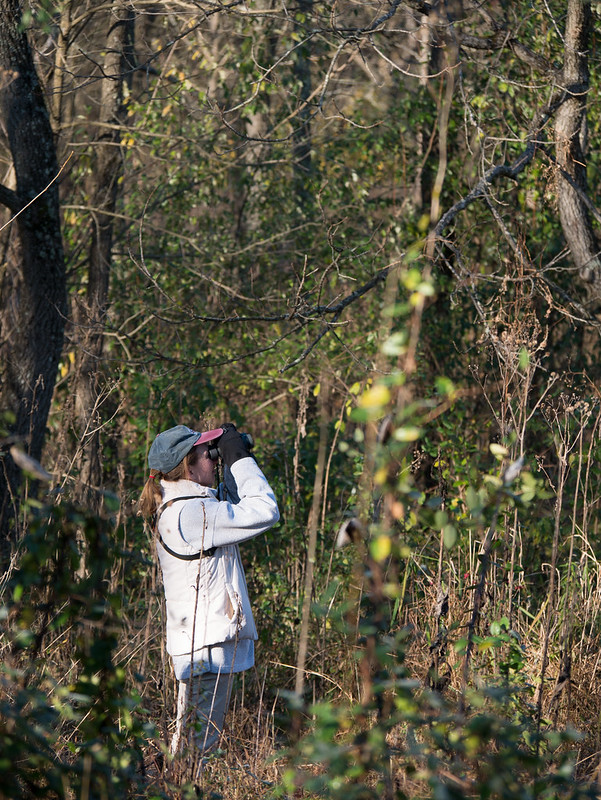
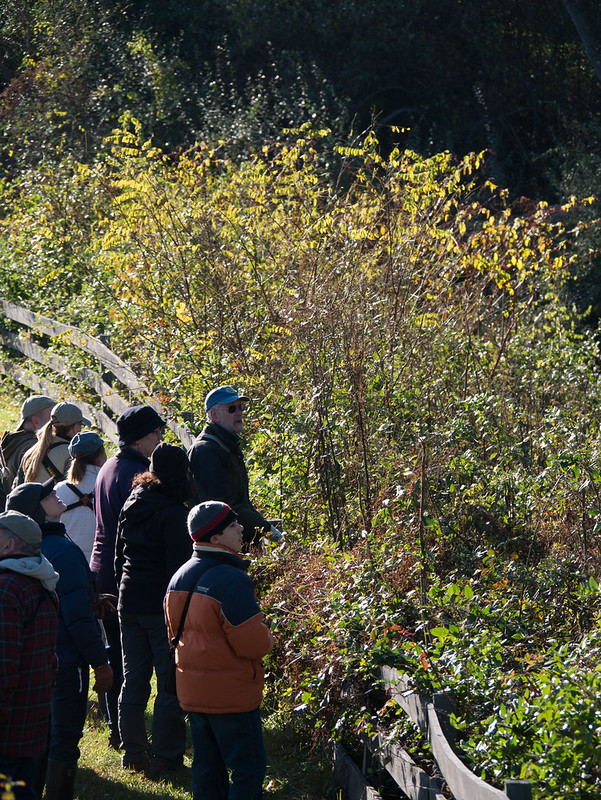
Yesterday, I joined a bird watching walk at my nearest wildlife preserve, which is called Banshee Reeks. The walk happens monthly, and is sponsored by the Loudoun Wildlife Conservancy. (Click Here) to read about the organization. They host quite a number of interesting events.
 
I realized that the walk was happening at 7:35 AM; it started at 8:00 AM. I quickly grabbed my Lumix GX7 and 100-300mm f4-5.6 OIS lens and headed out the door. A quick stop at Peets for my Saturday morning coffee, and away I went. I arrived just in time to join the group.
 
 
I really am a telephoto guy at heart. Though I've expanded my skills to include normal and wide angle lenses, from the start I've loved shooting long lenses. The 100-300 Lumix lens is a fantastic combination of long reach (600mm equivalent) and compact size. Because of the OIS vibration isolation, it's even more reasonable to use handheld.
 
Considering that it's winter, and the majority of migratory birds have already gone, we saw quite a range of birds: white throated sparrow, bluebird, fish crow, American crow, flicker, hawk (didn't get a good identification, but probably either red tailed or red shouldered), an immature bald eagle, mockingbird, plenty of robins. It's always great to go with someone like our tour leader Joe and his sidekick Del, who can spot and identify birds well beyond my capabilities.
 
Knowing that I had to get back home, after about an hour with the group I just wandered off into the forest and sat down. After a few minutes, I heard a single bird call. Then, I heard a different bird answer, much closer to where I was sitting. Within a few minutes, a small group of tufted titmouse had been drawn to an old hay bale, rolled off into the woods next to me.
 
I sat and enjoyed watching them for another ten minutes or so, and then got up, got the blood back into my legs, and began the walk back to the car.
 
I shot a few more pictures on the way back.
 
I think that telephoto lenses get underrated for their use in landscape photography.
 
Finally, coming around a corner in the trail, I got a quick shot off of this Mockingbird, against the blue autumn sky.
 
 
It was a very nice way to spend just a couple of hours on an autumn Saturday morning.
 
DMC-365.blogspot.com
 

Monday, November 3, 2014

Reductionism in Photography, as Covered by Theme

Reduction, by Reed A. George
Panasonic Lumix DMC-GX7, 14-42mm f3.5-5.6 Series II Kit Lens
iso 200, f9, 1/60 sec.
 
I read an interesting post on the blog Theme, about reductionism in photography. It considers the act of boiling down everything that we see, hear, and think to a simple concept. In photography, that translates to reducing composition to the absolute minimum.
 
(Click Here) to read the post about reductionism on the Theme blog.
 
Personally, I'm not sure where the intersection is between reductionism and simplicity. Many photographic texts and teachers stress simplicity in photographic composition. I don't really work that way. I have been told that some of my images have too much clutter, are not simple to understand. In general, I don't mind this, if the image still transmits a message. I don't want my images to be so simple as to be obvious or shallow.
 
The picture above is a rare example of simplicity (or is it reductionism?) for me. I took this one in Provincetown, Massachussetts when I was there for a workshop. To me, it represents a special quality to the light that I experienced there. It also reminds me of the simple yet completely satisfactory room that I stayed in while I was there. Of course, no other viewer will have the benefit of that experience.
 
It was the light that caught my eye, not the subject. I love how the light coming through the holes in the strainer is golden; I didn't set that up in any way. It's just the way it was.
 
Anyway, I'm sure that I can benefit from considering reductionism in my photographic work. I will do that, without losing some of the complexity that I feel when I make a picture. There's something to learn from each and every person's approach to photography and art.
 
But, I still don't really know if reductionism and simplicity are the same concept.
 
DMC-365.blogspot.com
 

Tuesday, October 14, 2014

Thoughts on the Panasonic Lumix DMC-LX100

 
Size Comparison - DMC-GX7 (Left) v. DMC-LX100 (Right)
Image Source: http://www.dpreview.com/articles/0540594623/opinion-why-buy-a-panasonic-lx100-when-you-could-buy-a-gx7
 
I am a huge fan of the Panasonic Lumix DMC-LX7. I have owned LX-series cameras since the LX2 came out. They are absolutely amazing in terms of features, lens speed and quality (Pana-Leica lenses, including the DC Vario-Summilux f1.4-2.3 lens on the LX7), and compact design. Up until now, the only downside to the LX cameras has been small sensor size. Of course, that small sensor enabled some of the very positive features already mentioned, most clearly the overall compact design of both body and lens (not interchangeable). From the LX3 on, there has been an available accessory electronic viewfinder (EVF).
 
The newest LX-series camera is the DMC-LX100, which was announced a few weeks back. The LX100 addresses that small sensor question by putting a full-size Micro 4/3 sensor into a compact camera body. Not as small as the LX7, but still pocketable, the LX100 sports a 24-75mm equivalent f1.7-2.8 lens. And, the LX100 has a built in EVF. Very nice.
 
Knowing that the LX100 is a little larger than the LX7, I began to wonder if the GX1 Micro 4/3 camera I already have doesn't fill the space of the LX100. Both have the Micro 4/3 sensor, though the LX100 reported uses slightly less than the full sensor area. The GX1 is truly tiny, especially without the accessory EVF attached. Even with, it's quite small. But, I have nothing like a 24-75mm equivalent zoom with fast f1.7-2.8 aperture for the GX1. There's the 14-42 Series II kit lens, which is nothing short of great in my opinion, but it's a slow f3.5-5.6 aperture lens and makes the camera too big to fit in a pocket. The Lumix 12-35mm f2.8 zoom lens for Micro 4/3, slower than that on the LX100, quite expensive, and a lot larger, just doesn't compare.
 
If it weren't for the compact and fast lens on the LX100, I think the GX1 would make it completely redundant. As it is, that differentiates the LX100 as a very capable pocket camera from the GX1 or GX7 for that matter, which have the benefits of many great interchangeable lenses, but at the cost of size.
 
I still wonder how they can make this lens on a Micro 4/3 sensor as small as it is. Maybe I need to hold an LX100 to see just how compact it has remained (or not)
 
I decided to see if others had the same question about the overlap of the larger LX camera and the smallest Micro 4/3 cameras. Of course they did.
 
(Click Here) to read a comparison of the LX100 and GX7 on dpreview.com.
 
Author Damien Demolder comes to essentially the same conclusion as I did - the LX100 is indeed distinct from both the previous LX-series cameras, and the interchangeable lens G cameras.
 
At about $900, the LX100 is more expensive than the LX7 was. But, I'm pretty convinced that it's going to be worth every penny.
 
DMC-365.blogspot.com



Saturday, September 27, 2014

Nice Summary of Six Years of Micro 4/3 on m43photo.blogspot.com

Dancing, Golden Gate Park, by Reed A. George
Panasonic Lumix DMC-G1, Voigtlander 28mm f2 Ultron Lens
 
 
I have spent a lot of time shooting, and thinking about, the Micro 4/3 format. In fact, my blog is named in observance of the standard "DMC-XX..." camera model designation of Panasonic's Lumix cameras. For Panasonic, the DMC-G1 was the first Micro 4/3 camera. I made good use of that one. Then, for an entire year, I focused mostly on shooting a pair of DMC-G3s.
 
I have ventured far and wide since that first year of 2012, but still regularly include Micro 4/3 gear and images in my posts.
 
The blog m43photo.blogspot.com, started in 2009, has been focused on Micro 4/3 longer, and more exclusively than my own, but with fewer overall blog posts. Now they have posted a brief retrospective of what's gone on in terms of camera and lens development over the past six years.
 
(Click Here) to read the post on m43photo.blogspot.com
 
I have been ambivalent over the years about whether or not the Micro 4/3 sensor size was the right compromise between sensor size (larger would provide better image quality) and equipment size (smaller sensors lead to smaller cameras and lenses). About a year or two ago, it seemed that APS-C was about the smallest you could go and still expect truly excellent image quality at higher iso settings. Now, I'm beginning to once again think that Micro 4/3 may turn out to be an ideal size.
 
In the Magnum workshop that I just attended, I shot with both my Leica M9, a full frame digital rangefinder, and the Lumix DMC-GX7, a Micro 4/3 camera. As it turned out, I used the GX7 for most of my shooting, which included a lot of bike rides around the Cape Cod National Seashore; most of the images in my final project submission were shot on Micro 4/3. There were certainly no complaints about image quality.
 
In fact, at the same workshop, David Alan Harvey showed us his new book Based on a True Story. The cover shot was made with a Lumix GF1 Micro 4/3 camera. It's hard to argue with the image quality he achieved.
 
It will be interesting to see how the evolution of Micro 4/3 proceeds over the coming several years.
 
DMC-365.blogspot.com

Thursday, August 28, 2014

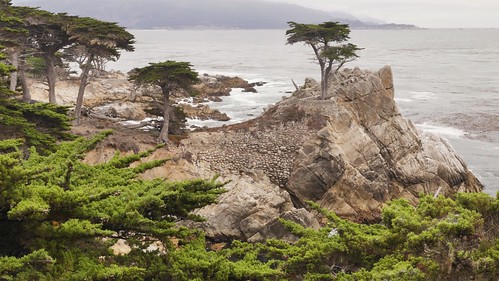
Lone Cypress, Pacific Grove, California

Here's a shot I made this afternoon of the Lone Cypress on the 17 Mile Drive in Pacific Grove (near Monterey) California.
 
Lone Cypress, by Reed A. George
Panasonic Lumix DMC-GX7, Lumix 14-42mm f3.5-5.6 Aspheric Series II Kit Zoom
at 23mm, with 3 stop ND + Polarizing Filter
iso 200, f22, 0.5 sec.
Edited in Snapseed on my iPad
 
This same spot is photographed hundreds or thousands of times every day. I tried to think hard about composition. I used the ND and polarizing filter to allow me to shoot a long exposure (1/2 second), in an attempt to make the water motion smooth and ethereal. It worked at a certain level.
 
What a gorgeous place this is.
 
DMC-365.blogspot.com

 

Tuesday, August 26, 2014

Another Berkeley Favorite - Used Book Stores

Actually, this bookstore (Pegasus) is at Rockridge in Oakland, just across the border from Berkeley. I find used bookstores to be a sign of true culture. Of course, that' just my opinion.
 
View from Pegasus, by Reed A. George
Panasonic Lumix DMC-GX7, 14-42mm f3.5-5.6 Series II Kit Zoom
iso 800, f5, 1/320 sec.
Unedited image straight from the camera
 
The light on this foggy morning was very subtle. It was the soft shadows around the bench the first caught my eye. Then the line of the bookshelves provided a nice lines, intersecting with the window ledge to focus attention near where the people outside were walking by.
 
Not an important shot, but a fun one none and an exercise in composition none the less.
 
DMC-365.blogspot.com


Sunday, August 24, 2014

Newport, California - Upper Newport Bay Nature Preserve

We arrived last night in Newport Beach, California, where we're attending the wedding of a close family friend.
 
I awoke early, being on East Coast time, and decided to find a nice place to take a sunrise walk. Pulling up Google Maps, I immediately found the Upper Newport Bay Nature Preserve, just a couple of miles from our hotel. While the web said it didn't open until 10:00 AM, I took a chance, and was rewarded with an open, yet empty parking lot. Here are a few scenes from the morning walk, all shot with the Panasonic Lumix DMC-GX7 and Series II 14-42mm kit zoom.
 
 
DMC-365.blogspot.com


Saturday, August 2, 2014

Combining Systems - Micro 4/3 (Lumix GX7) and Nikkor Super Telephoto 500mm f4 AiP Lens

Just for fun, I decided to take out my enormously heavy Nikkor AiP 500mm f4 lens, and mount my Panasonic Lumix DMC-GX7 body to it, for some bird photography. That's right, the body mounts to the lens in my mind, as it's tiny in size compared to the big telephoto.
 
I put the combination on my even heavier Gitzo tripod with Manfrotto gimbal mount, and commenced to photographing wading birds at my local nature walk. I set the GX7's in-body image stabilizer to 500mm, but left it on. You would usually turn it off when using a tripod.
 
Here's an example shot of a great blue heron.
 
Portrait of a GBH, by Reed A. George
Panasonic Lumix DMC-GX7, Nikkor AiP 500mm f4 Lens (Manual Focus)
iso 1600, f8, 1/1000 sec.
 
With an equivalent field of view to a 1000mm lens on full-frame 35mm, it's obviously a challenge to manually focus this big lens, and hold it steady enough to get a decent shot, even at 1/1000 second exposure. The manual focus magnifier and focus peaking helped immensely, especially the magnifier. The peaking seems to be a little too forgiving, overestimating the depth of field at this long focal length.
 
This bird actually was a little too close for me to get the shot I wanted, not your normal situation in bird photography.
 
Even at iso 1600, the noise levels are quite reasonable with the GX7.
 
So, rather than worry about carrying a tele-converter to get just a little more reach from my 500mm lens, I can just carry the GX7 body! It probably weighs less than a converter, and you don't lose an f-stop of light gathering. Pretty cool.
 
Now that I know it technically works okay, I need to go back and see if I can get some more interesting images with this combination.
 
DMC-365.blogspot.com



Saturday, July 26, 2014

Great Egret - Super Telephoto on Micro 4/3

Yesterday, I posted an image of a green heron, shot with my GX7 and modern Lumix 100-300mm f4-5.6 OIS lens.
 
Just for fun, I decided to try shooting at the same place with my very old (Nikon Pre-AI mount) Sigma 400mm f5.6 lens, adapted to fit the GX7. Here's a great egret shot with that combination.
 
 
Great Egret, Ardea alba, by Reed A. George
Panasonic Lumix DMC-GX7, Sigma 400mm f5.6 Manual Focus Lens (Pre-AI Nikon mount)
iso 1600, f11, 1/1000 sec.
 
Not bad for an old lens, huh? By the way, this is the lens that I won at the Film Photography Project's Walking Workshop in May. (Click Here) to read more about that.
 
I know that most of you can't click and zoom on this image, due to the way I post from flickr. Here's a ~100% crop from the image above:
 
You can see that he's just caught a minnow. While the results from this 30-40 year old lens don't match the modern Lumix 100-300mm zoom, they're pretty good, in my opinion. This is an extremely low-cost 800mm equivalent field of view combination for someone who has the patience to shoot nature with a manual focus lens. The GX7's manual focus magnifier really helps out, but is obviously only useful for static subjects. The Nikon-to-Micro 4/3 adapter is also very inexpensive, and available on Amazon (please buy yours from the link below and support my blog!).
 
DMC-365.blogspot.com


Friday, July 25, 2014

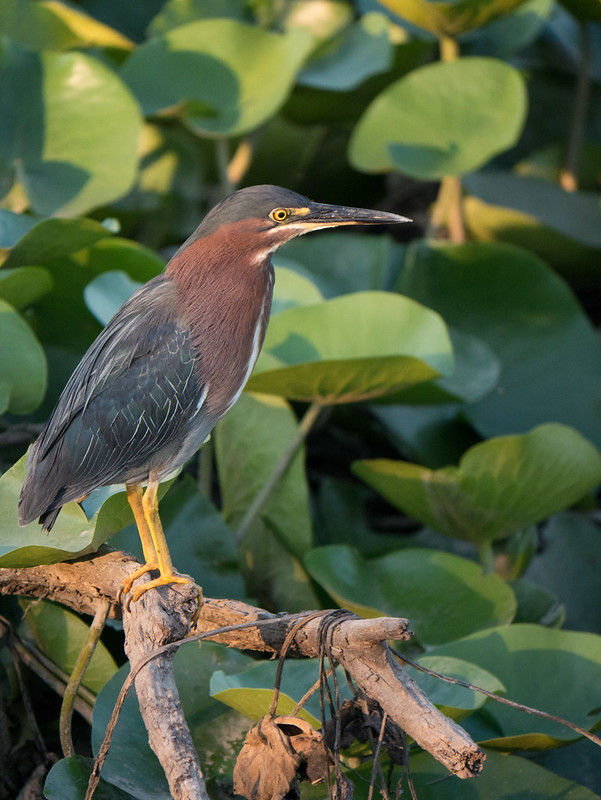
Green Heron - Panasonic Lumix DMC-GX7 and Lumix 100-300mm f4-5.6 Lens


Green Heron, Butorides virescens, by Reed A. George
Panasonic Lumix DMC-GX7, Lumix 100-300mm f4-5.6 Zoom Lens at 300mm
iso 1600, f6.3, 1/800 sec.
 
In our neighborhood suburban "nature preserve," I've been noticing a pair of green herons on our occasional evening walks. I took out a telephoto lens at sunrise last weekend, but they were nowhere to be found. Having seen them again last night, when I didn't have a long lens along, I decided that was it. I was coming back today with a long lens and tripod.
 
Well, I was rewarded with the presence of this little guy. I wasn't able to catch him feeding, so there's reason to try again (and again, I'm sure).
 
I'm pretty pleased with the result, especially given that I was shooting the GX7 at iso 1600. Not bad. Not bad at all...
 
DMC-365.blogspot.com
 

Tuesday, July 22, 2014

Caught in the Maze

The National Building Museum in Washington, DC is currently hosting an exhibit called the BIG Maze.
 
(Click Here) to read about the museum and the maze.
 
The BIG Maze, by Reed A. George
Panasonic Lumix DMC-GX7, 14-42mm f3.5-5.6 Series 2 Kit Lens
iso 800, f5.5, 1/80 sec.
 
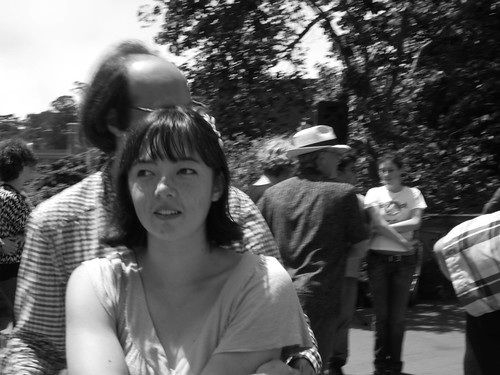
I like the context of the enormous museum interior to help show where the maze is in the larger space. I also like the single person in the very middle of the maze in this picture. She adds a lonesome element. People tended to gather in the center of the maze; I'm not sure why.
 
If you decide to attend this exhibit, be sure to get your maze entry tickets early. We came late and were not able to get it. But, that gave me the opportunity to photograph it from above as we watched others go through.
 
DMC-365.blogspot.com


Monday, July 14, 2014

Bug Closeups with the Micro 4/3 Panasonic-Leica 45mm f2.8 Macro Elmarit

I have had the Pana-Leica 45mm f2.8 Macro Elmarit lens for quite some time. When I purchased it, the Macro-Elmarit was the only medium telephoto available for the Micro 4/3 mount. Had the Olympus 45mm f1.8 been out at the time, I probably would have bought that instead.
The extra >1 f-stop of the Olympus would be nice. That said, the macro ability of the Pana-Leica is great. I like to be able to take closeups of details when I travel.
I have not really explored the capabilities of this lens in more classical macro applications. Yesterday, I had the time and opportunity to go bug hunting while my wife practiced free swimming in a local quarry. I decided to see what the Macro-Elmarit could do. So, I mounted it on my Panasonic Lumix DMC-GX7, set up the touch screen to focus and trigger exposure (I rarely use the touch screen features of the GX7), and connected my Nissin flash with a remote cord. Having mounted the camera on a sturdy tripod, I was ready to go.
Well, it was hot, and the bug hunting was a little tough. After waiting an eternity (okay, about 30 minutes) for a gorgeous dragonfly to return to a particular perch to no avail, I started stalking. By the way, dragonflies usually will come back to exactly the same spot over and over. I think maybe I was just too close for comfort. This is where a longer macro focal length would come in handy, giving me more working distance.
My stalking actually resulted in finding a stationary dragonfly, but my best subject of the day was this bug you see below. I'm not sure of his exact species, but guess that he's part of the hemiptera family of true bugs.
Bug, by Reed A. George
Panasonic Lumix DMC-GX7, Pana-Leica 45mm f2.8 Macro Elmarit, Remote Flash
iso 200, f11 1/100 sec.
 
I used a mini softbox mounted on the flash head, and handheld the flash. Even with the camera on a tripod, I had too many things to hold, and the flash-to-subject distance wasn't well controlled with my hand holding method. I should work on mounting the flash to a bracket if I continue this line of imaging. I did use the touch screen to identify where to focus and trigger the exposure. I must admit it's a pretty cool tool, as long as the camera is held stationary. It was a little difficult to get the focus point just right, on the bug's head, at this magnification. But, I did get it a few times.
 
I was not at the closest focus distance of the lens, but was at about the shortest useful working distance for this subject. Here's a 100% enlargement of the same image (a little clarity and sharpness applied in Lightroom):
 
100% Crop of Image Above
 
So, I'd say this lens is pretty capable in the true macro realm. I don't shoot a lot of nature macro images like this, and would normally tend toward the large sensor of my Nikon D700, and either my true macro 60mm Micro-Nikkor f2.8, or a longer lens (say 105mm f2.5) with extension tubes. The longer lens would make the working distance more reasonable. Now I know that the Micro 4/3 sensor in my GX7 and Macro-Elmarit are quite capable in this realm.
 
On top of that, the Macro-Elmarit is a reasonably good portrait lens (limited in its shallow depth of field potential by the relatively small maximum aperture of f2.8), and an excellent lens for capturing closeup details when on travel.
 
DMC-365.blogspot.com